Classic · 1961–1968

Jaguar E-Type Series 1

The car Enzo Ferrari reportedly called the most beautiful ever made — and the defining British sports car of the 1960s.

Fixed Head CoupeRoadster (OTS)2+2 Coupe
Last reviewed January 15, 2025 · Car Collector International Editorial
Jaguar E-Type Series 1
Overview

Why this car matters

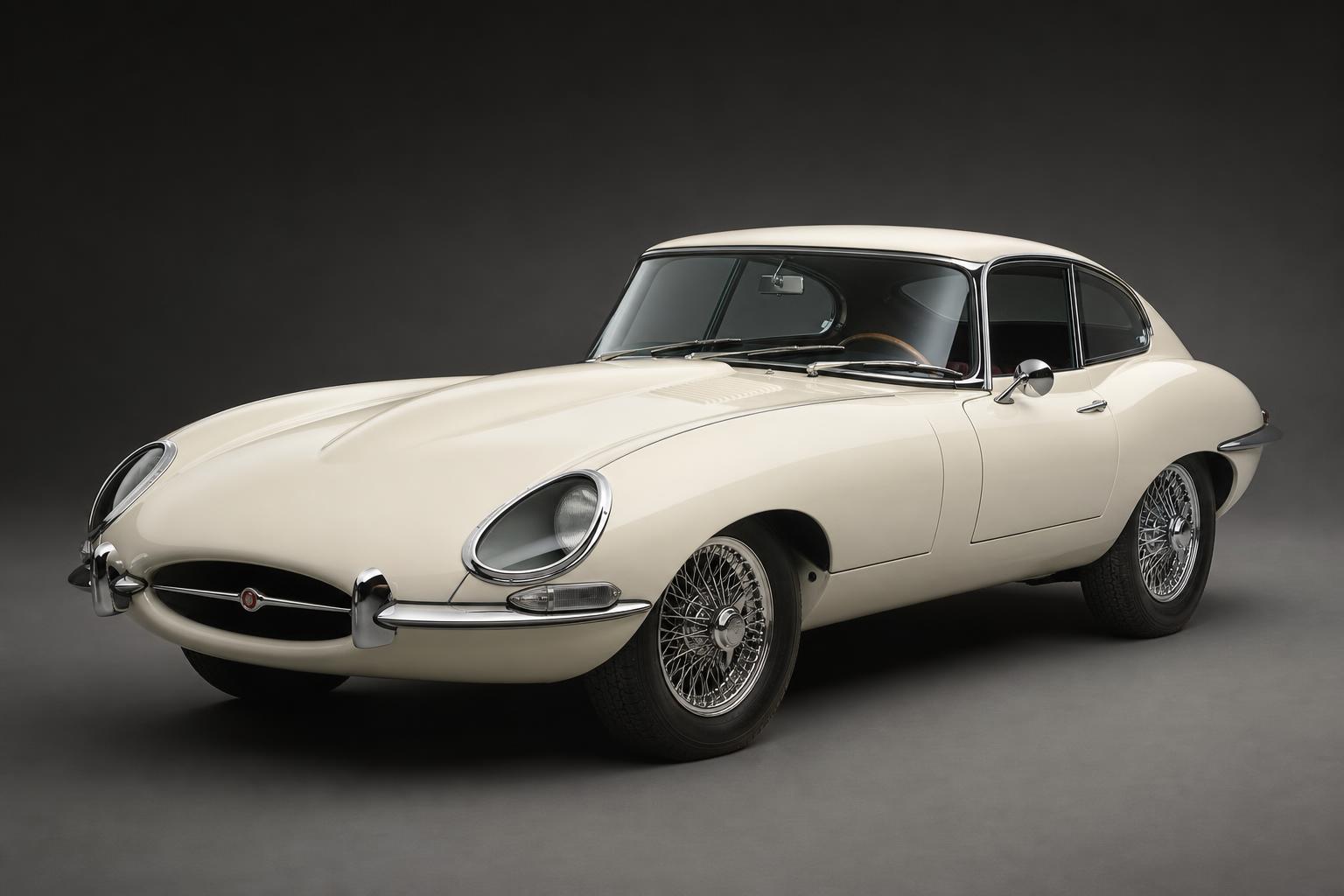
Launched at the Geneva Motor Show in March 1961, the Jaguar E-Type Series 1 set a new benchmark for road-going sports cars: independent rear suspension, four-wheel disc brakes, a 3.8-litre twin-cam straight-six derived from the Le Mans–winning D-Type, and a body styled by Malcolm Sayer that combined aerodynamic discipline with a sculptural elegance unmatched by anything else on the road. It was offered initially as a fixed-head coupé and an open two-seater roadster, with the 2+2 coupé following in 1966.

The Series 1 evolved through the decade: the original 3.8-litre cars (1961–1964), the 4.2-litre cars with a fully synchronised gearbox and improved seats (1964–1968), and the so-called 'Series 1.5' transitional cars (1967–1968) which adopted open headlights and revised switchgear to meet US safety legislation ahead of the Series 2. Roughly 38,000 Series 1 E-Types were built across all variants, the majority exported to the United States, and the model remains the high-water mark of British post-war sports car design.

The Series 1 is the purest expression of the E-Type and one of the most universally recognised car designs of the twentieth century. Period road tests recorded near-150 mph performance at a price that undercut comparable Ferraris and Aston Martins by a wide margin, and the car has been a fixture of major design retrospectives — including a permanent example in the Museum of Modern Art's design collection in New York. Early covered-headlight cars, particularly the 3.8-litre 'flat-floor' roadsters and the matching-numbers 4.2-litre coupés, anchor the model's collector market and have appreciated steadily over the past two decades.
Variants

Range and production

VariantYearsProductionNotes
3.8 Roadster (OTS)1961–1964Original 'flat-floor' and later cars; Moss four-speed gearbox; covered headlights; the foundation of the E-Type market.
3.8 Fixed Head Coupe (FHC)1961–1964Side-opening tailgate, fastback profile; Moss gearbox; the design icon.
4.2 Roadster (OTS)1964–1968All-synchromesh gearbox, improved seats and brakes; covered headlights retained.
4.2 Fixed Head Coupe (FHC)1964–1968Best-developed Series 1 coupé; the volume collector car today.
4.2 2+2 Coupe1966–1968Lengthened wheelbase, taller roofline, occasional rear seats; automatic gearbox optional.
Series 1.5 (transitional)1967–1968Open headlights, rocker switches, twin Stromberg carburettors on US cars; bridge to the Series 2.
Lightweight E-Type (competition)1963–196412 original aluminium-bodied racing cars built for competition; referenced for pedigree, not road-market comparables.
Buyer's Guide

What to look for

Provenance, matching numbers and the Jaguar Heritage Certificate

A Series 1 is bought on its documentation. The Jaguar Heritage Trust issues a Heritage Certificate confirming original engine and chassis numbers, factory colour, trim and delivery destination — an essential reference for any serious purchase. Matching-numbers cars (engine, gearbox and body to the original build record) command a clear premium, and a continuous ownership history with invoices from recognised specialists such as Classic Motor Cars (CMC), Eagle, RS Panels or JD Classics is decisive at the upper end of the market.

Bodywork, monocoque and bonnet — the dominant cost

The E-Type's monocoque tub and one-piece front-hinged bonnet are notoriously expensive to restore correctly. Inspect the front bulkhead, floors, sills, A-posts, rear wheel arches, boot floor and the bonnet's internal structure (particularly around the headlight bowls and bonnet hinges) for filler, weld repairs and corrosion. A full bare-metal restoration on a sound car routinely runs £150,000–£300,000 in the UK at recognised specialists; on a structurally compromised car it can comfortably exceed that. Always commission a paint-depth survey and an underbody inspection as part of any pre-purchase inspection.

3.8 vs 4.2, coupe vs roadster

Early 3.8-litre 'flat-floor' covered-headlight roadsters sit at the top of the market and trade more like investment-grade classics than driver cars. The 4.2-litre cars are the better driver's E-Type — the all-synchromesh gearbox, improved seats and uprated brakes make a meaningful difference — and 4.2 coupés are the most actively traded Series 1 variant today. The 2+2 has historically traded at a discount to two-seater cars but has recently begun to re-rate as buyers recognise its usability. Series 1.5 cars are valued below true Series 1 cars and above Series 2.

Mechanical service items and the rear suspension cage

The XK engine is durable and well supported but does not tolerate neglect; verify oil pressure when hot, listen for timing-chain rattle, and confirm a recent cooling system refresh. The independent rear suspension cage is a known maintenance item — bushes, radius arms, inboard discs and handbrake mechanism are all serviced as a unit, and a full rebuild is straightforward but not cheap. Budget £600–£1,200 for a PPI by an established marque specialist; the inspection should include a road test, compression test and a documented underbody assessment.

Pricing

What to pay

Project Series 1.5 / 2+2
USD$55,000 – $85,000
GBP£45,000 – £68,000
EUR€52,000 – €78,000
Restoration projects, incomplete cars, later Series 1.5 and 2+2 examples requiring significant work.
Good driver 4.2 FHC / 2+2
USD$95,000 – $145,000
GBP£76,000 – £115,000
EUR€88,000 – €135,000
Honest, presentable 4.2-litre coupés and 2+2s with documented history and recent mechanical work.
Excellent 4.2 Roadster
USD$165,000 – $235,000
GBP£130,000 – £185,000
EUR€150,000 – €215,000
Well-restored 4.2 roadsters with matching numbers and Heritage Certificate.
Concours 4.2 FHC / Roadster
USD$220,000 – $320,000
GBP£175,000 – £255,000
EUR€200,000 – €295,000
Concours-restored or exceptional original 4.2 cars, original specification and colour, full provenance.
3.8 'flat-floor' Roadster (top)
USD$300,000 – $475,000+
GBP£240,000 – £375,000+
EUR€275,000 – €435,000+
Early 3.8 covered-headlight flat-floor roadsters with full provenance; the top of the road-car market.

Regional ranges authored independently — each reflects its local market, not an FX conversion

Ownership

Living with it

Typical mileage
1,500–4,000 miles typical
Service interval
Annual oil and inspection service; major service every 6,000–10,000 miles
Annual running cost
$2,000 – $5,000 (excluding restoration or major mechanical work)
Fuel economy
17–22 mpg combined on a sympathetic carburettor setup
Insurance
Agreed-value classic policies from Hagerty, Adrian Flux, Footman James or Lockton typically run $1,200–$2,800/yr on a $180k Series 1 with limited mileage.

Parts supply is excellent

Sixty years of continuous specialist support means almost every mechanical, trim and body part for the Series 1 is available new from the UK marque specialist network (SNG Barratt, Martin Robey, David Manners, Welsh Enterprises in the US). The constraint is rarely parts availability — it is the labour required to fit them to factory standard.

Restoration economics

A well-bought, mechanically sound Series 1 is a relatively inexpensive car to live with. A cosmetically tired or structurally compromised car is not: full body restorations at recognised specialists routinely exceed the value of all but the rarest variants. The most predictable ownership comes from buying a car that has already had its restoration done — and verifying it properly.

Common Problems

Known issues by system

Body — Monocoque and bonnet corrosion

Front bulkhead, floors, sills, rear arches and bonnet structure corrode, often hidden under filler or recent paint

Critical$15,000 – $80,000+ depending on extent; a full bare-metal restoration can exceed $250,000
Symptoms — Bubbling at sill seams and arches; uneven panel gaps; flexing bonnet; previous weld repairs visible from underneath.
Inspection — Paint-depth survey across all panels; underbody inspection on a lift; inspection of bonnet's internal structure and hinges.
Engine — XK straight-six

Oil-pressure decline, timing-chain wear, head-gasket failure on neglected cars

Major$8,000 – $20,000 for a full engine rebuild at a marque specialist
Symptoms — Low hot oil pressure, timing-chain rattle on cold start, coolant loss, blue smoke under load.
Inspection — Compression test, hot oil-pressure check, coolant pressure test, review of recent invoices.
Transmission — Moss gearbox (3.8 cars)

Non-synchromesh first gear and ageing synchros make the Moss gearbox an acquired taste and a known wear item

Moderate$3,500 – $7,000 for a Moss gearbox rebuild
Symptoms — Crunching downshifts, vague selection, whining in lower gears.
Inspection — Road test through all gears cold and hot; verify any rebuild history.
Suspension — Independent rear cage

Bushes, radius arms, inboard disc brakes and handbrake mechanism all wear and are serviced as an assembly

Major$4,500 – $9,000 for a full IRS cage rebuild
Symptoms — Clunks over bumps, ineffective handbrake, brake judder, oil leaks from inboard discs.
Inspection — Inspect IRS cage on a lift; verify documented rebuild history.
Brakes — Dunlop / Girling system

Ageing master cylinder, servo and inboard rear discs lose effectiveness; brake bias issues common on unrestored cars

Major$2,500 – $5,500 for a full braking refresh
Symptoms — Long pedal travel, pulling under braking, fluid leaks at the servo or master cylinder.
Inspection — Inspect master cylinder, servo and all calipers; road test under firm braking.
Electrical — Lucas wiring and instruments

Original Lucas looms, fuse boxes and instrument voltage stabilisers age and become unreliable

Moderate$1,500 – $6,000 depending on extent of rewire and instrument refurbishment
Symptoms — Intermittent gauge readings, blown fuses, charging-system warnings, flickering lights.
Inspection — Cycle all electrical functions; inspect loom condition; verify any rewire.
Interior — Trim, leather and weather equipment

Original leather, headlining and (on roadsters) hood frame and fabric are expensive to retrim correctly

Moderate$3,500 – $12,000 for a full interior retrim or hood replacement
Symptoms — Cracked leather, sagging headlining, torn or shrunken hood, mismatched retrim work.
Inspection — Inspect leather, carpets, headlining and (roadsters) hood frame and fabric; verify retrim quality.
Valuation

Current value bands by region

Concours
USD
$280,000
GBP
£220,000
EUR
€255,000
+6% 12-mo
Excellent
USD
$195,000
GBP
£155,000
EUR
€180,000
+4% 12-mo
Good
USD
$130,000
GBP
£105,000
EUR
€120,000
+1% 12-mo
Fair
USD
$85,000
GBP
£68,000
EUR
€78,000
0% 12-mo
Project
USD
$55,000
GBP
£45,000
EUR
€52,000
-2% 12-mo

Each region quoted in its local currency — independent market readings, not FX conversions

The Series 1 E-Type market matured through the 2000s and early 2010s, with values for the best cars rising sharply alongside the broader blue-chip classic market. Early 3.8-litre flat-floor roadsters with covered headlights and full provenance now sit firmly in the top tier, and concours 4.2 cars trade in their own clearly defined band. The wider 4.2 coupé and 2+2 market has been more stable than headline-grabbing, but consistent: well-documented, properly restored cars sell readily, while compromised or partially restored cars are increasingly difficult to move at the prices their owners hope for.

Within the range, two-seater coupés and roadsters with matching numbers, Heritage Certificates and a documented restoration history at a recognised specialist are the defensible core of the market. Original colour combinations, particularly Opalescent Silver Blue, Carmen Red, British Racing Green and Old English White, support stronger values than non-original or popular but generic respray colours. Series 1.5 cars remain a value entry into covered-style E-Type ownership but should be bought as Series 1.5 rather than mis-described as Series 1.

Auctions

Recent results

DateAuctionCarMileageResult
2024-08-17
Gooding & Co.
Pebble Beach 2024
1962 3.8 Roadster (flat-floor)
Matching numbers; older restoration; original colour.
$412,500
Sold
2024-06-08
Bonhams
Goodwood 2024
1965 4.2 Roadster
62,000 mi
£182,500
Sold
2024-05-04
RM Sotheby's
Monaco 2024
1963 3.8 Fixed Head Coupe
€198,750
Sold
2024-03-02
Bring a Trailer
Online
1967 4.2 Fixed Head Coupe
57,400 mi
$148,000
Sold
2024-01-26
Mecum
Kissimmee 2024
1966 4.2 2+2
71,200 mi
$78,100
Sold
2023-10-21
Bonhams
Zoute 2023
1964 3.8 Fixed Head Coupe
€176,250
Sold
Investment

Long-term outlook

Blue ChipHorizon: 10+ years

The Series 1 E-Type is one of a small number of post-war classics with secure long-term collector status, supported by universal design recognition, deep specialist infrastructure and a global owner base. Early 3.8 flat-floor roadsters and matching-numbers 4.2 cars with full provenance behave as defensive store-of-value assets and have proven resilient through multiple market cycles.

For buyers focused on usability and value, well-documented 4.2 coupés represent the strongest risk-adjusted entry into Series 1 ownership. The 2+2 remains the most accessible Series 1 variant and has begun to re-rate as collectors revisit the model. Across the range, the deciding factor is the quality and verifiability of the restoration: a properly restored, documented car at a fair price will outperform a cheaper car whose true condition is unclear.

Recommended

The trusted network

Specialists

  • Classic Motor Cars (CMC)
    Bridgnorth, UK
    Concours-grade Jaguar restoration; recognised E-Type and XK authority.
  • Eagle E-Types
    East Sussex, UK
    Restoration and the renowned Eagle re-engineered E-Type programmes.
  • RS Panels
    Nuneaton, UK
    Specialist E-Type bodywork, panel fabrication and structural restoration.
  • JD Classics (successor firms)
    Essex, UK
    Long-established Jaguar restoration and historic competition preparation.
  • Classic Showcase
    Oceanside, CA, USA
    Full Jaguar restoration and sales for the US market.

Storage

  • Windrush Car Storage
    Cotswolds, UK
    Climate-controlled long-term storage for significant classics.
  • Autovault
    Bicester, UK
    Climate-controlled storage at Bicester Heritage.
  • Classic Remise
    Düsseldorf, DE
    Showroom-style enthusiast storage in continental Europe.

Transport

  • CARS UK
    UK & Europe
    Enclosed event and concours transport.
  • Reliable Carriers
    USA (national)
    Enclosed coast-to-coast transport for collector cars.
  • Passage Europe
    EU / UK
    Cross-Channel enclosed transport for classics.

Own a Jaguar E-Type Series 1?

Join Car Collector International's owners register for valuation updates, auction alerts and members-only events.

Register interest