
Car Collector International
Classic · 1928–1929

Auburn 8-120 Boattail Speedster

The Leamy-Sakhnoffsky boat-tail — the ultimate-specification 120-horsepower first-generation Boattail Speedster, built in roughly 55 examples through June 1929 and the direct ancestor of the supercharged 851 / 852.

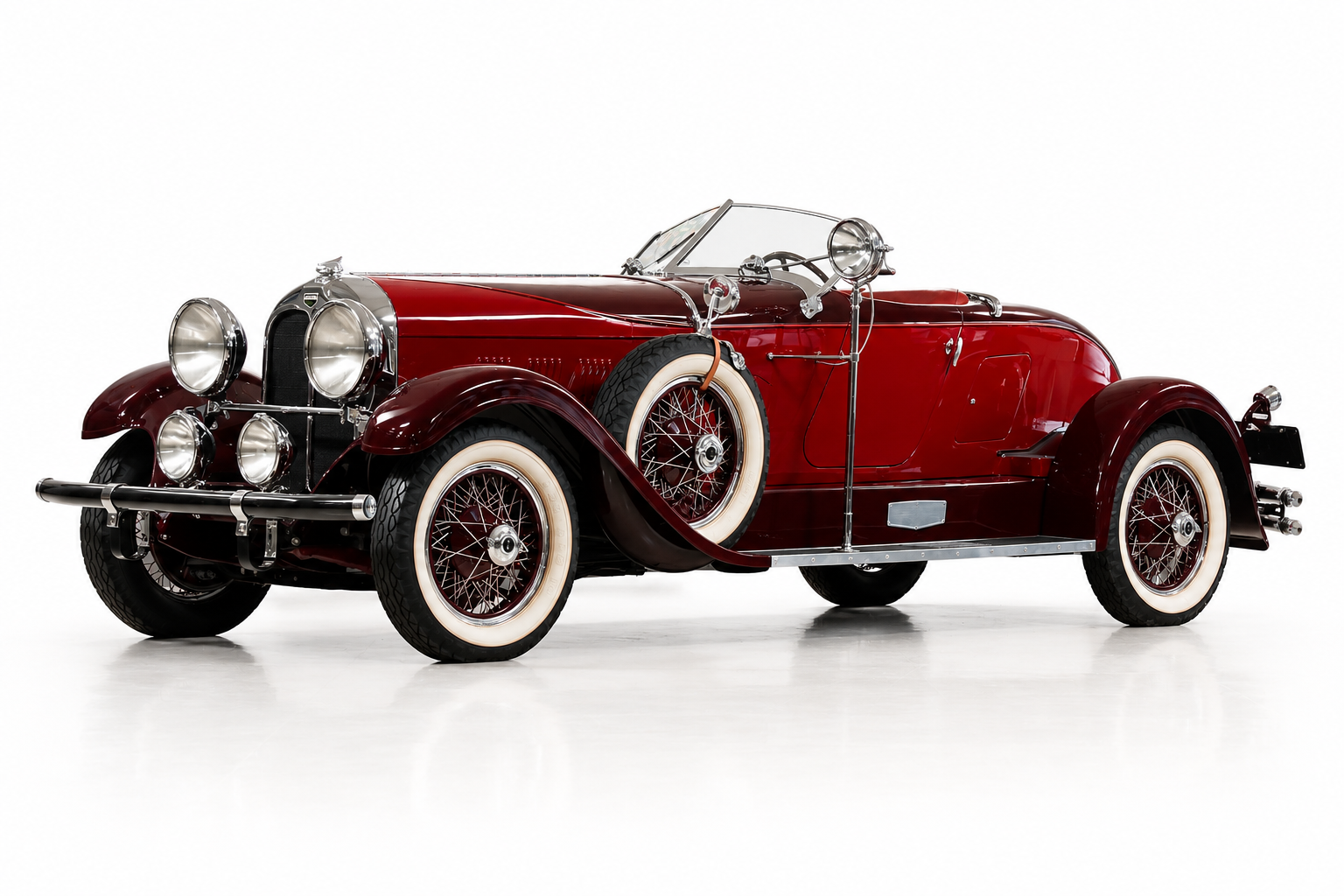
Auburn 8-120 Boattail Speedster in polished silver and black, front three-quarter studio view against a dark grey backdrop, showing the Alan Leamy and Count Alexis de Sakhnoffsky two-seat open body with pointed boat-tail rear deck, raked V'd windscreen, extensive hood louvres, deep chrome grille with bird radiator mascot, side-mounted spare wheel, chrome-plated side lamps, whitewall tyres on wire wheels, and the deep buttoned red leather cockpit set well back on the long chassis.
Overview

Why this car matters

The Auburn 8-120 Boattail Speedster is the ultimate specification of the first-generation Auburn Speedster, built at Auburn, Indiana from 1928 through June 1929 as the halo car of E. L. Cord's Auburn Automobile Company. It sits on the 130-inch-wheelbase 8-120 'Big Eight' chassis, powered by a Lycoming L-head straight-eight rated at 120 bhp at 3,300 rpm on a single Stromberg twin-throat UU-2 updraft carburettor, feeding a three-speed manual gearbox and four-wheel hydraulic drum brakes over solid-axle semi-elliptical leaf-spring suspension front and rear. Displacement is genuinely disputed in the surviving record: most reference sources cite 268 cu-in, while several auction catalogues cite 298.6 cu-in. The car's silhouette — a raked V'd windscreen, doors angled to match, deep runs of hood louvres and a sharply tapered pointed 'boat-tail' rear deck — was drawn by Alan Leamy and Count Alexis de Sakhnoffsky, adapted from a Duesenberg show car bodied by McFarlan. It was Leamy's first Auburn assignment before he moved on to design the Cord L-29. Roughly 55 8-120 Boattail Speedsters were built in period as a factory-catalogued low-volume promotional body on the Big Eight chassis, and somewhere between seven and eight are generally believed to survive today. The car is a Classic Car Club of America Full Classic and the direct pre-war ancestor of the Alan Leamy-styled 1931–1933 Speedsters and the Gordon Buehrig-styled 1935 851 and 1936 852 supercharged Boattail Speedsters that closed the Auburn story.

The 8-120 Boattail Speedster matters because it is the first-generation Auburn Speedster in its ultimate 120-horsepower specification and the car that put the 'boat-tail' silhouette on the American road. Three things underwrite its place in the pre-war American canon. First, design: the Leamy-Sakhnoffsky Boattail Speedster is the shape that defined Auburn for the next eight years and that the Gordon Buehrig-styled 851 and 852 Boattail Speedsters of 1935 and 1936 refined but never abandoned; the same Alan Leamy pen moved straight from this car to the Cord L-29. Second, competition pedigree: Auburn Speedsters raced against Stutz at Atlantic City, beat supercharged Mercedes at Salem, climbed Pikes Peak in under 22 minutes in November 1928, and set a measured-mile record of 108.46 mph at Daytona Beach with Wade Morton at the wheel — the styling was not merely decorative. Third, standing: it is a CCCA Full Classic, factory-catalogued at Auburn and built in roughly 55 examples, with somewhere between seven and eight generally believed to survive — a genuinely rare pre-war American production sports car and the reference open Auburn of the late 1920s.

Variants

Range and production

VariantYearsProductionNotes
8-120 Boattail Speedster — first-generation Big Eight, 1928–19291928–1929Ultimate-specification first-generation Auburn Speedster on the 130-inch-wheelbase 8-120 'Big Eight' chassis. Lycoming L-head straight-eight, 120 bhp at 3,300 rpm, single Stromberg twin-throat UU-2 updraft carburettor; three-speed manual gearbox; four-wheel hydraulic drum brakes; solid-axle semi-elliptical leaf-spring suspension front and rear. Displacement is genuinely disputed: 268 cu-in per most reference sources, 298.6 cu-in per several auction catalogues. Alan Leamy and Count Alexis de Sakhnoffsky two-seat open Boattail Speedster body, adapted from a Duesenberg show car bodied by McFarlan, with raked V'd windscreen, angled door cuts, extensive hood louvres and pointed boat-tail rear deck. Two independent auction-house catalogues on the same chassis agree on approximately 55 examples built; survivor count is genuinely unresolved and is generally cited at somewhere between seven and eight cars today. CCCA Full Classic.
8-120 chassis with Speedster-style re-body (aftermarket / homage)Post-periodDistinct from the factory Boattail Speedster: a 1929 Auburn 8-120 four-door or closed-body chassis re-bodied post-period with Speedster-style coachwork paying homage to the original Leamy-Sakhnoffsky design. Recent auction catalogues have described this practice openly as 'restored with bodywork paying homage to the original Speedster design'. These cars are not factory Boattail Speedsters in the market's terms, trade at a material discount to a factory car, and must be identified as such against the chassis-number record and the original Auburn factory build documentation. Not a factory sub-variant — treated here as a market context entry only.
Buyer's Guide

What to look for

Genuine factory Boattail Speedster body versus Speedster-style re-body

The single most important authentication question on any car offered as a 1929 Auburn 8-120 Boattail Speedster is whether the coachwork is a genuine period-built factory Boattail Speedster body on the Boattail chassis serial range, or a post-period Speedster-style body fitted to an 8-120 closed-body chassis. Auction catalogues have described the latter openly as 'bodywork paying homage to the original Speedster design'. Verify body number against the Auburn Cord Duesenberg Club chassis register, cross-reference to factory build documentation, and require an independent expert inspection before any deposit. The market differential between a factory Boattail Speedster and a homage-bodied 8-120 chassis is material.

Chassis and engine numbers, Auburn Cord Duesenberg Club register

The Auburn Cord Duesenberg Club register maintained in Auburn, Indiana is the standing reference for 8-120 Speedster chassis identity. A properly-authenticated 8-120 Boattail Speedster carries matching chassis and engine numbers correspondent to the club register, complete ownership chain documentation and, on the strongest cars, ACD Club Senior recognition and CCCA Full Classic status. Any car represented at reference tier without register confirmation, complete ownership chain and matching numbers must be treated on the underlying chassis, not on the badge.

Lycoming L-head straight-eight — displacement dispute, hot oil pressure and bearing condition

The Lycoming L-head straight-eight is rated at 120 bhp at 3,300 rpm with a single Stromberg twin-throat UU-2 updraft carburettor, but its displacement is genuinely disputed in the surviving record: most reference sources cite 268 cu-in, while several auction catalogues cite 298.6 cu-in. Treat either figure as a published claim rather than a settled fact, and verify what the engine in the specific car is documented as at the Auburn Cord Duesenberg Club. Beyond the displacement question, the unit is now approaching a century old; hot oil pressure, main and big-end bearing condition, valve gear condition, ignition system integrity, carburettor set-up and cooling capacity should be inspected in detail at any PPI. Rebuilds are a specialist commission through the small ACD-network machine shops and are not inexpensive; recent factory-quality restorations completed by the Auburn Cord Duesenberg Company set the reference for what a correct rebuild looks like on the block.

Competition pedigree — the styling was born on the track

The Boattail Speedster was not simply a styling exercise. Auburn Speedsters raced against Stutz at Atlantic City, beat supercharged Mercedes at Salem, climbed Pikes Peak in under 22 minutes in November 1928, and set a measured-mile record of 108.46 mph at Daytona Beach with Wade Morton at the wheel — covering 2,033 miles in 24 hours at Atlantic City in the same competitive season. Period competition photographs, factory publicity material and ACD Club archive records are therefore more than decoration: they are provenance documents that tie a specific chassis to the car's racing credentials. Ask whether the ownership file includes period race imagery or event entry documentation, and cross-reference any claimed competition history against the ACD Club register and contemporary press records.

Three-speed gearbox, clutch and driveline

The three-speed manual gearbox is period-appropriate; verify shift quality across all three ratios cold and hot, clutch bite-point and freeplay, and freedom from driveline vibration at speed. Universal joints, propshaft condition and the differential should be inspected on the ramp; any period record of gearbox rebuild or clutch replacement is a documented service item and should be reconciled to the ownership file.

Four-wheel hydraulic drum brakes — a period-progressive specification

The 8-120 chassis carries four-wheel hydraulic drum brakes, a period-progressive specification for a pre-1930 American production car and one that the CCCA and AACA judging communities take as original factory equipment. Verify master-cylinder and wheel-cylinder condition, hose age, drum condition and shoe wear; any conversion to a non-original brake system is a documented reversion item on any subsequent sale.

Body, wooden framing and boat-tail deck integrity

The Boattail Speedster body is a coach-built aluminium-and-steel skin over a hardwood frame. Inspect the wooden body frame for rot around the sills, door pillars and the pointed boat-tail deck; check the door fit and angled cutline against original body number references; verify the raked V'd windscreen frame integrity and the extensive hood-louvre panels for correct originality against factory records. Any period photograph of the specific chassis, and any Auburn Cord Duesenberg Club documentation of the specific car, is a decisive reference for correct body detail.

Suspension, running gear, wire wheels and tyres

Solid-axle semi-elliptical leaf-spring suspension front and rear is inspection-friendly; check leaf-spring condition, spring shackles, kingpins and steering box condition. Wire wheels and their spokes should be inspected for correct tension and originality; whitewall tyres should be date-code verified against age, as a pre-war chassis on aged rubber is a running-gear risk regardless of appearance.

Concours recognition — ACD Club Senior, AACA and CCCA

On a first-generation Auburn Speedster the strongest reference is documented ACD Club Senior recognition, AACA Senior Grand National status and CCCA Full Classic acceptance. Cars recognised at ACD Club First Senior and AACA Senior Grand National First Place level, with continuous ownership chain and complete restoration file, are the top of the market; cars with older restorations, thin paperwork or unresolved body-authenticity questions sit meaningfully below.

Pre-purchase inspection — specialist pre-war ACD expertise required

PPI on any 8-120 Boattail Speedster should be conducted by an inspector with direct pre-war Auburn Cord Duesenberg experience — the ACD Club specialist network in Auburn, Indiana is the reference channel. A generalist pre-war workshop, however experienced with other 1920s American cars, is not the reference for Boattail Speedster body authentication or for correct chassis, engine and body-number cross-referencing against the ACD Club register.

Pricing

What to pay

Reference-tier factory Boattail Speedster, ACD Club First Senior and AACA Senior Grand National First Place, complete history
USDUSD $400,000 – $650,000. Anchor is the recent Broad Arrow Amelia sale at $390,000 for a factory Boattail Speedster with ACD Club First Senior 2021 and AACA Senior Grand National First Place 2025; the upper end reflects continuous documented ownership, complete restoration file and Pebble Beach- or Amelia-class concours provenance.
GBPGBP £320,000 – £520,000. Authored independently per region — NOT FX-converted; reflects the deeper UK pre-war coachbuilt collector base for Alan Leamy-era Auburn Speedsters shown at CCCA and pre-war events.
EUREUR €370,000 – €600,000. Authored independently per region — NOT FX-converted; reflects European pre-war American concours interest and the standing of the Auburn Speedster silhouette on the Continent.
Basis: authored independently per region — NOT FX-converted. Anchored on the recent USD $390,000 Broad Arrow Amelia sale of a Johnny Risko-owned factory Boattail Speedster with two-tier concours recognition; widened at the top for exceptional early-ownership history and top-flight concours provenance.
Good factory Boattail Speedster, older restoration or thin documentation
USDUSD $275,000 – $400,000. Cars with factory Boattail Speedster body confirmed against ACD Club register but with an older restoration, thin ownership documentation or unresolved cosmetic items requiring rectification.
GBPGBP £220,000 – £320,000. Authored independently per region — NOT FX-converted.
EUREUR €250,000 – €370,000. Authored independently per region — NOT FX-converted.
Basis: authored independently per region — NOT FX-converted. Reflects the softer middle band between a top-of-market Amelia-class car and a project or re-body chassis.
Speedster-style re-body on 8-120 chassis — separate market
USDUSD $150,000 – $225,000. Post-period Speedster-style bodywork on a genuine 1929 8-120 chassis, presented openly as a homage to the original design. Anchor is the recent Broad Arrow Las Vegas sale of a homage-bodied 120 Eight Speedster at $190,400.
GBPGBP £120,000 – £180,000. Authored independently per region — NOT FX-converted.
EUREUR €140,000 – €210,000. Authored independently per region — NOT FX-converted.
Basis: authored independently per region — NOT FX-converted. Anchored on the recent Broad Arrow Las Vegas 2025 print at USD $190,400 for a chassis described in-catalogue as 'restored with bodywork paying homage to the original Speedster design'. A separate market from a factory Boattail Speedster and priced against the underlying 8-120 chassis, not the body.
Project factory Boattail Speedster requiring recommissioning or restoration
USDUSD $150,000 – $275,000. Documented factory Boattail Speedster chassis with body-authenticity confirmed against ACD Club register but requiring comprehensive engine, gearbox, brake and cosmetic recommissioning.
GBPGBP £120,000 – £220,000. Authored independently per region — NOT FX-converted.
EUREUR €140,000 – €255,000. Authored independently per region — NOT FX-converted.
Basis: authored independently per region — NOT FX-converted. Priced against the expected specialist-restoration cost through the ACD network to bring the car back to a Good tier.

Regional ranges authored independently — each reflects its local market, not an FX conversion

Ownership

Living with it

Typical mileage
300–1,500 miles / 480–2,400 km typical — a low-annual-mileage pre-war Full Classic used on ACD Club, AACA and CCCA tours and at concours events.
Service interval
Annual pre-season service through an ACD Club-recognised specialist; typically fluid renewal, ignition and carburettor service, brake and clutch inspection, and pre-tour driveline check.
Annual running cost
USD $6,000 – $18,000 typical for an ACD Club-network annual service programme; higher on any chassis requiring engine bearing, gearbox or hydraulic brake system rectification.
Fuel economy
Modest for a 4.9-litre pre-war straight-eight in low-speed collector use. Not a material ownership consideration on this car.
Insurance
Specialist agreed-value pre-war cover required; underwriting bands reflect ACD Club-network specialist parts and labour rates, and the low unit count of surviving factory Boattail Speedsters.

ACD Automobile Museum and the Auburn Cord Duesenberg Club

The Auburn Cord Duesenberg Automobile Museum (Auburn, Indiana) and the Auburn Cord Duesenberg Club are the central references for ownership. The ACD Club register is the reference authentication channel; the museum's technical files and library are the standing reference for factory correct detail. Owner participation in ACD Club events and the annual Labor Day meet in Auburn is a distinct provenance-enhancing activity on any 8-120 Boattail Speedster.

Concours calendar — ACD Club Senior, AACA Senior Grand National, CCCA CARavan

The reference concours calendar for a first-generation Auburn Boattail Speedster runs through ACD Club Senior judging in Auburn, AACA Senior Grand National First Place recognition, and CCCA CARavan participation as a Full Classic. Cars with active recognition across all three networks stand at the top of the collector market and set the reference for reference-tier valuation.

Storage — dry, climate-controlled, wooden-framed body preservation

The coach-built aluminium-and-steel body over a hardwood frame requires dry, climate-controlled storage to preserve the wooden body framing, veneers and interior. Long unheated storage is a body-frame risk on any pre-war coach-built car and is the standing preservation item.

Common Problems

Known issues by system

Lycoming L-head straight-eight — disputed displacement, bearings, oil pressure, valve gear

The Lycoming L-head straight-eight is a period-robust design, but its displacement is genuinely disputed — 268 cu-in per most reference sources, 298.6 cu-in per several auction catalogues — and a century of use, indifferent overhauls and dwindling specialist knowledge make the bottom end, valve gear and ignition system standing PPI items on any 8-120.

MajorUSD $25,000 – $75,000+ for a period-correct rebuild through an ACD Club-network specialist depending on the extent of bearing, valve gear and cooling-system work required.
Symptoms — Low or fluctuating hot oil pressure; audible bearing knock at idle or under load; smoke on the overrun; poor cold-start behaviour; irregular tickover on the Stromberg twin-throat UU-2 carburettor.
Inspection — Hot oil-pressure reading at temperature; compression and leak-down test; valve-gear inspection; carburettor set-up verification; ignition system inspection; ACD Club-network specialist opinion on any car offered at reference tier.
Body authenticity — factory Boattail Speedster versus Speedster-style re-body

The most consequential single question on any 1929 8-120 offered as a Boattail Speedster is whether the body is a genuine period-built factory Leamy-Sakhnoffsky Boattail Speedster or a post-period Speedster-style re-body on a closed-body 8-120 chassis. Recent auction catalogues have described the latter openly as 'bodywork paying homage to the original Speedster design'.

CriticalValue impact: differential between a factory Boattail Speedster and a Speedster-style re-body on the same 8-120 chassis is material and typically several hundred thousand dollars.
Symptoms — Body number cannot be reconciled to Auburn Cord Duesenberg Club register; body detail inconsistent with period factory photographs of the specific chassis; hardwood body framing shows evidence of post-period fabrication; door cuts, hood-louvre pattern or boat-tail deck detail out of specification.
Inspection — Cross-reference body and chassis numbers against ACD Club register; independent expert body inspection; period-photograph review; ownership-chain reconciliation.
Wooden body frame integrity

The coach-built aluminium-and-steel body sits on a hardwood frame that can rot over a century of use, particularly around the sills, door pillars and the pointed boat-tail rear deck. Any long period of unheated or damp storage compounds the risk.

MajorUSD $30,000 – $100,000+ for specialist pre-war coachbuilt body-frame rectification depending on extent.
Symptoms — Soft body-frame timber at sill and pillar junctions; door drop or misalignment; visible rot or repair at the boat-tail deck; door-cutline angle inconsistent with original.
Inspection — Independent expert pre-war coachbuilt body inspection; probe of sills, door pillars and boat-tail framing; ownership-chain review of prior body-shop work.
Four-wheel hydraulic drum brake system

Four-wheel hydraulic drum brakes were a period-progressive specification and are original factory equipment on the 8-120; a century of use puts the master and wheel cylinders, hoses, drums and shoes on the standing service list.

ModerateUSD $6,000 – $18,000 for a complete hydraulic brake-system service through an ACD Club-network specialist.
Symptoms — Long or spongy pedal; uneven brake pull; leaking master or wheel cylinders on inspection; hardened or perished hoses; drum scoring or shoe wear on the ramp.
Inspection — Static and dynamic brake test; visual inspection of hydraulic cylinders and hoses; drum and shoe inspection; date-code verification of any recent rubber-hose replacement.
Three-speed gearbox, clutch and driveline

The three-speed manual gearbox and clutch are period-appropriate but wear items on a century-old car; propshaft universal joints and the differential are standing driveline inspection points.

ModerateUSD $4,000 – $15,000 for gearbox or clutch rectification through an ACD Club-network specialist.
Symptoms — Notchy or noisy shift; clutch drag or judder; audible driveline vibration at cruising speed; oil leaks at the gearbox or differential.
Inspection — Cold and hot shift-quality verification; clutch operation inspection; propshaft and universal-joint inspection; differential oil condition check.
Long-idle preservation on a low-annual-mileage pre-war car

A low-annual-mileage pre-war Full Classic accumulates long-idle service items: fluid degradation, seal drying, tyre ageing, battery health and rodent-damage risk in non-climate-controlled storage.

ModerateUSD $3,000 – $12,000 for a comprehensive pre-tour long-idle service including fluids, filters, tyres and battery.
Symptoms — Aged tyres past date code; degraded brake or clutch fluid on inspection; battery replacement history in service file; evidence of long unheated storage or damp environment.
Inspection — Full underside inspection at PPI; tyre date-code verification; fluid chemistry check; documented storage history review.
Valuation

Current value bands by region

Concours
USD
USD $525,000
GBP
GBP £420,000
EUR
EUR €480,000
+4% 12-mo
Excellent
USD
USD $390,000
GBP
GBP £310,000
EUR
EUR €360,000
+2% 12-mo
Good
USD
USD $290,000
GBP
GBP £230,000
EUR
EUR €265,000
0% 12-mo
Fair
USD
USD $195,000
GBP
GBP £155,000
EUR
EUR €180,000
-1% 12-mo
Project
USD
USD $145,000
GBP
GBP £115,000
EUR
EUR €130,000
0% 12-mo

Each region quoted in its local currency — independent market readings, not FX conversions

The Auburn 8-120 Boattail Speedster market is small, concentrated on a survivor pool of somewhere between seven and eight factory-original cars, and dominated by two axes: body authenticity, and concours-recognition depth. Reference-tier cars — factory Boattail Speedster body confirmed against the Auburn Cord Duesenberg Club register, matching chassis and engine numbers, ACD Club First Senior and AACA Senior Grand National First Place recognition, complete ownership chain — anchor at the recent USD $390,000 result for a Johnny Risko-owned car with exactly that recognition. Well-preserved early-ownership history and top-flight concours provenance widen the top of the band above that anchor. Speedster-style re-bodies on genuine 1929 8-120 chassis — presented openly in-catalogue as bodywork paying homage to the original design — are a separate market entirely and trade at roughly half the factory-body figure, most recently at USD $190,400 in Las Vegas. The core buyer is a pre-war American Full Classic collector engaged with the ACD Club and CCCA event calendars; the reference restoration standard is set by the Auburn Cord Duesenberg Company's own work on recent factory Boattail Speedster refreshes. The first-generation body was a Leamy-Sakhnoffsky collaboration adapted from a Duesenberg show car bodied by McFarlan, and the same Alan Leamy pen moved from this car straight to the Cord L-29. Direct comparables at the top of the market are the Alan Leamy-styled 1931–1933 Auburn Speedsters and the Gordon Buehrig-styled 851 and 852 supercharged Boattail Speedsters that closed the Auburn story.

Auctions

Recent results

DateAuctionCarMileageResult
2026-03-07
Broad Arrow
The Amelia Auction 2026, Lot 210
1929 8-120 Boattail Speedster (chassis 2951598, the Johnny Risko car; ACD Club First Senior 2021, AACA Senior Grand National First Place 2025)
Reference-tier factory Boattail Speedster with two-tier concours recognition and 25 years of original Johnny Risko ownership. Estimate $375,000 – $475,000. Anchor sale of the review period.
$390,000
Sold
2025-10-31
Broad Arrow
Las Vegas 2025, Lot 114 (The Academy of Art University Collection)
1929 120 Eight 'Boattail' Speedster (chassis 2951761) — post-period Speedster-style re-body on a genuine 8-120 chassis
Not a factory Boattail Speedster. The lot description states in the catalogue that the car was 'restored with bodywork paying homage to the original Speedster design'. Priced against the underlying 8-120 chassis rather than a factory Speedster body — a separate market from the reference tier.
$190,400
Sold
2024-08-16
Gooding & Company
Pebble Beach Auctions 2024, Lot 191
1929 8-120 Boattail Speedster (chassis 2951598, the Johnny Risko car — same chassis subsequently sold at Broad Arrow Amelia 2026)
Offered at $450,000 – $550,000; no sold-price figure is published on the lot page and the same chassis was re-consigned to Broad Arrow Amelia 2026 six months later where it sold at $390,000. Recorded here honestly rather than asserting a Gooding sold price that cannot be confirmed from the lot page.
Est. $450,000 – $550,000; no published sold price on the lot page
Not Sold

Factory 8-120 Boattail Speedsters trade rarely — a survivor pool of somewhere between seven and eight cars produces a thin public auction record, and the reference anchor of the review period is the same chassis (2951598, Johnny Risko) tracked across two consecutive consignments. Speedster-style re-bodies on genuine 8-120 chassis appear more frequently but are a materially different market; the auction table above separates the two openly. Sedan, cabriolet and sport-sedan closed-body 1929 Auburn 8-120s that appear in pooled Auburn aggregate data are a different body style entirely and are not the reference for the Boattail Speedster.

Investment

Long-term outlook

Blue ChipHorizon: 10+ years

Three factors underwrite the 8-120 Boattail Speedster investment case. First, absolute rarity: two independent auction-house catalogues on the same chassis agree on roughly 55 factory Boattail Speedsters built in 1928–1929, with somewhere between seven and eight generally believed to survive today — a genuinely small survivor pool at CCCA Full Classic recognition. Second, design and competition lineage: the Leamy-Sakhnoffsky body, adapted from a Duesenberg show car bodied by McFarlan, gave Auburn a racing halo that included wins over Stutz and supercharged Mercedes, a Pikes Peak climb in under 22 minutes, and a 108.46 mph measured-mile record at Daytona Beach; the same Alan Leamy moved from this car to the Cord L-29, and the silhouette defined Auburn through the Gordon Buehrig-styled 851 and 852 that closed the marque. Third, concours currency: the reference market is set by ACD Club First Senior and AACA Senior Grand National First Place-recognised cars presented at Pebble Beach- or Amelia-class events, and the pool of such cars is definitionally finite. Best holds: factory Boattail Speedster body confirmed against ACD Club register, matching numbers, continuous ownership chain, active concours recognition. Watch items over the horizon: the pace at which top-tier factory cars appear at open auction (currently very slow), and the growing market separation between factory Boattail Speedsters and Speedster-style re-bodies as the collector base sharpens on body authenticity.

Recommended

The trusted network

Specialists

  • Auburn Cord Duesenberg Company
    View →
    Auburn, Indiana
    Factory-standard restoration and service for Auburn Cord Duesenberg family cars; recent factory-quality Boattail Speedster restorations set the reference standard.
  • Auburn Cord Duesenberg Automobile Museum
    View →
    Auburn, Indiana
    Marque authority and technical archive; permanent Auburn Speedster reference collection.
  • Auburn Cord Duesenberg Club (ACD Club)
    View →
    Indianapolis, Indiana
    Marque enthusiast club and technical bulletins network; chassis register for 8-120 Boattail Speedster authentication.
  • Broad Arrow Auctions / Gooding & Company
    View →
    International
    Reference international auction houses appropriate to consignment of factory Auburn Boattail Speedsters at Amelia, Pebble Beach and Monterey.
  • Hagerty Private Client
    View →
    USA / UK / EU
    Agreed-value cover for pre-war American Full Classics with specialist underwriting for CCCA-recognised cars.
  • American Collectors Insurance
    View →
    USA
    Domestic collector-car cover appropriate to Auburn 8-120 Speedster ownership, including tour and concours use.

Storage

  • ACD Automobile Museum Storage Network
    View →
    Auburn, Indiana
    Regional pre-war storage partners in the historical home of the Auburn / Cord / Duesenberg marques, appropriate to a first-generation Auburn Speedster.
  • Windrush Car Storage
    View →
    London / Cotswolds, UK
    Climate-controlled UK storage appropriate to a pre-war American Full Classic on a low-annual-mileage collector-use pattern.

Transport

  • Reliable Carriers
    View →
    USA (nationwide)
    Enclosed US collector-car transport for pre-war Auburn-Cord-Duesenberg family cars, including CCCA Full Classic transport to concours events.
  • Cosdel International
    View →
    USA / International
    International enclosed and customs-handled transport appropriate to concours-quality pre-war American collector cars.

Enjoyed this guide?

Get new buyer's guides and collector market intelligence delivered to your inbox. No spam. We respect your inbox.

The valuation figures in this guide are for research purposes only and do not constitute financial or investment advice. See our full disclaimer.