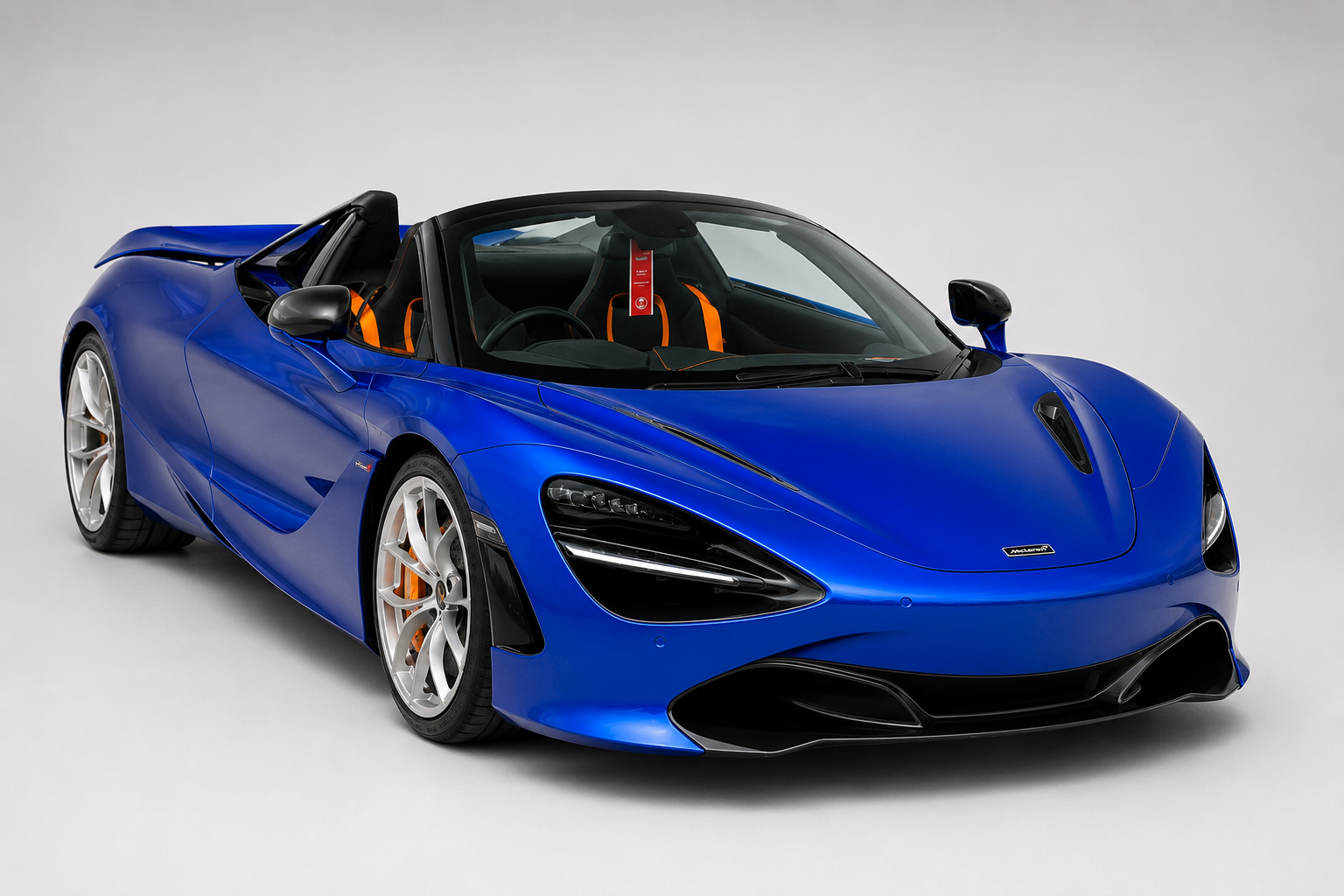
McLaren 720S — The First of a Generation, Not Yet Priced Like It
Added June 2026
The McLaren 720S occupies an unusual position for a car of its calibre: it was, by consensus, the best all-round supercar of its generation when new, and it's already gone — production ended in late 2022, succeeded by the closely related but pricier 750S — without the secondhand market having fully caught up to what that means.
The case for the 720S starts with what it actually was. Built on McLaren's Monocage II carbon monocoque, a genuine step forward from the 650S architecture it replaced, the 720S was widely judged in period testing to match or beat the Ferrari 488 GTB and Lamborghini Huracán Performante, and did so with a level of everyday usability — ride quality, visibility, luggage space — that neither Italian rival matched. McLaren doesn't get the same instant brand recognition as Ferrari or Lamborghini outside enthusiast circles, and that gap between objective ability and market perception is precisely the kind of mispricing that tends to close over time rather than persist indefinitely.
The 750S succeeded it as an evolution rather than a clean-sheet redesign — same monocoque generation, same 4.0-litre twin-turbo V8, modest gains in power — which means the 720S isn't being superseded so much as it's becoming the original, lower-priced entry point into a still-current architecture. There's a broader context worth noting too: McLaren's more recent road cars have moved toward hybrid powertrains, the Artura being the clearest example. The 720S sits within the company's purely combustion-engined turbo V8 era — a chapter that won't be repeated in quite the same form.
What to watch for: Spider versions for usability, low-mileage Performance-pack coupes for the purest expression of the original concept, and full McLaren service history given the complexity of the active suspension and aerodynamics systems.