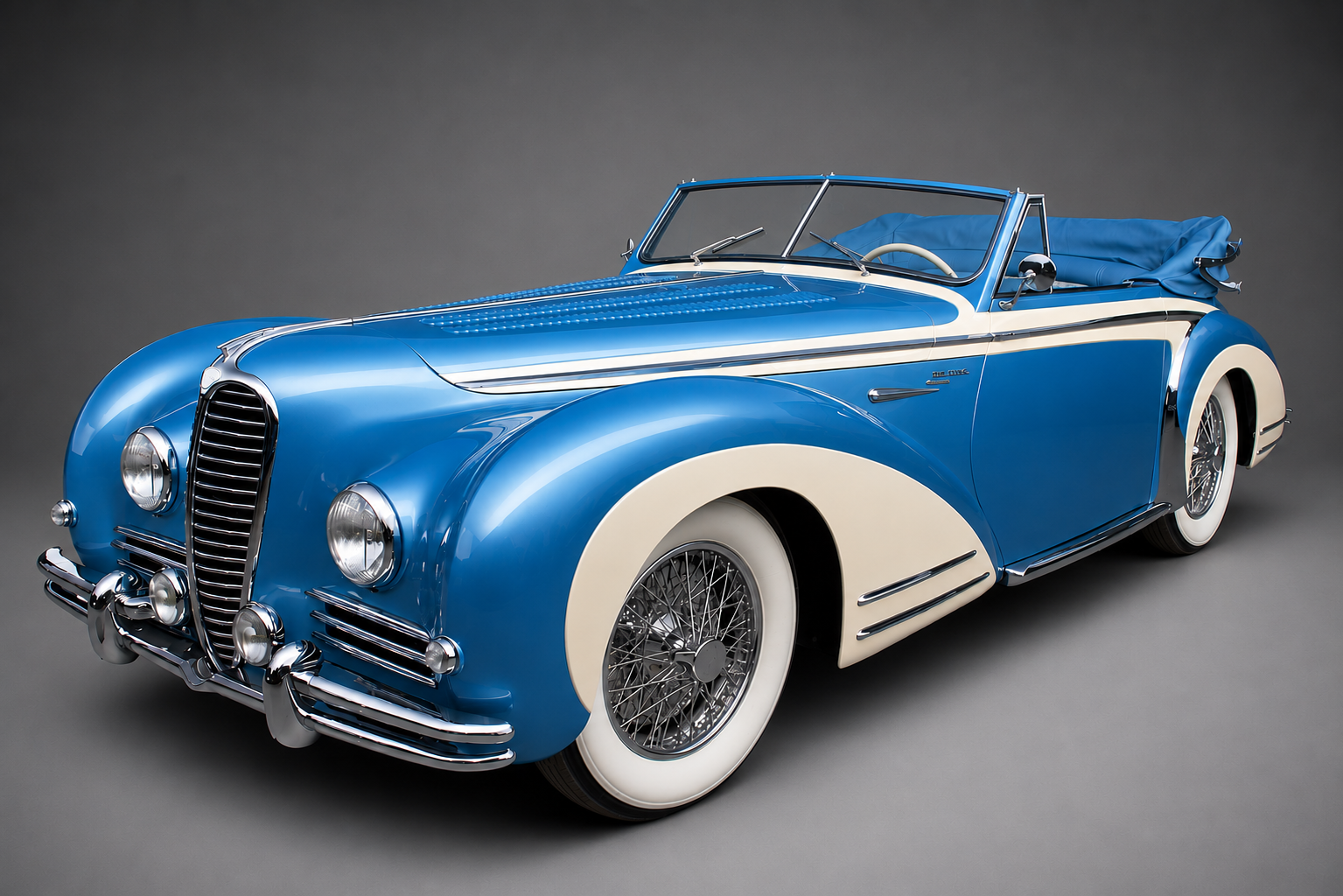
The Delahaye 175 was the marque's first all-new post-war model, launched in 1948 as the delayed successor to the Type 135 and the pre-war Type 165. Beneath the coachwork sat a 4,455cc overhead-valve straight-six (Type 183), paired with a Cotal four-speed electromagnetic pre-selector gearbox and offered in three shared-drivetrain wheelbases — the short 175, the longer-wheelbase 178 and the long-wheelbase 180. Standard 175 tune gave around 140 bhp; the 175S with triple Solex carburettors produced roughly 160–165 bhp; the Ecurie Lutetia competition engine built for Charles Pozzi and Eugène Chaboud ran 9.1:1 compression with three dual-choke carburettors and produced over 220 bhp. Approximately 107 chassis were built across all three types between early 1948 and mid-1951 — generally cited at 107, though some accounts of the same factory records give 105 — most bodied by Saoutchik, Chapron, Franay, Figoni et Falaschi and Letourneur et Marchand.
The last great French coachbuilt chassis. The 175/178/180 platform carries some of the most flamboyant post-war coachwork ever created — and marks the closing chapter of the Paris coachbuilders before punitive luxury taxes ended the tradition. It also delivered Delahaye its final major sporting result: outright victory in the 1951 Monte Carlo Rally.