
Car Collector International
Classic · 1967–1971

DeTomaso Mangusta

Alejandro de Tomaso's first series mid-engined GT — Giugiaro-bodied, Ford-powered, ZF-transaxled, and the direct blueprint for the Pantera that followed.

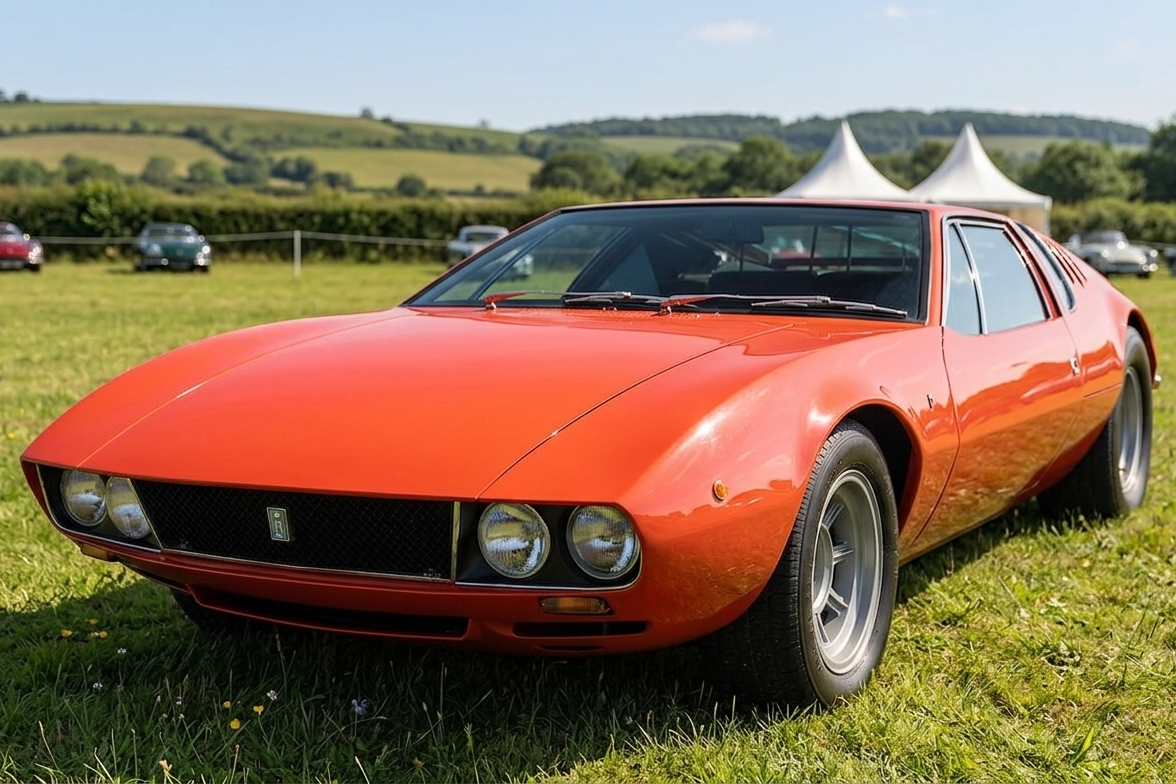
De Tomaso Mangusta, front three-quarter view — a low-slung 1960s Italian mid-engined coupé in bright red with pop-up headlamps recessed under the nose, exposed twin round headlamps, blacked-out grille, chrome window surrounds and finned five-spoke alloy wheels, photographed on grass at an outdoor concours.
Overview

Why this car matters

Shown as a prototype at the 1966 Turin Motor Show and in series production from 1967, the Mangusta was Alejandro de Tomaso's first attempt to move his Modena works from the small-run Vallelunga up to a proper mid-engined grand tourer. Giorgetto Giugiaro at Ghia drew the body — a long, low steel coupé with an aluminium roof and two gullwing engine covers hinged along the spine — and De Tomaso, who took full control of Ghia in 1967, built the coachwork in-house. Underneath sat a pressed-steel backbone chassis carried over conceptually from the Vallelunga, a Ford small-block V8 mounted longitudinally behind the cabin and a ZF 5DS-25 five-speed transaxle — the same gearbox family used in the Ford GT40. Engine fit was chronological: early cars used the 289 cu in Windsor (~306 bhp), and after Ford ceased 289 production in 1967 the line switched to the 302 cu in Windsor (~230 bhp net), which powered almost all later cars regardless of market. About 401 cars were built across the 1967 to 1971 production run, split roughly 150 European-delivered cars and 250 US-delivered cars, with sources differing on the exact split at the margins. The name Mangusta is Italian for mongoose — the animal that kills cobras — and is widely reported as a pointed jab at Carroll Shelby after their P70/Can-Am deal soured. The Mangusta never sold in the volumes De Tomaso wanted, and by 1971 the programme had been superseded by the Pantera on a properly engineered platform — but the Mangusta remains the design object that defined the De Tomaso silhouette and the direct ancestor of every mid-engined De Tomaso that followed.

The Mangusta is the car in which the Italian-American mid-engined GT idea — Ghia coachwork, Ford V8, ZF transaxle, sold in serious volume through a US network — was first tested. Every commercial and engineering lesson from the Mangusta went straight into the Pantera, which shipped through Lincoln-Mercury dealers from 1971 and became the most-produced Italian mid-engined V8 of its generation. It is also the definitive Giugiaro body of its period: the low nose, the near-flat glasshouse, the way the rear volume tapers to those hinged twin engine covers, and the impossibly low roofline (barely 43 in / 1.1 m) are the reference against which every mid-engined coupé Giugiaro drew afterwards is measured. And it is a genuine rarity — about 401 cars total across four production years, of which the early 289 cars are the rarer, more powerful and most desirable version and now the standing collector target. In today's market the Mangusta trades at a fraction of the visually similar Miura and 275 GTB it competed against in period, and the case that it has been chronically underpriced against its design and historical significance is the standing collector-investment thesis on the car.

Variants

Range and production

VariantYearsProductionNotes
Mangusta — early 289 cars1967–1968Ford 289 cu in (4.7L) Windsor V8, four-barrel carburettor, typically quoted at ~306 bhp. ZF 5DS-25 five-speed transaxle. The earliest, rarest and most powerful Mangustas, distinguished by quad headlamps (four exposed round lamps rather than the later pop-up arrangement). These cars command the standing collector premium. The exact early-289 count is not conclusively published, but the 289-powered subset is materially smaller than the later 302 population. A one-off Chevrolet-engined example, chassis 8MA 670, was built for GM design chief Bill Mitchell.
Mangusta — later 302 cars1968–1971Ford 302 cu in (4.9L) Windsor V8, US emissions specification, typically quoted at ~230 bhp net. ZF 5DS-25 five-speed transaxle. The majority of surviving Mangustas, including many European-delivered cars. The switch from 289 to 302 was driven by Ford ending 289 production in 1967, not by market. Rebuilds to 289 specification are extensively documented in the marque literature and do not confer early-289 collector status without full drivetrain and period documentation.
Buyer's Guide

What to look for

Chassis — pressed-steel backbone, sill boxes and rear engine bay corrosion

The Mangusta chassis is a pressed-steel backbone with outrigger sections carrying the sills and the rear engine cradle. Corrosion in the backbone spine, sill box sections, floor pans, front footwells and the rear engine-bay ledges is the standing structural failure mode on any Mangusta not restored to bare metal. Lift the carpets, inspect the sill boxes internally with a boroscope and paint-depth-gauge every panel; any car represented as concours-restored must carry photographic body-off restoration documentation from a marque specialist.

Ford V8 — early 289 vs later 302, matching numbers and correct-specification carburetion

Engine fit on the Mangusta is chronological, not market-specific: early cars used the Ford 289 Windsor (~306 bhp) and later cars switched to the Ford 302 Windsor (~230 bhp net) after Ford ceased 289 production in 1967. Many European-delivered cars therefore carry the 302. Verify block casting number, cylinder head casting numbers, intake and carburettor specification and the engine number against the chassis-number record and against the surviving marque-registry records. Rebuilds of 302 cars to 289 specification are common and do not confer early-289 collector status without full drivetrain and period documentation. Standing engine PPI items are compression on all eight, warm-oil pressure at cruise, correct-specification carburettor and evidence of a documented rebuild at a small-block Ford specialist familiar with the De Tomaso installation.

ZF 5DS-25 five-speed transaxle — the single most consequential mechanical item

The ZF 5DS-25/2 transaxle is the same gearbox family used in the Ford GT40 and later in the Pantera. It is a robust unit but is now half a century old on any surviving car and the rebuild cost is materially higher than the engine. Verify shift feel through all five gears and reverse, listen for whine at cruise, check for oil weep from the bell-housing and pinion nose, and insist on documented service history from a ZF-experienced specialist. A tired 5DS-25 is the standing large-ticket surprise on a Mangusta PPI.

Body originality — Giugiaro / Ghia steel body, aluminium roof, gullwing rear covers

The steel body over an aluminium roof, with the two hinged gullwing rear engine covers, is the defining coachwork on the car. Verify original panel signature — paint-depth-gauge readings, panel gap consistency, the fit and hinge condition of the gullwing covers, and the correct-specification aluminium roof panel. Rebodies, poorly-repaired accident damage and modified rear engine covers are all documented in the marque literature. Original factory colour and matching-numbers body panels are the standing concours reference items.

Suspension, brakes and Campagnolo wheels

Independent suspension all round, four-wheel disc brakes, and the signature Campagnolo alloy wheels are the Mangusta chassis reference. Verify wheel originality and stamping (period Campagnolo castings are individually numbered), suspension bush and ball-joint condition, and brake caliper and disc condition. Non-original wheels, replacement suspension components without documentation and modified brake set-ups are all common and each downgrade a matching-numbers car.

Interior originality — Giugiaro-designed cabin, instruments, seats, headlining

The Mangusta cabin is a small, extremely low-set Giugiaro design with distinctive instrument nacelles, fixed-back sports seats and a headlining that follows the aluminium roof line. Retrimmed seats, non-original steering wheel, replacement instruments and replacement headlining are all common and each downgrade a matching-numbers car. Verify original specification against period reference photography and against surviving marque-registry records.

Pre-purchase inspection — De Tomaso / small-block Ford / ZF specialist required

PPI must be conducted by a De Tomaso-experienced specialist with direct Mangusta knowledge (rather than by a generalist Italian-car workshop or a Pantera-only specialist). Insist on: full chassis and body-off-history inspection with paint-depth-gauge readings across every panel and boroscope inspection of the backbone spine and sill boxes; documented engine and transaxle service history; ZF 5DS-25 shift and oil-condition inspection; cross-check of engine and chassis numbers against the marque registries; and independent inspection of the coachwork by a specialist familiar with the Ghia body build.

Insurance, storage and event access

The Mangusta is a natural agreed-value classic policy car with Hagerty, Chubb Masterpiece or a comparable HNW carrier; premiums vary materially by engine specification (early 289 vs later 302), by matching-numbers documentation and by concours history. Climate-controlled storage is the standing reference — the combination of steel body, aluminium roof and low ride height makes long-term unheated storage unattractive. Event access includes major Italian mid-engined GT invitations at Pebble Beach, Amelia Island, Villa d'Este and the Concorso d'Eleganza in Italy for the best cars, and the full De Tomaso owners' club calendar in the US and Europe.

Pricing

What to pay

Concours — matching-numbers early 289 Mangusta with full restoration documentation
USDUSD $325,000 – $500,000 auction / private-treaty basis. Matching numbers, factory colour, documented body-off restoration and marque-registry paperwork. The upper end covers the best-in-class early 289 concours cars offered at reference international sales.
GBPGBP £260,000 – £400,000 dealer-listed basis at UK Italian-mid-engined specialists. Authored independently per region — NOT FX-converted.
EUREUR €300,000 – €470,000 dealer-listed basis at continental European Italian-mid-engined specialists. Authored independently per region — NOT FX-converted.
Basis: authored independently per region — NOT FX-converted. Top of the Mangusta market is a matching-numbers early 289 car with documented body-off restoration, factory colour and marque-registry paperwork. Wide range because the tier covers everything from a strong recent restoration through to the definitive concours records.
Excellent — matching-numbers early 289 or later 302 with documented restoration and honest ownership record
USDUSD $200,000 – $325,000 auction / private-treaty basis. Early 289 cars at the upper end; later 302 cars in matching-numbers restored condition at the lower end.
GBPGBP £160,000 – £260,000 dealer-listed basis. Authored independently per region — NOT FX-converted.
EUREUR €190,000 – €305,000 dealer-listed basis. Authored independently per region — NOT FX-converted.
Basis: authored independently per region — NOT FX-converted. Restored matching-numbers cars in either engine specification with clean recent PPI paperwork; the early 289 premium sits inside this tier at the top of the range.
Good — driver-quality Mangusta with honest older restoration or well-maintained originality
USDUSD $130,000 – $200,000 auction / private-treaty basis. Older restorations, cosmetic needs, running-and-driving cars with documented service history but not concours-standard cosmetic finish.
GBPGBP £105,000 – £160,000 dealer-listed basis. Authored independently per region — NOT FX-converted.
EUREUR €125,000 – €190,000 dealer-listed basis. Authored independently per region — NOT FX-converted.
Basis: authored independently per region — NOT FX-converted. Driver-quality cars in either engine specification; expect near-term cosmetic and drivetrain attention and price against a documented restoration budget.
Fair / Project — long-term-stored or partly-restored Mangusta requiring full body-off recommissioning or with paperwork gaps
USDUSD $70,000 – $130,000 auction / private-treaty basis. Non-matching engine, chassis-repair signature, incomplete drivetrain or coachwork corrosion at the bottom of the band.
GBPGBP £55,000 – £105,000 auction / private-treaty basis. Authored independently per region — NOT FX-converted.
EUREUR €65,000 – €125,000 auction / private-treaty basis. Authored independently per region — NOT FX-converted.
Basis: authored independently per region — NOT FX-converted. Any Mangusta at this band should be priced against a documented body-off restoration budget at a De Tomaso specialist — a full Mangusta restoration will typically consume a material multiple of the entry-band premium and is not economic on any car offered as a project without marque-registry chassis documentation.

Regional ranges authored independently — each reflects its local market, not an FX conversion

Ownership

Living with it

Typical mileage
1,000–3,000 miles / 1,600–4,800 km typical on a matching-numbers Mangusta used for De Tomaso club events, Italian GT rallies and occasional touring; lower on concours-restored early 289 cars reserved for major event entries.
Service interval
Annual service at a De Tomaso-experienced specialist familiar with the small-block Ford installation and the ZF 5DS-25 transaxle. Chassis and coachwork inspection at the same interval given the pressed-steel backbone construction.
Annual running cost
USD $6,000 – $15,000 typical annual budget for a driver-quality Mangusta in active use; materially higher on a concours-restored early 289 car where every service is marque-specialist work and coachwork upkeep is a distinct budget line.
Fuel economy
~12–16 mpg (US) / ~14–19 mpg (imp) / ~15–20 L/100 km on typical touring use.
Insurance
Agreed-value classic-policy cover through Hagerty, Chubb Masterpiece or a comparable HNW carrier is the standing channel; policies for a matching-numbers early 289 car require carrier familiarity with six-figure Italian mid-engined GT values and De Tomaso marque-registry provenance documentation.

De Tomaso specialist network — the standing reference

Route all major work through a De Tomaso-experienced specialist with direct Mangusta knowledge. The US Pantera specialist network covers a significant fraction of Mangusta expertise but the Mangusta is a materially different car (backbone chassis, Ghia body, earlier Ford small-block installation) and specialist Mangusta experience is a distinct qualification. Generalist Italian-car workshops are not the reference on any Mangusta mechanical or coachwork work.

ZF 5DS-25 transaxle service reserve

The single largest predictable mechanical item on a Mangusta is a ZF 5DS-25 transaxle rebuild — a properly-documented rebuild by a ZF-experienced specialist is the reference outcome, but the parts and labour cost is a distinct multiple of any equivalent-era gearbox work. Build a scheduled transaxle-inspection line into the annual service budget and plan the rebuild as a long-interval scheduled event.

Coachwork — steel body, aluminium roof, gullwing engine covers

The steel body over an aluminium roof, plus the two hinged gullwing rear engine covers, is a materially more complex coachwork proposition than a conventional all-steel body. Correct-specification bodywork by a Ghia / De Tomaso-experienced coachwork specialist is a distinct cost line from generic Italian coachwork restoration and should be budgeted as such on any car being kept to concours standard.

Common Problems

Known issues by system

Chassis — pressed-steel backbone spine, sill boxes, floor pans and rear engine cradle

The Mangusta chassis is a pressed-steel backbone with outrigger sections carrying the sills and rear engine cradle. Corrosion in the backbone spine, sill boxes, floor pans, front footwells and rear engine-bay ledges is the standing structural failure mode on any Mangusta not restored to bare metal.

CriticalUSD $40,000 – $150,000+ for full body-off chassis restoration and coachwork at a De Tomaso specialist.
Symptoms — Bubbling paint at the sills and floor pans, corrosion signature in the front footwells, evidence of prior chassis repair without documented paperwork, visible flex in the rear engine cradle mounting points.
Inspection — Full body-off chassis inspection at PPI; boroscope inspection of the backbone spine internal sections; paint-depth-gauge readings across every panel; documented body-off restoration paperwork on any concours-represented car.
ZF 5DS-25 transaxle — synchro wear, bearing wear, oil weep

The ZF 5DS-25/2 transaxle is a robust unit but is now half a century old. Synchro wear on second and third, pinion-bearing wear, oil weep from the bell-housing and pinion nose, and slop in the shift linkage are the standing recurring items.

CriticalUSD $20,000 – $45,000+ for a full ZF 5DS-25 rebuild by a specialist.
Symptoms — Crunching or hesitation into second and third at road speed, whine at cruise, oil signature under the transaxle, imprecise shift feel through the gate.
Inspection — Full transaxle shift and oil-condition inspection at PPI by a ZF-experienced specialist; documented service history covering any prior transaxle work; road test through all five gears and reverse from cold and hot.
Matching-numbers engine — early 289 vs later 302, replacement Ford small-blocks

A meaningful proportion of the surviving Mangusta population has been fitted with a non-original replacement Ford small-block at some point in its ownership chain. Engine fit was chronological, not market-specific: after Ford ceased 289 production in 1967 the line switched to the 302, and many European-delivered cars carry the 302. Rebuilds of 302 cars to 289 specification are extensively documented in the marque literature and do not confer early-289 collector status without full drivetrain and period documentation.

MajorUSD $15,000 – $40,000+ for a correct-specification matching-numbers rebuild; sourcing a chassis-correct replacement engine is a distinct market exercise.
Symptoms — Engine number does not match the chassis-number stamping; block casting number wrong for the specification and build date; carburettor and intake specification wrong for the represented engine spec; missing marque-registry documentation for engine-to-chassis correspondence.
Inspection — Cross-check engine and chassis numbers against the De Tomaso marque registries; verify block casting, cylinder head casting, intake and carburettor specification against the engine-spec reference for the chassis build date.
Body — Ghia coachwork, aluminium roof, gullwing rear engine covers

The steel body over the aluminium roof and the two gullwing rear engine covers is the defining coachwork on the car. Poorly-repaired accident damage, non-original replacement rear engine covers, filler signature in the rear quarters and sub-standard paint work on the aluminium roof panel are all documented in the marque literature.

MajorUSD $30,000 – $90,000+ for correct-specification body and paint restoration at a Ghia / De Tomaso-experienced coachwork specialist.
Symptoms — Panel gap inconsistency at the gullwing engine cover shut lines, filler signature under paint-depth-gauge readings on the rear quarters, colour mismatch on the aluminium roof, evidence of poorly-repaired front or rear collision damage.
Inspection — Full paint-depth-gauge readings across every panel at PPI; specialist coachwork inspection by a Ghia / De Tomaso body-experienced restorer; documented body-off restoration paperwork on any concours-represented car.
Cooling system — mid-engined V8 in a tight rear engine bay

The Ford V8 in the tight Mangusta rear engine bay is marginal on cooling in traffic and hot ambient conditions — an unmodified original cooling system is prone to running hot and any long-term originality-focused Mangusta needs documented cooling-system service history.

ModerateUSD $3,000 – $10,000 for a correct-specification cooling system refresh at a De Tomaso specialist.
Symptoms — Coolant temperature climbs into the upper register in traffic, radiator cap or hose weep signature, evidence of aftermarket cooling upgrades that must be documented as reversible.
Inspection — Cooling-system pressure test and hot-idle observation at PPI; documented service history for radiator recore, hose specification and (if fitted) auxiliary cooling fan work.
Interior originality — Giugiaro-designed cabin, seats, instruments, headlining

The Mangusta cabin is a small, extremely low-set Giugiaro design with distinctive instrument nacelles, fixed-back sports seats and a headlining that follows the aluminium roof line. Retrimmed seats, non-original steering wheel, replacement instruments and replacement headlining are all common and each downgrade a matching-numbers car.

MinorUSD $8,000 – $22,000 for correct-specification interior sourcing and refit at a De Tomaso-experienced trim specialist.
Symptoms — Non-original seat trim material or pattern, non-original steering wheel, replacement instrument cluster, replacement headlining material.
Inspection — Verify original trim specification against period reference photography and against surviving marque-registry records for the individual chassis.
Valuation

Current value bands by region

Concours
USD
USD $325,000 – $500,000 (early 289 matching numbers)
GBP
GBP £260,000 – £400,000
EUR
EUR €300,000 – €470,000
+2% 12-mo
Excellent
USD
USD $200,000 – $325,000 (both engine specifications; 289 at upper end)
GBP
GBP £160,000 – £260,000
EUR
EUR €190,000 – €305,000
+1% 12-mo
Good
USD
USD $130,000 – $200,000 (driver-quality, either engine specification)
GBP
GBP £105,000 – £160,000
EUR
EUR €125,000 – €190,000
0% 12-mo
Fair
USD
USD $90,000 – $130,000 (older restoration, cosmetic needs)
GBP
GBP £70,000 – £105,000
EUR
EUR €85,000 – €125,000
0% 12-mo
Project
USD
USD $60,000 – $95,000 (long-term-stored, drivetrain or chassis case-by-case; non-matching engine at bottom of band)
GBP
GBP £48,000 – £75,000
EUR
EUR €55,000 – €90,000
0% 12-mo

Each region quoted in its local currency — independent market readings, not FX conversions

The Mangusta market splits cleanly on two axes: engine specification and condition. The specification axis is straightforward — a matching-numbers early 289 car with ~306 bhp, factory colour and marque-registry documentation carries a material premium over a later 302 car in comparable condition; the premium reflects the power difference, the earlier quad-headlight styling on the earliest examples and the fact that the 289-powered subset is materially smaller than the later 302 population. The condition axis is the classic Italian mid-engined GT story: matching numbers, documented body-off restoration, honest chassis paperwork and no prior collision or corrosion repair history define the concours tier at USD $325,000 to $500,000; matching-numbers restored cars in either engine specification sit a step below at USD $200,000 to $325,000, with the early 289 premium at the top of the range; driver-quality cars with honest older restoration sit at USD $130,000 to $200,000 and are the practical entry into serious Mangusta ownership. Project cars trade case-by-case in the USD $70,000 to $130,000 band but do not restore economically without matching-numbers documentation and clean chassis paperwork. The standing structural read on the model: the Mangusta trades at a fraction of the visually comparable Miura and 275 GTB it competed against in period, the total is genuinely rare (~401 cars), and the case for chronic underpricing against design, historical significance and rarity is the collector-investment argument on the car. Practical target: a matching-numbers early 289 with body-off restoration paperwork and marque-registry chassis documentation is the standing collector pick; a matching-numbers later 302 in comparable condition is the sensible entry a step below.

Auctions

Recent results

DateAuctionCarMileageResult
2023-01-19
Mecum
Kissimmee 2023
1969 Mangusta (later 302 specification)
Reference public-print band for a matching-numbers restored later-302 Mangusta at a Mecum Kissimmee sale. CCI has NOT independently re-fetched the specific Mecum lot page during this review — the entry is treated as a public-print reference band and should be verified against the specific lot record at mecum.com before use as a firm market anchor.
USD $250,000 – $325,000 (public-print band)
Sold
2022-08-19
RM Sotheby's
Monterey 2022
1969 Mangusta (early 289 specification)
Reference public-print band for a matching-numbers early-289 Mangusta at a Monterey Car Week sale. CCI has NOT independently re-fetched the specific RM Sotheby's lot page during this review — the entry is treated as a public-print reference band and should be verified against the specific lot record at rmsothebys.com before use as a firm market anchor.
USD $350,000 – $475,000 (public-print band)
Sold
2021-08-13
Gooding & Company
Pebble Beach 2021
1968 Mangusta (early 289 specification)
Reference public-print band for a documented early-289 Mangusta at a Gooding & Company sale during the Pebble Beach week. CCI has NOT independently re-fetched the specific Gooding lot page during this review — the entry is treated as a public-print reference band and should be verified against the specific lot record at goodingco.com before use as a firm market anchor.
USD $325,000 – $450,000 (public-print band)
Sold
2019-08-16
Bonhams
Bonhams Quail Lodge (Monterey week)
1970 Mangusta (later 302 specification)
Reference public-print band for a driver-quality later-302 Mangusta at a Bonhams Quail Lodge sale during the Monterey week. CCI has NOT independently re-fetched the specific Bonhams lot page during this review — the entry is treated as a public-print reference band and should be verified against the specific lot record at bonhams.com before use as a firm market anchor.
USD $175,000 – $250,000 (public-print band)
Sold

The results above are cited as public-print reference bands for De Tomaso Mangusta sales at reference international auction houses. CCI has NOT independently re-fetched the individual auction-house lot pages for these results during this specific review — each entry should be verified against the specific lot record at the naming auction house before use as a firm market anchor. The Mangusta market splits cleanly by engine specification (early 289 vs later 302) and by matching-numbers restoration documentation, and specific transaction pricing must be built from marque-registry chassis-number documentation, documented body-off restoration paperwork and direct inspection at a De Tomaso specialist rather than from secondary auction reporting.

Investment

Long-term outlook

Strong HoldHorizon: 5–15 years

Three factors underwrite the Mangusta investment case. First, absolute rarity: about 401 cars were built across four production years, of which the early 289-powered subset is the rarer and more powerful tier that anchors the top of the market — a genuinely low-production Italian mid-engined GT of the late 1960s. Second, design and historical significance: the Giugiaro body is one of the defining pieces of 1960s Italian mid-engined coupé design, the Mangusta is the direct blueprint for the Pantera that shipped through Lincoln-Mercury from 1971, and the model sits at the origin of the Italian-American mid-engined V8 idea in series production. Third, structural underpricing against peers: the Mangusta trades at a fraction of the visually comparable Miura and 275 GTB it competed against in period, and the gap between the Mangusta print and the wider mid-engined 1960s Italian GT market is the standing repricing thesis on the car. Best hold: a matching-numbers early 289 with documented body-off restoration and marque-registry chassis paperwork for a collector seeking a reference low-production Italian mid-engined GT below Miura print; a matching-numbers later 302 in comparable condition for the sensible entry a step below. Watch items over the horizon: whether the early 289 tier is repriced upwards as sub-500-car mid-engined Italian GTs of the period catch up with the Miura reference, and whether documented body-off restorations of chassis-matched 302 cars are formally re-documented to early 289 specification at the coachwork rather than the drivetrain level.

Recommended

The trusted network

Specialists

  • De Tomaso Registry / De Tomaso Owners' Clubs (US and European chapters)
    View →
    USA / International
    The marque owners' network and reference chassis-number registry for the De Tomaso Mangusta — chassis records, specification-split census work and the reference chassis-number provenance channel.
  • Hall Pantera
    View →
    Provo, Utah, USA
    Long-standing US De Tomaso specialist — Mangusta drivetrain, ZF 5DS-25 transaxle work and body / trim parts sourcing on top of core Pantera expertise.
  • Wilkinson's Automobilia / De Tomaso specialist workshops (UK / EU)
    View →
    UK / Continental Europe
    European De Tomaso specialist coverage for Mangusta service and restoration work, including Ghia coachwork expertise on the steel body and aluminium roof panel.
  • RM Sotheby's / Gooding & Company / Bonhams / Broad Arrow Auctions
    View →
    International
    Reference international auction houses appropriate to matching-numbers early-289 and top-condition later-302 Mangusta cars at Pebble Beach, Amelia Island and Monterey Car Week.
  • Hagerty
    View →
    USA / UK / EU
    Agreed-value cover for low-production Italian-American GTs including the De Tomaso Mangusta.
  • Chubb Masterpiece
    View →
    USA / International
    HNW carrier familiar with rare mid-engined 1960s Italian GT risk profiles.

Storage

  • Windrush Car Storage
    View →
    London / Cotswolds, UK
    Climate-controlled UK storage appropriate to a mid-engined Italian-American GT of the Mangusta era.
  • Autobahn Indoor Storage
    View →
    Chicago / Dallas / West Palm Beach, USA
    Climate-controlled US collector-car storage appropriate to the De Tomaso Mangusta.

Transport

  • Reliable Carriers
    View →
    USA (nationwide)
    Enclosed US collector-car transport for low-slung mid-engined GTs of the Mangusta era.
  • CARS UK
    View →
    UK / EU
    Enclosed European transport for Italian mid-engined GTs of the 1960s and early 1970s.

Enjoyed this guide?

Get new buyer's guides and collector market intelligence delivered to your inbox. No spam. We respect your inbox.

The valuation figures in this guide are for research purposes only and do not constitute financial or investment advice. See our full disclaimer.