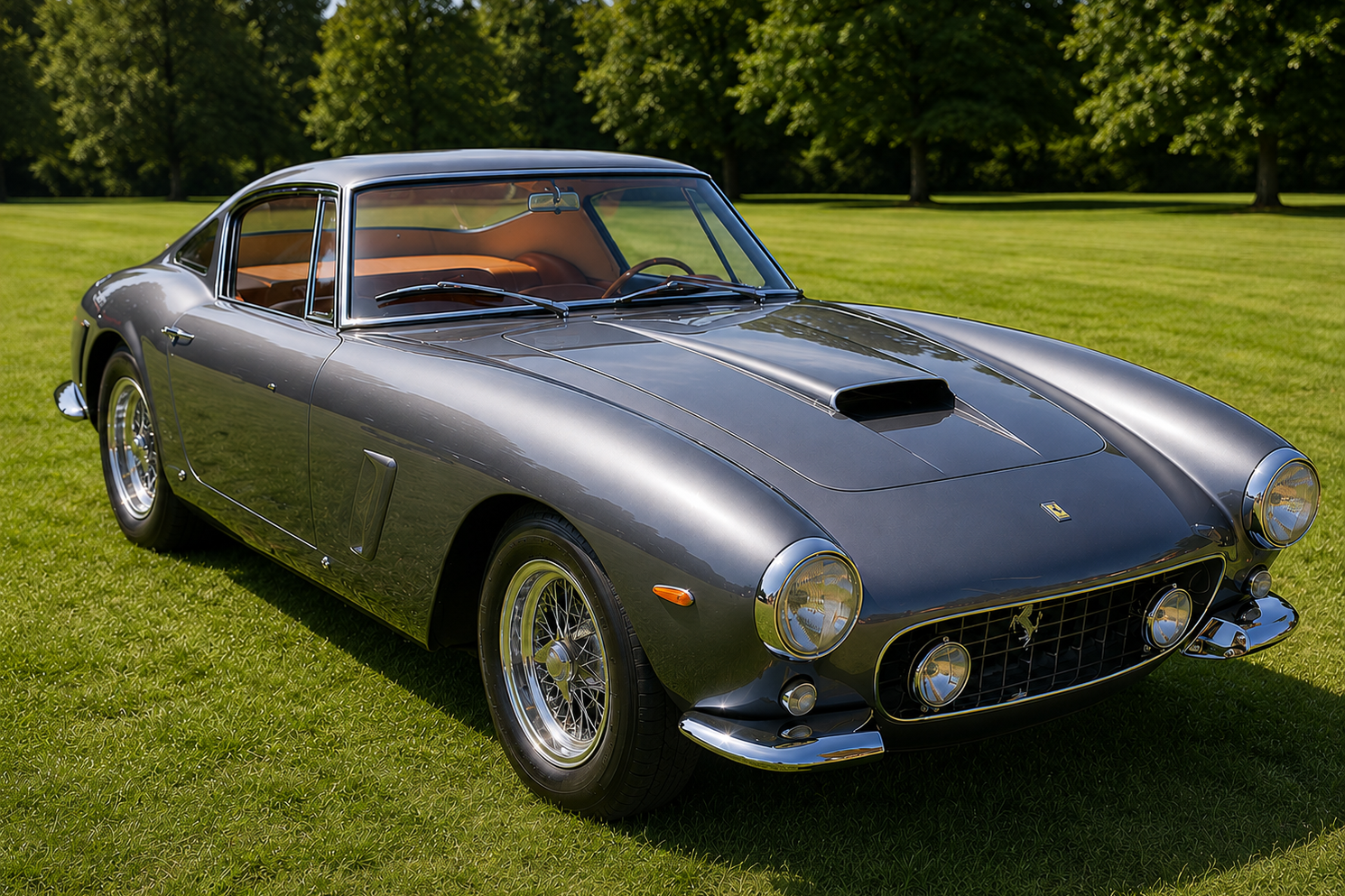
The complete Ferrari 250 GT road-car family — from the Lampredi-engined Europa to the Colombo-V12 SWB, Lusso and GTE — the range that defined Ferrari as a road-car maker.
The Ferrari 250 GT road cars are the foundation of the modern Ferrari brand. Built from 1953 until 1964, the family began with the Lampredi-engined 250 Europa, transitioned to Gioacchino Colombo's short-block 3.0-litre V12 with the Europa GT of 1954, and evolved through a dozen distinct bodies — Boano and Ellena coupes, the Pininfarina Coupé and Cabriolet, the Tour de France Berlinetta, the Berlinetta SWB, the Lusso and the four-seat GTE — before giving way to the 275 in 1964.
At the pinnacle sits the Berlinetta SWB (covered in depth below), the dual-purpose competition-bred road Berlinetta that has become one of the most desirable post-war Ferraris ever built. Around it, the Tour de France Berlinetta and Lusso are firmly blue-chip; the Pininfarina Cabriolet Series I is a coachbuilt one-off in all but name; and the GTE remains the accessible route into 250 GT ownership.
Two further 250 GT road cars have their own standalone guides on Car Collector International and are cross-referenced but not duplicated here: the 250 GTO — the competition Berlinetta that evolved directly from the SWB Competizione programme — and the 250 GT California Spyder (LWB and SWB), the North American-market open derivative of the Tour de France and SWB Berlinettas. Ferrari's pure sports-racers of the period (250 Testa Rossa, 250 LM, 250 MM, 250 Monza, 250 P) are a separate category and are not covered in this guide.
The 250 GT range is where Ferrari made the transition from a small-series racing constructor into a genuine road-car marque. Its variants sit across the full spectrum of the collector market — from seven-figure Blue Chip Berlinettas to six-figure entry-level 2+2s — and provenance research on any 250 GT is decisive.
Variants
Range and production
Variant
Years
Production
Notes
250 Europa (Lampredi V12)
1953–1954
17
Approximately 17 built. Long-block Lampredi 3.0-litre V12, 2,800 mm wheelbase; predecessor rather than true member of the Colombo-engined 250 GT line but wears the 250 designation.
250 Europa GT (Colombo V12)
1954–1955
36
Approximately 36 built. First 250 with the Colombo short-block V12 that would power the rest of the family; 2,600 mm wheelbase.
250 GT Boano ('low-roof')
1956–1957
Not separately recorded
Approximately 63–74 built; exact total not recorded. Body construction contracted from Pininfarina to Carrozzeria Boano. Note: the low-roof/high-roof split is not a clean Boano/Ellena binary — the earliest Ellena cars remained low-roof, and around 5 examples were Pinin Farina-built during the transition.
250 GT Ellena ('high-roof')
1957–1958
Not separately recorded
Approximately 40–50 built; exact total not recorded. Continuation of the Boano contract under Ezio Ellena; body raised for headroom on later cars.
250 GT Coupé Pininfarina
1958–1960
Not separately recorded
Approximately 335–359 built; exact total not recorded. The first true series-production Ferrari, in-house Pininfarina bodywork on 2,600 mm wheelbase.
250 GT Cabriolet Pinin Farina Series I
1957–1959
40
Approximately 36–40 built, effectively individually specified. Series I bodies vary chassis to chassis (covered/open headlamps, different trim); a coachbuilt one-off in all but name.
250 GT Cabriolet Pinin Farina Series II
1959–1962
200
Approximately 200 built. Standardised body; the formal open 250 GT, sold alongside the sportier California Spyder (separate guide).
250 GT Berlinetta 'Tour de France' (TdF)
1956–1959
77
Approximately 77 chassis across five bodystyle sub-series — 14-louvre, 3-louvre, single-louvre, 'no-louvre' Scaglietti bodies, and 5 Zagato-bodied cars. Long-wheelbase competition Berlinetta, four consecutive Tour de France Automobile class wins.
250 GT Berlinetta SWB (steel + alloy)
1959–1962
Not separately recorded
Approximately 165–176 built; exact total not recorded. Short-wheelbase (2,400 mm) dual-purpose Berlinetta, Scaglietti-built on Pininfarina design, first road Ferrari with disc brakes. See the dedicated SWB coverage in the sections below.
250 GT SWB Competizione / SEFAC 'Hot Rod'
1960–1962
Not separately recorded
A subset (not additional cars) within the SWB run: approximately 74 alloy-bodied competizione cars, of which around 21 are the 1961–62 SEFAC 'Hot Rod' final-evolution specification. The competition SWB programme evolved directly into the 250 GTO — see the separate GTO guide for that lineage.
250 GT Berlinetta Lusso
1962–1964
350
Approximately 350 built. Final 250 GT Berlinetta, Pininfarina-designed and Scaglietti-built on the SWB chassis with the instrument binnacle centrally mounted. Widely considered the most beautiful road Ferrari of the period.
250 GTE / 250 GT 2+2
1960–1963
955
Approximately 955 cars across Series I, II and III (commonly ~320 / ~356 / ~279). Ferrari's first production 2+2, the model that made the company commercially viable; still the accessible entry to 250 GT ownership.
250 GTO
1962–1964
Not separately recorded
Covered in its own dedicated guide; not treated as a variant here. Direct successor to the SWB Competizione programme.
250 GT California Spider (LWB and SWB)
1957–1963
Not separately recorded
Covered in its own dedicated guide; not treated as a variant here. Open derivative of the TdF and SWB Berlinettas in long-wheelbase (1957–1960) and short-wheelbase (1960–1963) form.
Collector Variants
Limited & special editions
The models below represent the most significant limited and special edition variants — factory-produced cars that command meaningful premiums over standard examples and warrant specific attention from serious collectors.
Approximately 74 alloy competition-spec cars within the ~165–176 total SWB run; roughly 21 of those are the 1961–62 SEFAC 'Hot Rod' final-evolution specification
Distinguishing features
Aluminium bodyshell over a thinner steel frame, plexiglass side and rear glass, lightweight bumpers, 280+ hp Tipo 168 Comp engine and competition-spec interior. The 1961–62 SEFAC 'Hot Rod' cars received further uprated engines and gearboxes and represent the direct precursor to the 250 GTO (covered in the separate GTO guide).
Value premium
Significantly above steel-bodied Lusso SWBs; competition aluminium cars routinely trade at multi-million premiums. SEFAC-spec cars anchor the top of the SWB market.
Inspection points
Confirm Ferrari Classiche Red Book certification. Verify aluminium body skins (magnet test), competition-spec engine and gearbox numbers, and Tipo 539/61 internals.
Authentication
Every SWB is individually documented by Ferrari Classiche. Provenance documentation, original chassis/engine numbers and Classiche certification are essential.
250 GT Berlinetta 'Tour de France' (TdF) · 1956–1959
Approximately 77 chassis across five bodystyle sub-series — 14-louvre, 3-louvre, single-louvre, 'no-louvre' Scaglietti bodies, and 5 Zagato-bodied cars (Verify)
Distinguishing features
Long-wheelbase (2,600 mm) competition Berlinetta, Scaglietti-built on Pininfarina design (except the 5 Zagato-bodied cars). Named for four consecutive class wins in the Tour de France Automobile 1956–59. Sub-series distinguished visually by the number of louvres in the rear sail panel.
Value premium
TdFs trade broadly in a similar tier to steel-bodied SWBs, with Zagato-bodied cars in a separate top tier that regularly exceeds $20 million at auction.
Inspection points
Verify body sub-series against Ferrari Classiche and period photography; confirm louvre count, headlamp treatment (covered vs open) and body-number stamping are correct for the chassis.
Authentication
Ferrari Classiche Red Book certification is essential; the TdF has been a target for period race-history embellishment and non-original body sub-series conversions.
250 GT Berlinetta Lusso · 1962–1964
Approximately 350 (Verify — 350 the most-cited figure, 351 also appears)
Distinguishing features
Final 250 GT Berlinetta, on the SWB chassis with a Pininfarina design executed by Scaglietti. Distinctive centre-mounted instrument binnacle, delicate roofline and short deck. Colombo Tipo 168 V12 with three Weber 36 DCS carburettors, ~240 hp.
Value premium
Trades in a separate tier from other 250 GT road cars: significantly above the PF Coupé and Cabriolet SII, comfortably below the SWB. Concours matching-numbers cars with original colour combinations are the ceiling.
Inspection points
Verify Classiche Red Book, original colour combination and matching-numbers Tipo 168 engine; check body integrity around sills, front valance and rear light panel.
Authentication
Ferrari Classiche certification, original build-sheet and colour-change history are decisive.
250 GT Cabriolet Pinin Farina Series I · 1957–1959
Approximately 36–40 cars (Verify)
Distinguishing features
Effectively coachbuilt: each Series I Cabriolet is individually specified with unique combinations of covered or open headlamps, side vents, trim and colour. Sold alongside the sportier California Spyder (separate guide).
Value premium
Ordered chassis-by-chassis rather than to a market range; regularly exceeds the standardised Series II by a multiple. Concours cars trade in the $3.5–6.5m+ tier.
Inspection points
Verify body specification against period photography of the specific chassis; Series I cars vary so widely that a generic 'PF Cabriolet' benchmark does not apply.
Authentication
Ferrari Classiche Red Book with full period photographic documentation is essential for a Series I.
Buyer's Guide
What to look for
Provenance and originality
Start with identity, paperwork and originality. For the Ferrari 250 GT, the strongest cars have a continuous ownership file, matching numbers where applicable, original manuals, invoices and evidence of work by recognised marque specialists. Continuous chassis history, matching-numbers powertrain, coachbuilder-correct body construction (Scaglietti steel or alloy, Pininfarina, Boano, Ellena), original colour combination, Ferrari Classiche Red Book certification and any documented period competition history are decisive.
Mechanical inspection priorities
The Colombo 3.0-litre V12 (Tipo 128 in most 250 GT road cars, evolutions through 168) is durable when correctly rebuilt — bottom-end condition, cam and rocker wear, valve-guide seal, distributor timing and correct triple-Weber calibration are the checkpoints. The earliest 250 Europa uses the physically larger Lampredi long-block V12, which is a different engine family entirely and has its own specialist requirements. A proper pre-purchase inspection includes cold-start behaviour, leak-down or compression testing where appropriate, underbody photography, suspension and chassis-point inspection, brake condition and a road test long enough to expose heat-related faults. Deferred maintenance is almost always more expensive than buying a better-sorted car.
Body, paint and accident history
Use a paint-depth gauge, lift access and a specialist familiar with the model's factory seams and panel gaps. Collector value is dramatically affected by structural repairs, poor paintwork, corrosion, incorrect panels and missing factory trim. Documented cosmetic restoration is acceptable; concealed accident repair must be priced severely.
Specification strategy
Provenance, matching numbers, Ferrari Classiche certification and coachbuilder-correct body integrity drive value across every variant. Within the range, the SWB Competizione, Tour de France Berlinetta (especially the Zagato-bodied cars), Pininfarina Cabriolet Series I and Lusso lead; steel SWBs, PF Coupés and GTEs are the more accessible tiers. Specification, colour, transmission and limited-build variants move values significantly. Buy the best-documented example in the most desirable specification you can justify rather than a tired example of a rarer derivative that will need years of corrective work.
Ownership
Living with it
Typical mileage
1,500–4,000 miles typical for collector use
Service interval
12 months; mileage interval varies by model and use
Annual running cost
$4,000 – $12,000
Fuel economy
15–24 mpg depending on use
Insurance
Use an agreed-value collector policy with limited mileage, secure storage, documented photography and an annual value review. Premiums vary sharply by age, storage location and declared value.
Maintenance planning
Budget annually even if the car is used sparingly. Fluids age, tyres date out, fuel systems suffer from ethanol, batteries fail and stored cars need exercise. A documented maintenance rhythm protects both reliability and resale value.
Parts and specialist access
Only top-tier Ferrari Classiche-approved specialists should inspect, service or restore a 250 GT. The market is intolerant of weak work and coachbuilder-incorrect body repairs are the single most common depressant on value. Before purchase, confirm parts availability for model-specific trim, suspension, fuel system, electronics and engine components. A cheap car waiting on unobtainable parts is rarely cheap in collector ownership.
Common Problems
Known issues by system
Chassis
Period accident repair, tube replacement and non-original bodyshells
CriticalSix- or seven-figure discount to market for undocumented structural work
Symptoms — Mismatched welds, asymmetric body lines, repaired tubes around the bulkhead and front structure; especially prevalent on TdF, SWB and Competizione cars with period race history.
Inspection — Classiche-grade chassis inspection with reference to the factory book; jig measurement of frame; coachbuilder-correct panel comparison.
Engine
Non-original Colombo V12, gearbox or rear axle
CriticalPricing impact only — non-original cars trade well below matching-numbers cars
Symptoms — Numbers that do not match the factory build sheet; later-spec internals; incorrect carburettor / distributor / cam specification for the variant.
Inspection — Cross-reference against Ferrari Classiche records and period documentation; verify Tipo number is correct for the variant (128 / 128F / 168 / 168B / etc.).
Body
Coachbuilder-incorrect re-skinning and alloy/steel mix errors
Major$200,000+ for correct re-skin / restoration of original panels; substantially more for full body remake
Symptoms — Inconsistent panel thickness, body filler, seams that do not match Scaglietti / Pininfarina / Boano-Ellena factory drawings; SWBs and TdFs re-bodied in incorrect material.
Inspection — Specialist body inspection with magnet / paint-depth survey and reference to factory drawings; verify body-number stamping where applicable.
Body (GTE / PF Coupé / Cabriolet)
Rust in sills, floors, boot floor and rear arches
Major$60,000 – $180,000 for correct steel bodywork restoration on a road-going 250 GT
Symptoms — Bubbling paint, filler at joins, sagging doors, evidence of welded-in repair sections particularly around jack points and inner sills.
Inspection — Lift inspection by a Ferrari specialist; magnet survey of every panel including boot floor and spare-wheel well.
Brakes / suspension (early cars)
Drum brake fade on pre-SWB cars and tired suspension bushings across the range
Moderate$8,000 – $25,000 for full suspension and brake overhaul to correct specification
Inspection — Road test long enough to expose heat-related fade; ride-height measurement; steering-box play check.
Auctions
Recent results
Date
Auction
Car
Mileage
Result
2026-02-14
RM Sotheby's
Cavallino, Palm Beach — Lot 110
1955 250 Europa GT Coupé by Pinin Farina (chassis 0405 GT)
—
$1,462,500
Sold
2025-08-15
Bonhams
The Quail — Lot 132P
1956 250 Europa GT (chassis 0427 GT — re-offer of the 2022 Quail car)
—
$1,512,000
Sold
2025-03-07
Gooding & Co.
Amelia Island — Lot 142
1955 250 Europa GT (chassis 0419 GT)
—
$1,765,000
Sold
2025-01-25
RM Sotheby's
Arizona — Lot 160
1958 250 GT LWB Berlinetta 'Tour de France' by Scaglietti (chassis 0933 GT)
—
$3,772,500
Sold
2025-01-24
RM Sotheby's
Arizona — Lot 127
1963 250 GT/L Berlinetta Lusso by Scaglietti (chassis 5129)
—
$1,352,500
Sold
2024-12-19
Bring a Trailer
Online — Lot 174,476
1961 250 GTE 2+2 Series I
—
$392,000
Sold
2024-12-07
RM Sotheby's
Miami — Lot 152
1962 250 GTE 2+2 Series II by Pininfarina (chassis 4043)
—
$291,000
Sold
2024-10-31
RM Sotheby's
London — Lot 356
1964 250 GT/L Berlinetta Lusso by Scaglietti (chassis 5913)
—
£1,146,875
Sold
2024-08-16
RM Sotheby's
Monterey — Lot 116
1960 250 GT Coupé by Pinin Farina (chassis 1825 GT)
—
$483,500
Sold
2024-03-02
Gooding & Co.
Amelia Island — Lot 171
1960 250 GT Cabriolet Series II by Pinin Farina (chassis 1879 GT)
—
$940,000
Sold
2024-01-31
RM Sotheby's
Paris — Lot 161
1960 250 GT SWB Berlinetta Competizione (alloy, chassis 1773 GT — Scuderia Ferrari 1960 competition car; not SEFAC-labeled on the lot page)
—
€10,158,125
Sold
2023-08-18
RM Sotheby's
Monterey — Lot 120
1959 250 GT Coupé by Pinin Farina (chassis 1391 GT)
—
$731,000
Sold
2023-08-18
RM Sotheby's
Monterey — Lot 257
1962 250 GT Cabriolet Series II by Pininfarina (chassis 3499)
—
$1,380,000
Sold
2023-08-18
RM Sotheby's
Monterey — Lot 122
1962 250 GTE 2+2 Series II by Pininfarina (chassis 4089)
—
$544,000
Sold
2023-05-27
RM Sotheby's
Villa Erba — Lot 138
1960 250 GT Coupé Series II by Pinin Farina (chassis 1873 GT)
—
€483,125
Sold
2022-08-20
Bonhams
The Quail — Lot 50
1955 250 Europa GT by Pinin Farina (chassis 0427 GT)
—
$2,095,000
Sold
2022-08-19
RM Sotheby's
Monterey — Lot 328
1959 250 GT LWB Berlinetta 'Tour de France' by Scaglietti (chassis 1161 GT)
—
$5,340,000
Sold
2022-08-19
RM Sotheby's
Monterey — Lot 258
1958 250 GT Cabriolet Series I by Pinin Farina (chassis 0963 GT)
—
$6,825,000
Sold
2022-08-19
RM Sotheby's
Monterey — Lot 231
1961 250 GT Cabriolet Series II by Pininfarina (chassis 2683)
—
$1,105,000
Sold
2022-08-19
RM Sotheby's
Monterey — Lot 330
1964 250 GT/L Berlinetta Lusso by Scaglietti (chassis 5141)
—
$2,205,000
Sold
2021-08-14
RM Sotheby's
Monterey — Lot 331
1958 250 GT LWB Berlinetta 'Tour de France' by Scaglietti (chassis 1031 GT)
—
$6,000,000
Sold
2021-08-13
Gooding & Co.
Pebble Beach — Lot 137
1958 250 GT Cabriolet Series I by Pinin Farina (chassis 1075 GT)
—
$4,405,000
Sold
2021-08-13
RM Sotheby's
Monterey — Lot 264
1957 250 GT Coupé by Boano (chassis 0667 GT)
—
$995,000
Sold
2021-01-22
RM Sotheby's
Arizona — Lot 143
1956 250 GT Alloy Coupé by Boano (chassis 0613 GT)
—
$1,352,500
Sold
Investment
Long-term outlook
Blue ChipHorizon: 10+ years
The 250 GT road-car family anchors the post-war Ferrari market. The SWB, TdF, Lusso and PF Cabriolet Series I should continue to lead among documented, matching-numbers cars with Classiche certification; the GTE 2+2 is the most credible accessible-entry Ferrari of the era and has upside as broader recognition catches up with the mid-tier PF Coupé and Boano/Ellena market.
Our view, not advice. This section is Car Collector International's editorial judgement on where this model sits in the collector market, based on the production, specification and market data set out in this guide. It is not a recommendation to buy or sell and it is not investment advice. Values can fall as well as rise.