Car Collector International
Classic · 1957–1963

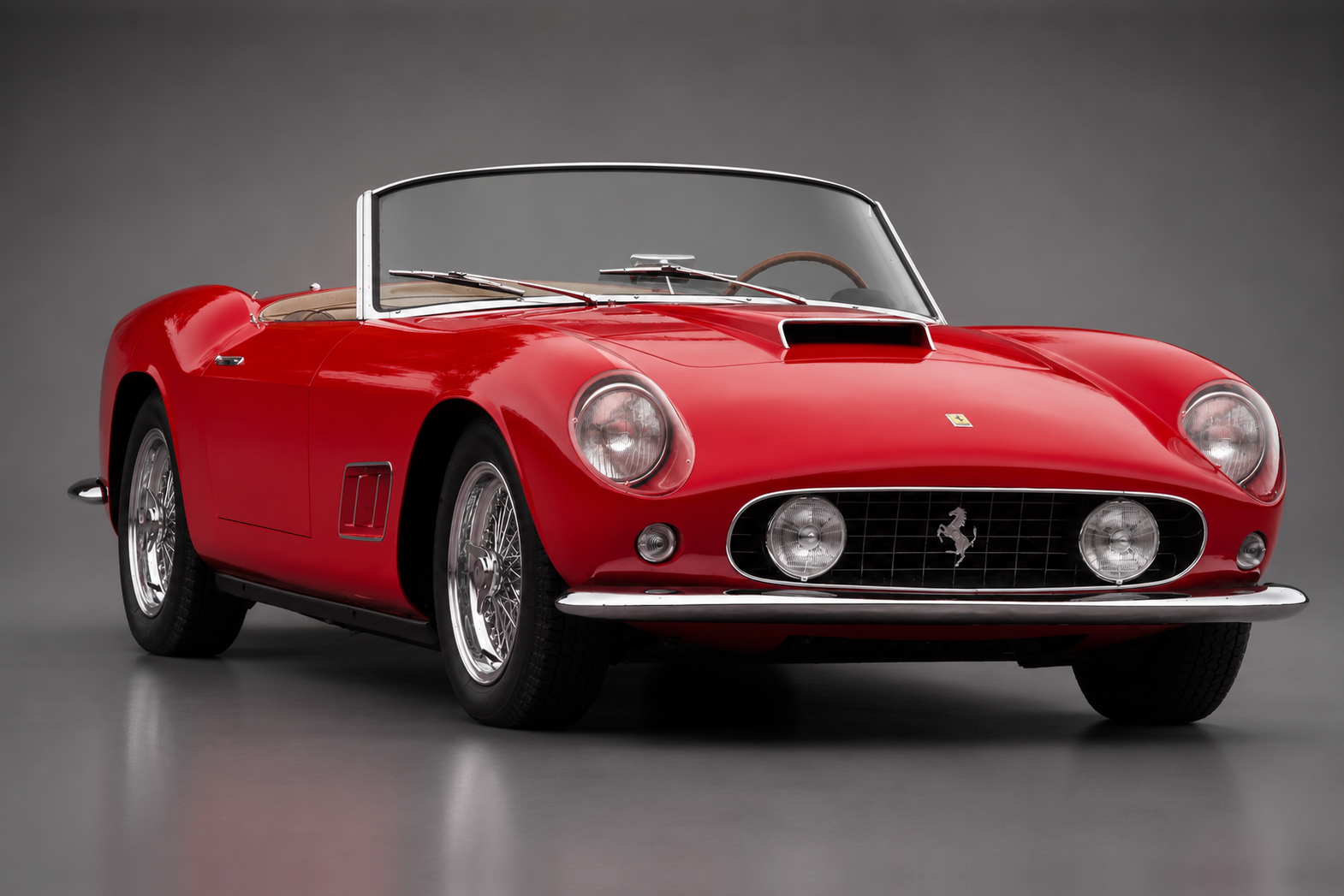
Ferrari 250 GT California Spider

Scaglietti-bodied open 250 GT commissioned by Ferrari's North American importers — built in two forms on the long and short 250 GT chassis, in fewer than 110 examples combined.

Car Collector International Editorial
Ferrari 250 GT California Spider
Overview

Why this car matters

Conceived at the urging of Ferrari's North American importers Luigi Chinetti and John von Neumann, the 250 GT California Spider was an open-top derivative of the 250 GT Berlinetta engineered for American clients who wanted a competition-derived Ferrari they could drive on the road. Powered by the Colombo 3.0-litre V12 and clothed by Scaglietti to a Pininfarina-approved design, it was sold alongside the more formal Pinin Farina Cabriolet as the sporting open Ferrari of its day.

Production ran continuously from 1957 to 1963 in two closely related forms sharing the same name, coachbuilder and engine but built on different chassis. The Long Wheelbase (LWB) car, 1957–1960, used the 2,600 mm Tour de France Berlinetta chassis. From 1960 the model migrated to the shorter 2,400 mm 250 GT SWB chassis with disc brakes and a stiffer platform — sold as the Short Wheelbase (SWB) California Spider through to 1963. Ferrari's own usage, and every recent auction-house catalogue, is 'Spider' rather than 'Spyder'. Together the two forms today occupy the top tier of the 250 GT market, with the SWB commanding a substantial and consistent premium over the LWB.

The California Spider is the original road-going open 250 GT, engineered from the outset around competition mechanicals. Total production across both forms is well under 110 chassis, continuous histories are traceable, and the market is intolerant of gaps. The SWB is a genuinely different car from the LWB — shorter, stiffer, disc-braked, more expensive to build and correspondingly rarer — and the two are not interchangeable when assessing value.

Variants

Range and production

VariantYearsProductionNotes
LWB, steel body, open headlamp1957–1959Earliest LWB specification; open headlamps, steel Scaglietti bodywork on the 2,600 mm 250 GT chassis. LWB uses the inside-plug Colombo V12 (tipo 128) rated ~240 hp with drum brakes at all four corners.
LWB, steel body, covered headlamp1959–1960Later LWB specification with plexiglass headlamp covers; the more sought-after LWB configuration. 38 of the 50 LWB cars were built with covered headlamps (Gooding Christie's Rétromobile Paris 2026 lot 31 catalogue for chassis 0923 GT).
LWB, alloy competizione1959–19609Of the 50 LWB cars, 9 were aluminium-bodied — 8 of those built to full Competizione specification with high-lift cams and three Weber 42 DCN carburettors. A further ~10 LWB cars were factory-prepared with competition features on steel bodies. Chassis-by-chassis on the Massini register.
SWB, steel body, open headlamp1960–1963Introduced 1960 on the 2,400 mm 250 GT SWB chassis. Mechanically a different car from the LWB: outside-plug tipo 168 V12 with revised heads and larger valves rated ~280 hp, four-wheel Dunlop disc brakes standard. The standard SWB California specification. Chassis 4137 — the last SWB California Spider built — is a steel-bodied SWB (Mecum Indianapolis 2026 lot S159 catalogue for chassis 4137).
SWB, steel body, covered headlamp1960–196339 of the 56 SWB cars were built with plexiglass covered headlamps — the most sought-after SWB road configuration and the specification of the recent eight-figure results, including chassis 2955 GT at RM Monaco 2026 and chassis 1915 GT at RM Paris 2026 (RM Sotheby's Paris 2026 lot 140 catalogue for chassis 1915 GT).
SWB, alloy competizione1960–19632Only 2 of the 56 SWB cars were built to full competition specification with aluminium bodywork; chassis-by-chassis on Massini.
Buyer's Guide

What to look for

Provenance and originality

Start with identity, paperwork and originality. For the Ferrari 250 GT California Spider, the strongest cars have a continuous ownership file, matching numbers where applicable, original manuals, invoices and evidence of work by recognised marque specialists. Ferrari Classiche Red Book certification, matching-numbers engine and gearbox, original colour combination, covered-headlamp specification, alloy competizione bodywork and any documented period competition history are decisive to value on both LWB and SWB cars. SWB cars additionally attract a large premium for the shorter chassis, disc brakes and Scaglietti's tauter later body.

Mechanical inspection priorities

The Colombo V12 is durable when correctly rebuilt, but originality of block, heads, gearbox and rear axle — and the quality of any recent mechanical refresh by a Classiche-approved specialist — defines the car's standing. SWB cars add disc brakes and a stiffer chassis, but the V12 architecture and inspection priorities are common to both. A proper pre-purchase inspection includes cold-start behaviour, leak-down or compression testing where appropriate, underbody photography, suspension and chassis-point inspection, brake condition and a road test long enough to expose heat-related faults. Deferred maintenance is almost always more expensive than buying a better-sorted car.

Body, paint and accident history

Use a paint-depth gauge, lift access and a specialist familiar with the model's factory seams and panel gaps. Collector value is dramatically affected by structural repairs, poor paintwork, corrosion, incorrect panels and missing factory trim. Documented cosmetic restoration is acceptable; concealed accident repair must be priced severely.

Specification strategy

Alloy-bodied competition-specification cars with period race history lead both markets; covered-headlamp examples trade above open-headlamp cars in both LWB and SWB form; SWB cars trade at a substantial premium to LWB equivalents; and Ferrari Classiche Red Book certification is expected at every level. Specification, colour, transmission and limited-build variants move values significantly. Buy the best-documented example in the most desirable specification you can justify rather than a tired example of a rarer derivative that will need years of corrective work.

Pricing

What to pay

LWB, steel, open headlamp
USD$9,000,000 – $12,500,000
GBP£7,200,000 – £10,000,000
EUR€8,300,000 – €11,500,000
Documented steel-bodied open-headlamp LWB with Classiche certification and continuous ownership file.
LWB, steel, covered headlamp
USD$12,000,000 – $16,000,000
GBP£9,500,000 – £12,800,000
EUR€11,000,000 – €14,700,000
Later-specification covered-headlamp steel LWB; the LWB market's preferred configuration.
LWB, alloy competizione
USD$16,000,000 – $22,000,000+
GBP£12,800,000 – £17,500,000+
EUR€14,700,000 – €20,200,000+
One of ~9 alloy-bodied LWB cars with three-carburettor engine; pricing is chassis-by-chassis on race history.
SWB, steel, open headlamp
USD$13,000,000 – $17,000,000
GBP£10,400,000 – £13,600,000
EUR€11,900,000 – €15,600,000
Documented steel-bodied open-headlamp SWB with Classiche certification and continuous ownership file.
SWB, steel, covered headlamp
USD$16,000,000 – $22,000,000+
GBP£12,800,000 – £17,500,000+
EUR€14,700,000 – €20,200,000+
Covered-headlamp SWB — the most sought-after road specification and the configuration of every 2026 eight-figure result to date.
SWB, alloy competizione
USD$22,000,000+
GBP£17,500,000+
EUR€20,200,000+
The rarest California specification; pricing chassis-by-chassis on period competition history and Classiche certification.

Regional ranges authored independently — each reflects its local market, not an FX conversion

Ownership

Living with it

Typical mileage
1,500–4,000 miles typical for collector use
Service interval
12 months; mileage interval varies by model and use
Annual running cost
$4,000 – $12,000
Fuel economy
15–24 mpg depending on use
Insurance
Use an agreed-value collector policy with limited mileage, secure storage, documented photography and an annual value review. Premiums vary sharply by age, storage location and declared value.

Maintenance planning

Budget annually even if the car is used sparingly. Fluids age, tyres date out, fuel systems suffer from ethanol, batteries fail and stored cars need exercise. A documented maintenance rhythm protects both reliability and resale value.

Parts and specialist access

Only top-tier Ferrari Classiche-approved specialists should inspect, service or restore a California Spider of either wheelbase. Given how few genuine cars exist and how many recreations and rebodied berlinettas circulate, the market is intolerant of weak work or thin documentation. Before purchase, confirm parts availability for model-specific trim, suspension, fuel system, electronics and engine components. A cheap car waiting on unobtainable parts is rarely cheap in collector ownership.

Common Problems

Known issues by system

Identity

Non-original engine, gearbox or bodyshell

CriticalPricing impact only — non-matching cars trade at seven-figure discounts to matching-numbers examples
Symptoms — Numbers that do not match the factory build sheet; later-spec V12 internals; replacement Scaglietti body or panels.
Inspection — Ferrari Classiche Red Book application and cross-reference of chassis, engine and gearbox numbers against the factory records and the Massini register.
Chassis

Period accident repair and tube replacement

CriticalDiscount to market — six- or seven-figure value impact
Symptoms — Mismatched welds, asymmetric body lines, repaired tubes around the front bulkhead and rear differential mounts.
Inspection — Classiche-grade chassis inspection with jig measurement of the frame against factory drawings.
Body

Corrosion, re-skinning and incorrect steel/alloy substitution

Major$250,000+ for correct re-skin and structural restoration of original Scaglietti bodywork
Symptoms — Body filler, inconsistent panel thickness, mismatched seams, incorrect alloy on nominally steel cars (or vice versa).
Inspection — Specialist body inspection with magnet and paint-depth survey, comparison to factory drawings, and lift access to inspect floors, sills and rear structure.
Engine

Tired or incorrectly rebuilt Colombo V12

Major$150,000 – $300,000+ for a correct full V12 rebuild
Symptoms — Low oil pressure when hot, smoke on the overrun, uneven carburettor sync, poor cold-start behaviour.
Inspection — Compression and leak-down testing, oil-pressure gauge inspection, documentation of the last full rebuild by a Classiche-approved specialist.
Provenance

Rebodied berlinettas and continuation / recreation cars

CriticalPricing impact only — recreations trade at a fraction of genuine California values
Symptoms — Chassis number outside the accepted California register range; documentation gaps between period and current ownership; body seams that do not match Scaglietti drawings.
Inspection — Cross-reference against the recognised 250 GT California register and Marcel Massini history file; require Classiche Red Book.
Valuation

Current value bands by region

Concours
USD
$15,500,000
GBP
£12,400,000
EUR
€14,300,000
+4% 12-mo
Excellent
USD
$12,000,000
GBP
£9,600,000
EUR
€11,000,000
+3% 12-mo
Good
USD
$9,500,000
GBP
£7,600,000
EUR
€8,700,000
+1% 12-mo
Fair
USD
$7,500,000
GBP
£6,000,000
EUR
€6,900,000
0% 12-mo
Project
USD
$5,500,000
GBP
£4,400,000
EUR
€5,050,000
0% 12-mo

Each region quoted in its local currency — independent market readings, not FX conversions

The LWB California Spider (1957–1960) and the SWB California Spider (1960–1963) are distinct, non-comparable markets and should not be treated as one range when assessing value. LWB cars currently average in the $7–9 million band at public auction, with covered-headlamp and alloy competizione examples pushing higher. SWB cars trade in a materially higher bracket — comfortably eight figures for good steel road cars and pushing well into the mid-teens and beyond for covered-headlamp examples with clean Classiche books.

Within each form, value is set chassis-by-chassis rather than by a generic range. Covered-headlamp cars, matching-numbers drivetrains, original colour combinations and continuous ownership files dominate. Public trades of headline-grade cars in either form are thin, so private results and asking prices are often running ahead of the last public hammer figure.

The 2026 season is the strongest single-season read the market has produced. Three SWB sales landed inside a ten-week window at €16,655,000, €14,067,500 and $16,505,000 inclusive (against $15,000,000 hammer disclosed by the house); a further SWB printed at $18,150,000 in May. Over the same season the LWB anchor printed at $7,045,000 and a further LWB failed to meet a €5,500,000–€6,500,000 estimate. That is a roughly 3-to-1 SWB-over-LWB premium observed across a single season on a car that trades perhaps twice a year at public auction.

Auctions

Recent results

DateAuctionCarMileageResult
2026-04-25
RM Sotheby's
Monaco 2026, Lot 164
1961 SWB California Spider
Chassis 2955 GT. Covered headlamps, Ferrari Classiche Red Book, 1961 Frankfurt show car. Top of the SWB band alongside chassis 4137 at Mecum Indianapolis 2026 — the two are the highest public SWB results of the season and are not ranked against one another because they printed in different currencies. (RM Sotheby's Monaco 2026 lot 164 catalogue for chassis 2955 GT.)
€16,655,000
Sold
2026-05-16
Mecum
Indianapolis 2026, Lot S159
1963 SWB California Spider
Chassis 4137 — the last SWB California Spider built. Top of the SWB band alongside chassis 2955 GT at RM Monaco 2026 — the two are the highest public SWB results of the season and are not ranked against one another because they printed in different currencies. (Mecum Indianapolis 2026 lot S159 catalogue for chassis 4137.)
67,463 mi
$18,150,000
Sold
2026-03-07
Gooding Christie's
Amelia Island 2026, Lot 145
1960 SWB California Spider
Chassis 1963 GT. Covered headlamps, rare factory hardtop, delivered new to Auto Becker of Düsseldorf, a fixture in just two West Coast collections since 1976. Both hammer ($15,000,000) and inclusive ($16,505,000) figures published by the house — unusual — and recorded here as such. (Gooding Christie's Amelia Island Auctions 2026 lot 145 catalogue for chassis 1963 GT.)
$16,505,000 inclusive of premium ($15,000,000 hammer, disclosed by the house)
Sold
2026-01-28
RM Sotheby's
Paris 2026, Lot 140
1960 SWB California Spider
Chassis 1915 GT. Third of 56 SWB cars built; one of 39 originally configured with covered headlamps; delivered new to Paris. (RM Sotheby's Paris 2026 lot 140 catalogue for chassis 1915 GT.)
€14,067,500
Sold
2026-02-27
RM Sotheby's
Miami 2026, Lot 145
1959 LWB California Spider
Chassis 1431 GT — the 28th of the 50 LWB cars and the last LWB fitted with the inside-plug Colombo V12, with eleven recorded owners. Top public LWB result of the season and the LWB anchor for this guide. (RM Sotheby's Miami 2026 lot 145 catalogue for chassis 1431 GT.)
$7,045,000
Sold
2026-01-29
Gooding Christie's
Rétromobile Paris 2026, Lot 31
1958 LWB California Spider
Chassis 0923 GT. One of 38 covered-headlamp LWB cars (of 50 LWBs built); well-documented provenance to first owner. The market refused the estimated LWB band this season — a floor read as well as a not-sold read. (Gooding Christie's Rétromobile Paris 2026 lot 31 catalogue for chassis 0923 GT.)
Not sold — estimate €5,500,000–€6,500,000
Not Sold
Investment

Long-term outlook

Blue ChipHorizon: 10+ years

With approximately 106 cars built across both wheelbases and a global collector base, the California Spider is among the most secure assets in the collector-car market. Classiche-certified matching-numbers cars — particularly covered-headlamp steel and alloy competizione examples in either form — should continue to lead, with SWB retaining its structural premium over LWB. The material risk is authentication: rebodied berlinettas, continuation cars and recreations circulate, and cars without a full history file will lag.

Recommended

The trusted network

Specialists

  • Ferrari marque specialist
    View →
    UK / Europe
    Ferrari 250 GT California Spider inspections, servicing and originality reviews.
  • Model-focused independent
    View →
    United States
    Pre-purchase inspections, major service planning and market-correct preparation for the 250 GT California Spider.
  • Concours preparation studio
    View →
    International
    Paint correction, detailing, preservation and sale preparation for premium collector cars.

Storage

  • Windrush Car Storage
    View →
    Cotswolds, UK
    Climate-controlled storage and collection management for high-value collector cars.
  • Autovault
    View →
    Bicester, UK
    Secure storage at Bicester Heritage with regular inspection programmes.
  • Classic Car Club Manhattan
    View →
    New York, NY
    Secure urban storage for collector and modern-classic performance cars.

Transport

  • CARS UK
    View →
    UK & Europe
    Enclosed event, concours and collection transport across Europe.
  • Reliable Carriers
    View →
    USA (national)
    Enclosed coast-to-coast transport for premium and collector cars.
  • FERRLOG
    View →
    Italy / Europe
    Air-ride enclosed transport for Italian and European collector cars.

Enjoyed this guide?

Get new buyer's guides and collector market intelligence delivered to your inbox. No spam. We respect your inbox.

The valuation figures in this guide are for research purposes only and do not constitute financial or investment advice. See our full disclaimer.