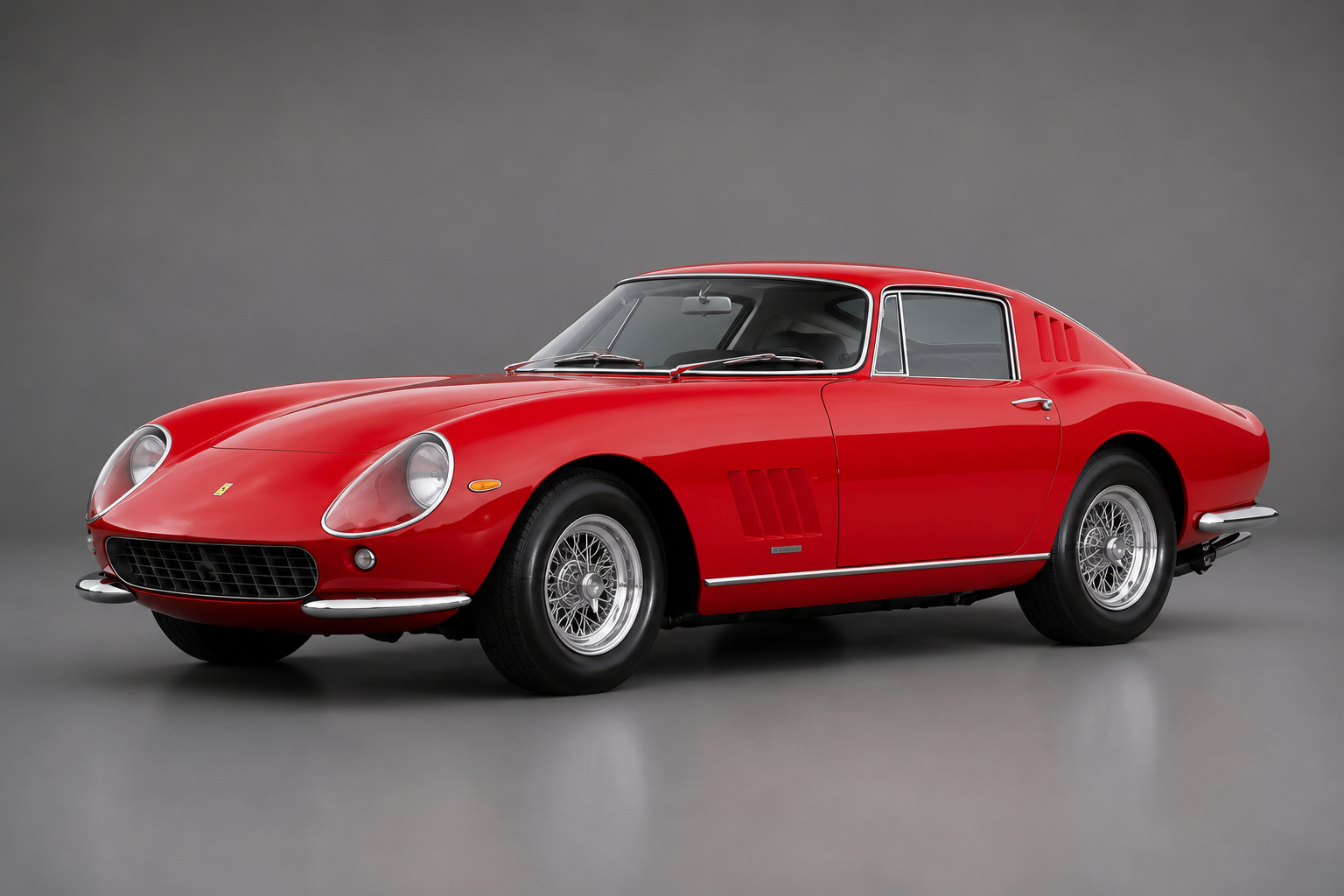
The full 275 family — GTB, GTS, GTB/4 and the competition and NART Spider derivatives — Ferrari's first transaxle road cars and the bridge between the 250 GT era and the Daytona.
Launched at the 1964 Paris Salon, the Ferrari 275 introduced a rear-mounted transaxle gearbox, fully independent suspension and a 3.3-litre Colombo V12 to Ferrari's road-car line. The family opens with the 275 GTB berlinetta by Pininfarina/Scaglietti and the open 275 GTS Pininfarina spider, evolves through the 1965 'long-nose' revision and the switch to a torque-tube driveshaft in late 1965/1966, and culminates in the four-cam 275 GTB/4 introduced at the 1966 Paris Salon and the North American Racing Team-inspired 275 GTB/4*S NART Spider of 1967–1968.
Alongside the road cars, Ferrari built a small run of factory competition 275s: three 1964–65 lightweight prototypes (variously labelled 'GTB Competizione Speciale' or 'GTB/C Series I' — the same three cars under two names) and the distinct 1966 run of twelve 275 GTB/C. Total factory competition production: 15 cars.
The 275 family closes the Colombo-engined V12 road-car era and is now firmly part of the front-engined V12 Ferrari blue-chip collector set.
First Ferrari road car with a transaxle and independent rear suspension; first four-cam production Ferrari engine (GTB/4); spiritual bridge between the 250 GT SWB / Lusso and the 365 GTB/4 Daytona; and — via the NART Spider and GTB/C — the source of two of the most valuable non-250 road-derived Ferraris ever built.
Variants
Range and production
Variant
Years
Production
Notes
275 GTB short-nose (2-cam)
1964–1965
Not separately recorded
Earliest berlinettas by Scaglietti to a Pininfarina design; nose aerodynamics later revised on the long-nose. Steel body standard, aluminium body a factory option. Three twin-choke Weber 40 DCZ 6 carburettors standard; six twin-choke Webers an option.
275 GTB long-nose (2-cam)
1965–1966
Not separately recorded
Revised, longer front end (larger radiator opening) from late 1965; torque-tube driveshaft replacing the exposed prop-shaft on later cars. Alloy body and 6-carb induction remained factory options.
275 GTB (2-cam) — total production
1964–1966
453
Sources give 453 as the widely-cited combined short- and long-nose total (Barchetta.cc, multiple RM Sotheby's and Gooding catalogue entries); Ferrari's own model page rounds, and some references give 454.
275 GTB (2-cam) — alloy body subset
1964–1966
Not separately recorded
Reported at roughly 70–80 cars of the 453 built with aluminium coachwork, predominantly the short-nose run (one detailed source gives ~70 of the short-nose cars specifically); the balance were steel-bodied. Subset of the 275 GTB total, not additional cars.
275 GTB (2-cam) — 6-carburettor subset
1964–1966
Not separately recorded
Factory 6-Weber induction was an option on 2-cam GTBs; per-car counts vary between sources and no settled figure is published. Subset of the 275 GTB total, not additional cars.
275 GTS (Pininfarina spider)
1964–1966
200
Open two-seat Pininfarina-designed and -built spider on the 275 chassis; visually and mechanically distinct from the later NART Spider. 200 is the widely-cited factory total.
275 GTB/4 (4-cam)
1966–1968
330
Commonly cited as 330 (chassis range 09007–11069), though Ferrari's own materials also state 280 built on the same model page, and some compilations give 350. The exact total is unsettled. Four-cam evolution introduced at the 1966 Paris Salon; six Weber carburettors and dry-sump lubrication standard; torque-tube driveshaft standard.
275 GTB/4*S NART Spider
1967–1968
10
Ten open cars converted by Scaglietti at Luigi Chinetti's (NART) request; widely regarded as among the rarest and most valuable production-derived Ferraris. Ten cars is the settled figure across Ferrari and the major auction-house catalogues.
275 GTB Speciale / GTB/C Series I
1964–1965
3
Three factory lightweight competition prototypes, variously labelled 'GTB Competizione Speciale' or 'GTB/C Series I' across the literature — the two designations refer to the same three cars (chassis 06885, 07185 and a third variously cited as 06021/07437).
275 GTB/C (1966)
1966
12
Twelve lightweight competition berlinettas built in 1966 with alloy bodies (thinner-gauge than the road-car alloy option), dry-sump lubrication and Le Mans-type fuel fillers. A distinct programme from the 3 Speciale/Series I cars. 12 is the figure used by Ferrari and the major auction catalogues.
Collector Variants
Limited & special editions
The models below represent the most significant limited and special edition variants — factory-produced cars that command meaningful premiums over standard examples and warrant specific attention from serious collectors.
275 GTB/4 · 1966–1968
330
Distinguishing features
Four-cam (4-camshaft) version of the 3.3 V12 producing 300 hp, with revised rear suspension geometry and torque tube driveshaft. Bonnet bulge denotes the 4-cam.
Value premium
1.5–2× a 275 GTB 2-cam long-nose in equivalent condition.
Inspection points
Verify four-cam tipo 226 engine number against Classiche records. Confirm matching torque tube and rear transaxle.
275 GTB/4 NART Spyder · 1967–1968
10
Distinguishing features
North American Racing Team commission: open-top conversion of the GTB/4 by Scaglietti to the order of Luigi Chinetti. Each car is individually documented.
Value premium
Multi-tens-of-millions territory; the highest-value 275 derivative.
Inspection points
Only 10 chassis numbers exist — verify against the published NART Spyder list. Demand Ferrari Classiche Red Book.
Authentication
Numerous 'NART tribute' Spyders exist, converted from GTB or GTB/4 coupes. None should be confused with originals — Ferrari Classiche certification is definitive.
275 GTB Competizione (GTB/C and 275 GTB/C Speciale) · 1965–1966
12 (GTB/C 1966) + 3 (GTB/C Speciale 1965)
Distinguishing features
Lightweight competition Berlinettas: aluminium body, plexiglass, larger fuel tank, dry-sump six-carb engine and homologation-spec bodywork. The 3 GTB/C Speciale are even lighter and more extreme.
Value premium
Multi-million-dollar premium over a steel-bodied 2-cam 275 GTB.
Inspection points
Demand Ferrari Classiche certification and cross-reference each chassis against the GTB/C register.
Buyer's Guide
What to look for
Provenance and originality
Start with identity, paperwork and originality. For the Ferrari 275, the strongest cars have continuous ownership history, matching numbers where applicable, original books and tools, factory build documentation and evidence of work by manufacturer-approved specialists. Matching numbers, Ferrari Classiche certification, complete original tool roll, correct engine specification (2-cam vs 4-cam; 3- vs 6-carburettor; steel vs alloy body), original colour, and continuous ownership documentation. NART Spider and GTB/C provenance is authenticated by chassis number against the published factory records.
Mechanical inspection priorities
The Colombo V12 (Tipo 213 in 2-cam form, Tipo 226 in 4-cam form) is well documented and serviceable by Classiche specialists; cam timing, distributor health, six-carburettor synchronisation where fitted, and torque-tube / transaxle alignment on later cars are the practical concerns. A proper pre-purchase inspection includes cold-start behaviour, ECU diagnostics and fault-code history (where applicable), leak-down or compression testing, underbody photography, suspension and chassis inspection, brake condition and a long enough road test to expose heat-related faults. Deferred maintenance on a car of this class is almost always more expensive than buying a better-sorted example.
Body, paint and accident history
Use a paint-depth gauge, lift access and a specialist familiar with the model's factory panel gaps and finish standards. Collector value is dramatically affected by structural repairs, refinished panels, poor paintwork and missing factory trim or option content. Documented cosmetic refresh is acceptable; concealed accident or fire damage must be priced severely.
Specification strategy
GTB/4 four-cam coupés lead the volume market. Long-nose torque-tube two-cam cars are firmly collectable and now the entry point to the family. GTS Pininfarina spiders sit above them. GTB/C competition cars and the ten NART Spiders are trophy assets priced individually. Specification, colour, options and limited-build variants move values significantly. Buy the best-documented example in the most desirable specification you can justify, rather than a tired example of a rarer derivative that will need years of corrective work.
Ownership
Living with it
Typical mileage
1,000–4,000 miles typical for collector use
Service interval
12 months; mileage interval varies by model and use
Annual running cost
$5,000 – $18,000
Fuel economy
15–28 mpg depending on use
Insurance
Use an agreed-value collector or specialist supercar policy with limited mileage, secure storage, documented photography and an annual value review. Premiums vary sharply by age, storage location, declared value and driver profile.
Maintenance planning
Budget annually even if the car is used sparingly. Fluids age, tyres and date-coded rubber components must be replaced regardless of mileage, and stored cars need exercise. A documented maintenance rhythm protects both reliability and resale value.
Parts and specialist access
Ferrari Classiche review is the central reference; use established 250/275-era specialists for inspection, service and any authentication question involving alloy-bodied, 6-carb, or competition-spec cars. Before purchase, confirm parts availability for model-specific bodywork, electronics, gearbox and engine components. A discounted car waiting on unobtainable parts or a factory service slot is rarely a saving in collector ownership.
Common Problems
Known issues by system
Identity
Engine, body and chassis number consistency (all variants)
CriticalValue impact, not repair cost
Symptoms — Discrepancies in stamping, restamping, or undocumented re-bodywork; period conversions between 2-cam and 4-cam, or between GTB and GTS/NART configurations.
Inspection — Ferrari Classiche review; independent chassis-record cross-check for GTB/C and NART Spider claims.
Bodywork
Repaired or repanelled aluminium bodywork (alloy GTB, GTB/4, GTB/C)
Major$80,000 – $300,000+ for correct coachwork
Symptoms — Filler depth anomalies, panel-gap inconsistency, refinished history; on GTB/C cars the correct thin-gauge alloy is critical.
Inspection — Specialist coachwork inspection with panel-thickness measurement.
Engine / transaxle
Transaxle alignment, torque-tube bearing wear and driveshaft health
Major$25,000 – $60,000
Symptoms — Driveline vibration (particularly on early open-prop-shaft short-nose cars), gearbox noise, oil leakage.
Inspection — Set up on a rolling road by a Ferrari carburettor specialist.
Auctions
Recent results
Date
Auction
Car
Mileage
Result
2026-05-16
Mecum
Indianapolis
1967 1967 275 GTB/4
—
$2,860,000
Sold
2026-05-16
Mecum
Indianapolis
1966 1966 275 GTS
—
$1,870,000
Sold
2026-04-25
RM Sotheby's
Monaco
1967 1967 275 GTB/4, chassis 10217
—
€2,283,125
Sold
2026-04-25
RM Sotheby's
Monaco
1966 1966 275 GTB/6C, chassis 08895
—
€2,367,500
Sold
Investment
Long-term outlook
Blue ChipHorizon: 10+ years
Front-engined V12 Ferrari road-car blue chip. GTB/4, GTB/C and NART Spider lead; the entire 275 family is supported by the Ferrari Classiche programme and by a stable, thin public-auction record that keeps price discovery orderly.
Our view, not advice. This section is Car Collector International's editorial judgement on where this model sits in the collector market, based on the production, specification and market data set out in this guide. It is not a recommendation to buy or sell and it is not investment advice. Values can fall as well as rise.