
Car Collector International
Classic · 1976–1985

Ferrari 400

Maranello's late-1970s / early-1980s Pininfarina 2+2 flagship — 4.8-litre Colombo V12, Ferrari's first factory automatic, and the enthusiast-market entry point into a V12 Ferrari.

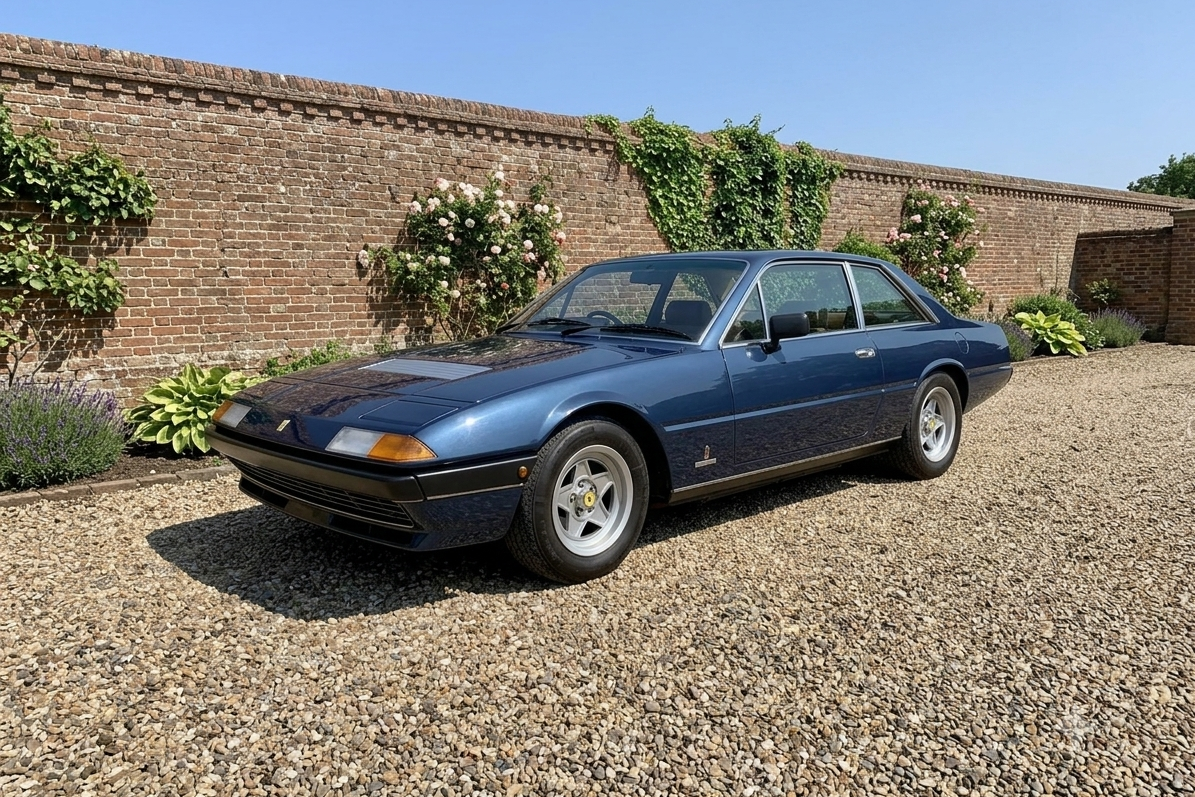
Ferrari 400, front three-quarter view — Pininfarina-designed 1976–1985 front-engined V12 2+2 grand tourer in dark metallic blue, five-spoke alloy wheels and twin round headlamps set against a walled garden backdrop.
Overview

Why this car matters

Introduced at the 1976 Paris Motor Show and produced through 1985, the Ferrari 400 was the middle chapter of Maranello's Pininfarina-designed front-engined V12 2+2 lineage — bracketed by the 365 GT4 2+2 that preceded it and the 412 that followed. Beneath the elegant three-box bodywork lay a 4,823 cc (4.8-litre) Colombo V12 enlarged from the 365 GT4 2+2's 4.4-litre unit, and the model's defining commercial move was the offer, for the first time in Ferrari's history, of a factory automatic transmission. The 1979 arrival of the 400i added a second milestone: Bosch K-Jetronic fuel injection made it the first fuel-injected Ferrari road car. Approximately 1,800 cars were built across three factory variants: the carburettor 400 GT and 400 Automatic through 1979, and the Bosch fuel-injected 400i in manual and automatic form from 1979 to 1985.

The 400 is the model that made Ferrari a genuine four-seater grand-touring alternative to Bentley, Aston Martin and Mercedes-Benz — a Pininfarina 2+2 with a 4.8-litre V12 enlarged from the earlier 4.4-litre unit that could be ordered with an automatic gearbox, the first such transmission in a Ferrari road car, and which later became the first fuel-injected Ferrari road car in 400i form. It was sold predominantly into the European market rather than the United States (Ferrari never officially federalised the car for US sale). It sits inside a well-documented four-variant factory range — 400 GT manual (147 cars), 400 Automatic (355 cars), 400i manual (422 cars) and 400i Automatic (883 cars) — and the model's long-running enthusiast underappreciation has produced a distinctive collector position: a genuine matching-numbers V12 Ferrari GT available at a fraction of the price of a contemporaneous Daytona or 512 BB, with the manual carburettor 400 GT emerging as the rarest and most collector-relevant single sub-variant of the run.

Variants

Range and production

VariantYearsProductionNotes
400 GT (carburettor, 5-speed manual)1976–1979147The rarest and most enthusiast-focused variant of the 400 range: 4,823 cc Colombo V12 with six Weber 38 DCOE carburettors, rated at a nominal 340 PS at 6,500 rpm, and a 5-speed manual gearbox. Production of 147 cars per Wikipedia's 'Ferrari 365 GT4 2+2, 400 and 412' article (fetched 7 July 2026); the figure is well-corroborated across marque references.
400 Automatic (carburettor, GM 3-speed automatic)1976–1979355Ferrari's first production car available with an automatic transmission — a GM Turbo-Hydramatic 400 three-speed unit sourced from General Motors. Same 4,823 cc carburettor V12 as the 400 GT manual at a nominal 340 PS. Production of 355 cars per Wikipedia (fetched 7 July 2026).
400i (Bosch K-Jetronic fuel injection, 5-speed manual)1979–1985422Fuel-injected replacement for the 400 GT manual and the first fuel-injected Ferrari road car: 4,823 cc V12 with Bosch K-Jetronic mechanical fuel injection in place of the six Weber carburettors, rated at ~310 PS at introduction and ~315 PS in the Series II 400i from 1982 onward. The manual gearbox is the reference enthusiast specification of the fuel-injected subseries. Production of 422 cars per Wikipedia (fetched 7 July 2026).
400i (Bosch K-Jetronic fuel injection, GM 3-speed automatic)1979–1985883The volume variant of the range and the largest single sub-figure at 883 cars: fuel-injected V12 with the GM Turbo-Hydramatic 400 three-speed automatic. Production of 883 cars per Wikipedia (fetched 7 July 2026). Aggregate 147 + 355 + 422 + 883 = 1,807; minority marque references cite 1,806 or 1,810 as the total, treated as unresolved.
Collector Variants

Limited & special editions

The models below represent the most significant limited and special edition variants — factory-produced cars that command meaningful premiums over standard examples and warrant specific attention from serious collectors.

400 GT manual (1976–1979) — carburettor, 5-speed manual subseries · 1976–1979

147 (of approximately 1,800 total 400 / 400i cars)
Distinguishing features
The rarest single sub-variant of the 400 range and the only carburettor-plus-manual-gearbox combination: 4,823 cc V12 with six Weber 38 DCOE carburettors rated at a nominal 340 PS at 6,500 rpm, paired with a 5-speed manual gearbox. Built as the enthusiast-reference specification within an otherwise automatic-dominated 400 production run, and distinguished externally only by discreet badging and (on some cars) the manual gearshift itself.
Value premium
Trades at a distinct premium above every other 400 sub-variant in comparable condition — the 147-car production count is the defining scarcity item at the top of the 400 market band. Concours matching-numbers 400 GT manual examples clear the USD $150,000+ print with growing regularity and are the collector target within the 400 range.
Inspection points
Verify original carburettor specification (six Weber 38 DCOE) against the chassis paperwork — a 400 GT chassis retrofitted with K-Jetronic injection is NOT a matching-specification 400 GT. Verify original 5-speed manual gearbox against the chassis paperwork — a 400 Automatic chassis retrofitted with a manual gearbox is NOT a 400 GT. Cross-check chassis and engine numbers against Ferrari Classiche where available.
Authentication
400 GT manual status must be documented against the chassis-number range, original carburettor specification and original 5-speed manual gearbox. Any car presented as a 400 GT manual without paperwork that confirms all three is treated as unverified and priced against the cost and time of a full marque-specialist review.

Production figures sourced from official marque records and specialist registers. Verify chassis documentation with the relevant marque register before purchase.

Buyer's Guide

What to look for

Matching-numbers V12 and Ferrari Classiche documentation

Verify the 4,823 cc V12 is the original matching-numbers unit and that engine and chassis numbers are cross-checked against a Ferrari Classiche entry where available. The 400 / 400i is not universally Classiche-certified — many surviving cars have never been through the Maranello heritage process — but a Classiche Red Book is the standing marque-heritage document for any car being bought or sold above the driver-quality band, and its presence or absence materially affects pricing at the top of each condition tier.

Carburettor 400 GT / 400 Automatic vs Bosch-injected 400i — service regime differs materially

The pre-1979 400 GT and 400 Automatic use six Weber 38 DCOE carburettors, which require balanced setup, correct jetting and periodic rebuilds at a marque specialist. The post-1979 400i uses Bosch K-Jetronic mechanical fuel injection, which is more emissions-friendly and less finicky in daily use but requires its own periodic inspection of the fuel distributor, warm-up regulator, thermo-time switch and cold-start valve — components that are increasingly hard to source unrebuilt. Inspect fuel-system service history against the correct specification for the variant, and treat any 400i where the K-Jetronic has been swapped out for a non-original carburettor conversion as a documented paperwork item that materially affects value.

GM Turbo-Hydramatic 400 automatic — genuine GM unit, serviced against GM specification

The 400 Automatic and 400i Automatic use the GM Turbo-Hydramatic 400 three-speed sourced from General Motors — a genuinely robust unit with a well-established service and rebuild reference at any transmission specialist familiar with the GM range. Inspect for correct-shift behaviour from cold, ATF condition and colour, kickdown-cable adjustment and pan-gasket weep. A rebuilt Turbo-Hydramatic 400 is not itself a value item unless the paperwork records a marque-specialist installation to correct Ferrari-specification torque converter and mount setup.

Bodyshell corrosion — Pininfarina steel coachwork of the late 1970s / early 1980s

The 400 bodyshell is a hand-completed Pininfarina steel structure without full modern rustproofing, and corrosion at the sills, floor pans, front-boot floor, rear wheel-arches, doorframe seams and rear valance is common on cars that have lived outdoors or in coastal climates. Priority PPI items are underside condition on a two-post lift, paint-depth-gauge readings across every panel, and inspection of any prior weld or panel work against paperwork from a marque-recognised specialist. Undocumented panel work at the sills or arches is the single most common value-destroying finding on driver-quality cars.

Grey-market federalisation on US-market cars — paperwork depth is a distinct value item

Ferrari never officially sold the 400 / 400i in the United States, so all US-market cars are grey-market imports federalised after private import. Inspect the federalisation paperwork carefully: emissions and safety compliance documentation must survive against the current owner's title, and any car whose federalisation package is missing or incomplete carries a distinct discount against a comparable UK or European car with clean original paperwork. A number of surviving US cars have been re-exported to Europe over the past decade and now carry mixed-paperwork chains.

Interior originality — Pininfarina 2+2 cabin, seats, dashboard, gauges, air-conditioning

Original correct interior specification is a distinct value item, particularly the seat leather, door cards, dashboard trim and correct-period Veglia instrument cluster. The 400's air-conditioning system is period-specification and rarely fully functional on cars that have not had it recently serviced or converted to modern refrigerant — a common cost-of-ownership item to budget for. Retrimmed seats, non-original steering wheels and replacement instrument clusters are common on cars that have passed through multiple owners and each downgrades a matching-numbers car.

Pre-purchase inspection at a Ferrari specialist familiar with the 400 range

PPI must be conducted by a Ferrari specialist familiar with the 400 range specifically — GTO Engineering (UK), DK Engineering (UK), Bell Sport & Classic (UK), Kessler Automotive (Germany), Talacrest (UK), or a comparable US specialist for federalised US-market cars. Insist on: full compression / leak-down test on the V12, borescope inspection of the cylinder heads, Weber carburettor balance and jetting inspection (400 GT / 400 Automatic) or K-Jetronic fuel-system inspection (400i), full underbody survey on a two-post lift, paint-depth-gauge readings across every panel, and verification of chassis and engine numbers against Ferrari Classiche where available.

Insurance, storage and event access

A matching-numbers 400 / 400i is a natural agreed-value classic-policy car with Hagerty, Chubb Masterpiece or a comparable HNW carrier — premiums are modest by Ferrari V12 standards, reflecting the model's underappreciated position in the marque hierarchy. Climate-controlled storage is the standing reference. Event access includes Ferrari Owners' Club events (national and international), Concorso Italiano at Monterey Car Week, and Ferrari Classiche-recognised concours where a Classiche Red Book is present.

Pricing

What to pay

Concours — matching-numbers 400 GT manual (1976–1979, carburettor, 5-speed) with full documented service history, original factory colour combination and single-owner or single-marque ownership chain
USDUSD $110,000 – $180,000+ auction / private-treaty basis. Reflects the rarity of the 147-car manual carburettor sub-variant and the small US-market federalised supply.
GBPGBP £75,000 – £120,000+ dealer-listed basis at UK Ferrari specialists. Authored independently per region — NOT FX-converted; anchored on typical UK dealer asking prices for concours 400 GT manual examples at review date.
EUREUR €85,000 – €140,000+ dealer-listed basis at continental European Ferrari specialists. Authored independently per region — NOT FX-converted; anchored on typical continental European dealer asking prices for concours 400 GT manual examples at review date.
Basis: authored independently per region — NOT FX-converted. Top of the market is a matching-numbers 400 GT manual in an original factory colour combination with full service history and, ideally, Ferrari Classiche documentation. The 147-car manual carburettor sub-variant is the defining scarcity item at the top of the 400 market band.
Excellent — matching-numbers 400i manual (1979–1985, fuel-injected, 5-speed) with documented service history and cosmetically strong presentation
USDUSD $60,000 – $95,000 auction / private-treaty basis. Reflects the reference enthusiast specification within the fuel-injected subseries at a supply-constrained US federalised price point.
GBPGBP £40,000 – £65,000 dealer-listed basis. Authored independently per region — NOT FX-converted.
EUREUR €48,000 – €75,000 dealer-listed basis. Authored independently per region — NOT FX-converted.
Basis: authored independently per region — NOT FX-converted. The 400i manual is the reference enthusiast specification of the fuel-injected subseries and trades at a distinct premium above comparable automatic cars in the same condition.
Good — driver-quality 400 Automatic or 400i Automatic with cosmetic needs, matching-numbers engine and documented ownership chain
USDUSD $35,000 – $60,000 auction / private-treaty basis. The volume band for a useable, correctly-configured automatic-variant 400.
GBPGBP £22,000 – £40,000 dealer-listed basis. Authored independently per region — NOT FX-converted.
EUREUR €28,000 – €48,000 dealer-listed basis. Authored independently per region — NOT FX-converted.
Basis: authored independently per region — NOT FX-converted. Any car in this band will typically require near-term carburettor / K-Jetronic service, brake and suspension recommissioning and interior refresh — the delta to the excellent band consistently reflects the specialist-labour budget required to move the car up.
Fair / Project — long-term-stored or partly-restored 400 requiring full recommissioning, incomplete paperwork or non-matching engine
USDUSD $18,000 – $35,000 auction / private-treaty basis. Projects with a matching-numbers V12 and documented chassis history sit at the top of the band; projects with a non-matching engine or major paperwork gaps sit at the bottom.
GBPGBP £12,000 – £22,000 auction / private-treaty basis. Authored independently per region — NOT FX-converted.
EUREUR €15,000 – €28,000 auction / private-treaty basis. Authored independently per region — NOT FX-converted.
Basis: authored independently per region — NOT FX-converted. Any 400 in this band should be priced against a documented recommissioning budget — a full V12 top-end refresh plus paint and body work will typically consume a material portion of the excellent-band premium, and buyers should approach project cars as long-term ownership rather than short-term flip candidates.

Regional ranges authored independently — each reflects its local market, not an FX conversion

Ownership

Living with it

Typical mileage
1,500–4,000 miles / 2,400–6,400 km typical — the 400 is a genuinely useable Ferrari V12 GT and, in automatic-variant form, one of the most relaxed long-distance touring cars Ferrari has ever built.
Service interval
Annual service at a Ferrari marque specialist. Six-Weber carburettor rebalance and jetting inspection (400 GT / 400 Automatic) or K-Jetronic fuel-system inspection (400i) are the standing recurring items alongside conventional V12 top-end and belt-service work.
Annual running cost
USD $6,000 – $15,000+ typical annual budget — dominated by specialist labour, fuel-system service reserve and air-conditioning maintenance. Cars used regularly on tour or at concours widen the annual budget materially.
Fuel economy
~11–14 mpg (US) / ~13–17 mpg (imp) / ~17–22 L/100 km on real-world use.
Insurance
Agreed-value classic-policy cover through Hagerty, Chubb Masterpiece or a comparable HNW carrier is the standing channel; annual policies for a matching-numbers 400 / 400i are typically mid-three-figure to low-four-figure depending on stated agreed value and use profile.

400 range specialist network — the standing reference

Route all major work through a Ferrari marque specialist familiar with the 400 range: GTO Engineering, DK Engineering, Bell Sport & Classic, Talacrest, Kessler Automotive or a comparable US Ferrari specialist. Independent generalist workshops are not the reference for a matching-numbers 400.

Fuel-system service reserve — carburettor or K-Jetronic

The single largest scheduled maintenance item on a 400 is the fuel system — six Weber 38 DCOE carburettors on the 400 GT / 400 Automatic, or Bosch K-Jetronic mechanical injection on the 400i. Build a fuel-system service reserve into the annual running-cost budget rather than treat it as a one-off event; K-Jetronic components (fuel distributor, warm-up regulator, thermo-time switch, cold-start valve) are increasingly hard to source unrebuilt.

Automatic transmission — service against GM specification

The GM Turbo-Hydramatic 400 in the automatic variants is a genuinely robust unit and can be serviced or rebuilt at any transmission specialist familiar with the GM range. Verify ATF condition, kickdown-cable adjustment and pan-gasket weep annually; correct-shift behaviour from cold is the reference PPI item.

Common Problems

Known issues by system

V12 top-end service — six Weber carburettors (400 GT / 400 Automatic) or Bosch K-Jetronic (400i)

The 4,823 cc V12 is technically demanding to keep in specification. Deferred top-end service, carburettor imbalance (carburettor variants) or K-Jetronic component drift (fuel-injected variants) are the defining preventable failure modes on the model.

CriticalUSD $8,000 – $22,000+ for a full V12 top-end service and fuel-system rebuild at a marque specialist.
Symptoms — Uneven idle when warm, cold-start hesitation, exhaust-note imbalance across cylinder banks, oil weep from the cam covers, low compression on individual cylinders, K-Jetronic warm-up regulator failure symptoms on 400i cars.
Inspection — Documented V12 top-end service history at a marque specialist; full compression and leak-down test across all twelve cylinders at PPI; carburettor-balance and jetting inspection (400 GT / 400 Automatic) or K-Jetronic fuel-system pressure and component inspection (400i).
Bodyshell corrosion — Pininfarina steel coachwork of the late 1970s / early 1980s

The 400 bodyshell is a hand-completed Pininfarina steel structure without full modern rustproofing. Priority hotspots are the sills, floor pans, front-boot floor, rear wheel-arches, doorframe seams and rear valance.

CriticalUSD $15,000 – $60,000+ for correctly-executed panel and structural work at a marque specialist. A full shell restoration can approach the market value of an excellent-condition driver.
Symptoms — Bubbling paint at sill / A-pillar / rear arch; weld splatter or thick underseal on the inner longitudinals; evidence of repaint at the front-boot floor or rear valance; uneven panel gaps.
Inspection — Full underbody survey on a two-post lift; paint-depth-gauge readings across every panel; borescope inspection of the inner longitudinals; verification of any prior weld or panel work against paperwork from a marque-recognised specialist.
Matching-numbers V12 — replacement engines within the 365 / 400 / 412 family

A proportion of the surviving 400 population has been fitted with a non-original engine at some point in its ownership chain, most commonly a period 365 GT4 2+2 or 412 donor V12. None carry the matching-numbers premium of an original correct-spec 4,823 cc unit.

MajorUSD $30,000 – $80,000+ for a full V12 rebuild at a marque specialist. Sourcing a correct matching-numbers replacement 4,823 cc V12 is a distinct market exercise on its own.
Symptoms — Engine number does not match the chassis; incorrect fuel-system specification for the stated variant (carburettors on a 400i chassis or K-Jetronic on a 400 GT chassis); block casting date incompatible with the chassis build date.
Inspection — Cross-check engine number against Ferrari Classiche where available; verify correct fuel-system specification for the variant; verify block casting date against the chassis build date.
Air-conditioning system — period specification, rarely fully functional

The 400's period air-conditioning system is rarely fully functional on cars that have not had it recently serviced or converted to modern refrigerant. A common cost-of-ownership item on any car being brought up to daily-usable specification.

ModerateUSD $2,500 – $8,000 for a full air-conditioning refresh or modern-refrigerant conversion at a marque specialist.
Symptoms — No cooling from the vents, compressor cycling incorrectly, refrigerant loss between services, non-original replacement compressor without paperwork.
Inspection — Full air-conditioning system inspection at PPI; verify refrigerant type and any prior conversion work against paperwork; inspect compressor, condenser and evaporator condition.
Electrical system — late-1970s Italian wiring loom, corrosion at connector blocks

The 400's Italian wiring loom and Veglia instrument cluster are well-documented intermittent-fault sources. Corrosion at connector blocks (behind the dashboard, at the headlamp bowls and at the engine-bay bulkhead) is common on cars that have been long-term-stored.

ModerateUSD $3,000 – $10,000 for a full loom recondition or partial rewire at a marque specialist.
Symptoms — Intermittent headlamp operation, dashboard-instrument fluttering, gauges falling in and out of calibration, non-functional accessory circuits, power-window failure.
Inspection — Full electrical inspection at a marque specialist; inspection of connector blocks for corrosion; verification of instrument-cluster function against the original factory schematic.
Interior originality — Pininfarina 2+2 cabin, seats, dashboard, gauges

Original correct interior specification is a distinct value item. Retrimmed seats, replacement dashboards, non-original steering wheels and replacement instrument clusters are common on cars that have been through multiple owners and materially downgrade a matching-numbers car.

MinorUSD $5,000 – $15,000 for correct-specification interior sourcing and refit at a marque specialist.
Symptoms — Non-original seats or seat piping, non-original steering wheel, retrimmed dashboard, non-original door cards, replacement Veglia instrument cluster.
Inspection — Verify original trim specification against period reference; inspect seat piping, door-card grain and dashboard trim against factory specification.
Valuation

Current value bands by region

Concours
USD
USD $110,000 – $180,000+ (matching-numbers 400 GT manual, Classiche where available, factory colour)
GBP
GBP £75,000 – £120,000+
EUR
EUR €85,000 – €140,000+
+4% 12-mo
Excellent
USD
USD $60,000 – $95,000 (matching-numbers 400i manual, documented service)
GBP
GBP £40,000 – £65,000
EUR
EUR €48,000 – €75,000
+3% 12-mo
Good
USD
USD $35,000 – $60,000 (driver-quality automatic, service due)
GBP
GBP £22,000 – £40,000
EUR
EUR €28,000 – €48,000
0% 12-mo
Fair
USD
USD $25,000 – $40,000 (paperwork gaps, cosmetic needs)
GBP
GBP £15,000 – £25,000
EUR
EUR €20,000 – €32,000
0% 12-mo
Project
USD
USD $15,000 – $28,000 (long-term-stored, recommissioning case-by-case; non-matching engine at bottom of band)
GBP
GBP £10,000 – £18,000
EUR
EUR €12,000 – €22,000
0% 12-mo

Each region quoted in its local currency — independent market readings, not FX conversions

The 400 sits in the underappreciated middle band of Ferrari's front-engined V12 2+2 lineage — long overshadowed by the 365 GT4 2+2 that preceded it (a period road-test favourite with a smaller total production) and the 456 GT that succeeded the 412 in the 1990s. That underappreciation has produced a distinctive collector position: a genuine matching-numbers V12 Ferrari GT available at a fraction of the price of a contemporaneous Daytona or 512 BB, with the manual carburettor 400 GT (147 cars) emerging over the past decade as the rarest and most collector-relevant single sub-variant. Public secondary-market prints for driver-quality 400i Automatic cars have consistently landed in the USD $35,000–$60,000 band across the past several years, matching-numbers 400i manual cars in the USD $60,000–$95,000 band, and concours-standard 400 GT manuals in the USD $110,000–$180,000+ band — a meaningful spread that reflects the growing collector recognition of the manual carburettor specification. Practical market read: a matching-numbers 400 GT manual in an original factory colour combination is the collector target; a matching-numbers 400i manual is the enthusiast volume band; and driver-quality automatic cars are the entry point into V12 Ferrari ownership at a Porsche 911 (997)-adjacent price point.

Auctions

Recent results

DateAuctionCarMileageResult
2022-08-19
RM Sotheby's
Monterey 2022
1979 Ferrari 400i (early fuel-injected)
Reference public-print band for a driver-quality matching-numbers 400i at a Monterey Car Week sale. CCI has NOT independently re-fetched the specific RM Sotheby's lot page during this review — the entry is cited from widely-referenced public marque literature and should be verified against the specific lot record at rmsothebys.com before use as a firm market anchor.
USD $50,000–$75,000 (public-print band)
Sold
2021-05-15
Bonhams
Bonhams MPH Auction (UK)
1978 Ferrari 400 Automatic (carburettor)
Reference public-print band for a UK-market matching-numbers 400 Automatic at a Bonhams sale. CCI has NOT independently re-fetched the specific Bonhams lot page during this review — the entry is cited from widely-referenced public marque literature and should be verified against the specific lot record at bonhams.com before use as a firm market anchor.
GBP £35,000–£55,000 (public-print band)
Sold
2020-09-10
Gooding & Company
Passion of a Lifetime (online)
1977 Ferrari 400 GT (manual, carburettor)
Reference public-print band for a matching-numbers 400 GT manual — the rarest sub-variant of the 400 range at 147 cars. CCI has NOT independently re-fetched the specific Gooding lot page during this review — the entry is cited from widely-referenced public marque literature and should be verified against the specific lot record at goodingco.com before use as a firm market anchor.
USD $100,000–$150,000 (public-print band)
Sold

The results above are cited from widely-referenced public marque literature covering Ferrari 400 / 400i sales at reference international auction houses. CCI has NOT independently re-fetched the individual auction-house lot pages for these results during this specific review — each entry should be verified against the specific lot record at the naming auction house before use as a firm market anchor. The 400 range trades in a lower-volume, lower-value band than most V12 Ferraris of the era, and specific transaction pricing must be built from a documented service history, chassis paperwork and direct inspection at a marque-recognised specialist rather than from secondary auction reporting.

Investment

Long-term outlook

EmergingHorizon: 5–10 years

Three factors underwrite the 400 investment case. First, structural underappreciation: the 400 has spent decades in the shadow of the 365 GT4 2+2 that preceded it and the 456 GT that succeeded the 412, and a genuine V12 Ferrari GT of the era remains available at a fraction of the price of a contemporaneous Daytona or 512 BB. Second, a well-documented four-variant factory range with the manual carburettor 400 GT (147 cars) now clearly emerging as the rarest and most collector-relevant single sub-variant — the same market pattern that repriced early Porsche 928 S manual cars and Aston Martin V8 five-speed cars over the past decade. Third, the model's twin Ferrari firsts — the first factory automatic gearbox in 1976 and the first fuel-injected Ferrari road car with the 400i in 1979 — genuine milestones in the marque's road-car history and distinct pieces of Ferrari heritage that will read increasingly clearly as the automatic-transmission Ferrari GT lineage (400 → 412 → 456 GT Automatic → 612 Scaglietti F1A) is treated as a coherent collector category. Best hold: a matching-numbers 400 GT manual in a documented factory colour combination with full service history and, where available, Ferrari Classiche documentation. Watch items over the horizon: whether a concours 400 GT manual clears the USD $200,000 print in the next 24–36 months, and whether the reference European Ferrari specialists formally position the 400 GT manual as a distinct collector variant in their retail books.

Recommended

The trusted network

Specialists

  • Ferrari Classiche
    View →
    Maranello, Italy
    Ferrari's factory heritage division — the standing marque-heritage channel for 400 / 400i Red Book certification where available, chassis-and-engine number verification and original-specification confirmation.
  • GTO Engineering
    View →
    UK
    UK Ferrari specialist appropriate to 400 / 400i service, restoration and PPI work.
  • DK Engineering
    View →
    UK
    UK Ferrari specialist and dealer appropriate to 400 / 400i private-treaty transactions, PPI and mechanical service.
  • Bell Sport & Classic
    View →
    UK
    UK Ferrari specialist and restorer appropriate to 400 / 400i restoration and long-term-service programmes.
  • Talacrest
    View →
    UK
    UK Ferrari dealer with a long-standing 1970s / 1980s reference book; appropriate to 400 / 400i private-treaty transactions in the UK / European market.
  • Kessler Automotive
    View →
    Germany
    Continental European Ferrari specialist appropriate to 400 / 400i restoration, service and European private-treaty transactions.
  • Fantasy Junction
    View →
    Emeryville, California, USA
    US Ferrari dealer appropriate to federalised 400 / 400i private-treaty transactions in the US market.
  • RM Sotheby's / Gooding & Company / Bonhams / Broad Arrow Auctions
    View →
    International
    Reference international auction houses appropriate to a top-condition matching-numbers Ferrari 400 GT manual or matching-numbers 400i manual.
  • Hagerty
    View →
    USA / UK / EU
    Agreed-value cover for Ferrari front-engined V12 2+2s of the 400 / 400i era.
  • Chubb Masterpiece
    View →
    USA / International
    HNW carrier familiar with Ferrari 400 / 400i risks in a broader collection context.

Storage

  • Windrush Car Storage
    View →
    London / Cotswolds, UK
    Climate-controlled UK storage appropriate to a late-1970s / early-1980s Ferrari front-engined V12 2+2.
  • Autobahn Indoor Storage
    View →
    Chicago / Dallas / West Palm Beach, USA
    Climate-controlled US collector-car storage appropriate to a Ferrari 400 / 400i.

Transport

  • CARS UK
    View →
    UK / EU
    Enclosed European transport for Ferrari front-engined V12 GTs.
  • Reliable Carriers
    View →
    USA (nationwide)
    Enclosed US collector-car transport for Ferrari front-engined V12 2+2s.

Enjoyed this guide?

Get new buyer's guides and collector market intelligence delivered to your inbox. No spam. We respect your inbox.

The valuation figures in this guide are for research purposes only and do not constitute financial or investment advice. See our full disclaimer.