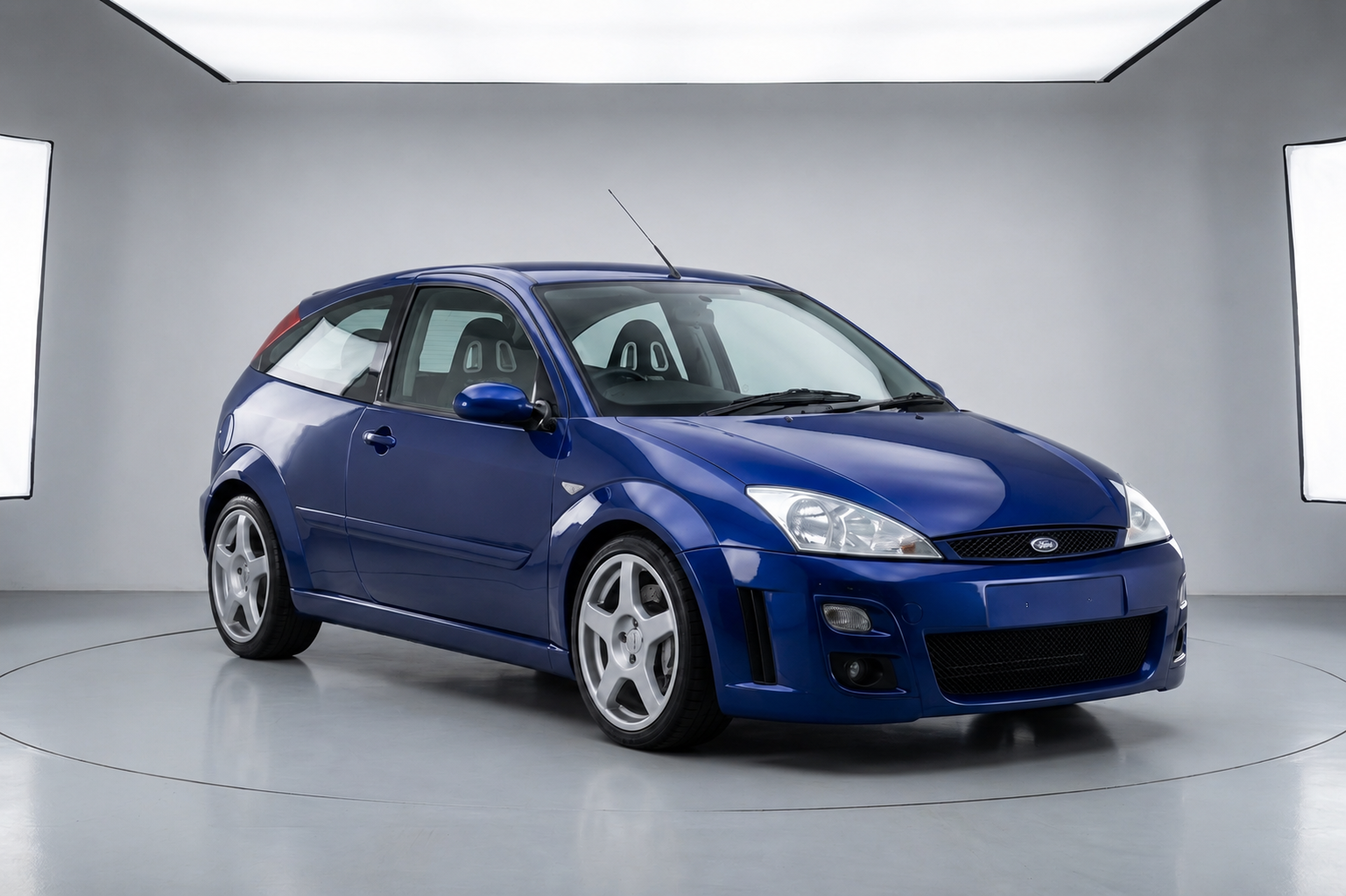
The road-car Focus RS across three distinct generations — 2002–2018 — from the 4,501-unit Mk1 to the 500-unit Mk2 RS500 and the final AWD Mk3 with its Drift Mode and 50-car UK Heritage Edition send-off.
The Focus RS is Ford Performance's road-car flagship on the Focus platform across three distinct generations. The Mk1 (2002–2003) was built in a strict run of 4,501 cars, Imperial Blue only, with a 2.0-litre Zetec-E turbocharged four at 212 bhp / 215 PS driving the front wheels through a Quaife ATB limited-slip differential. The Mk2 (2009–2011) shifted architecture entirely: a 2.5-litre Duratec turbocharged inline-five at 305 PS / 301 bhp, still front-wheel drive but with the RevoKnuckle front suspension geometry engineered to contain torque steer, offered in Ultimate Green, Performance Blue, Frozen White and Panther Black. Approximately 11,500 Mk2 cars were built across 2009–2011. Ford closed the Mk2 with the RS500 in 2010: 500 numbered cars, matte-black finish over Panther Black base paint, 350 PS / 345 bhp on a Cosworth-developed calibration with a larger intercooler and larger injectors — a subset within the 11,500 Mk2 total, not additional to it. The Mk3 (2016–2018) went global and all-wheel drive — a 2.3-litre EcoBoost four (shared block architecture with the Mustang EcoBoost) at 350 PS / 345 bhp, GKN twinclutch rear torque-vectoring axle and a driver-selectable Drift Mode — and closed the model with late-run Red Edition and Blue Edition variants and the final 50-car UK-market Heritage Edition. As the first Focus RS sold in the United States and Canada, the Mk3 was built in far greater volume than the Europe-only Mk1 and Mk2; Ford has not published a definitive global total but the figure is well above both earlier generations combined, making the Mk3 by a wide margin the highest-volume and least-rare generation. Across the three generations the Mk1 and Mk2 are the low-volume propositions, and the RS500 and UK Heritage Edition are the numbered-plaque collector variants at the top of the model.
The Focus RS matters as the definitive statement of Ford Performance's fast-hatch programme on the Focus platform, and because each generation solved the fast-hatchback problem from a completely different architectural direction. The Mk1 in 2002 re-established the RS badge in Europe after a fifteen-year hiatus with a strictly homologated 4,501-car run — a three-door front-driver with a Quaife ATB differential and deep chassis rework — and its build integrity and Imperial-Blue-only livery make it the collectable Mk1 fast-Ford of its era. The Mk2 in 2009 answered with a 305 PS turbocharged inline-five (a Volvo-derived Duratec) and Ford's RevoKnuckle geometry to contain torque steer at the driven axle; the Mk2 RS500 that closed the run in 2010 is the strict 500-unit collector object at the top of the road-car RS programme, with a Cosworth-developed calibration and its own hardware bill of materials — a subset within the ~11,500 Mk2 total, not additional to it. The Mk3 in 2016 went AWD with a GKN twinclutch rear axle, Drift Mode and 350 PS from a 2.3-litre EcoBoost, added the United States and Canada to the RS badge for the first time as a global production car, and closed with the 50-car UK Heritage Edition marking the end of the Focus RS badge as Ford consolidated its European small-car range. Three fast-hatch architectures — turbo four FWD, turbo five FWD, turbo four AWD — under one badge across sixteen years, with the Mk1 and Mk2 the low-volume propositions, the Mk3 by a wide margin the highest-volume generation on the strength of its global reach, and the RS500 and Heritage Edition as the numbered-plaque collector variants at the top. That is what makes the model matter.
Variants
Range and production
Variant
Years
Production
Notes
Mk1 Focus RS
2002–2003
4,501
Strict production run of 4,501 cars, Imperial Blue only, three-door only. 2.0-litre Zetec-E four with Garrett GT2560LS turbocharger at 212 bhp / 215 PS and 310 Nm, five-speed manual, Quaife ATB helical limited-slip differential, uprated front brakes with Brembo four-pot calipers, OZ Racing five-spoke wheels and blistered front and rear arches. Built at Saarlouis, converted at the Ford SVT facility. Anchor of the Mk1 fast-Ford market.
Mk2 Focus RS
2009–2011
Approx. 11,500
2.5-litre Duratec turbocharged inline-five at 305 PS / 301 bhp and 440 Nm; six-speed manual; front-wheel drive with Quaife ATB limited-slip differential and RevoKnuckle front suspension. Catalogue colours: Ultimate Green, Performance Blue, Frozen White, Panther Black. Approximately 11,500 built for 2009–2011, including the 500-unit RS500.
Strict 500-unit run with numbered plaque (001/500 to 500/500) and matte-black wrap over Panther Black base paint. 350 PS / 345 bhp and 460 Nm on a Cosworth-developed calibration, with a larger intercooler, larger injectors and revised charge-air routing over the mainstream Mk2 RS. Six-speed manual only. RS500 numbered-plaque and Ford Motor Company build documentation are the definitive authentication axes — non-plaqued matte-wrapped Mk2 RS cars exist and are a documented market risk.
Mk3 Focus RS
2016–2018
Not separately recorded
2.3-litre EcoBoost turbocharged four at 350 PS / 345 bhp and 470 Nm; six-speed manual; all-wheel drive with torque-vectoring twin-clutch rear axle and driver-selectable Drift Mode. Five-door only. The first Focus RS sold globally, including the USA and Canada, and by a wide margin the highest-volume generation. Exact global production total not recorded. Early cars are subject to a documented head-gasket coolant-loss issue addressed under a Ford extended engine warranty programme; documented remediation strengthens any Mk3's paperwork.
Mk3 Focus RS Red Edition and Blue Edition — 2017–2018
2017–2018
Not separately recorded
Late-run Mk3 limited editions in Race Red and Nitrous Blue respectively, with contrast black roof, black bonnet-vent surround and specific interior trim. Combined production commonly cited at approximately 1,500 units across both editions, with common splits placing the Red at ~300 and the Blue at ~1,200 — splits differ by source and are treated as disputed. Distinct trim editions within the Mk3 catalogue; a step above the mainstream Mk3 in specification but closer to a trim level than a low-volume factory rarity under the CCI collector-variant bar.
Final 50 UK-registered Focus RS cars at the end of the Mk3 run, marking the end of the Focus RS badge. Deep Orange or Race Red paint with numbered interior plaque and unique trim; sources vary slightly on the exact allocation split within the 50 cars. Genuine low-volume factory limited edition — meets the CCI collector-variant bar and is treated as such in this guide.
Focus RS WRC (competition car) — not a road-car RS variant
1999–2010
Not separately recorded
The Focus WRC was a bespoke competition car built under WRC regulations, not a road-going homologation variant of the Focus RS road car. Included here only to distinguish from the road-car RS programme; not a variant of the road-car Focus RS and not a collector variant of this model.
Buyer's Guide
What to look for
Identifying the generation and confirming the specification
Confirm the generation first — Mk1 (2002–2003 three-door in Imperial Blue only), Mk2 (2009–2011 three-door in Ultimate Green / Performance Blue / Frozen White / Panther Black), Mk2 RS500 (matte-black 2010 with numbered dash plaque), Mk3 (2016–2018 five-door in Nitrous Blue / Race Red / Frozen White / Shadow Black / Stealth Grey), Mk3 Red or Blue Edition (2017–2018 with contrast black roof) and Mk3 Heritage Edition (Deep Orange or Race Red 2018 with numbered interior plaque). Cross-check VIN, build plate and — on RS500 and Heritage Edition — numbered-plaque correspondence and Ford Motor Company build documentation before proceeding.
Mk1 — chassis integrity, front subframe and headlamp mounts
A significant portion of the 4,501 Mk1 cars were lost to accident, corrosion, modification or track use. Front subframe corrosion, headlamp-mount degradation, front chassis-leg rot around the subframe pickup points and rear arch corrosion are the standing structural service items. Verify absence of prior structural repair, filler or non-Ford panelwork; a genuine documented low-mileage Imperial Blue Mk1 with clean structural condition is a materially smaller subset than the headline production figure suggests.
Mk1 — engine, turbo and Quaife ATB
The Mk1 2.0 Zetec-E turbo is a robust engine but the Garrett turbocharger, intercooler pipework and boost-control solenoid all have age-related service points; low-mileage cars in particular can hide long-standing turbo-oil-feed and boost-solenoid issues. Verify Quaife ATB function via a low-speed lock-to-lock manoeuvre under load and confirm absence of clunking or LSD-related driveline noise. Modified maps and non-standard boost hardware are common on the Mk1 and any deviation from factory calibration is a paperwork and reversion item.
Mk2 — RevoKnuckle geometry, front tyres and torque steer
The Mk2's RevoKnuckle geometry engineers out much of the torque steer that would otherwise attend a 305 PS front-driver, but the price is a specific front-suspension bill of materials that must be inspected at PPI: RevoKnuckle bushings, drop links, ARB mounts, subframe bolts and wheel-bearing condition. Tyres must be matched and to specification — mismatched or budget front tyres on a Mk2 RS are a documented handling-degradation item and a diagnostic clue to prior owner discipline.
Mk2 — 2.5 Duratec I5 head bolts, coolant and turbocharger
The Mk2 2.5 turbo I5 has a documented head-bolt torque discipline requirement and coolant-system service history is the primary paperwork axis. Verify absence of head-gasket weep, coolant loss without external leak signature and any evidence of prior head-off work. The turbocharger, intercooler and charge-air pipework are all standing service items; documented turbo-service history on a high-mileage car is a positive paperwork item.
Mk2 RS500 — numbered plaque, calibration and non-plaqued conversions
The Mk2 RS500 is a strict 500-unit numbered run and its numbered dash plaque plus Ford Motor Company build documentation is the definitive authentication axis. Non-plaqued matte-wrapped Mk2 RS cars — cars that visually resemble an RS500 without the numbered plaque or build documentation — exist and are a documented market risk. On any car represented as an RS500, require the numbered plaque, the build documentation and, where available, the original delivery paperwork before proceeding. Verify the Cosworth-developed calibration is intact and the larger intercooler and larger injectors are in place at PPI.
Mk3 — head-gasket / coolant-loss issue and Ford extended warranty
Early Mk3 cars are subject to a documented head-gasket / coolant-loss issue that Ford addressed under an extended engine warranty programme in 2018–2020. Documented remediation under the Ford programme, or a documented replacement cylinder head or engine, is a positive paperwork item on any Mk3. A Mk3 with no documented remediation and no evidence of the issue must still be treated as a specific PPI item: pressure-test the cooling system, verify absence of exhaust gases in the coolant and confirm coolant chemistry at PPI. Any Mk3 with active coolant loss or intermittent overheating must be priced against a full head-off repair.
Mk3 — all-wheel-drive system, GKN rear axle and Drift Mode use
The GKN twinclutch rear axle is the enabling piece of hardware for the Mk3's Drift Mode. Verify absence of clutch-pack shudder, driveline noise or evidence of overheating (odour, discolouration around the housing) — a Mk3 that has been used heavily in Drift Mode on track without cooling breaks may show early clutch-pack wear. Confirm all AWD modes function correctly and diagnostic-scan for any stored AWD-controller codes at PPI.
Mk3 Heritage Edition — numbered plaque and end-of-run authentication
The final 50 UK-registered Mk3 Focus RS cars carry a numbered interior plaque and specific paint / trim specification. The numbered plaque, Ford Motor Company build documentation and — where available — the original UK dealer allocation paperwork are the definitive authentication axes. Verify plaque, paint code, trim specification and VIN correspondence before proceeding.
Modifications and reversion cost
The Focus RS is one of the most-modified fast-hatchback platforms of the modern era and modified cars are the majority of the market on every generation. Non-standard maps, non-standard intake, exhaust and turbo hardware, non-standard suspension and non-standard wheels are common. Reference cars are unmodified or fully reverted to factory specification with the removed original hardware present and documented. Verify factory calibration on the ECU, factory hardware in the engine bay and factory suspension / brake / wheel specification; if not present, price the car against reversion cost and against a documented factory-specification example.
Pre-purchase inspection — RS-experienced Ford specialist required
PPI must be conducted by a Ford Performance or RS-experienced independent specialist with direct Mk1 / Mk2 / Mk3 experience — not a generalist workshop and not a modern-Ford main-dealer without RS background. Insist on: cooling-system pressure test on Mk3 cars; head-bolt-history discussion on Mk2 cars; structural inspection on Mk1 cars; drivetrain and RS500- or Heritage-plaque authentication on the relevant limited-edition cars; and diagnostic scan on all generations.
Insurance, storage and event access
Mk1, Mk2 and mainstream Mk3 Focus RS cars underwrite as standard modern-classic performance-car risks with Hagerty or a comparable classic-policy carrier; the Mk2 RS500 and Mk3 Heritage Edition require higher-tier underwriting reflecting numbered-plaque provenance. Climate-controlled storage is the reference for any low-mileage RS500 or Heritage Edition. Event access includes Ford RS Owners Club events, RS-specialist track days, Silverstone / Goodwood cars-and-coffee circuits and manufacturer-supported Ford Performance events on the Mk3.
Ownership
Living with it
Typical mileage
3,000–7,000 miles / 4,800–11,300 km typical on a well-cared-for Focus RS; RS500 and Heritage Edition cars see materially lower annual mileage.
Service interval
Annual service with a Ford Performance or RS-experienced independent specialist; cooling-system inspection at the same interval on Mk3 cars.
Annual running cost
USD $1,500 – $4,000 typical for Mk1 and Mk2 cars in active use; USD $2,500 – $6,000 for Mk3 cars reflecting AWD service and cooling-system discipline; RS500 and Heritage Edition materially higher on a storage / specialist-only basis.
Fuel economy
~24–28 mpg (US) Mk1; ~20–24 mpg (US) Mk2; ~19–25 mpg (US) Mk3 depending on Drift Mode use and driving pattern.
Insurance
Standard modern-classic agreed-value cover through Hagerty or a comparable carrier for Mk1, Mk2 and mainstream Mk3; RS500 and Heritage Edition underwrite as higher-tier risks and numbered-plaque provenance materially affects agreed value.
Specialist service — RS-experienced independent Ford workshop is the reference
Route all major service through an RS-experienced independent Ford workshop or Ford Performance dealership. Generalist workshops without direct Focus RS experience are not the reference channel — particularly on Mk2 head-bolt discipline, Mk3 cooling-system discipline and Mk3 AWD service.
Mk3 cooling-system discipline
On any Mk3 the cooling system is the primary preventative-service surface. Continuous documented cooling-system service and documented Ford extended-warranty engine remediation (where applicable) is the reference paperwork chain and any gap is a distinct paperwork item at PPI and at sale.
Mk3 AWD service and Drift Mode discipline
The GKN twinclutch rear axle requires periodic fluid service and heavy Drift Mode use without cooling breaks accelerates clutch-pack wear. Documented AWD-fluid service and a moderate Drift Mode-use history are positive paperwork items.
Common Problems
Known issues by system
Mk3 — head gasket / cylinder-head coolant loss
Early Mk3 cars are subject to a documented head-gasket / coolant-loss issue that Ford addressed under an extended engine warranty programme in 2018–2020. Documented remediation, or a documented replacement cylinder head or engine, is a positive paperwork item; undocumented cars are a specific PPI risk.
MajorUSD $4,000 – $12,000+ for a specialist-level head-off repair including cylinder head; documented Ford warranty rectification is a nil-cost item on the specific work performed.
Symptoms — Coolant loss without external leak signature; sweet exhaust odour; occasional overheating warning; misfire codes stored; oily residue in coolant expansion tank.
Inspection — Cooling-system pressure test at PPI; exhaust-gas-in-coolant test; coolant chemistry test; documented service history review for Ford extended-warranty engine work.
The Mk2 2.5 turbo I5 has a documented head-bolt torque discipline requirement; head-gasket weep on high-mileage or non-specialist-serviced cars is a standing service item.
MajorUSD $3,500 – $8,000 for a specialist-level head-gasket rectification including uprated head bolts.
Symptoms — Coolant loss without external leak signature; head-gasket weep at the head-block interface; oil/coolant emulsion in filler cap.
Inspection — Cooling-system pressure test at PPI; documented service history review; specialist head-bolt torque and head-gasket discussion.
Mk1 — front subframe and headlamp-mount corrosion
Mk1 cars carry a documented structural corrosion signature at the front subframe pickup points, front chassis legs and headlamp mounts. A significant portion of the 4,501 Mk1 cars have been lost to structural corrosion, accident or modification.
MajorUSD $2,500 – $10,000+ for a specialist-level structural repair programme depending on extent.
Symptoms — Corrosion or filler at front subframe mounts; headlamp-mount degradation; chassis-leg rot around the subframe pickup points; rear-arch corrosion.
Inspection — Full underside inspection at PPI; front subframe visual and probe inspection; headlamp-mount inspection; documented restoration paperwork review.
Mk1 and Mk2 — turbocharger and intercooler service surface
Both the Mk1 Garrett and the Mk2 turbocharger have age-related service points; boost-control solenoids, intercooler pipework and turbo oil-feed lines are the standing items.
ModerateUSD $1,500 – $5,000 for a specialist-level turbo and boost-system refresh.
Symptoms — Boost-related engine warning codes; excessive turbo shaft play on inspection; intercooler pipework loose or oily; loss of full-boost power.
Inspection — Diagnostic scan at PPI; turbo shaft-play check; visual inspection of intercooler pipework and oil-feed lines; documented service history review.
Mk3 — GKN twinclutch rear axle wear from heavy Drift Mode use
The GKN twinclutch rear axle enables Drift Mode but heavy track use of Drift Mode without cooling breaks accelerates clutch-pack wear. Documented moderate Drift Mode use is a positive paperwork item; undocumented heavy-use cars are a specific PPI item.
ModerateUSD $2,500 – $7,000 for a specialist-level rear-axle clutch-pack rebuild.
Symptoms — Rear-axle clutch shudder on low-speed manoeuvres; driveline noise; odour or discolouration around the rear-axle housing; stored AWD-controller codes.
Inspection — Low-speed lock-to-lock manoeuvre at PPI; diagnostic scan for AWD-controller codes; visual inspection of rear-axle housing.
All generations — modified maps and non-standard hardware
Non-standard ECU maps, non-standard intake, exhaust and turbo hardware, non-standard suspension and non-standard wheels are common on all three generations. Reference cars are unmodified or fully reverted to factory specification with the removed original hardware present.
ModerateReversion cost varies materially by extent; specialist reversion to full factory specification runs USD $2,000 – $10,000+ depending on generation and modifications.
Symptoms — Non-factory ECU calibration on diagnostic scan; non-factory intake, intercooler or exhaust hardware visible; non-factory suspension or wheel specification; missing original hardware from previous modification programme.
Inspection — Diagnostic scan of ECU calibration at PPI; visual inspection of engine-bay hardware; suspension and wheel specification check; verification of removed-original-hardware presence.
Interior electronics and infotainment (Mk3)
Mk3 SYNC infotainment, Recaro shell-seat trim and interior electronics are standing service items on higher-mileage cars.
MinorUSD $300 – $2,000 per subsystem depending on component sourcing.
Symptoms — SYNC infotainment reboot loops or unresponsive touchscreen; Recaro shell-seat trim bolster wear; interior electronics intermittent function.
Inspection — Full function check of infotainment, seat trim and interior electronics at PPI.
Auctions
Recent results
Date
Auction
Car
Mileage
Result
2026-05-16
Iconic Auctioneers
The Iconic Sale at Supercar Fest
2002 Focus RS Mk1 (Lot 598)
—
£63,000
Sold
2026-02-21
Iconic Auctioneers
Race Retro
2018 Focus RS Mk3 (Lot 712)
—
£31,500
Sold
2025-11-08
Iconic Auctioneers
The Iconic Sale at the NEC
2010 Focus RS500 (Lot 299)
—
£84,375
Sold
2025-08-22
Iconic Auctioneers
The Iconic Sale at Silverstone Festival
2017 Focus RS Mk3 (Lot 461)
—
£35,437
Sold
2024-08-24
Iconic Auctioneers
Collectors' Car Sale at Silverstone Festival
2010 Focus RS500 (Lot 368)
—
£99,000
Sold
The Focus RS has an active auction footprint in the UK on Silverstone Auctions and Collecting Cars, on Bring a Trailer in the USA (predominantly for the Mk3, with 25-year-rule Mk1 exposure opening from 2027 onward), and across specialist RS dealers on private-treaty basis in the UK and Europe. The results above are cited as public-print reference bands rather than firm market anchors, and specific lot records at the named venues remain the standing reference for any confirmed transaction figure. Reference pricing on any specific Focus RS must be built from continuous RS-specialist service history, factory calibration, cooling-system service records (Mk2 and Mk3) and — on RS500 and Heritage Edition cars — numbered-plaque and Ford Motor Company build documentation, not from headline auction reporting alone.
Investment
Long-term outlook
Strong HoldHorizon: 10+ years
Three factors underwrite the Focus RS investment case. First, three distinct architectural generations under one badge (turbo four FWD Mk1; turbo five FWD Mk2; turbo four AWD Mk3), each now a modern-classic proposition in its own right — with the Mk1 (4,501 built) and Mk2 (~11,500 built) as the low-volume Europe-only propositions and the global-market Mk3 as by a wide margin the higher-volume, less-rare generation. Second, clean numbered-plaque provenance at the top: the Mk2 RS500 (strict 500-unit run, a subset within the ~11,500-car Mk2 total) and the Mk3 Heritage Edition (final 50 UK cars) are the two collector-variant anchors of the entire road-car RS programme, both authenticated by numbered plaque and Ford Motor Company build documentation. Third, condition scarcity: documented unmodified factory-calibration Focus RS cars with continuous specialist service history are a materially smaller subset of the surviving population than headline production figures suggest — the Mk1 in particular has lost a significant portion of its 4,501-car run to accident, corrosion and modification. Best holds: any matching-plaque Mk2 RS500 or Mk3 Heritage Edition; a documented low-mileage unmodified Imperial Blue Mk1 with clean structural condition; a Mk3 in Nitrous Blue with Recaro shell seats and documented Ford extended-warranty engine remediation. Watch items over the horizon: the pace at which the Mk1 25-year US import window (from 2027) draws inventory across the Atlantic and reprices UK/EU Mk1 stock; and the pace at which head-gasket-remediated Mk3s separate cleanly from unremediated cars on pricing.
Our view, not advice. This section is Car Collector International's editorial judgement on where this model sits in the collector market, based on the production, specification and market data set out in this guide. It is not a recommendation to buy or sell and it is not investment advice. Values can fall as well as rise.
Independent workshops with direct Focus RS experience across all three generations — RevoKnuckle service, Mk2 head-bolt discipline, Mk3 cooling-system and AWD service.
Silverstone Auctions / Collecting Cars / Bring a Trailer
Climate-controlled UK storage for Mk1, Mk2 and Mk3 Focus RS — turbocharged four-cylinder cars benefit from controlled humidity for underbonnet electronics and hoses.