
Car Collector International
Classic · 1966–1968

Lamborghini 400 GT

Touring-bodied, front-engined V12 Lamborghini — Sant'Agata's second production model and the founding chassis of the Islero–Jarama V12 GT line.

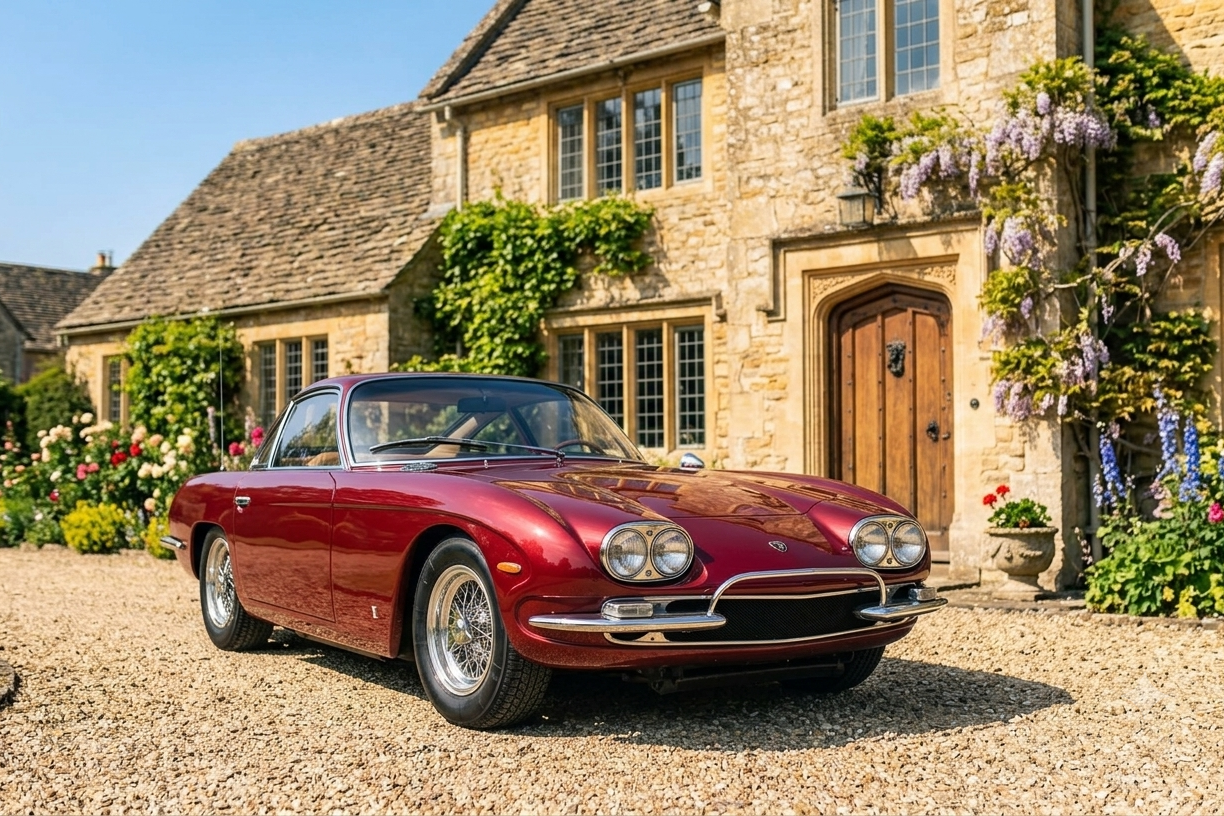
Lamborghini 400 GT, front three-quarter view — Touring-designed 1966–1968 front-engined V12 Sant'Agata grand tourer in dark burgundy, wire wheels and quad-headlamp nose set against a stone Cotswold country house.
Overview

Why this car matters

Introduced at the 1966 Geneva Auto Show and in production from 1966 to 1968, the Lamborghini 400 GT was Sant'Agata's second production model: a front-engined, Touring-bodied grand tourer powered by a 3,929 cc quad-cam V12 and driven through a Lamborghini-designed all-synchromesh five-speed gearbox. Only 247 were built across the two-year run — 23 short-shell 400 GT Interim cars carrying the new V12 in the 350 GT bodyshell, and 224 examples of the definitive 400 GT 2+2 with revised Touring bodywork and 2+2 seating.

The 400 GT is the founding front-engined V12 Lamborghini road car in its own right. It is the direct successor to the 350 GT, the direct predecessor of the Islero and the Jarama, and the first Sant'Agata model to combine the enlarged 3.9-litre V12 with a Lamborghini-designed all-synchromesh gearbox — the technical package that defined the marque's front-engined GT line into the 1970s. Rarer in absolute terms than any contemporary Ferrari 330 GT, hand-built in Touring aluminium-and-steel construction and produced only across a two-year window, a matching-numbers 400 GT 2+2 in an original factory colour is a marque-recognised entry point into an early Sant'Agata V12 GT for buyers priced out of Miura territory.

Variants

Range and production

VariantYearsProductionNotes
400 GT Interim (1966)196623Short-run transitional series: the outgoing 350 GT two-seater bodyshell fitted with the new 3,929 cc Lamborghini quad-cam V12 producing a nominal 320 bhp / ~324 PS at 6,500 rpm. 23 cars in total, of which 3 were built with factory aluminium bodywork — a genuine works-built rarity within the 400 GT name and treated as a collectorVariant here. Verify chassis history against a factory build record (Polo Storico) before any transaction; the Interim shares its shell with the 350 GT and paperwork clarity is the defining value item.
400 GT 2+2 (1966–1968)1966–1968224Definitive 400 GT: revised Touring bodywork with a raised beltline, larger side windows, a smaller rear windshield and 2+2 rear seating in place of the 350 GT's rear luggage bay. Same 3,929 cc quad-cam V12 as the Interim, now paired with a Lamborghini-designed five-speed gearbox with synchromesh on all gears — a distinct technical improvement over the ZF unit used in the 350 GT. Body construction was carried out by Carrozzeria Touring initially and then by Marazzi after Touring's 1967 bankruptcy, and the 224-car figure aligns with individual-listing prose across the surviving public secondary market. Some period references publish narrower per-year and per-colour splits at chassis level — any narrower claim must be verified against a factory build record before use as a market anchor.
Collector Variants

Limited & special editions

The models below represent the most significant limited and special edition variants — factory-produced cars that command meaningful premiums over standard examples and warrant specific attention from serious collectors.

400 GT Interim (1966) — 23 cars total, 3 with factory aluminium bodywork · 1966

23 total (3 with factory aluminium bodywork)
Distinguishing features
Short-run factory subseries at the very start of the 400 GT name: the outgoing 350 GT two-seater bodyshell fitted with the new 3,929 cc quad-cam V12 producing a nominal 320 hp. Three of the 23 Interims were completed with factory aluminium bodywork — the tightest rarity band inside the 400 GT model name.
Value premium
Trades in its own distinct rarity band above the matching-numbers 2+2 concours print; the three factory-aluminium Interims are negotiated as bespoke transactions rather than against comparable coupe prints.
Inspection points
Verify chassis and engine numbers against factory records via Lamborghini Polo Storico; on any car presented as one of the three aluminium-bodied Interims, obtain documented body-material verification (paint-depth-gauge readings, magnet testing panel-by-panel and a specialist coachwork inspection) before use as a market anchor.
Authentication
Interim status must be documented against a primary Lamborghini factory build record via Polo Storico. The aluminium-bodied subset must additionally be verified by direct panel-by-panel body-material inspection at a marque-recognised coachwork specialist — a steel-bodied Interim presented as one of the three aluminium cars is a material misrepresentation.

400 GT Monza (1966) — Neri and Bonacini one-off · 1966

1 (one-off, on 350 GT chassis 01030 fitted with a 400 GT V12)
Distinguishing features
One-off two-seater built by Giorgio Neri and Luciano Bonacini on 350 GT chassis 01030 and fitted with a 400 GT V12. Distinctive fastback bodywork with a long hood and Kamm tail, an integrated roll bar in the extremely thick C-pillar, a very low raked windshield and non-functional vent grilles behind the front wheels — commissioned in the period for racing use that homologation problems ultimately prevented.
Value premium
Sits outside the comparable-sales market for the standard 400 GT entirely; the last public print is the Bonhams London December 2005 sale at £177,500. Any current transaction is a bespoke negotiation against primary provenance rather than a comparable-sales exercise.
Inspection points
Full documented chassis-history reconstruction against Lamborghini factory records (350 GT chassis 01030), Neri and Bonacini shop paperwork and the Bonhams December 2005 catalogue entry. Structural inspection of the aluminium bodyshell and integrated C-pillar roll structure at a marque-recognised coachwork specialist.
Authentication
Only chassis 01030 is the genuine Monza. Any car presented as a Monza-derivative or Monza-tribute is by definition NOT the one-off Monza and must be treated as an aftermarket special.

400 GT Flying Star II (1966) — Carrozzeria Touring one-off show car · 1966

1 (one-off show car on a shortened 400 GT chassis)
Distinguishing features
One-off shooting-brake-style show car built by Carrozzeria Touring on a shortened 400 GT chassis and displayed at the 1966 Turin Motor Show. A factory-era, coachbuilt one-off by the same house that designed the standard 400 GT bodywork, with a distinctive glassed rear roof section and lightweight aluminium construction.
Value premium
Sits outside the comparable-sales market for standard 400 GT coupes entirely; any current transaction is a bespoke negotiation against documented show-car provenance and coachbuilding history rather than a comparable-sales exercise.
Inspection points
Full documented chassis-history reconstruction against Lamborghini factory records and Carrozzeria Touring paperwork; structural inspection of the aluminium bodyshell and glassed rear roof section at a marque-recognised coachwork specialist.
Authentication
Only the original 1966 Turin Motor Show Carrozzeria Touring car on the shortened 400 GT chassis is the genuine Flying Star II. Any later tribute or recreation is by definition not the factory-era one-off.

Production figures sourced from official marque records and specialist registers. Verify chassis documentation with the relevant marque register before purchase.

Buyer's Guide

What to look for

Matching-numbers V12 and correct body specification for the chassis

The single most important structural check on any 400 GT is whether it retains its original, matching-numbers 3,929 cc Lamborghini quad-cam V12 and whether the body specification (Interim two-seater shell vs. definitive 2+2) matches the chassis history on the factory build record. Cross-check the engine number against the chassis via Lamborghini Polo Storico. A 400 GT 2+2 chassis fitted with a later Islero or Jarama V12 sits at a distinct market discount to a matching-numbers original — the higher band on any 400 GT is anchored on the original correct-specification V12, not the chassis alone.

Touring / Marazzi bodyshell condition and coachwork paperwork

The 400 GT was body-completed by Touring for the first cars of the 2+2 run and by Marazzi from 1967 onward, and the Interim cars share their shell with the 350 GT. All three body configurations are hand-built by 1960s Italian coachbuilding standards — priority inspection points are the rear valance, sills, floor pans (particularly at the driver's footwell), the front and rear inner wheel-arches, the front-boot compartment floor and the doorframe seams. Any weld work or panel replacement must be paperwork-supported by a marque-recognised specialist. On any Interim, the distinction between the three factory-aluminium cars and the twenty steel-bodied cars is a material provenance question and must be verified from primary factory records.

Lamborghini-designed all-synchro gearbox (2+2) vs. ZF gearbox (Interim)

The definitive 400 GT 2+2 introduced Lamborghini's own five-speed all-synchromesh gearbox, replacing the ZF unit used in the 350 GT and carried over into the 400 GT Interim. The all-synchro Lamborghini box is the model's most-cited technical improvement and its condition is a distinct value item — inspect synchro engagement (particularly 2nd and 3rd), shift-linkage wear, gearbox oil weep and clutch bite-point on any 2+2. A non-original replacement gearbox is a paperwork item that materially affects the top of the market band.

V12 service history — six Weber sidedraft carburettors and quad-cam top end

The 3,929 cc quad-cam V12 is a technically demanding engine to keep in specification. It runs six Weber sidedraft carburettors, requires balanced and correctly-jetted carburettor setup, and the quad-cam top end is intolerant of deferred cam-cover, valve-clearance and timing-chain service. Any 400 GT without a documented recent V12 service history at a marque specialist should be inspected on the assumption that a full top-end service and carburettor rebalance is required before regular use. Compression and leak-down testing across all twelve cylinders is a non-negotiable PPI item.

Interior originality — Touring cabin, seats, dashboard, gauges

Original correct interior specification is a distinct value item. Retrimmed seats, replacement dashboards, non-original steering wheels and replacement instrument clusters are common on cars that have been through multiple owners, and materially downgrade a matching-numbers car. Verify original trim specification against Polo Storico documentation where possible; inspect the piping, door cards and instrument-cluster faces against factory specification.

Pre-purchase inspection at an early-Lamborghini specialist

PPI must be conducted by a reputable marque-recognised early-Lamborghini specialist — Lamborghini Polo Storico (Sant'Agata), Colin Clarke Engineering (UK), Emblem Sports Cars (UK), Kessler Automotive (Germany) or a comparable West Coast US specialist (Symbolic International, Canepa). Insist on: full compression / leak-down test on the V12, borescope inspection of the cylinder heads and cam housings, a complete underbody survey on a two-post lift, paint-depth-gauge readings across every panel, verification of chassis and engine numbers against factory records via Polo Storico, and a documented review of the V12 top-end service history.

Insurance, storage and event access

A matching-numbers 400 GT is a natural agreed-value classic-policy car with Hagerty, Chubb Masterpiece or a comparable HNW carrier. Museum-grade climate-controlled storage is the standing reference. Event access includes Lamborghini Club events (marque and regional), Concorso Italiano at Monterey, the Lamborghini & Design Concorso, Villa d'Este classes for 1960s Italian coachwork, and Polo Storico-recognised concours entries at Sant'Agata heritage weekends.

Pricing

What to pay

Concours — matching-numbers 400 GT 2+2 in an original factory colour with Polo Storico documentation, single-marque ownership chain and unmolested Touring bodyshell
USDUSD $450,000 – $650,000+ private-treaty / auction basis. Anchored above the standing USD $483,000 public sold print for a matching-numbers 2+2 in its original factory Grigio Saint Vincent / Tobacco colour combination.
GBPGBP £360,000 – £520,000 dealer-listed basis at UK early-Lamborghini specialists. Authored independently per region — NOT FX-converted; anchored on typical UK dealer asking prices for concours 400 GT 2+2 examples at review date.
EUREUR €430,000 – €620,000 dealer-listed basis at continental European early-Lamborghini specialists. Authored independently per region — NOT FX-converted; anchored on typical continental European dealer asking prices for concours 400 GT 2+2 examples at review date.
Basis: authored independently per region — NOT FX-converted. Top of the market is a matching-numbers 400 GT 2+2 in a factory colour with Polo Storico documentation, an unmolested Touring bodyshell, correct interior and single-marque ownership chain. A matching-numbers 400 GT Interim — and in particular one of the three factory-aluminium Interim cars — trades in its own distinct rarity band and is negotiated as a bespoke transaction rather than a comparable-sales exercise.
Excellent — matching-numbers 400 GT 2+2, running and driving, cosmetically presentable
USDUSD $340,000 – $460,000 private-treaty / auction basis. Anchored on the standing USD $368,000 and USD $450,000 sold prints and the USD $422,000 reserve-not-met bid for cosmetically-presentable, refurbished 2+2 examples.
GBPGBP £275,000 – £370,000 dealer-listed basis. Authored independently per region — NOT FX-converted.
EUREUR €325,000 – €440,000 dealer-listed basis. Authored independently per region — NOT FX-converted.
Basis: authored independently per region — NOT FX-converted. The volume band for a genuinely useable, correctly-configured 400 GT 2+2. Specific price is a function of engine originality, paint / trim condition and documentation depth.
Good — driver-quality 400 GT 2+2 with cosmetic needs, minor non-original changes, or long-term-stored condition
USDUSD $260,000 – $340,000 private-treaty / auction basis. Anchored on the standing USD $285,000 sold print for a chassis-01012 long-term-stored project and the USD $295,000 reserve-not-met bid for a refurbished 1966 2+2.
GBPGBP £210,000 – £275,000 dealer-listed basis. Authored independently per region — NOT FX-converted.
EUREUR €250,000 – €325,000 dealer-listed basis. Authored independently per region — NOT FX-converted.
Basis: authored independently per region — NOT FX-converted. Sensible entry point for a running-driving 400 GT 2+2 that will nonetheless require sympathetic recommissioning and near-term V12 top-end service at a marque specialist.
Fair / Project — long-term-stored or partly-restored 400 GT requiring full recommissioning, incomplete paperwork, or non-matching engine
USDUSD $150,000 – $260,000 private-treaty / auction basis. Projects with a matching-numbers V12 sit at the top of the band; projects with a non-matching engine or major paperwork gaps sit at the bottom.
GBPGBP £120,000 – £210,000 auction / private-treaty basis. Authored independently per region — NOT FX-converted.
EUREUR €140,000 – €250,000 auction / private-treaty basis. Authored independently per region — NOT FX-converted.
Basis: authored independently per region — NOT FX-converted. Any 400 GT in this band should be priced against a documented recommissioning budget from a marque-recognised specialist — a full V12 top-end refresh plus body-and-paint restoration will typically consume the entire excellent-band premium.

Regional ranges authored independently — each reflects its local market, not an FX conversion

Ownership

Living with it

Typical mileage
1,000–3,000 miles / 1,500–5,000 km typical — the 400 GT is a genuinely useable early Sant'Agata GT and rewards regular use, but real-world touring mileage is constrained by the V12 top-end service regime.
Service interval
Annual service at a marque-recognised early-Lamborghini specialist. Six-Weber carburettor rebalance, valve-clearance check and cam-cover inspection are the standing recurring items; a full V12 top-end service is a periodic non-negotiable at extended calendar intervals even at low mileage.
Annual running cost
USD $6,000 – $15,000+ typical annual budget — dominated by specialist labour, V12 top-end reserve and any bodywork or paint rectification. Cars used at classic-touring or concours events widen the annual budget.
Fuel economy
~11–14 mpg (US) / ~13–17 mpg (imp) / ~17–21 L/100 km on real-world use.
Insurance
Agreed-value classic-policy cover through Hagerty, Chubb Masterpiece or a comparable HNW carrier is the standing channel; annual policies for a matching-numbers 400 GT are typically low- to mid-four-figure.

Early-Lamborghini specialist network — the standing reference

Route all major work through a marque-recognised early-Sant'Agata specialist (Lamborghini Polo Storico at Sant'Agata, Colin Clarke Engineering, Emblem Sports Cars, Kessler Automotive, Symbolic International, Canepa, or an equivalent regional Italian-GT workshop). Independent generalist workshops are not the reference for a matching-numbers 400 GT.

Polo Storico documentation

For any car being bought or sold above the driver-quality band, Lamborghini Polo Storico at Sant'Agata is the standing marque-heritage channel for factory-build-record confirmation, chassis-and-engine number verification and heritage certification.

V12 top-end service reserve — build into the annual running-cost budget

The quad-cam V12 top-end service is the defining scheduled item on any 400 GT. Build a top-end service reserve into the annual running-cost budget rather than treat it as a one-off event.

Common Problems

Known issues by system

V12 top-end service — six Weber carburettors and quad-cam valve train

The 3,929 cc quad-cam V12 is technically demanding to keep in specification. Deferred top-end service, carburettor imbalance and quad-cam valve-clearance drift are the defining preventable failure modes on the model.

CriticalUSD $8,000 – $25,000+ for a full V12 top-end service and carburettor rebuild at a marque specialist.
Symptoms — Uneven idle when warm, cold-start hesitation, exhaust-note imbalance across cylinder banks, oil weep from the cam covers, low compression on individual cylinders.
Inspection — Documented V12 top-end service history at a marque specialist; full compression and leak-down test across all twelve cylinders at PPI; carburettor-balance and jetting inspection.
Bodyshell corrosion — Touring / Marazzi 1960s coachwork condition

The 400 GT is a hand-built 1960s Italian coachwork car without full modern rustproofing. Priority hotspots are the sills, floor pans, front-boot floor, inner wheel-arches, doorframe seams and rear valance.

CriticalUSD $20,000 – $80,000+ for correctly-executed panel and structural work at a marque-recognised specialist. A full concours-standard shell restoration can exceed the market value of a driver-quality car.
Symptoms — Bubbling paint at sill / A-pillar / rear arch; weld splatter or thick underseal on the inner longitudinals; evidence of repaint at the front-boot floor or engine-bay bulkhead; uneven panel gaps.
Inspection — Full underbody survey on a two-post lift; paint-depth-gauge readings across every panel; borescope inspection of the inner longitudinals; verification of any prior weld or panel work against paperwork from a marque-recognised specialist.
Matching-numbers V12 — replacement engines and cross-model swaps

A material proportion of the surviving 400 GT population has been fitted with a non-original engine at some point in its ownership chain, either from period replacement V12s or from later Islero / Jarama donor engines. None carry the matching-numbers premium of an original correct-spec V12.

MajorUSD $30,000 – $90,000+ for a full V12 rebuild at a marque specialist. Sourcing a correct matching-numbers replacement V12 is a distinct and material market exercise.
Symptoms — Engine number does not match the Polo Storico entry; incorrect carburettor specification for the stated variant; block casting date incompatible with the chassis build date.
Inspection — Cross-check the engine number against Lamborghini Polo Storico; verify block casting date against the chassis build date; verify correct carburettor specification.
Gearbox — Lamborghini all-synchro (2+2) vs. ZF (Interim); synchro wear

The definitive 400 GT 2+2 uses Lamborghini's own all-synchromesh five-speed; the Interim retains the earlier ZF unit. Synchro engagement (particularly 2nd and 3rd) is a distinct value item on either box.

ModerateUSD $6,000 – $18,000 for a full gearbox rebuild at a marque specialist.
Symptoms — Notchy or baulky 2nd / 3rd engagement, shift-linkage slop, transmission oil weep, non-original replacement gearbox referenced in the paperwork.
Inspection — Full gearbox inspection at PPI; verify original gearbox against Polo Storico documentation; inspect synchro engagement across all gears from cold.
Electrical system — 1960s Italian wiring loom, corrosion at connector blocks

The 400 GT's 1960s Italian wiring loom is well-documented as an intermittent-fault source. Corrosion at connector blocks (behind the dashboard, at the headlamp bowls and at the engine-bay bulkhead) is common on cars that have been long-term-stored.

ModerateUSD $3,000 – $10,000 for a full loom recondition or partial rewire at a marque specialist.
Symptoms — Intermittent headlamp operation, dashboard-instrument fluttering, gauges falling in and out of calibration, non-functional accessory circuits.
Inspection — Full electrical inspection at a marque specialist; inspection of connector blocks for corrosion; verification of instrument-cluster function against the original factory schematic.
Interior originality — Touring cabin, seats, dashboard, gauges

Original correct interior specification is a distinct value item. Retrimmed seats, replacement dashboards and non-original steering wheels are common on cars that have been through multiple owners and materially downgrade a matching-numbers car.

MinorUSD $6,000 – $20,000 for correct-specification interior sourcing and refit at a marque specialist.
Symptoms — Non-original seats or seat piping, non-original steering wheel, retrimmed dashboard, non-original door cards, replacement instrument cluster.
Inspection — Verify original trim specification against Polo Storico data; inspect seat piping, door-card grain and dashboard trim against factory specification.
Valuation

Current value bands by region

Concours
USD
USD $450,000 – $650,000+ (matching-numbers 2+2, factory colour, Polo Storico)
GBP
GBP £360,000 – £520,000
EUR
EUR €430,000 – €620,000
+4% 12-mo
Excellent
USD
USD $340,000 – $460,000 (matching-numbers 2+2, running, presentable)
GBP
GBP £275,000 – £370,000
EUR
EUR €325,000 – €440,000
+3% 12-mo
Good
USD
USD $260,000 – $340,000 (driver-quality, cosmetic needs, service due)
GBP
GBP £210,000 – £275,000
EUR
EUR €250,000 – €325,000
0% 12-mo
Fair
USD
USD $180,000 – $260,000 (non-matching engine or paperwork gaps)
GBP
GBP £145,000 – £210,000
EUR
EUR €170,000 – €250,000
0% 12-mo
Project
USD
USD $120,000 – $200,000 (long-term-stored, recommissioning case-by-case)
GBP
GBP £95,000 – £160,000
EUR
EUR €110,000 – €190,000
0% 12-mo

Each region quoted in its local currency — independent market readings, not FX conversions

The 400 GT sits in a distinct sub-band of the early Sant'Agata V12 market: rarer in absolute terms than the 350 GT (247 vs. 120 built), technically more developed than the 350 GT thanks to the larger 3.9-litre V12 and Lamborghini's own all-synchro gearbox on the 2+2, and the direct predecessor of the Islero and Jarama. Public secondary-market prints for matching-numbers 400 GT 2+2 examples have clustered in the USD $360,000–$485,000 band across the past five to seven years, with a standing USD $483,000 top print for a matching-numbers 2+2 in its original Grigio Saint Vincent / Tobacco factory colour combination and multiple further lots closing between USD $368,000 and USD $450,000. Reserve-not-met results at USD $295,000 and USD $422,000 confirm the market remains reserve-sensitive at the top of the excellent band. Practical market read: a matching-numbers 400 GT 2+2 in an original factory colour with Polo Storico documentation is the collector target; a matching-numbers 400 GT Interim, and in particular one of the three factory-aluminium Interims, sits in its own distinct rarity band negotiated as a bespoke transaction rather than against comparable coupe prints; and the 400 GT Monza one-off is a distinct one-of-one asset outside the comparable-sales market entirely.

Auctions

Recent results

DateAuctionCarMileageResult
2021-02-17
Bring a Trailer
Online auction — bringatrailer.com/listing/1968-lamborghini-400gt/
1968 Lamborghini 400 GT 2+2 (matching-numbers, Grigio Saint Vincent over Tobacco, ex-Rombauer Vineyard Collection)
Matching-numbers 3,929 cc quad-cam V12 with six Weber sidedraft carburettors, presented in the original factory Grigio Saint Vincent over Tobacco colour combination and previously part of the Rombauer Vineyard Collection. Standing top-of-market public print for a matching-numbers 400 GT 2+2 in an original factory colour.
USD $483,000
Sold
2022-07-18
Bring a Trailer
Online auction
1967 Lamborghini 400 GT 2+2 (chassis 0760, silver over tan leather, 2021 repaint)
One of approximately 224 2+2 coupes built across the two-year run. Repainted in 2021 by the previous owner ahead of sale.
USD $450,000
Sold
2023-04-14
Bring a Trailer
Online auction
1967 Lamborghini 400 GT 2+2 (chassis 0472, red over black leather, refurbished with V12 overhaul and overbore)
High-bid reserve-not-met result — cited here as market evidence, not as a completed transaction.
USD $422,000
Bid To
2024-10-09
Bring a Trailer
Online auction
1967 Lamborghini 400 GT 2+2 'Project' (chassis 01012, approx. 40 years dry storage in California)
Long-term-storage project car (approximately 40 years dry-storage in California). Anchors the top of the CCI 'Good' driver-quality band for a matching-numbers project 2+2.
USD $285,000
Sold
2024-12-12
Bring a Trailer
Online auction
1966 Lamborghini 400 GT 2+2 (#76 of approximately 247, metallic green over black, multi-year refurbishment completed 2020)
High-bid reserve-not-met result on a multi-year refurbishment completed in 2020 — cited here as market evidence, not as a completed transaction.
USD $295,000
Bid To
2019-09-18
Bring a Trailer
Online auction
1968 Lamborghini 400 GT 2+2 (production #244 of 247, Grigio Saint Vincent over Tobacco — within the final 10 examples produced)
Matching-numbers late-production car in its original Grigio Saint Vincent over Tobacco colour combination — one of the final 10 examples completed before the model was replaced by the Islero.
USD $368,000
Sold
2026-05-06
Bring a Trailer
Online auction
1967 Lamborghini 400 GT — aftermarket Spider Conversion (chassis 0877, Newport Specialty-executed conversion of a standard coupe)
Aftermarket Spider Conversion of a standard 400 GT coupe (chassis 0877), executed by Newport Specialty. This is NOT a factory-built variant and is cited here for completeness rather than as a comparable anchor for factory coupes.
USD $250,000
Sold

Results above are drawn from independently-checked public sales on Bring a Trailer's Lamborghini 350 GT & 400 GT model page. RM Sotheby's, Gooding & Company, Bonhams and Broad Arrow individual 400 GT lot pages have not been independently re-checked at review date — any specific hammer print at those houses should be confirmed against the specific lot page before use as a market anchor.

Investment

Long-term outlook

Strong HoldHorizon: 10+ years

Three factors underwrite the 400 GT investment case. First, finite supply against a full-model-run production of just 247 cars across the 1966–1968 window, with a still-smaller matching-numbers 2+2 survivor pool against the 224-car total and a 23-car 400 GT Interim subset in which just three cars carried factory aluminium bodywork. Second, the 400 GT is the founding correct-specification front-engined V12 Lamborghini road car — the direct successor to the 350 GT, the direct predecessor of the Islero and the Jarama, and the first Sant'Agata car with the marque's own all-synchromesh gearbox — a marque-heritage position the broader market has only partially priced in relative to Ferrari 330 GT and 365 GT contemporaries. Third, the top of the 400 GT 2+2 market has consolidated in the USD $360,000–$485,000 band across multiple public prints, providing a stable pricing floor for matching-numbers examples with Polo Storico documentation. Best hold: a matching-numbers 400 GT 2+2 in a documented factory colour with a Polo Storico entry, single-marque ownership chain, unmolested Touring / Marazzi bodyshell and complete tool roll. Watch items over the horizon: whether the standing USD $483,000 top print is exceeded by a matching-numbers concours 2+2 in the next 24–36 months, and whether one of the three factory-aluminium Interim cars appears at auction in that window — a print for either would reprice the entire matching-numbers 2+2 band.

Recommended

The trusted network

Specialists

  • Lamborghini Polo Storico
    View →
    Sant'Agata Bolognese, Italy
    Lamborghini's factory heritage division — the standing marque-heritage channel for 400 GT factory-build-record confirmation, chassis-and-engine number verification and heritage certification.
  • Colin Clarke Engineering
    View →
    UK
    UK Lamborghini and early-Sant'Agata specialist appropriate to 400 GT service, restoration and PPI work.
  • Emblem Sports Cars
    View →
    UK
    UK 1960s / 1970s Italian-GT specialist appropriate to 400 GT private-treaty transactions, PPI and mechanical service.
  • Kessler Automotive
    View →
    Germany
    Continental European Lamborghini specialist appropriate to 400 GT restoration, service and European private-treaty transactions.
  • Symbolic International
    View →
    La Jolla, California, USA
    US supercar dealer with a long-standing 1960s Italian V12 GT reference book; appropriate to 400 GT private-treaty transactions in the US market.
  • Canepa
    View →
    Scotts Valley, California, USA
    US collector-supercar workshop and dealer; appropriate to 400 GT mechanical restoration, service and PPI work on the US West Coast.
  • Bring a Trailer
    View →
    USA / International
    Standing US secondary-market auction platform for the 400 GT — see the recent auction results above for representative recent prints.
  • RM Sotheby's / Gooding & Company / Bonhams / Broad Arrow Auctions
    View →
    International
    Reference international auction houses appropriate to a top-condition matching-numbers 400 GT 2+2 or a documented 400 GT Interim.
  • Hagerty
    View →
    USA / UK / EU
    Agreed-value cover for 1960s Lamborghini V12 grand tourers.
  • Chubb Masterpiece
    View →
    USA / International
    HNW carrier familiar with early Sant'Agata V12 GT risks in a broader collection context.

Storage

  • Windrush Car Storage
    View →
    London / Cotswolds, UK
    Climate-controlled UK storage appropriate to a 1960s front-engined V12 Sant'Agata GT.
  • Autobahn Indoor Storage
    View →
    Chicago / Dallas / West Palm Beach, USA
    Climate-controlled US collector-car storage appropriate to a matching-numbers 1966–1968 Lamborghini 400 GT.

Transport

  • CARS UK
    View →
    UK / EU
    Enclosed European transport for early Lamborghini GTs.
  • Reliable Carriers
    View →
    USA (nationwide)
    Enclosed collector-car transport — standing US reference carrier for 1960s Italian V12 GTs.

Enjoyed this guide?

Get new buyer's guides and collector market intelligence delivered to your inbox. No spam. We respect your inbox.

The valuation figures in this guide are for research purposes only and do not constitute financial or investment advice. See our full disclaimer.