
Car Collector International
Classic · 1972–1979

Lamborghini Urraco

Gandini's mid-engined V8 Lamborghini 2+2 — the Sant'Agata answer to the Dino, and the founding chassis of the Silhouette / Jalpa V8 line.

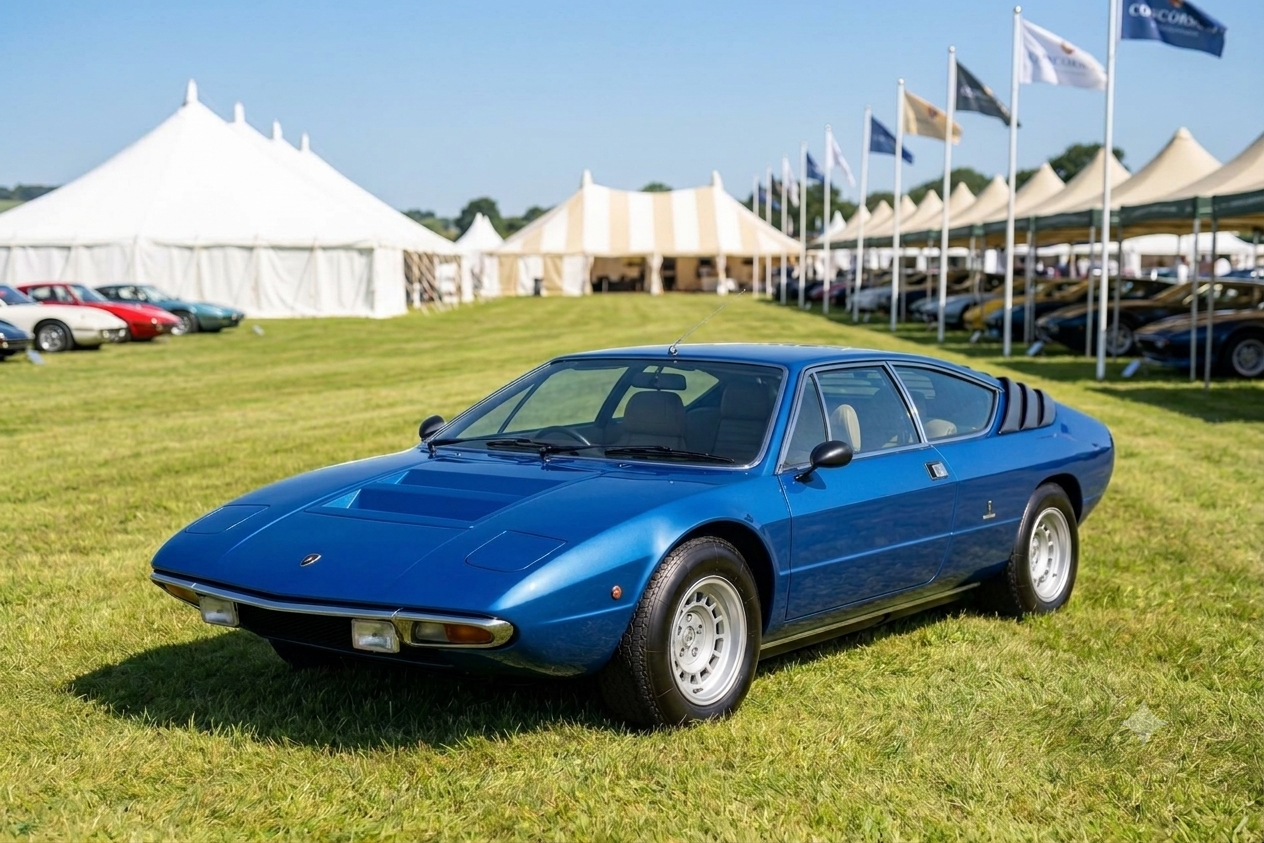
Lamborghini Urraco, front three-quarter view at a UK concours — Gandini-designed, Bertone-bodied 1972–1979 mid-engined Lamborghini V8 2+2 in metallic blue, with the correct Campagnolo alloy wheels, factory louvred rear-quarter panels and the flush pop-up-headlamp nose.
Overview

Why this car matters

Introduced as a prototype at the 1970 Turin Auto Show and in production from 1972 to 1979, the Lamborghini Urraco was Sant'Agata's answer to the Ferrari Dino, Maserati Merak and Porsche 911 — a Gandini-designed, Bertone-bodied 2+2 with a transverse mid-mounted Lamborghini V8, a five-speed transaxle and pop-up headlamps. Only 791 were built across three engine specifications (P200, P250 and P300) before production ceased in 1979, making it the founding chassis of the Sant'Agata V8 line that continued through the Silhouette and the Jalpa.

The Urraco is the origin story of Lamborghini's V8 sports-car line. Rarer than the contemporary Ferrari Dino / GT4 in absolute production terms, styled by Marcello Gandini in his Bertone prime, and — in P300 DOHC form — the most powerful of the small-block Sant'Agata cars, it is the marque-recognised entry point into a mid-engined Lamborghini for buyers priced out of Miura and Countach territory. Best long-term hold: a P300 DOHC in a documented factory colour with matching-numbers V8, unmolested Bertone bodyshell, complete tool roll, original Campagnolo wheels and a documented single-marque ownership chain.

Variants

Range and production

VariantYearsProductionNotes
Urraco P250 / P250S (1972–1976)1972–1976520Launch specification and the volume Urraco. 2,463 cc SOHC Lamborghini V8 producing 217 bhp / 220 PS at 7,500 rpm, with 520 units built across the full P250 run — the widely-cited figure across period references and independent marque histories alike. Revised as the P250S in 1973 with full leather upholstery, tinted power windows, optional metallic paint and Weber 40 DCNF carburettors on non-emissions-controlled cars.
Urraco P111 (P250 Tipo 111, US-market subseries)1975 model year (US market)21US-market regulatory-compliance subseries of the P250, with 21 units built to comply with US federal safety and emissions standards. The P111 carries larger front bumpers and emissions-control equipment, and produces a reduced output relative to the European P250 — the specific US-market power figure is not firmly anchored in the public record.
Urraco P200 (Italian home-market entry engine)1975–197766Italian home-market variant with a 1,994 cc SOHC Lamborghini V8 producing 180 bhp / 182 PS at 7,500 rpm. The 2-litre displacement existed to sit below the Italian market's period 38% VAT threshold on cars over 2 litres — a tax-driven engineering variant, not a poor spec. Approximately 66 P200 units were built; some published sources quote 77.
Urraco P300 (DOHC, 1974–1979)1974–1979205The top-of-line Urraco and the most collectable of the family. 2,996 cc DOHC 16-valve Lamborghini V8 with chain-driven camshafts and a revised cylinder head, producing ~247–265 bhp / 250 PS depending on the source (265 Nm / 195 lb-ft of torque at 3,500 rpm), 0–100 km/h in 5.6 seconds and 260 km/h (162 mph) flat out. Approximately 205 P300 units were built; some published sources quote 190. Either way, the P300 is the technically most-developed Urraco and the collector-target chassis.
Buyer's Guide

What to look for

Matching-numbers V8 and correct engine specification for the chassis

The single most important structural check on any Urraco is whether it retains its original, matching-numbers Lamborghini V8 in the correct specification for the chassis (P200 1,994 cc SOHC, P250 2,463 cc SOHC, or P300 2,996 cc DOHC). Cross-engine swaps between P250 and P300 do exist in the market and are a material paperwork item. Cross-check the engine number against the factory build record via the marque registry and, where possible, a Polo Storico heritage confirmation. Watch specifically for a P250 SOHC engine fitted to a chassis originally supplied as a P300 DOHC — the P300's higher market band is anchored on the DOHC engine, not the chassis alone.

Timing-belt / chain condition and cam-drive service history

The P250 SOHC uses a belt-driven single-overhead-cam arrangement (belts require regular replacement); the P300 introduced a chain-driven DOHC head that is more service-tolerant but not maintenance-free. Any Urraco without documented recent cam-drive service — belts on the P200 / P250, timing chains on the P300 — should be inspected on the assumption that immediate cam-drive service is required. A belt failure on a P250 is an engine-out rebuild, not a driveway job. Any Urraco offered without a documented cam-drive service history should be priced against a full engine-out cam-drive refresh at a marque specialist.

Bodyshell corrosion — Sant'Agata 1970s Italian body-panel condition

The Urraco shares the standard 1970s Italian-supercar body-quality profile: hand-built Bertone steel panels on a semi-monocoque platform without full modern rustproofing. Priority inspection points: floor pans (particularly at the driver's footwell), sills (inner and outer), front and rear inner wheel-arches, the engine-bay bulkhead, the front-boot compartment floor, and the rear valance around the exhaust cutouts. Any weld work or panel replacement must be paperwork-supported by a marque-recognised Italian-supercar specialist. Repainted cars are common; a car in an authentic factory colour with unmolested original panels is materially rarer and prices at a distinct premium.

P200 vs P250 vs P300 vs P111 — correct spec for the collector band

The P300 DOHC is the collector-target Urraco: most powerful, most technically-developed and produced in the smallest numbers of the three main engine specs — approximately 205 cars. The P250 is the volume car (around 520 built) and the standing entry point for a running-driving Urraco with the correct SOHC V8. The P200 is Italian-home-market-only, was built in the smallest numbers of the family (approximately 66 cars, though sources differ), and its lower-output 2-litre V8 is a tax-driven market-specification distinction rather than a poor spec. The P111 US-market Tipo 111 (21 cars) is a regulatory-compliance subseries with larger front bumpers and reduced emissions-controlled output — collectable within the US market for its rarity but distinct from a European P250 or P300.

Transaxle, clutch, and gated-shift condition

The five-speed transaxle is a single specification across the entire model line and is a well-understood Lamborghini unit. Inspect: synchro engagement (particularly 2nd and 3rd), gated-shift-gate wear, shift-linkage condition, transaxle oil weep at the output, and the condition of the clutch pedal biting point. Any non-original replacement transaxle is a material paperwork item and must be inspected as such. Cars with a rebuilt clutch and recent transaxle service documentation price at a premium against cars with unknown transmission history.

Pre-purchase inspection at a Sant'Agata-era Lamborghini specialist

PPI must be conducted by a reputable marque-recognised Sant'Agata-era Lamborghini specialist — Lamborghini Polo Storico (Sant'Agata), Colin Clarke Engineering (UK), Emblem Sports Cars (UK), Kessler Automotive (Germany) or an equivalent US marque specialist (Symbolic International, Canepa or a comparable West Coast supercar workshop). Insist on: full compression / leak-down test on the V8, borescope inspection of the cylinder heads and cam housings, complete underbody survey on a two-post lift, paint-depth-gauge readings across every panel, verification of the chassis and engine numbers against the Lamborghini Registry, and a documented review of the cam-drive service history.

Insurance, storage and event access

A matching-numbers Urraco is a natural agreed-value classic-policy car with Hagerty, Chubb Masterpiece or a comparable HNW carrier. Museum-grade climate-controlled storage is the standing reference for a top-condition car. Event access includes the Lamborghini Club events (both marque and regional clubs), the Concorso Italiano at Monterey, the Lamborghini & Design Concorso, Villa d'Este classes for 1970s Italian design, and Polo Storico-recognised concours entries at Sant'Agata heritage weekends.

Ownership

Living with it

Typical mileage
1,500–4,000 miles / 2,500–6,500 km typical — the Urraco is a genuinely useable classic supercar and rewards regular use, but real-world touring mileage is constrained by the cam-drive service regime.
Service interval
Annual service at a marque-recognised Sant'Agata-era Lamborghini specialist. Cam-drive service (belts on P200 / P250, chains on P300) is the standing critical scheduled item — belt intervals should follow marque-specialist guidance, not defer beyond calendar limit even at low mileage.
Annual running cost
USD $4,500 – $12,000+ typical annual budget — dominated by specialist labour, cam-drive service reserve, and any bodywork or paint rectification. Cars used at classic-touring or concours events widen the annual budget.
Fuel economy
~13–17 mpg (US) / ~16–20 mpg (imp) / ~14–18 L/100 km on real-world use across the P200 / P250 / P300 line.
Insurance
Agreed-value classic-policy cover through Hagerty, Chubb Masterpiece or a comparable HNW carrier is the standing channel; annual policies for a matching-numbers Urraco are typically low-four-figure.

Sant'Agata-era Lamborghini specialist network — the standing reference

Route all major work through a marque-recognised Sant'Agata-era Lamborghini specialist (Lamborghini Polo Storico at Sant'Agata, Colin Clarke Engineering, Emblem Sports Cars, Kessler Automotive, Symbolic International, Canepa, or an equivalent regional Italian-supercar workshop). Independent generalist workshops are not the reference for a matching-numbers Urraco.

Lamborghini Registry and Polo Storico documentation

The Lamborghini Registry is the standing community reference for chassis-level Urraco production data. For any car being bought or sold above the driver-quality band, Lamborghini Polo Storico at Sant'Agata is the standing marque-heritage channel for factory-build-record confirmation and heritage certification.

Cam-drive service reserve — build into the annual running-cost budget

Cam-drive service (belts on the P200 / P250 SOHC engines, chains on the P300 DOHC engine) is the defining scheduled item on any Urraco. Build a cam-drive service reserve into the annual running-cost budget rather than treat it as a one-off event; a belt failure on a P250 is an engine-out rebuild, not a driveway job.
Common Problems

Known issues by system

Cam-drive service — belts on P200 / P250 SOHC, chains on P300 DOHC

The single most important scheduled item on any Urraco. A belt failure on a P200 / P250 SOHC engine is an engine-out rebuild; the P300 chain-drive DOHC is more tolerant but not maintenance-free. Deferred cam-drive service is the defining preventable failure mode on the model.

CriticalUSD $6,000 – $18,000+ for a full cam-drive service on a P250 SOHC at a marque specialist (engine-out); the P300 DOHC chain-and-tensioner inspection and refresh sits at the lower end of that range.
Symptoms — No documented recent cam-drive service; original-looking belts; low-mileage cars stored for extended periods without cam-drive refresh; oil weep from the cam covers.
Inspection — Documented cam-drive service history at a marque specialist; if absent, budget for immediate engine-out cam-drive service on any P200 / P250 SOHC car, and a chain-and-tensioner inspection on any P300.
Bodyshell corrosion — floor pans, sills, engine-bay bulkhead, front-boot floor

The Urraco shares the standard 1970s Italian-supercar body-quality profile without full modern rustproofing. Any car that has not had documented body-panel and structural restoration by a marque-recognised specialist is at material risk of hidden corrosion at the standard 1970s-Italian-supercar hotspots.

CriticalUSD $12,000 – $60,000+ for correctly-executed panel and structural work at a marque-recognised specialist. A full concours-standard shell restoration can exceed the market value of a driver-quality car.
Symptoms — Bubbling paint at sill / A-pillar / rear arch; weld splatter or thick underseal on the inner longitudinals; evidence of repaint at the front-boot floor or engine-bay bulkhead; uneven panel gaps.
Inspection — Full underbody survey on a two-post lift; paint-depth-gauge readings across every panel; borescope inspection of the inner longitudinals; verification of any prior weld or panel work against paperwork from a marque-recognised specialist.
Matching-numbers V8 — cross-swaps between P250 and P300, replacement engines

A material proportion of the surviving Urraco population has been fitted with a non-original engine, either from cross-swaps within the model line or from replacement engines sourced from Silhouette / Jalpa donor cars. None carry the matching-numbers premium of an original correct-spec V8.

MajorUSD $18,000 – $55,000+ for a full V8 rebuild at a marque specialist. Sourcing a correct matching-numbers replacement V8 is a distinct and material market exercise.
Symptoms — Engine number does not match the marque-registry entry; incorrect carburettors or fuel-injection specification for the stated variant; SOHC engine fitted to a P300 chassis; a replacement engine referenced in the seller's paperwork (a well-documented phenomenon in the P300 population in particular, where public-auction listings have described replacement 3.0-litre quad-cam V8s in cars presented as original).
Inspection — Cross-check the engine number against the Lamborghini Registry and, where possible, Polo Storico; verify the correct carburettor / fuel-injection specification for the stated variant; verify the SOHC / DOHC head architecture against the stated variant.
Weber carburettors and fuel-system integrity (P200 / P250 SOHC)

The Weber-carburetted P200 and P250 SOHC engines are known for cold-start hesitation, over-fuelling on trailing throttle, and fuel-line seepage at the tank-to-carburettor lines, particularly on cars run infrequently.

ModerateUSD $3,000 – $8,000 for a full Weber overhaul at a marque specialist.
Symptoms — Uneven idle when warm, cold-start hesitation, over-rich exhaust smell, fuel-line seepage at the front tank / carburettor connections, evidence of non-original carburettor conversion.
Inspection — Full cold-start test at PPI; verification of correct Weber carburettor specification (period-correct Weber 40 DCNF on post-1973 P250S non-emissions cars); inspection of fuel-line integrity, particularly at the front tank and carburettor connections.
Electrical system — 1970s Italian wiring loom, corrosion at connector blocks

The Urraco's 1970s Italian wiring loom is well-documented as an intermittent-fault source. Corrosion at connector blocks (behind the dashboard, at the pop-up-headlamp motors, and at the engine-bay bulkhead) is common on cars that have been long-term-stored.

ModerateUSD $2,500 – $8,000 for a full loom recondition or partial rewire at a marque specialist.
Symptoms — Intermittent pop-up-headlamp operation, dashboard-instrument fluttering, gauges falling in and out of calibration, non-functional electric-window motors on P250S cars fitted with the tinted power-window option.
Inspection — Full electrical inspection at a marque specialist; inspection of connector blocks for corrosion; verification of instrument-cluster function against the original factory schematic.
Interior originality — Gandini-designed cabin, seats, dashboard, gated shifter

Original correct interior specification is a distinct value item. Retrimmed seats, replacement dashboards, and non-original steering wheels are common on cars that have been through multiple owners, and materially downgrade a matching-numbers car.

MinorUSD $5,000 – $18,000 for correct-specification interior sourcing and refit at a marque specialist.
Symptoms — Non-original seats or seat piping, non-original steering wheel, retrimmed dashboard, non-original door cards, replacement instrument cluster.
Inspection — Verify original trim specification against Lamborghini Registry data and, where possible, Polo Storico; inspect seat piping, door-card grain, and dashboard trim against factory specification.
Auctions

Recent results

DateAuctionCarMileageResult
2024-04-03
Bring a Trailer
Online auction
1974 Lamborghini Urraco P250S (European-market, sold new Italy, imported US 2014)
European-market P250S imported to the US in 2014.
USD $90,000
Sold
2023-03-29
Bring a Trailer
Online auction
1974 Lamborghini Urraco P250S (European-market, blue over black leather)
USD $80,100
Sold
2022-10-26
Bring a Trailer
Online auction
1974 Lamborghini Urraco P250S (European-market, imported to Canada 1980, 30-year single ownership)
Long-term Canadian ownership with subsequent storage period — anchors the top of the 'Good' driver-quality band.
USD $62,789
Sold
2021-05-11
Bring a Trailer
Online auction
1975 Lamborghini Urraco P300 (delivered new Lebanon; replacement 3.0L V8; 2017 Evans Automotive Repair refurbishment)
Cited here as the standing top-of-market print for a refurbished P300 with a replacement V8, NOT as an anchor for a matching-numbers original P300.
USD $135,000
Sold
2019-10-28
Bring a Trailer
Online auction
1975 Lamborghini Urraco P250 Tipo 111 (US-market, one of 21, black over tan)
Anchors the US-market P111 subseries band.
USD $91,500
Sold
2016-07-18
Bring a Trailer
Online auction
1976 Lamborghini Urraco P200 (original 2.0L V8 with quad Webers, imported from Holland, mechanical refresh)
One of the very few completed public P200 sales — the P200 is Italian-home-market-only and rarely reaches the US secondary market.
USD $76,000
Sold
Investment

Long-term outlook

Strong HoldHorizon: 10+ years

Three factors underwrite the Urraco investment case. First, finite supply against a full-model-run production of just 791 cars across the 1972–1979 window, with an even smaller matching-numbers P300 DOHC survivor pool against the ~205-car approximate figure and a further-narrower US-market P111 pool against the 21-car factory figure. Second, the Urraco is structurally repriced by the market's rediscovery of Gandini's 1970s design portfolio (Countach, Miura, Stratos, Urraco) and by continued escalation in the surrounding 1970s mid-engined Italian supercar market (Ferrari 308 / GT4, Maserati Merak, De Tomaso Pantera). Third, the Urraco is the founding chassis of the Sant'Agata V8 line — the Silhouette (1976–1979) and Jalpa (1981–1988) are direct derivatives — which gives the model a distinct marque-heritage position that the market has only partially priced in. Best hold: a matching-numbers P300 DOHC in a documented factory colour with a marque-registry entry, Polo Storico heritage confirmation, single-marque ownership chain, unmolested Bertone bodyshell and complete tool roll. Watch items over the horizon: whether the current USD $135,000 top print for a refurbished P300 is exceeded by a matching-numbers unmolested P300 in the next 24–36 months, and whether the P111 US-market subseries settles into its own distinct US-market collector band relative to European P250s.

Our view, not advice. This section is Car Collector International's editorial judgement on where this model sits in the collector market, based on the production, specification and market data set out in this guide. It is not a recommendation to buy or sell and it is not investment advice. Values can fall as well as rise.

Recommended

The trusted network

Specialists

  • Lamborghini Polo Storico
    View →
    Sant'Agata Bolognese, Italy
    Lamborghini's factory heritage division — the standing marque-heritage channel for Urraco factory-build-record confirmation, heritage certification and Sant'Agata-era parts.
  • Colin Clarke Engineering
    View →
    UK
    UK Lamborghini and Sant'Agata-era Italian-supercar specialist appropriate to Urraco service, restoration and PPI work.
  • Emblem Sports Cars
    View →
    UK
    UK 1970s Italian-supercar specialist appropriate to Urraco private-treaty transactions, PPI and mechanical service.
  • Kessler Automotive
    View →
    Germany
    Continental European Lamborghini specialist appropriate to Urraco restoration, service and European private-treaty transactions.
  • Symbolic International
    View →
    La Jolla, California, USA
    US supercar dealer with a long-standing 1970s Italian mid-engined-supercar reference book; appropriate to Urraco private-treaty transactions in the US market.
  • Canepa
    View →
    Scotts Valley, California, USA
    US collector-supercar workshop and dealer; appropriate to Urraco mechanical restoration, service and PPI work on the US West Coast.
  • Lamborghini Registry
    View →
    USA / International
    The standing marque-specific chassis-level community reference for Urraco production data. Membership is the standing recommendation for any long-term Urraco owner.
  • Bring a Trailer
    View →
    USA / International
    Standing US secondary-market auction platform for the Urraco — see the recent auction results above for representative recent prints.
  • RM Sotheby's / Gooding & Company / Bonhams / Broad Arrow Auctions
    View →
    International
    Reference international auction houses appropriate to a top-condition matching-numbers P300.
  • Hagerty
    View →
    USA / UK / EU
    Agreed-value cover for 1970s Lamborghinis including the Urraco.
  • Chubb Masterpiece
    View →
    USA / International
    HNW carrier familiar with 1970s Italian mid-engined supercar risks in a broader collection context.

Storage

  • Windrush Car Storage
    View →
    London & Cotswolds, UK
    Climate-controlled UK storage appropriate to a 1970s mid-engined Lamborghini V8.
  • Autobahn Indoor Storage
    View →
    Chicago / Dallas / West Palm Beach, USA
    Climate-controlled US collector-car storage — a natural fit for a 1972–1979 Urraco in a broader supercar collection.

Transport

  • CARS UK
    View →
    UK / EU
    Enclosed European transport for 1970s mid-engined Italian exotics.
  • Reliable Carriers
    View →
    USA (nationwide)
    Enclosed collector-car transport — a standing US reference carrier for 1970s Italian mid-engined supercars.

Enjoyed this guide?

Get new buyer's guides and collector market intelligence delivered to your inbox. No spam. We respect your inbox.

The valuation figures in this guide are for research purposes only and do not constitute financial or investment advice. See our full disclaimer.