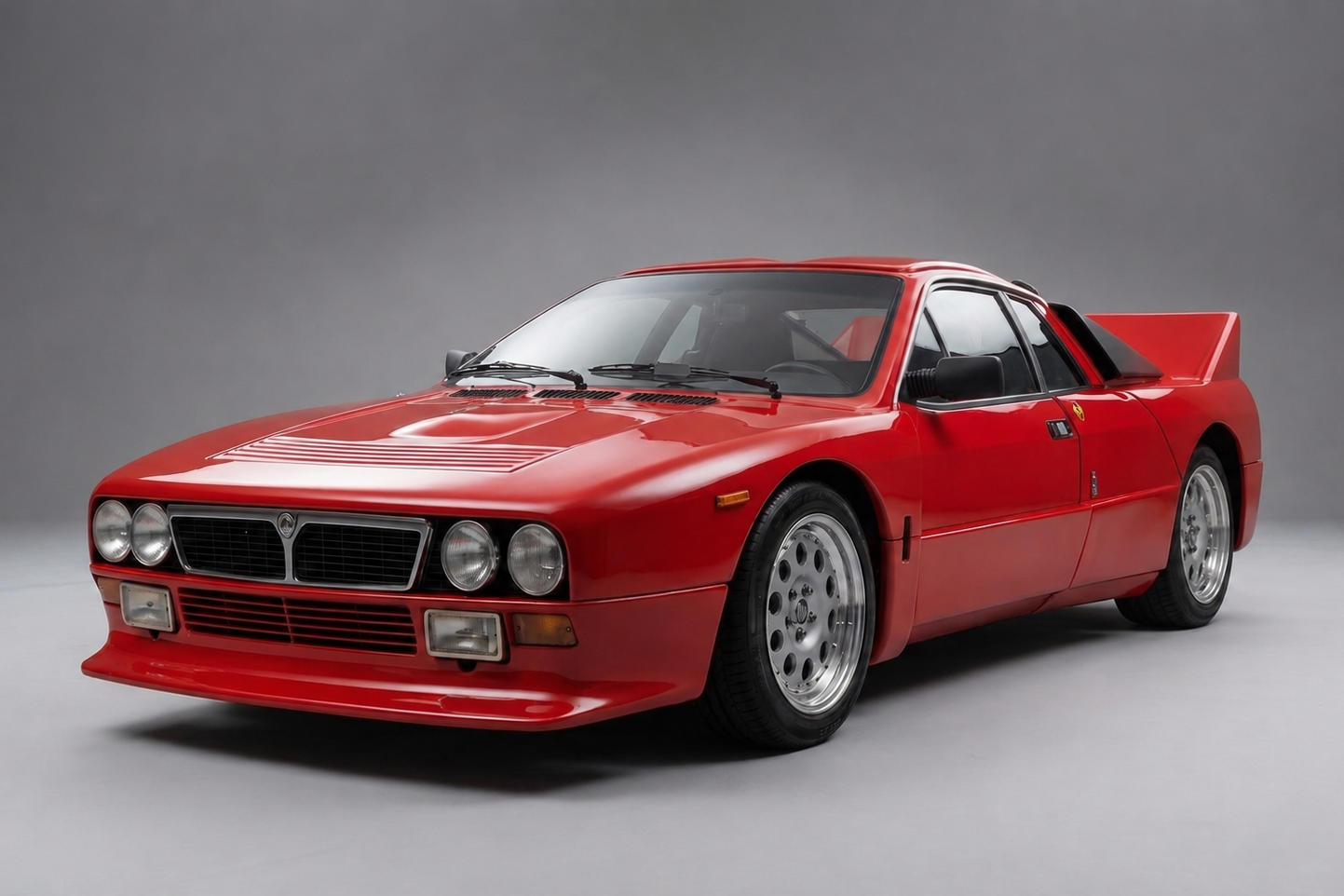
Abarth-built homologation for Lancia's Group B rally programme and the last rear-wheel-drive car to win the World Rally Championship — a Pininfarina-bodied, Volumex-supercharged mid-engined coupé produced in tiny numbers.
The Lancia Rally 037 Stradale is one of the purest homologation cars ever built. Produced between 1982 and 1984 in a run generally cited at 207 road cars, it exists because Group B required a minimum production run before a manufacturer could go rallying at the top level — and Lancia, having decided that its Group B weapon would be mid-engined and rear-wheel drive, needed to build road versions of it. The Stradale carries the central steel monocoque of the Beta Montecarlo with bolt-on tubular sub-frames front and rear, Pininfarina bodywork in fibreglass and Kevlar, and a mid-mounted longitudinal 2.0-litre DOHC 16-valve inline-four fed by a Roots-type Volumex supercharger — 205 PS / 202 bhp at 7,000 rpm and 225 Nm of torque, driving the rear wheels through a five-speed manual transaxle. Kerb weight is approximately 1,170 kg, 0–100 km/h takes around 6.6 seconds and top speed is quoted at 220 km/h / 137 mph. In competition trim, the 037 delivered Lancia the 1983 World Rally Championship constructors' title in the hands of Walter Röhrl and Markku Alén and became, once the Audi Quattro-era four-wheel-drive cars took hold, the last rear-wheel-drive car ever to win the WRC manufacturers' championship. That competition record is the axis on which every surviving Stradale trades.
The 037 Stradale matters for three reasons. First, it is a genuine homologation car in the strictest sense of the term — built in low numbers only because Group B regulations required Lancia to build them, engineered as a road-legal cousin of the works rally machine, with the same tubular sub-frames, the same mid-engined layout and the same Volumex-supercharged four-cylinder architecture. Second, it is the road-going face of the last rear-wheel-drive WRC manufacturers' champion, a distinction that cannot be repeated and that anchors the car in rally history at the very end of the RWD era. Third, it is a Pininfarina-designed, Abarth-built, Dallara-consulted Italian competition object built in Volumex-supercharged form — a specific technical and industrial confluence that produced approximately 207 cars and nothing else. Every surviving Stradale is individually tracked in the marque enthusiast community, chassis records are the standing reference for provenance verification, and the underlying works Evolution rally cars — outside the Stradale count — form their own separate and higher market.
Variants
Range and production
Variant
Years
Production
Notes
Rally 037 Stradale — production homologation road car (1982–1984)
1982–1984
Not separately recorded
Generally cited at 207 road cars, though some period references give the Group B homologation minimum of 200 as the delivered figure; a fuller count of 222 including 2 prototypes is also cited. 207 remains the working headline number in the specialist community. Beta Montecarlo central steel monocoque with bolt-on tubular steel sub-frames front and rear (Dallara-consulted), Pininfarina fibreglass and Kevlar bodywork, mid-mounted longitudinal 2.0-litre Volumex-supercharged DOHC 16-valve inline-four at 205 PS / 202 bhp and 225 Nm, five-speed manual transaxle, rear-wheel drive. Assembled by Abarth under Lancia direction. Trim materials, Volumex installation componentry and cabin specification are Abarth-specific and continuous chassis-record tracking is the standing reference for any car on the market.
Works Evolution 1 and Evolution 2 rally cars — noted for context only
1982–1984 (Evo 1); 1984 (Evo 2)
Not separately recorded
Approximately 20 works chassis in total across Evolution 1 (1982–1984) and Evolution 2 (1984, revised aero and larger supercharger for the 1984 works effort). These are separate from the ~207 Stradale road-car population and constitute their own distinct market that trades materially above the Stradale on the strength of period competition provenance. Out of scope on this Stradale-focused guide; noted for context so buyers can distinguish a Stradale from a works chassis at inspection.
Buyer's Guide
What to look for
Chassis identity — Stradale vs works Evolution
The single most consequential provenance check on any 037 offered for sale is confirming that the chassis is a genuine Stradale road car and not a works Evolution 1 or Evolution 2 rally chassis represented as a Stradale — or vice versa. The two populations are physically and mechanically distinct and every chassis is individually tracked in the marque community. Verify chassis number against the standing Stradale registry, cross-check bodywork specification (Stradale trim, glass, lighting, interior fit) against period reference photography for the individual chassis, and confirm that Volumex installation, cabin componentry and sub-frame specification are Stradale-correct rather than Evolution-specification. Retrofitted 'Evo-look' bodywork or aero on a Stradale does not confer Evolution status and must be documented as a Stradale-based modification rather than a works car.
Central Beta Montecarlo monocoque and bolt-on tubular sub-frames
The 037 combines a central Beta Montecarlo steel monocoque with bolt-on tubular steel sub-frames front and rear. Both sub-frames are the primary structural inspection surface after the monocoque itself: verify sub-frame integrity, correct mounting-point condition, absence of prior collision repair and correct-specification sub-frame componentry at PPI. Corrosion in the central monocoque, particularly around the sub-frame pick-up points and the sills, is the most consequential single value-damaging finding on the model and must be reconciled against documented restoration paperwork. Full body-off inspection by a specialist familiar with 037 construction is the standing PPI reference on any car at reference tier.
Pininfarina fibreglass and Kevlar bodywork — panel originality and repair
Bodywork is Pininfarina-supplied fibreglass and Kevlar rather than steel. Verify panel originality, correct-specification bumper and spoiler fit, correct rear bi-plane wing installation and absence of undocumented repair at PPI. Gel-coat cracking, resin re-lamination and non-original panel replacement each require reconciliation against documented restoration paperwork; retrofitted fibreglass componentry from later replicas or Evolution-style panels does not carry the market position of factory-Stradale bodywork and must be documented as a specification variance.
Volumex-supercharged 2.0 four — matching numbers, correct installation, service history
The 2.0-litre DOHC 16-valve Volumex-supercharged four is the mechanical signature of the Stradale. Engine identity, Volumex installation, intake tract, engine management and ancillaries are Abarth-specific and any deviation from factory specification is immediately visible on inspection. Verify engine number against chassis records, cross-check the Volumex charger for correct-specification installation and service history, and confirm the intake, fuel-delivery and cooling ancillaries are factory-correct. Non-original engines, aftermarket Volumex substitutions, uprated intake or fuelling componentry and non-factory engine management each disqualify a matching-numbers car and must be reconciled against paperwork.
Five-speed manual transaxle, clutch and driveshafts
The five-speed manual transaxle is a low-volume unit and specialist rebuild knowledge is concentrated with a small number of European rally-heritage transmission houses. Verify transaxle number against chassis records, inspect clutch condition, driveshaft integrity and final-drive fit, and cross-check every documented service intervention. Undocumented transmission work is a material item at PPI and must be reconciled against paperwork before purchase.
Cooling, intake and Volumex-charger ancillaries
The Volumex-charger drive, intercooling, intake tract and cooling ancillaries are the primary reliability-and-maintenance surface on the powertrain. Verify Volumex drive-belt condition, correct-specification intake plumbing, intercooler integrity and correct ancillary fit at PPI. Any period non-original ancillary fitment — a common outcome across four decades of use — must be documented and, on a concours-represented car, treated as reversible against a return to factory specification.
Suspension, brakes and wheels — factory specification, service history
Verify suspension, brake and wheel specification against period reference. Original-specification dampers (double-wishbone with twin coil-over-damper units at each corner), correct brake componentry and correct factory-supplied Speedline wheels are the standing reference. Any uprated suspension, brake or wheel componentry must be documented, and on a concours-represented car treated as reversible against a return to factory specification.
Interior originality — Abarth-specific trim, instrumentation and switch-gear
The Stradale cabin is hand-trimmed and hand-assembled at Abarth. Verify original trim material (predominantly cloth and Alcantara), correct-specification Momo steering wheel, correct instrumentation, and correct centre-console and switch-gear componentry against period reference photography for the individual chassis. Retrimmed cabins and non-original componentry on a low-volume Italian homologation car are materially damaging to value and each item must be reconciled against paperwork on any concours-represented car.
Provenance — chassis record, service history, marque-registry tracking
Provenance documentation is the primary axis on which Stradale value moves after mechanical originality. The specialist marque chassis registry, continuous service history from delivery to present and marque-enthusiast community tracking of the individual chassis are the standing reference. Any chassis represented at reference tier without confirmed chassis-record correspondence must be treated as unresolved on provenance until the record is confirmed. Cars with any period rally or privateer competition history are a distinct and typically more valuable sub-population, but require documented competition paperwork.
Pre-purchase inspection — specialist required
PPI must be conducted by an established Italian rally-heritage specialist or a Lancia works-connected workshop with direct 037 experience — not a generalist Italian classic-car workshop and not a Delta Integrale specialist without direct 037 knowledge. Insist on: full body-off inspection with monocoque and sub-frame corrosion survey; matching-numbers verification of engine, Volumex charger and transaxle against chassis records; independent inspection of Pininfarina bodywork and cabin componentry against period reference for the individual chassis; and a complete review of documented service history including any prior restoration work.
Insurance, storage and event access
The 037 Stradale is a natural agreed-value classic-policy insurance risk with Hagerty, Lockton Performance or a comparable competition-heritage carrier. Climate-controlled storage is the standing reference; the fibreglass/Kevlar bodywork and Beta Montecarlo-derived monocoque are both sensitive to humidity. Event access includes the Goodwood Festival of Speed (Rally Stage), Rallylegend San Marino, Race Retro, Salon Privé and top-tier concours entries at Villa d'Este and The Quail on the strength of the Group B provenance.
Ownership
Living with it
Typical mileage
300–1,500 miles / 500–2,400 km typical on a matching-numbers Stradale in active use; a large share of the surviving population is museum- or concours-condition and sees only event use.
Service interval
Annual service with an Italian rally-heritage specialist or works-connected Lancia workshop with direct 037 experience. Volumex-charger inspection, sub-frame corrosion survey and bodywork condition review at the same interval.
Annual running cost
USD $12,000 – $35,000+ typical annual budget for a matching-numbers Stradale in active use with continuous specialist service — dominated by Volumex-charger service, low-volume driveline componentry sourcing and specialist labour rates.
Fuel economy
~15–20 mpg (US) / ~18–24 mpg (imp) / ~12–16 L/100 km on typical use.
Insurance
Agreed-value classic-policy cover through Hagerty, Lockton Performance or a comparable competition-heritage carrier is the standing channel; premiums are set by variant identity (Stradale vs works Evolution — the Evolutions are a different insurance risk entirely), matching-numbers status and documented chassis history.
Specialist service — the reference channel
Route all major service and any powertrain, bodywork or structural work through an established Italian rally-heritage specialist with direct 037 experience. Generalist Italian classic-car workshops and Delta Integrale specialists without direct 037 knowledge are not the reference on this model, and any period of non-specialist service is priced as a paperwork deduction against continuous specialist history.
Volumex-charger service discipline
The Roots-type Volumex supercharger, its drive, intake plumbing and ancillaries are the primary powertrain-service surface on the Stradale. Continuous Volumex-charger service documented from delivery to present is the reference paperwork chain and any gap in that history is a distinct paperwork item at PPI and at sale.
Bodywork and monocoque preservation
Pininfarina fibreglass and Kevlar bodywork requires climate-controlled storage and periodic gel-coat inspection; the Beta Montecarlo-derived central monocoque is sensitive to humidity and requires the same standing storage discipline. Long-term outdoor storage or humid environments are materially damaging to both structural systems and are reflected in market pricing on any car with a documented storage history in such conditions.
Common Problems
Known issues by system
Central monocoque and sub-frame corrosion
Corrosion in the Beta Montecarlo-derived central steel monocoque — particularly around the sill sections and the front and rear sub-frame pick-up points — and in the bolt-on tubular sub-frames themselves is the most consequential single structural failure mode on the model. Undocumented structural repair is the largest single value-damaging discovery at PPI.
CriticalUSD $60,000 – $180,000+ for a specialist-level monocoque and sub-frame restoration programme.
Symptoms — Corrosion signature on sill sections and sub-frame pick-up points, evidence of prior structural repair not documented in restoration paperwork, panel-fit anomalies around the sub-frame mounting areas, sub-frame corrosion or evidence of tube replacement.
Inspection — Full body-off inspection with monocoque and sub-frame corrosion survey at PPI; documented restoration paperwork covering any structural work; reconciliation of chassis identity against the standing marque registry.
Matching-numbers Volumex-supercharged 2.0 four — non-original engine, non-factory Volumex
The 2.0-litre Volumex-supercharged engine is Abarth-specific and any deviation from factory engine, Volumex charger or engine-management specification is immediately visible on inspection and downgrades the car materially. Non-original engines, aftermarket Volumex substitutions, uprated intake or fuelling componentry and non-factory engine management each disqualify a matching-numbers car.
CriticalUSD $45,000 – $130,000+ for a specialist-level engine and Volumex-charger inspection and rectification programme; sourcing a chassis-correct replacement engine on a Stradale is a distinct specialist exercise.
Symptoms — Engine number does not match chassis records; Volumex charger non-factory or evidence of non-specialist charger rebuild; intake or fuelling componentry non-original; engine-management calibration non-factory.
Inspection — Cross-check engine and Volumex-charger stampings against chassis records at PPI; independent inspection by a Lancia works-connected specialist; documented service paperwork covering engine and Volumex-charger service history specifically.
The Pininfarina fibreglass and Kevlar bodywork is a distinct structural and cosmetic system. Gel-coat cracking, resin re-lamination and non-original panel replacement each require reconciliation against paperwork; retrofitted Evolution-style bodywork or aero on a Stradale does not confer Evolution status and must be documented as a Stradale-based modification.
MajorUSD $25,000 – $85,000+ for correct-specification Pininfarina bodywork sourcing and refit at a specialist.
Symptoms — Gel-coat cracking or star-cracking signature, resin re-lamination visible under paint, panel-fit anomalies, non-original bumper or spoiler fit, Evolution-style aero not documented on the individual chassis.
Inspection — Bodywork inspection at PPI against period reference photography for the individual chassis; documented restoration paperwork covering any bodywork intervention; reconciliation against chassis records.
The five-speed manual transaxle is a low-volume unit with specialist rebuild knowledge concentrated at a small number of European rally-heritage transmission houses. Any prior transmission work outside those channels is a material item on any PPI and undocumented transmission intervention is priced as a paperwork deduction.
MajorUSD $18,000 – $45,000+ for a specialist-level transaxle inspection and rebuild.
Symptoms — Transmission number does not match chassis records, evidence of prior non-specialist transmission work, gear-selection anomalies, clutch or driveshaft wear inconsistent with documented mileage.
Inspection — Cross-check transaxle number against chassis records at PPI; independent inspection by a rally-heritage transmission specialist; documented service paperwork covering the transmission specifically.
Cooling and Volumex ancillaries — drive belt, intercooling, intake tract
The Volumex-charger drive, intercooling, intake tract and cooling ancillaries are the primary reliability-and-maintenance surface on the powertrain. Any non-factory ancillary fit — a common outcome across four decades of use — must be documented and, on a concours-represented car, treated as reversible against a return to factory specification.
ModerateUSD $6,000 – $18,000 for a specialist-level cooling and Volumex ancillary inspection and refresh.
Symptoms — Coolant temperature climbs on sustained load, Volumex drive noise inconsistent with factory reference, intercooler or plumbing signature non-factory, evidence of prior non-specialist cooling-system or Volumex work.
Inspection — Cooling and Volumex-drive pressure test and hot-idle observation at PPI; documented service paperwork covering the Volumex charger, drive belt, intercooler and cooling system.
Interior trim and Abarth-specific cabin componentry
The Stradale cabin is hand-trimmed and hand-assembled at Abarth. Retrimmed seats, non-original Momo steering wheel or shifter, replacement instrument componentry and non-original centre-console or switch-gear fit are each material items on a low-volume Italian homologation car and must be documented and, on a concours-represented car, treated as reversible against a return to factory specification.
MinorUSD $12,000 – $35,000+ for correct-specification interior sourcing and refit at an Abarth-experienced trim specialist.
Symptoms — Non-original trim material or pattern, non-original steering wheel or shifter, replacement instruments or switch-gear, non-original centre-console componentry.
Inspection — Verify original trim and instrument specification against period reference photography for the individual chassis at PPI.
Auctions
Recent results
Date
Auction
Car
Mileage
Result
2024-03-01
Broad Arrow
The Amelia Auction
1982 Rally 037 Stradale
—
US$588,000
Sold
2023-08-17
RM Sotheby's
Monterey
1982 Rally 037 Stradale
—
US$654,000
Sold
Public auction volume on the Rally 037 Stradale is thin, with most cars changing hands by private treaty through European marque specialists. Works Evolution 1 and Evolution 2 rally cars trade at a materially higher level as a separate market.
Investment
Long-term outlook
Strong HoldHorizon: 10+ years
Three factors underwrite the Stradale investment case. First, absolute production rarity — approximately 207 road cars, none of which will ever be built again. Second, category-defining competition heritage: the 037 is the road-going face of the last rear-wheel-drive WRC manufacturers' champion, a distinction that cannot be repeated and that permanently anchors the model in rally history. Third, homologation authenticity: the Stradale is a genuine low-volume road cousin of the works rally car, engineered under Group B regulations for that specific purpose, and every surviving example is individually tracked in the marque community. Best holds: a matching-numbers concours-restored Stradale with confirmed chassis-record correspondence, complete Abarth-specification cabin and bodywork, and any documented period privateer competition history. Watch items over the horizon: whether the market for works Evolution 1 and Evolution 2 chassis continues to pull the Stradale market upward from above, and how the broader Group B homologation-car market (Delta S4 Stradale, Ferrari 288 GTO, Porsche 959) trades over the same horizon.
Our view, not advice. This section is Car Collector International's editorial judgement on where this model sits in the collector market, based on the production, specification and market data set out in this guide. It is not a recommendation to buy or sell and it is not investment advice. Values can fall as well as rise.
Recommended
The trusted network
Specialists
Lancia works-connected European specialist network
Established Italian rally-heritage workshops with direct 037 Stradale and works Evolution experience — the reference service and restoration channel on the model.