
Car Collector International
Classic · 1970

Plymouth Superbird

Chrysler's 1970 NASCAR aero-warrior homologation — a Road Runner fitted from the factory with an extended nose cone and a towering rear wing, built for a single model year to bring Richard Petty back to Plymouth and legislated off the superspeedways after one season.

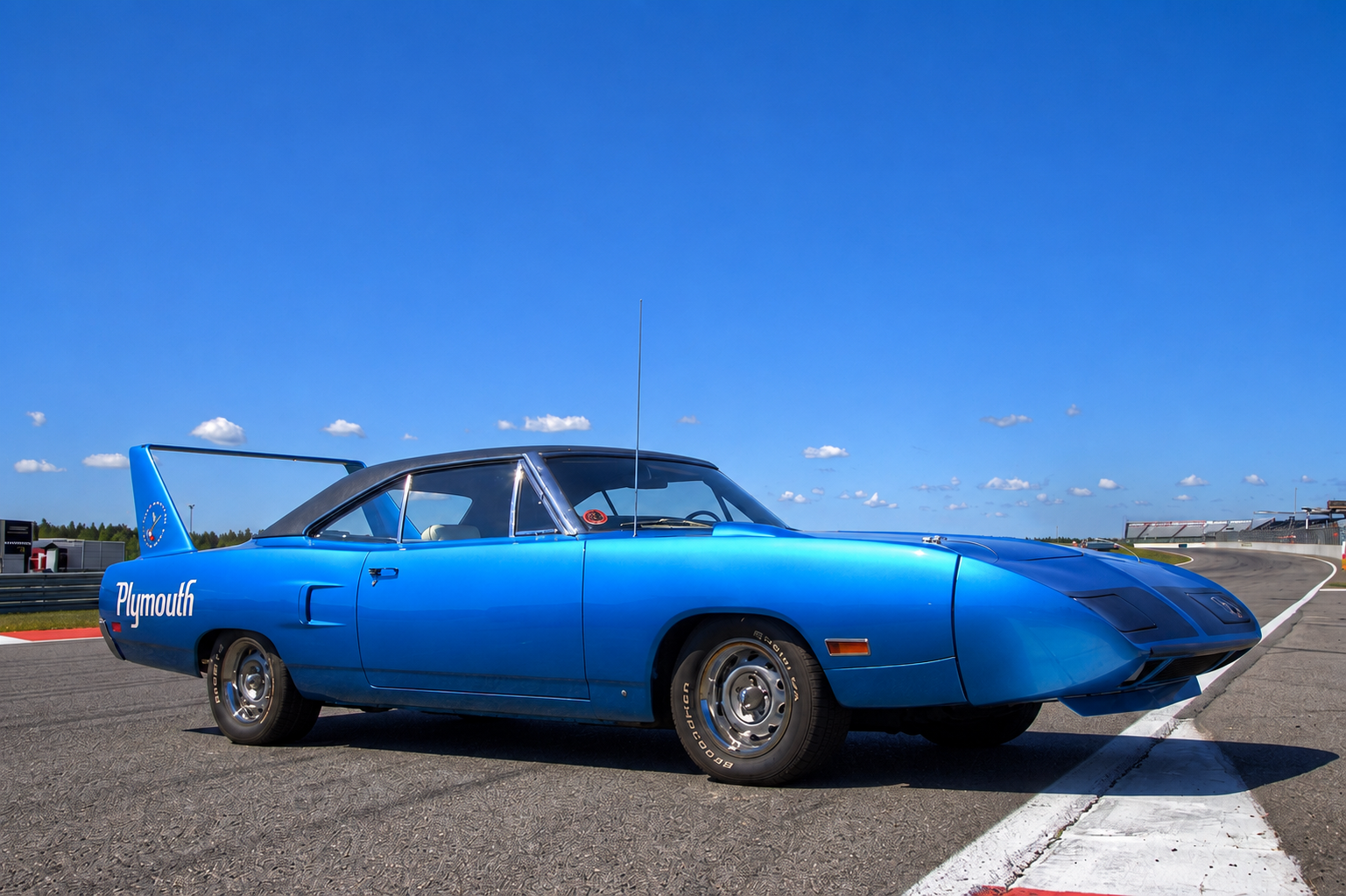
Plymouth Superbird in Petty Blue on a race circuit, side-on view showing the fully-extended fibreglass nose cone, pop-up headlamps, black vinyl roof, flush rear backlight and the tall aluminium-uprighted rear stabiliser wing rising well above the roofline — Chrysler's 1970 NASCAR aero homologation built on the Road Runner platform.
Overview

Why this car matters

The Plymouth Superbird is one of the most literal homologation cars in motorsport history. Built for the 1970 model year only, on the Road Runner platform, it was Plymouth's aero follow-up to the 1969 Dodge Charger Daytona and was engineered by Chrysler to homologate the aero body for NASCAR superspeedway competition — specifically to bring Richard Petty back to Plymouth for the 1970 season after he had defected to Ford. Production is generally accepted at around 1,935 built and shipped, which reconciles to the engine splits below; the commonly-quoted 1,920 comes from an earlier Chrysler sales-planning memo rather than the final built count, and a further 34–47 cars were shipped to Canada. Three factory V8 engines were offered: the 440 Super Commando with a single four-barrel carburettor at 375 bhp / 380 PS, the 440 Six Barrel with triple two-barrel Holleys at 390 bhp / 395 PS, and the 426 Hemi with dual four-barrels at 425 bhp / 431 PS. Transmission was either the 727 TorqueFlite three-speed automatic or the A833 four-speed manual. Both winged Mopar aero cars — the 1969 Charger Daytona and the 1970 Superbird — were legislated off the superspeedways for 1971 when NASCAR capped aero-body cars at 305 cu in, ending the era after a single season. The 135 Hemi-engined cars, of which 58 were fitted with the four-speed manual, sit at the top of the model.

The Superbird matters first and foremost as a NASCAR homologation object. Chrysler built it in 1970 as Plymouth's aero follow-up to the 1969 Dodge Charger Daytona, specifically to legalise the extended nose cone and tall rear stabiliser wing for superspeedway competition — and specifically to bring Richard Petty back to Plymouth for the 1970 season after his move to Ford the year before. Every car left the Lynch Road plant with the same fundamental aero geometry that ran at Daytona and Talladega, and both winged Mopar aero cars were banned from top-tier NASCAR competition for 1971 by the new 305 cu in displacement cap on aero-body cars, giving the model a single-season historical bracket that cannot be repeated. Beyond that, the Superbird exists for one model year and no other, it is the last of the great winged Mopar aero cars, and the Petty-blue works cars remain among the most recognisable single silhouettes in American motorsport. The 426 Hemi Superbird, and the four-speed manual subset within it, is the anchor of the collector market and trades on its own plane.

Variants

Range and production

VariantYearsProductionNotes
Superbird — 426 Hemi V8 (collector-variant anchor, 135 built)1970135 factory-built cars with the 426 cu in / 7.0-litre Hemi V8 (dual 4-barrel Holley carburettors, 425 hp SAE gross / ~431 PS, 490 lb-ft / 664 Nm). Commonly-cited split: 77 with 727 TorqueFlite automatic, 58 with A833 4-speed manual — the 4-speed Hemi is the rarest factory configuration. Distinct VIN character identifies the Hemi block. Continuous Broadcast Sheet, fender-tag and Chrysler Registry correspondence is the standing paperwork chain and any gap materially affects value. Trades at a distinct plane above the 440-engined cars.
Superbird — 440 Six Barrel V8 (716 built)1970716 factory-built cars with the 440 cu in / 7.2-litre V8 fitted with three two-barrel Holley carburettors (Six Barrel / 6-Pack induction), 390 hp SAE gross / ~395 PS, 490 lb-ft / 664 Nm. Available with TorqueFlite automatic or 4-speed manual. Distinct VIN character identifies the 440 Six Barrel. A significant collector market in its own right — materially below the Hemi plane but above the standard 440 4-barrel cars.
Superbird — 440 Super Commando V8, single 4-barrel (balance of production)1970The mainstream engine option — 1,084 cars (the balance to the accepted ~1,935 total after the 135 Hemi and 716 Six Barrel cars). 440 cu in Super Commando V8 with a single Carter 4-barrel carburettor, 375 hp SAE gross / ~380 PS, 480 lb-ft / 651 Nm. TorqueFlite automatic or 4-speed manual. The reference base Superbird and the point of entry to the market.
Collector Variants

Limited & special editions

The models below represent the most significant limited and special edition variants — factory-produced cars that command meaningful premiums over standard examples and warrant specific attention from serious collectors.

1970 Superbird 426 Hemi · 1970

135 (77 TorqueFlite automatic + 58 A833 4-speed manual)
Distinguishing features
426 cu in / 7.0-litre Hemi V8 with dual four-barrel Holley carburettors — 425 bhp / 431 PS SAE gross and 490 lb-ft / 664 Nm — in the 1970-only Superbird aero body with extended nose cone, pop-up headlamps and tall rear stabiliser wing. Distinct VIN engine character and distinct fender-tag code. The 58 four-speed-manual cars are the rarest single factory configuration.
Value premium
Materially above the 440 Six Barrel and 440 4-barrel Superbirds — matching-numbers Hemi cars trade at multiples of a 440 4-barrel car in equivalent condition; concours-restored 4-speed Hemi examples anchor the top of the model.
Inspection points
Independent Mopar-specialist inspection of engine casting numbers and stamping-pad character against the VIN and fender-tag Hemi codes; Broadcast Sheet correspondence; standing Chrysler / Mopar Registry entry; correct-specification dual-4-bbl Holley induction and Dana 60 rear axle.
Authentication
The 426 Hemi is the single most-forged engine identity in muscle-era American car provenance. 440-to-Hemi tribute conversions and re-stamped blocks exist in numbers; a genuine Hemi Superbird is authenticated by matching VIN engine character, fender-tag Hemi code, Broadcast Sheet (where preserved) and registry entry — not by cosmetic specification or an installed Hemi block alone.

Production figures sourced from official marque records and specialist registers. Verify chassis documentation with the relevant marque register before purchase.

Buyer's Guide

What to look for

VIN, fender tag and Broadcast Sheet — engine identity is everything

The single most consequential provenance check on any Superbird is verifying that the engine currently in the car matches the factory-fitted engine encoded in the VIN and confirmed by the fender tag and — where available — the original Broadcast Sheet. Hemi cars carry a distinct VIN engine character and a distinct fender-tag code; 440 Six Barrel and 440 4-barrel cars each carry their own codes. A car sold as a Hemi with a re-stamped block, a Six Barrel with a swapped carb setup, or any car with fender-tag inconsistencies is a materially different market object from a matching-numbers example. Registry cross-check against the standing Superbird / Mopar registries is the reference discipline and any car represented at reference tier without confirmed registry correspondence should be treated as unresolved on provenance until confirmed.

Nose cone, headlamp mechanism and rear-wing originality

The extended nose cone and the tall rear stabiliser wing are the aerodynamic identity of the car and — with pop-up headlamps and specific-to-Superbird brackets, hardware and fibreglass mouldings — are the single most reproduced componentry set on the model. Verify original Creative Industries-supplied nose cone and wing where possible, correct-specification pop-up headlamp mechanism condition and operation, correct-specification aluminium wing uprights and their body pick-ups, and absence of undocumented replacement panels. Reproduction nose cones and wings exist for restoration use and are acceptable when documented, but must not be represented as original componentry on a concours-tier car.

Structural condition — Road Runner B-body corrosion signature

Underneath the aero panels the Superbird is a Road Runner B-body and shares the muscle-era Mopar corrosion signature: rear quarters (especially at the wing pick-up areas), trunk floor, rear frame rails, floorpans, cowl and rocker sills. Any prior body-off restoration must be reconciled against paperwork; undocumented structural repair and prior collision repair are the largest single value-damaging findings at PPI. Nose-cone crush damage from front-end collision — the nose is a specific and expensive rebuild — is a distinct inspection item.

Matching-numbers powertrain — engine, transmission, rear axle

On a Hemi car the matching-numbers powertrain reference is the original 426 Hemi block, correct dual-4-barrel Holley induction, correct-specification 727 TorqueFlite or A833 4-speed, and correct Dana 60 rear axle assembly. On a 440 Six Barrel car it is the original 440 block with correct 6-Pack induction and correct axle. On a 440 4-barrel car it is the original 440 with the correct Carter 4-barrel. Cross-check every drivetrain casting number and date code against the Broadcast Sheet and the standing registry. Re-stamped blocks, non-original heads, incorrect intake manifolds and swapped rear axles are each material and cumulative discount items.

Colour, trim and factory-option originality

Verify paint code, interior trim code and option codes against the fender tag. Petty Blue (Corporation Blue), Alpine White, Tor-Red, Vitamin C Orange, Lemon Twist and Lime Light are the recognised factory colours. Confirm the vinyl roof (fitted to almost every Superbird as a factory production expedient), the correct-specification 'plum crazy' Superbird decal on the rear stabiliser wing, and correct-specification interior trim. Colour-changed cars, retrimmed interiors and non-original decal work must each be documented and, on a concours-represented car, priced against a return to factory specification.

Brakes, suspension and wheels — factory specification

Verify correct-specification front disc / rear drum brake componentry (or drum / drum on base-brake cars), correct torsion-bar front and leaf-sprung rear suspension geometry, and correct 15-inch factory steel or optional Rallye wheels with correct-specification Goodyear Polyglas GT reproduction tyres. Non-original wheels, disc-brake conversions on originally-drum cars, and modernised suspension bushings are each documentation items and, on a concours-represented car, treated as reversible against factory specification.

Provenance — Broadcast Sheet, fender tag, registry, ownership chain

Superbird provenance discipline rests on four documents: the fender tag on the driver-side inner fender, the Broadcast Sheet (where preserved, typically found under the rear seat or above the glovebox), the standing Superbird / Mopar Chrysler Registry entry for the individual VIN, and continuous documented ownership. Any two-of-four is workable; missing Broadcast Sheet is common and priced accordingly. Documented dealer-network delivery paperwork, original window sticker and any period competition or period magazine feature history each add discretely to a car's paperwork weight.

Pre-purchase inspection — muscle-era Mopar specialist required

PPI must be conducted by an established muscle-era Mopar specialist with direct 1969 Charger Daytona / 1970 Superbird aero-car experience — not a generalist American classic-car workshop. Insist on: full body-off-appropriate inspection with corrosion survey of Road Runner B-body structure; nose-cone, wing and pop-up headlamp inspection; matching-numbers verification of engine, transmission and rear axle against Broadcast Sheet and fender tag; independent inspection against the standing Superbird registry; and a complete review of documented restoration and service history.

Insurance, storage and event access

The Superbird is a natural agreed-value classic-policy insurance risk with Hagerty, Grundy or a comparable US muscle-era carrier; European coverage is available through Hagerty and Lockton. Climate-controlled storage is the standing reference — the fibreglass nose cone and the wing pick-up areas are humidity-sensitive. Event access includes the Mopar Nationals, Muscle Car and Corvette Nationals (MCACN), Amelia Island Concours, The Quail on selective years, and any Chrysler / NASCAR heritage class at the top US concours; the Petty-blue Hemi cars are consistent invitation cars.

Pricing

What to pay

426 Hemi — matching numbers, concours restored, complete documentation
USDUSD $1,200,000 – $2,000,000+ at reference muscle-era auctions and private-treaty specialists. Matching-numbers Hemi block, correct dual-4-bbl induction, Broadcast Sheet present, complete fender-tag and registry correspondence, complete restoration paperwork. 4-speed Hemi cars trade at the top of the band.
GBPGBP £950,000 – £1,600,000+ private-treaty basis. Authored independently per region — NOT FX-converted.
EUREUR €1,100,000 – €1,850,000+ private-treaty basis. Authored independently per region — NOT FX-converted.
Basis: authored independently per region — NOT FX-converted. Reference top of the Superbird market — a matching-numbers concours-restored Hemi car with Broadcast Sheet, ideally a 4-speed.
426 Hemi — excellent original or restored, matching numbers
USDUSD $850,000 – $1,300,000 at reference specialists and quality auctions. Matching numbers, documented history, correct-specification aero panels and interior.
GBPGBP £680,000 – £1,050,000 private-treaty basis. Authored independently per region — NOT FX-converted.
EUREUR €780,000 – €1,200,000 private-treaty basis. Authored independently per region — NOT FX-converted.
Basis: authored independently per region — NOT FX-converted. Working reference band for a matching-numbers Hemi Superbird in excellent condition with continuous paperwork.
440 Six Barrel — matching numbers, excellent to concours
USDUSD $350,000 – $600,000 at reference specialists and quality auctions. Matching numbers, correct-specification 6-Pack induction, Broadcast Sheet where available, correct-specification aero panels and interior.
GBPGBP £280,000 – £480,000 private-treaty basis. Authored independently per region — NOT FX-converted.
EUREUR €320,000 – €550,000 private-treaty basis. Authored independently per region — NOT FX-converted.
Basis: authored independently per region — NOT FX-converted. Reference band for the mid-tier engine option in matching-numbers, well-documented condition.
440 Super Commando 4-barrel — matching numbers, excellent condition
USDUSD $220,000 – $380,000 at reference specialists and quality auctions. Matching numbers, correct 4-barrel induction, Broadcast Sheet where available.
GBPGBP £175,000 – £300,000 private-treaty basis. Authored independently per region — NOT FX-converted.
EUREUR €200,000 – €350,000 private-treaty basis. Authored independently per region — NOT FX-converted.
Basis: authored independently per region — NOT FX-converted. Entry-tier reference band — a matching-numbers 440 4-barrel car in excellent condition.
Project or non-matching-numbers — engine-swapped, paperwork gaps or structural repair needed
USDCase-by-case; any Superbird with a non-original engine, unresolved fender-tag or registry issues, or structural repair required must be priced against a factory-level restoration budget and re-verification exercise. Pricing at this tier is not a public-market discipline.
GBPCase-by-case; authored independently per region — NOT FX-converted.
EURCase-by-case; authored independently per region — NOT FX-converted.
Basis: authored independently per region — NOT FX-converted. Case-by-case only. Non-matching-numbers, tribute cars represented as originals, or cars with structural issues are priced against restoration budgets and a return to factory specification.

Regional ranges authored independently — each reflects its local market, not an FX conversion

Ownership

Living with it

Typical mileage
300–2,000 miles / 500–3,200 km typical on a matching-numbers Superbird in active use; Hemi cars in particular see mostly event and concours use.
Service interval
Annual service with an established muscle-era Mopar specialist; nose-cone, wing-mount and pop-up headlamp inspection at the same interval.
Annual running cost
USD $6,000 – $20,000+ typical annual budget for a matching-numbers Superbird in active use with specialist service — dominated by carburettor and ignition tuning on the 6-Pack and Hemi cars, driveline maintenance, and specialist bodywork attention to the aero panels.
Fuel economy
~8–12 mpg (US) / ~10–14 mpg (imp) / ~20–30 L/100 km on typical use — depends heavily on engine and driving style.
Insurance
Agreed-value classic-policy cover through Hagerty, Grundy or a comparable US muscle-era carrier is the standing channel; Hemi Superbirds are underwritten as a distinct and higher-tier risk from 440-engined cars, and matching-numbers status materially affects agreed value.

Specialist service — muscle-era Mopar experience is the reference

Route all major service and any powertrain, bodywork or structural work through an established muscle-era Mopar specialist with direct aero-car experience. Generalist American-classic workshops without Superbird / Charger Daytona experience are not the reference channel, and any period of non-specialist service is priced as a paperwork deduction.

Aero panel and wing preservation

The fibreglass and steel nose cone, the pop-up headlamp mechanism and the tall rear stabiliser wing require climate-controlled storage and periodic inspection of mounting hardware and pick-up points. Long-term outdoor storage, humid environments and repeated wing removal/refit cycles are each materially damaging and are reflected in market pricing on any car with a documented storage or event-use history in such conditions.

Fuel-system discipline on 440 Six Barrel and 426 Hemi

The 6-Pack induction on the 440 Six Barrel and the dual-4-bbl induction on the 426 Hemi are the primary tuning surfaces on the car. Correct-specification carburettors, correct linkage geometry and correct fuel-delivery pressures are the reference; any deviation from factory specification must be documented and, on a concours-represented car, treated as reversible.

Common Problems

Known issues by system

Non-original engine or re-stamped block on a Hemi-represented car

The 426 Hemi is the single most-forged engine identity in muscle-era American car provenance. Non-original Hemi blocks, re-stamped blocks and 440-to-Hemi tribute conversions are a distinct market risk on any Hemi-represented Superbird. Fender-tag, VIN and Broadcast Sheet correspondence, together with independent inspection of engine casting numbers and stamping-pad character, are the standing verification discipline.

CriticalPractically infinite as a value item — a non-matching Hemi identity converts a $1M+ car into a $250,000–$400,000 car. Rectification is not possible without a period-correct matching Hemi engine.
Symptoms — VIN engine character inconsistent with the engine currently fitted; fender-tag engine code inconsistent with car; Broadcast Sheet missing or inconsistent; stamping-pad character shows evidence of re-stamp; block casting numbers or date codes inconsistent with car build date.
Inspection — Independent Mopar-specialist inspection of engine identity against Broadcast Sheet, fender tag and VIN; registry cross-check; casting-number and date-code verification.
Structural corrosion — Road Runner B-body signature

The Superbird shares the Road Runner B-body structure and its corrosion signature: rear quarters (particularly at the wing pick-up areas), trunk floor, rear frame rails, floorpans, cowl and rocker sills. Any prior structural repair not documented in restoration paperwork is a material item at PPI.

CriticalUSD $40,000 – $150,000+ for a specialist-level structural restoration programme.
Symptoms — Corrosion signature at rear quarters and wing pick-up areas, trunk-floor perforation, frame-rail corrosion, cowl leakage evidence, panel-fit anomalies suggesting prior collision or structural repair.
Inspection — Full body-off-appropriate inspection with structural corrosion survey; documented restoration paperwork covering any structural work; alignment and panel-fit reference against period specification.
Nose cone and pop-up headlamp mechanism — original vs reproduction

The extended nose cone and its integrated pop-up headlamp mechanism are Superbird-specific and the single most reproduced componentry set on the model. Reproduction nose cones are acceptable when documented but must not be represented as original componentry on a concours-tier car; pop-up headlamp mechanism condition is a distinct inspection and rebuild item.

MajorUSD $15,000 – $60,000+ for correct-specification nose-cone sourcing and refit, including pop-up mechanism rebuild.
Symptoms — Nose-cone panel material or fitment inconsistent with original Creative Industries specification; pop-up headlamp mechanism binding, misalignment or non-original componentry; nose-cone crush damage from prior front-end collision; brackets or hardware non-factory.
Inspection — Nose-cone inspection at PPI against original Creative Industries specification; pop-up headlamp mechanism function test and independent inspection; documentation of any prior nose-cone replacement.
Rear stabiliser wing — uprights, body pick-ups, corrosion

The tall aluminium-uprighted rear stabiliser wing is a distinct structural and cosmetic system. Wing uprights, body pick-up points and any evidence of prior wing removal / refit or corrosion at the pick-ups are material items on a concours-represented car.

MajorUSD $8,000 – $30,000+ for correct-specification wing sourcing, pick-up repair and decal work.
Symptoms — Wing upright material, profile or hardware non-factory; body pick-up corrosion or evidence of repair; wing-decal ('plum crazy' Superbird script on the wing) missing, non-original or over-restored; wing mis-aligned to body centreline.
Inspection — Wing and pick-up-point inspection at PPI; documented restoration paperwork covering any wing intervention; decal specification cross-check against factory reference.
6-Pack / Hemi induction — carburettor originality, linkage, tuning

The 440 Six Barrel 6-Pack induction and the 426 Hemi dual-4-barrel induction are the primary tuning surfaces on the higher-tier cars. Non-original carburettors, incorrect linkage geometry, non-factory fuel-delivery componentry and non-specialist tuning history are each material items on a matching-numbers car and, on a concours-represented car, treated as reversible against factory specification.

ModerateUSD $6,000 – $22,000+ for correct-specification carburettor sourcing, refit and specialist tuning.
Symptoms — Carburettor part numbers or date codes inconsistent with car build date; linkage geometry non-factory; fuel-delivery componentry non-original; documented tuning history through non-specialist channels.
Inspection — Independent Mopar-specialist inspection of induction componentry against Broadcast Sheet and factory reference; carburettor part-number and date-code verification.
Interior originality — trim, gauges, steering wheel, console

Superbird interiors follow Road Runner trim conventions with model-specific componentry. Non-original trim material, incorrect steering wheel or shifter, replacement gauges and non-factory console fit are each documentation items on any car and, on a concours-represented car, treated as reversible against factory specification.

MinorUSD $8,000 – $25,000+ for correct-specification interior sourcing and refit.
Symptoms — Non-original trim material or pattern; non-original steering wheel or shifter; replacement gauges; non-factory console or dash-pad fit.
Inspection — Interior inspection at PPI against fender-tag trim code and period reference; documented restoration paperwork covering any interior intervention.
Valuation

Current value bands by region

Concours
USD
USD $220,000 – $2,000,000+ (engine-dependent)
GBP
GBP £175,000 – £1,600,000+
EUR
EUR €200,000 – €1,850,000+
+10% 12-mo
Excellent
USD
USD $180,000 – $1,300,000 (engine-dependent)
GBP
GBP £145,000 – £1,050,000
EUR
EUR €165,000 – €1,200,000
+8% 12-mo
Good
USD
USD $140,000 – $700,000 (engine-dependent)
GBP
GBP £110,000 – £560,000
EUR
EUR €130,000 – €640,000
+3% 12-mo
Fair
USD
USD $95,000 – $400,000 (paperwork or specification issues)
GBP
GBP £75,000 – £320,000
EUR
EUR €85,000 – €365,000
0% 12-mo
Project
USD
Case-by-case
GBP
Case-by-case
EUR
Case-by-case
0% 12-mo

Each region quoted in its local currency — independent market readings, not FX conversions

The Superbird market is structured around four facts. First, single-year-only production — 1970, no other year — combined with an aero configuration legislated off the NASCAR superspeedways for 1971, meaning the model exists in a hard historical bracket that cannot be repeated. Second, engine stratification is absolute: the 135 factory-built 426 Hemi cars (of which 58 with 4-speed manual) trade on a distinct plane materially above the 716 440 Six Barrel cars, which in turn trade above the 1,084 440 4-barrel cars that make up the balance of the ~1,935-car total. Third, provenance discipline: fender tag, Broadcast Sheet, Chrysler / Mopar Registry correspondence and matching-numbers powertrain are the paperwork axes on which value moves between two otherwise-equivalent cars. Fourth, the aero-panel authenticity question: nose cones, pop-up headlamp mechanisms and rear wings are the single most reproduced componentry sets on the model, and factory-original panels command a documented premium. Reference top of the market: a matching-numbers 4-speed Hemi Superbird with complete Broadcast Sheet and registry correspondence, factory-original nose cone and wing, and unbroken ownership chain. Cases outside the reference bands are case-by-case exercises priced against specialist restoration budgets and re-verification.

Auctions

Recent results

DateAuctionCarMileageResult
2022-01-15
Mecum
Kissimmee 2022 (public-print reference)
1970 Superbird 426 Hemi — TorqueFlite automatic, matching numbers, documented restoration
Public-print reference band for a matching-numbers Hemi Superbird at Mecum Kissimmee. Treated as an indicative band rather than a firm market anchor; the specific lot record at the auction house is the standing reference for any confirmed transaction figure.
USD $1,000,000 – $1,500,000 (public-print band)
Sold
2023-01-28
Barrett-Jackson
Scottsdale 2023 (public-print reference)
1970 Superbird 440 Six Barrel — 4-speed manual, matching numbers, correct-specification aero panels
Public-print reference band for a matching-numbers 440 Six Barrel Superbird at Barrett-Jackson Scottsdale. Treated as an indicative band rather than a firm market anchor; the specific lot record at the auction house is the standing reference for any confirmed transaction figure.
USD $400,000 – $550,000 (public-print band)
Sold
2024-05-04
Mecum
Indy 2024 (public-print reference)
1970 Superbird 426 Hemi — 4-speed manual, matching numbers, Broadcast Sheet present
Public-print reference band for a 4-speed Hemi Superbird — the rarest factory configuration — at Mecum Indy. Treated as an indicative band rather than a firm market anchor; the specific lot record at the auction house is the standing reference for any confirmed transaction figure.
USD $1,600,000 – $2,200,000 (public-print band)
Sold

The Superbird has an active US auction market — Mecum Kissimmee and Indy, Barrett-Jackson Scottsdale — and Hemi cars in particular have been the subject of well-publicised seven-figure results. The results above are cited as public-print reference bands rather than firm market anchors, and specific lot records at the named auction houses remain the standing reference for any confirmed transaction figure. Reference pricing on any specific Superbird must be built from Broadcast Sheet correspondence, matching-numbers powertrain verification and standing Chrysler / Mopar Registry entry, not from headline auction reporting alone.

Investment

Long-term outlook

Strong HoldHorizon: 10–25 years

Three factors underwrite the Superbird investment case. First, absolute production rarity within the highest-tier engine option — 135 Hemi cars, of which 58 with the 4-speed manual, none of which will ever be built again. Second, category-defining status: the Superbird is the road-going face of the 1970 NASCAR aero war, legislated out of top-tier competition after a single season, and it will remain one of the two definitive winged Chrysler aero cars for as long as the muscle era is collected. Third, provenance economy: matching-numbers status, Broadcast Sheet presence and Chrysler / Mopar Registry correspondence are non-substitutable value axes and reward long-hold owners with continuous paperwork discipline. Best holds: a matching-numbers 4-speed Hemi Superbird with Broadcast Sheet and registry correspondence, or — a step down but with strong tailwind — a matching-numbers 440 Six Barrel 4-speed. Watch items over the horizon: how the muscle-era buyer demographic evolves, how the top of the Hemi market prices against the 1969 Dodge Charger Daytona Hemi as its natural comparator, and how well factory-original aero-panel discipline holds as reproduction componentry ages.

Recommended

The trusted network

Specialists

  • Muscle-era Mopar specialist network
    View →
    USA (Midwest / Southeast)
    Established Chrysler B-body specialists with direct 1969 Charger Daytona / 1970 Superbird experience — the reference service and restoration channel on the model.
  • Aero-car nose-cone and wing specialists
    View →
    USA
    Specialist workshops experienced with Creative Industries nose cones, pop-up headlamp mechanisms and rear stabiliser wing pick-ups.
  • Mecum / Barrett-Jackson / RM Sotheby's
    View →
    International
    Reference international auction houses appropriate to matching-numbers Superbird consignment at Kissimmee, Indy, Scottsdale and top US concours-adjacent sales.
  • Hagerty
    View →
    USA / UK / EU
    Agreed-value cover for 1970 Chrysler aero-warrior muscle cars, including Hemi-engined Superbirds.
  • Grundy
    View →
    USA
    US collector-car agreed-value carrier with muscle-era Mopar underwriting experience.

Storage

  • Chicago Motor Cars Storage
    View →
    Illinois, USA
    Climate-controlled Midwest US storage appropriate to full-size Mopar aero cars with fibreglass nose cones and tall rear wings.
  • Windrush Car Storage
    View →
    London / Cotswolds, UK
    Climate-controlled UK storage for imported American muscle-era collector cars.

Transport

  • Reliable Carriers
    View →
    USA / International
    Enclosed domestic and export transport for full-size 1970 Chrysler aero cars — nose-cone and rear-wing clearance is a specialist load discipline.
  • Cosdel International
    View →
    USA / International
    Enclosed transatlantic transport appropriate to a matching-numbers 426 Hemi Superbird.

Enjoyed this guide?

Get new buyer's guides and collector market intelligence delivered to your inbox. No spam. We respect your inbox.

The valuation figures in this guide are for research purposes only and do not constitute financial or investment advice. See our full disclaimer.