
Car Collector International
Classic · 1965–1969

Porsche 912

The four-cylinder 911 — 356 heart, early 911 body, and the balanced-handling secret of the air-cooled world.

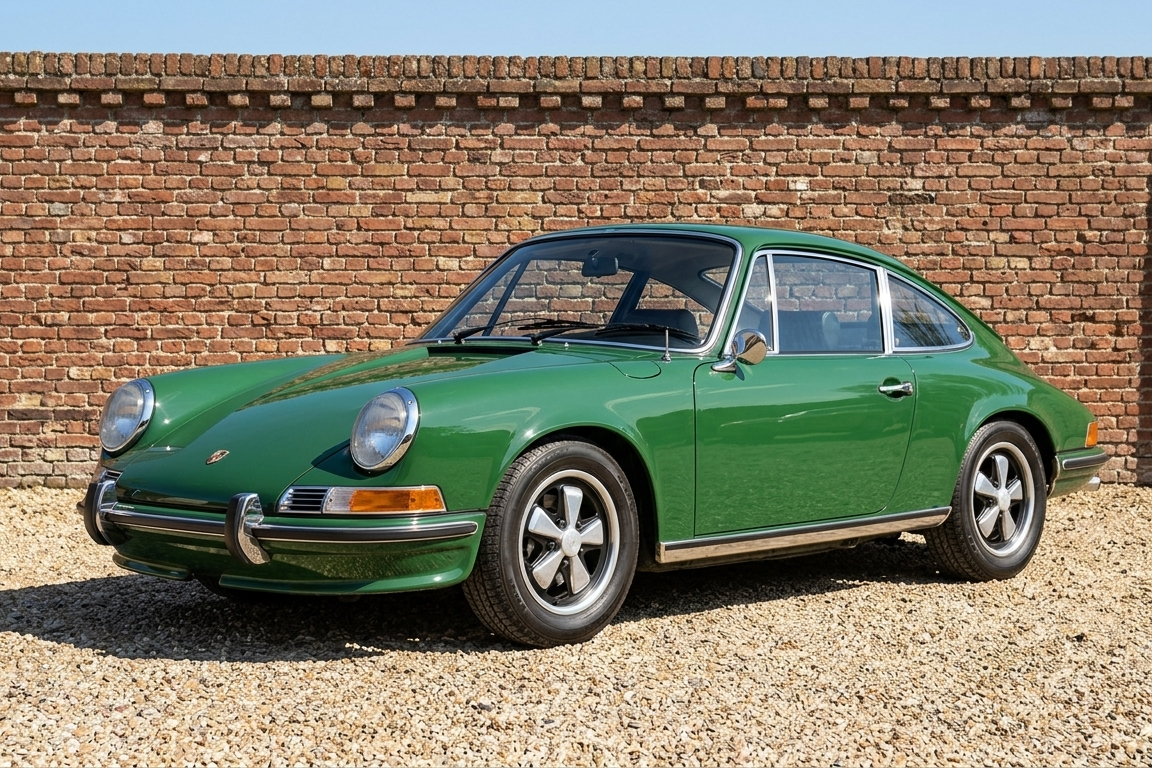
Porsche 912 coupé, front three-quarter view — original 1965–1969 four-cylinder 911-bodied Porsche, dark green over black interior, on the classic early-911 body with fluted-centre alloy wheels.
Overview

Why this car matters

Built from April 1965 to July 1969, the Porsche 912 is the four-cylinder, entry-level version of the early 911 — a 356SC-derived pushrod flat-four in the newly launched 911 bodyshell, cheaper than the 911 at launch, notably lighter over the rear axle, and famously the best-handling of the first-generation air-cooled Porsches. The 912 outsold the 911 in its first years of production, kept the Zuffenhausen line profitable while the six-cylinder car found its feet, and delivered — thanks to the Porsche-inheritance-of-the-356's 1.6-litre Type 616/36 — 30 mpg (US) fuel economy and the touring range that made it credible transport in period. It was discontinued after 1969 as production capacity was reallocated to the Porsche-Volkswagen 914.

The 912 is not a lesser 911; it is the balanced-handling early-911. Less mass behind the rear axle than a contemporary 911, the same Butzi-Porsche-designed bodyshell, the same brakes and running gear philosophy, and — crucially — a light, revvy 356-heritage pushrod flat-four that rewards being driven hard rather than punished for being pushed on a trailing throttle. Best long-term hold: an early short-wheelbase coupé in a documented factory colour, matching-numbers Type 616/36 engine, unmolested original body panels, and a documented single-marque ownership chain. Targa cars trade in a distinct band; soft-window 'Version I' Targas are the rarer body style and command a premium against hard-window cars.

Variants

Range and production

VariantYearsProductionNotes
912 Coupé (1965–1968, short-wheelbase)April 1965 – 19680The 912 entered production as a coupé on 5 April 1965 on the newly-introduced 911 short-wheelbase chassis. Coupé-only production across the full 1965–1969 run is generally cited at approximately 30,000 cars; the community reference figure widely quoted for the coupé is ~30,300 units. Specific per-year splits between short-wheelbase (through the 1968 model year) and long-wheelbase (1969 only) are less well-anchored and remain subject to registry verification.
912 Coupé (1969, long-wheelbase)1969 model year0For 1969 the 912 adopted the extended 2,268 mm 911 long-wheelbase chassis in step with the sister 911 line, alongside a range of chassis and electrical revisions. 1969 was the final year of the original 912 before production ended in July of that year. Precise 1969-only production figures are not firmly anchored and should be verified against a factory build record before use as a market claim.
912 Targa 'Version I' (soft-window, December 1966 onwards)December 1966 – 19680The Targa 'Version I' was introduced in December 1966 as a 1967 model, with a removable roof panel and a heavy transparent-plastic rear window openable with a zipper — the 'soft-window Targa' of enthusiast usage. Aggregate 912 Targa production across the 1965–1969 span is generally cited at approximately 2,500 cars, with the community reference figure for the combined Targa run of ~2,562. The specific split between Version I soft-window and Version II hard-window Targas is not firmly anchored in the public record.
912 Targa 'Version II' (hard-window, January 1968 onwards)January 1968 – 19690Targa 'Version II' introduced in January 1968 with a fixed glass rear window, in effect turning the Targa into a coupé with a removable roof panel. Included within the aggregate ~2,500-unit Targa production figure; the Version I / Version II split is not firmly anchored in the public record.
Buyer's Guide

What to look for

Matching-numbers Type 616/36 engine and correct four-cylinder engine bay

The single most important structural check on any 912 is whether it retains its original, matching-numbers Type 616/36 (or US-market 616/39) 1.6-litre pushrod flat-four in the correct four-cylinder engine bay. Long histories of 911 six-cylinder swaps, VW Type 4 conversions, and modern 1.7 / 1.75 / 1.8 / 2.1-litre big-bore rebuilds are well-documented in the market — many are excellent driver cars, but a numbers-matching 912 with the correct engine, correct carburettors (Solex 40 PI), correct sheet-metal shrouding and correct ancillaries is materially rarer and prices at a distinct premium against an engine-swapped or big-bore car. Cross-check the engine number against the Porsche Kardex / Certificate of Authenticity.

Bodyshell rust — the defining structural risk

The 912 shares the early 911 bodyshell and its well-documented rust map. Priority inspection points: front boot floor and battery-box mountings, longitudinal chassis rails behind the front wheels, kidney bowls at the base of the A-pillars, sills (inner and outer), rear torsion-bar tube ends, rear wheel arches, front and rear valances, headlight-bucket surrounds, and the entire underside. A car in an authentic factory colour with unmolested original panels is materially rarer than a repainted, part-replaced shell. Any weld work must be paperwork-supported by an air-cooled specialist.

Short-wheelbase vs long-wheelbase, and Targa 'Version I' vs 'Version II'

Short-wheelbase coupés (1965–1968) sit in a different collector band from long-wheelbase 1969 cars; the SWB is the purer early-911 experience and typically the more valued body configuration. Within the Targa line, the December 1966 – January 1968 'Version I' soft-window with the zip-open plastic rear window is the rarer specification and prices at a premium against the 'Version II' fixed-glass Targa. Confirm the exact production window and body configuration against the Porsche Kardex before pricing.

Transmission — original 902 four-speed vs optional five-speed

The 912 was sold with the four-speed 902 transmission as standard and a five-speed as a factory option. Both are correct; the presence of the five-speed does not signal a modified car. Inspect synchro engagement (particularly 2nd and 3rd), shift linkage bushing wear, gearbox oil weep at the transaxle output, and the condition of the clutch pedal biting point. Any non-original 915-transmission swap is a material paperwork item and must be inspected as such.

Interior originality — dash, seats, dials, and horn ring

The correct early-911-era interior is a distinct value item: original ivory-faced VDO instruments, the correct three-spoke horn-ring steering wheel, correct upright vinyl seats with the correct piping, correct door-card grain and correct headliner. Non-original 911-donor interior swaps, later 911S/T sport-seat retrofits, and non-standard steering wheels are all common and downgrade a matching-numbers car materially. Verify against Porsche Kardex / Certificate of Authenticity for the correct trim code.

Pre-purchase inspection at an air-cooled Porsche specialist

PPI must be conducted by a reputable early-911-era air-cooled Porsche specialist — 912 Registry-recommended workshops, marque-recognised specialists such as Autofarm (UK), Paul Stephens (UK), Sportwagen Eckert (Germany), Willhoit Auto Restoration (USA), Callas Rennsport (USA) or an equivalent regional early-911 specialist. Insist on: full compression / leak-down test on the flat-four, borescope inspection of the cylinder heads, complete underbody survey with the car on a lift, paint-depth-gauge readings across every panel, verification of the Porsche Kardex, and confirmation of the engine and transmission numbers against the chassis.

Insurance, storage and event access

A stock-configuration matching-numbers 912 is a natural agreed-value classic-policy car with Hagerty, Chubb Masterpiece or a comparable HNW carrier. Museum-grade climate-controlled storage is the standing reference for a top-condition car. Event access includes the 912 Registry annual gatherings, Porsche Club of America (PCA) events, Porsche Club GB events, Rennsport Reunion, and — for genuine 1967 rally-history cars — the Rally Poland historic calendar.

Pricing

What to pay

Concours — matching-numbers, correct engine and transmission, original factory colour, documented single-marque history, short-wheelbase coupé or 'Version I' soft-window Targa
USDUSD $115,000 – $175,000+ private-treaty / dealer-listed basis. Anchored on recent public US prints for driver-quality refurbished coupés in the USD $100–150k band — a concours matching-numbers stock car prints above that, not below.
GBPGBP £85,000 – £140,000 dealer-listed basis at UK air-cooled Porsche specialists. Authored independently per region — NOT FX-converted; anchored on typical UK dealer asking prices for stock-configuration matching-numbers coupés at review date.
EUREUR €100,000 – €160,000 dealer-listed basis at continental European air-cooled Porsche specialists. Authored independently per region — NOT FX-converted; anchored on typical continental European dealer asking prices at review date.
Basis: authored independently per region — NOT FX-converted. Top of the market is a matching-numbers, correct-engine, factory-colour SWB coupé or 'Version I' soft-window Targa with a Porsche Certificate of Authenticity and a documented ownership chain.
Excellent — running, driving, matching-numbers or correct-type 1.6L Type 616/36, cosmetically presentable coupé
USDUSD $70,000 – $115,000 private-treaty / auction basis. Anchored on recent public US prints for stock-configuration matching-numbers or correct-type coupés on either 4- or 5-speed transaxles, with well-documented long-ownership cars sitting at the top of the band.
GBPGBP £55,000 – £90,000 dealer-listed basis. Authored independently per region — NOT FX-converted.
EUREUR €65,000 – €105,000 dealer-listed basis. Authored independently per region — NOT FX-converted.
Basis: authored independently per region — NOT FX-converted. The volume band for a genuinely useable, correctly-configured 912. Specific price is a function of body configuration (SWB vs LWB, coupé vs Targa), engine originality and paint / trim condition.
Good — driver-quality 912 with cosmetic needs or minor non-original changes, correct-type engine
USDUSD $45,000 – $70,000 private-treaty / auction basis. Anchored on recent public US prints for driver-quality coupés with replacement 1.6L or big-bore engines and cosmetic needs — the volume band for cars that need work but not a full restoration.
GBPGBP £35,000 – £55,000 dealer-listed basis. Authored independently per region — NOT FX-converted.
EUREUR €40,000 – €65,000 dealer-listed basis. Authored independently per region — NOT FX-converted.
Basis: authored independently per region — NOT FX-converted. Sensible entry point for a running-driving 912 that will not immediately require a full restoration.
Fair / Project — long-term-stored or partly-restored 912 requiring recommissioning, missing paperwork, non-original engine
USDUSD $18,000 – $45,000 private-treaty / auction basis. Projects and long-term-stored Targa cars anchor the bottom of the band; drivers with non-matching engines and paperwork gaps sit in the mid-range.
GBPGBP £14,000 – £35,000 auction / private-treaty basis. Authored independently per region — NOT FX-converted.
EUREUR €17,000 – €40,000 auction / private-treaty basis. Authored independently per region — NOT FX-converted.
Basis: authored independently per region — NOT FX-converted. Any 912 in this band should be priced against a documented recommissioning / restoration budget from a marque-recognised specialist — a full paint-and-panel restoration will typically consume the entire concours-band premium.

Regional ranges authored independently — each reflects its local market, not an FX conversion

Ownership

Living with it

Typical mileage
3,000–6,000 miles / 5,000–10,000 km typical — a 912 is a genuinely useable classic and rewards regular use more than static preservation.
Service interval
Annual service / 3,000–5,000-mile intervals at an air-cooled Porsche specialist. Valve clearances on the pushrod Type 616/36 flat-four should be checked at every service.
Annual running cost
USD $2,500 – $8,000+ range typical, depending on use — dominated by specialist labour, tyres and any bodywork rectification. Cars used at classic-touring or club-motorsport events widen the annual budget.
Fuel economy
~25–30 mpg (US) / ~30–36 mpg (imp) / ~8–9 L/100 km on real-world use — genuinely economical, particularly for a 1960s Porsche.
Insurance
Agreed-value classic-policy cover through Hagerty, Chubb Masterpiece or a comparable HNW carrier is the standing channel; annual policies for a stock-configuration matching-numbers car are typically low-four-figure.

Air-cooled Porsche specialist network — the standing reference

Route all major work through a marque-recognised early-911-era specialist (Autofarm, Paul Stephens, Sportwagen Eckert, Willhoit Auto Restoration, Callas Rennsport or an equivalent regional workshop). Independent generalist workshops are not the reference for a matching-numbers 912.

Porsche Kardex / Certificate of Authenticity

Order a Porsche Kardex / Certificate of Authenticity from Porsche AG for any 912 being bought or sold above the driver-quality band. The COA confirms original colour, trim, engine and transmission specification and is the standing paperwork reference for a matching-numbers claim.

912 Registry membership

The 912 Registry is the standing community reference for original-specification data, per-year production splits, and marque-recognised specialist workshop referrals. Membership is the standing recommendation for any long-term 912 owner.

Common Problems

Known issues by system

Bodyshell corrosion — kidney bowls, longitudinals, battery box, torsion-tube ends and sills

The 912 shares the pre-galvanised early 911 bodyshell and is materially rust-prone. Any 912 that has not had documented body-panel and structural restoration by an air-cooled Porsche specialist is at material risk of hidden corrosion at the standard early-911 hotspots.

CriticalUSD $15,000 – $80,000+ for correctly-executed panel and structural work at an air-cooled Porsche restoration specialist. A full concours-standard shell restoration can exceed the market value of a driver-quality car.
Symptoms — Bubbling paint at sill / A-pillar / rear arch, weld splatter or thick underseal on the inner longitudinals, evidence of repaint at the front boot floor or battery box, uneven panel gaps, doors that drop on their hinges.
Inspection — Full underbody survey on a two-post lift; paint-depth-gauge readings across every panel; borescope inspection of the inner longitudinals and torsion-tube ends; verification of any prior weld or panel work against paperwork from an air-cooled Porsche specialist.
Type 616/36 flat-four — matching-numbers status, non-original 911 six-cylinder swaps and big-bore rebuilds

A significant proportion of the surviving 912 population has been fitted with either a 911 six-cylinder engine, a VW Type 4 unit, or a big-bore 1.7 / 1.75 / 1.8 / 2.1-litre rebuild of the four-cylinder. Some are excellent; none carry the matching-numbers premium of an original Type 616/36.

MajorUSD $8,000 – $30,000+ for a full Type 616/36 rebuild at an air-cooled Porsche specialist. Sourcing a correct matching-numbers replacement Type 616/36 is a distinct and material market exercise.
Symptoms — Engine number does not match the Porsche Kardex; non-original carburettors (non-Solex 40 PI); non-original ancillaries; engine sheet-metal shrouding replaced with a 911 pattern; six-cylinder exhaust cutouts in the rear valance; big-bore displacement stamped or referenced in the seller's paperwork.
Inspection — Cross-check the engine number against the Porsche Certificate of Authenticity; verify the correct Solex 40 PI carburettors, correct sheet-metal shrouding and correct ancillaries; verify the engine bay corresponds to the four-cylinder specification.
Fuel system — Solex 40 PI carburettors, fuel-line integrity and cold-start behaviour

The Solex 40 PI carburettors on the Type 616/36 are the correct factory specification and are known for cold-start hesitation and idle-tuning sensitivity, particularly on cars run infrequently.

ModerateUSD $2,000 – $6,000 for a Solex 40 PI overhaul at a marque specialist; a full Weber or PMO conversion is a distinct paperwork item.
Symptoms — Uneven idle when warm, cold-start hesitation, over-rich exhaust smell, fuel-line seepage at the front tank / carburettor connections, evidence of aftermarket Weber or PMO conversion (a legitimate specification choice but not matching-numbers).
Inspection — Full cold-start test at PPI; verification of correct Solex 40 PI carburettors against Porsche Kardex; inspection of fuel-line integrity, particularly at the front tank and carburettor connections.
Transmission — 902 four-speed synchros, 5-speed option, non-original 915 swap

The 912 was sold with the 902 four-speed as standard and an optional five-speed. Both are correct; a 915-transmission swap from a later 911 is a material paperwork item.

ModerateUSD $3,500 – $9,000 for a 902 rebuild at a specialist. Sourcing a correct matching-numbers replacement 902 is a distinct market exercise.
Symptoms — Notchy 2nd / 3rd shift, high or vague clutch bite point, gearbox oil weep at the transaxle output, unfamiliar linkage feel, evidence of non-original 915 casting.
Inspection — Full transmission inspection at an air-cooled Porsche specialist; verification of the correct 902 casting against the Porsche Kardex; inspection of shift linkage bushings.
Electrical — six-volt vs twelve-volt, correct wiring loom and correct VDO instruments

Early 912s carry the six-volt electrical architecture; later cars are twelve-volt. Confirm the correct architecture for the exact production date and verify the original VDO instruments have not been swapped for later 911 dials.

ModerateUSD $1,500 – $6,000 for correct rewiring and instrument sourcing at a marque specialist.
Symptoms — Non-original VDO instruments, non-original horn-ring steering wheel, evidence of aftermarket wiring, incorrect six-volt / twelve-volt battery configuration relative to production date.
Inspection — Verify original VDO instruments against Porsche Kardex; inspect wiring loom for aftermarket splicing; confirm correct six-volt / twelve-volt architecture for the production date.
Interior originality — seats, door cards, headliner and trim originality

Original correct early-911-era interior specification is a distinct value item. Non-original 911S / 911T sport-seat retrofits, non-original steering wheels and retrimmed door cards are common and materially downgrade a matching-numbers car.

MinorUSD $3,000 – $12,000 for correct-specification interior sourcing and refit at a marque specialist.
Symptoms — Non-original seats or seat piping, non-original steering wheel, non-original door cards, non-original headliner, retrimmed interior without paperwork.
Inspection — Verify original trim code against Porsche Kardex; inspect seat piping, door-card grain and headliner against factory specification.
Valuation

Current value bands by region

Concours
USD
USD $115,000 – $175,000+ (matching-numbers, SWB coupé or Version I Targa, factory colour, COA)
GBP
GBP £85,000 – £140,000
EUR
EUR €100,000 – €160,000
+4% 12-mo
Excellent
USD
USD $70,000 – $115,000 (running, matching or correct-type 1.6L, presentable)
GBP
GBP £55,000 – £90,000
EUR
EUR €65,000 – €105,000
+3% 12-mo
Good
USD
USD $45,000 – $70,000 (driver-quality, cosmetic needs)
GBP
GBP £35,000 – £55,000
EUR
EUR €40,000 – €65,000
0% 12-mo
Fair
USD
USD $25,000 – $45,000 (non-matching engine, paperwork gaps)
GBP
GBP £18,000 – £35,000
EUR
EUR €22,000 – €40,000
0% 12-mo
Project
USD
USD $12,000 – $25,000 (Verify — recommissioning / restoration case-by-case)
GBP
GBP £9,000 – £18,000
EUR
EUR €10,000 – €22,000
0% 12-mo

Each region quoted in its local currency — independent market readings, not FX conversions

The 912 has spent the last decade climbing steadily out of its long-standing 'poor man's 911' discount and into a distinct collector band of its own — driven by the market's rediscovery of the balanced-handling early-911 experience, the finite supply of matching-numbers Type 616/36 cars, and the continued run-up in early 911 pricing that has repriced the 912 in relative terms. Recent US public prints for stock-configuration coupés cluster in the USD $70,000–$115,000 band for genuine driver-quality cars, with matching-numbers refurbished examples printing into the USD $100,000+ range and a handful of specialist-rebuilt big-bore cars printing higher still. Project-condition and long-term-stored cars trade meaningfully below that, in the USD $20,000–$50,000 band, and any Targa Project should be priced against a documented recommissioning budget rather than a running-driving reference. Practical market read: matching-numbers short-wheelbase coupés in a factory colour are the collector target; Version I soft-window Targas trade at a distinct premium against hard-window cars; big-bore engine-swapped drivers are a legitimate and enjoyable use of a non-numbers car but should not be priced against a matching-numbers reference.

Auctions

Recent results

DateAuctionCarMileageResult
2026-06-11
Bring a Trailer
Online auction — bringatrailer.com/listing/1966-porsche-912-coupe-125/
1966 Porsche 912 Coupe 5-Speed (rest-of-world 1.6L, Golf Blue, refreshed 2019 onwards)
Independently fetched from Bring a Trailer (bringatrailer.com/porsche/912/, fetched 7 July 2026); listing URL: bringatrailer.com/listing/1966-porsche-912-coupe-125/. Rest-of-world 1966 coupé, 1.6-litre flat-four, five-speed manual transaxle, refresh 2019 onwards including engine overhaul, replacement clutch, reupholstered interior, partial repaint, brake and suspension refresh. Result quoted directly from the BaT listing (Sold for USD $103,000 on 06/11/2026).
USD $103,000
Sold
2026-05-30
Bring a Trailer
Online auction — bringatrailer.com/listing/1966-porsche-912-coupe-122/
1966 Porsche 912 Coupe (2020 refurbishment, repaint in blue, rebuilt flat-four, four-speed transaxle)
Independently fetched from Bring a Trailer (bringatrailer.com/porsche/912/, fetched 7 July 2026); listing URL: bringatrailer.com/listing/1966-porsche-912-coupe-122/. Result quoted directly from the BaT listing (Sold for USD $113,000 on 05/30/2026). 2020 refurbishment including bodywork, repaint in blue, interior overhaul and flat-four rebuild.
USD $113,000
Sold
2026-05-25
Bring a Trailer
Online auction — bringatrailer.com/listing/1967-porsche-912-coupe-94/
1967 Modified Porsche 912 Coupe 5-Speed (Willhoit 2.1L rebuild, Slate Gray repaint, USD $170k stated refurbishment)
Independently fetched from Bring a Trailer (bringatrailer.com/porsche/912/, fetched 7 July 2026); listing URL: bringatrailer.com/listing/1967-porsche-912-coupe-94/. Willhoit Auto Restoration 2.1L big-bore flat-four, five-speed manual transaxle refresh, USD $170,000 stated 2018 refurbishment. Result quoted directly from the BaT listing (Sold for USD $148,000 on 05/25/2026). This is a modified car — cited here as the top-of-market print for a driver-quality car with a documented big-bore rebuild, NOT as an anchor for a matching-numbers original 1.6L example.
USD $148,000
Sold
2026-06-22
Bring a Trailer
Online auction — bringatrailer.com/listing/1966-porsche-912-coupe-121/
1966 22-Years-Owned Porsche 912 Coupe (1.6L flat-four, four-speed manual)
Independently fetched from Bring a Trailer (bringatrailer.com/porsche/912/, fetched 7 July 2026); listing URL: bringatrailer.com/listing/1966-porsche-912-coupe-121/. Long-term-owned 1966 coupé refurbished 2004; result quoted directly from the BaT listing (Sold for USD $57,000 on 06/22/2026). Anchors the top of the 'Good' driver-quality band.
USD $57,000
Sold
2026-04-21
Bring a Trailer
Online auction — bringatrailer.com/listing/1966-porsche-912-coupe-118/
1966 Porsche 912 Coupe (single-family since 1965, Signal Red, twice refinished)
Independently fetched from Bring a Trailer (bringatrailer.com/porsche/912/, fetched 7 July 2026); listing URL: bringatrailer.com/listing/1966-porsche-912-coupe-118/. Single-family car since 1965, twice refinished in original Signal Red; result quoted directly from the BaT listing (Sold for USD $70,000 on 04/21/2026). Cited as the anchor for the 'Excellent' band on a car with documented long-term single-family ownership.
USD $70,000
Sold

All results above are independently fetched from the Bring a Trailer 912 model page (bringatrailer.com/porsche/912/, fetched 7 July 2026) and each individual listing URL is quoted directly. RM Sotheby's, Gooding & Company, Bonhams and Broad Arrow Auctions individual 912 lot pages were NOT independently re-fetched during this review — reported here explicitly per user rule rather than asserted as 'verified' from memory. VERIFY any specific hammer print at those houses by direct fetch of the specific lot page before use as a market anchor.

Investment

Long-term outlook

Blue ChipHorizon: 10+ years

Three factors underwrite the 912 investment case. First, finite matching-numbers supply against a total 1965–1969 production run of approximately 32,000 cars, with an unknown but material proportion of the survivor pool having received 911 six-cylinder swaps, VW Type 4 conversions or big-bore rebuilds — the residual matching-numbers Type 616/36 population is a finite and diminishing pool. Second, the 912 is structurally repriced by the early 911 market: as early short-wheelbase 911s continue to escalate, the 912 — the same bodyshell with a rarer four-cylinder engine — trades in a distinct but linked band. Third, body-configuration scarcity: within the 912, the short-wheelbase coupé and the Version I soft-window Targa are materially rarer body configurations than the 1969 long-wheelbase coupé or the Version II hard-window Targa. Best hold: a matching-numbers short-wheelbase coupé or Version I Targa in a documented factory colour with a Porsche Certificate of Authenticity, single-marque ownership chain, correct original interior and unmolested body panels. Watch items over the horizon: whether the current run of USD $100k+ prints for stock-configuration matching-numbers coupés is sustained across the next 24–36 months, and whether the market repositions Version I soft-window Targas into their own distinct band relative to hard-window cars.

Recommended

The trusted network

Specialists

  • Autofarm
    View →
    Oxfordshire, UK
    Long-standing UK early-911-era air-cooled Porsche specialist appropriate to 912 service, restoration and PPI work.
  • Paul Stephens
    View →
    Essex, UK
    Air-cooled Porsche dealer and specialist appropriate to 912 private-treaty transactions and inspection work.
  • Sportwagen Eckert
    View →
    Germany
    German air-cooled Porsche specialist appropriate to 912 restoration, service and continental European private-treaty transactions.
  • Willhoit Auto Restoration
    View →
    Long Beach, California, USA
    US early-911-era Porsche specialist appropriate to 912 restoration and big-bore engine rebuild work.
  • Callas Rennsport
    View →
    Torrance, California, USA
    US air-cooled Porsche specialist appropriate to 912 service, mechanical restoration and PPI work.
  • 912 Registry
    View →
    USA / International
    The standing 912-marque community and reference for original-specification data, per-year production splits and marque-recognised specialist workshop referrals.
  • Bring a Trailer
    View →
    USA / International
    Standing US secondary-market auction platform for the 912 — see the recent auction results above for representative recent prints.
  • RM Sotheby's / Gooding & Company / Bonhams / Broad Arrow Auctions
    View →
    International
    Reference international auction houses appropriate to a top-condition matching-numbers 912.
  • Hagerty
    View →
    USA / UK / EU
    Agreed-value cover for 1960s air-cooled Porsches including the 912.
  • Chubb Masterpiece
    View →
    USA / International
    HNW carrier familiar with early air-cooled Porsche risks in a broader collection context.

Storage

  • Windrush Car Storage
    View →
    London / Cotswolds, UK
    Climate-controlled UK storage appropriate to a driver-quality or matching-numbers early-911-era Porsche 912.
  • Autobahn Indoor Storage
    View →
    Chicago / Dallas / West Palm Beach, USA
    Climate-controlled US collector-car storage — a natural fit for a 1965–1969 Porsche 912 in a broader air-cooled Porsche collection.

Transport

  • CARS UK
    View →
    UK / EU
    Enclosed European transport for early air-cooled Porsches moving between UK and continental owners.
  • Reliable Carriers
    View →
    USA (nationwide)
    Enclosed collector-car transport — a standing US reference carrier for early 911-era Porsches.

Enjoyed this guide?

Get new buyer's guides and collector market intelligence delivered to your inbox. No spam. We respect your inbox.

The valuation figures in this guide are for research purposes only and do not constitute financial or investment advice. See our full disclaimer.