
Car Collector International
Classic · 1912–1924

Stutz Bearcat

The car that made good in a day — America's original sports car, and the Roaring Twenties in a single silhouette.

Car Collector International Editorial
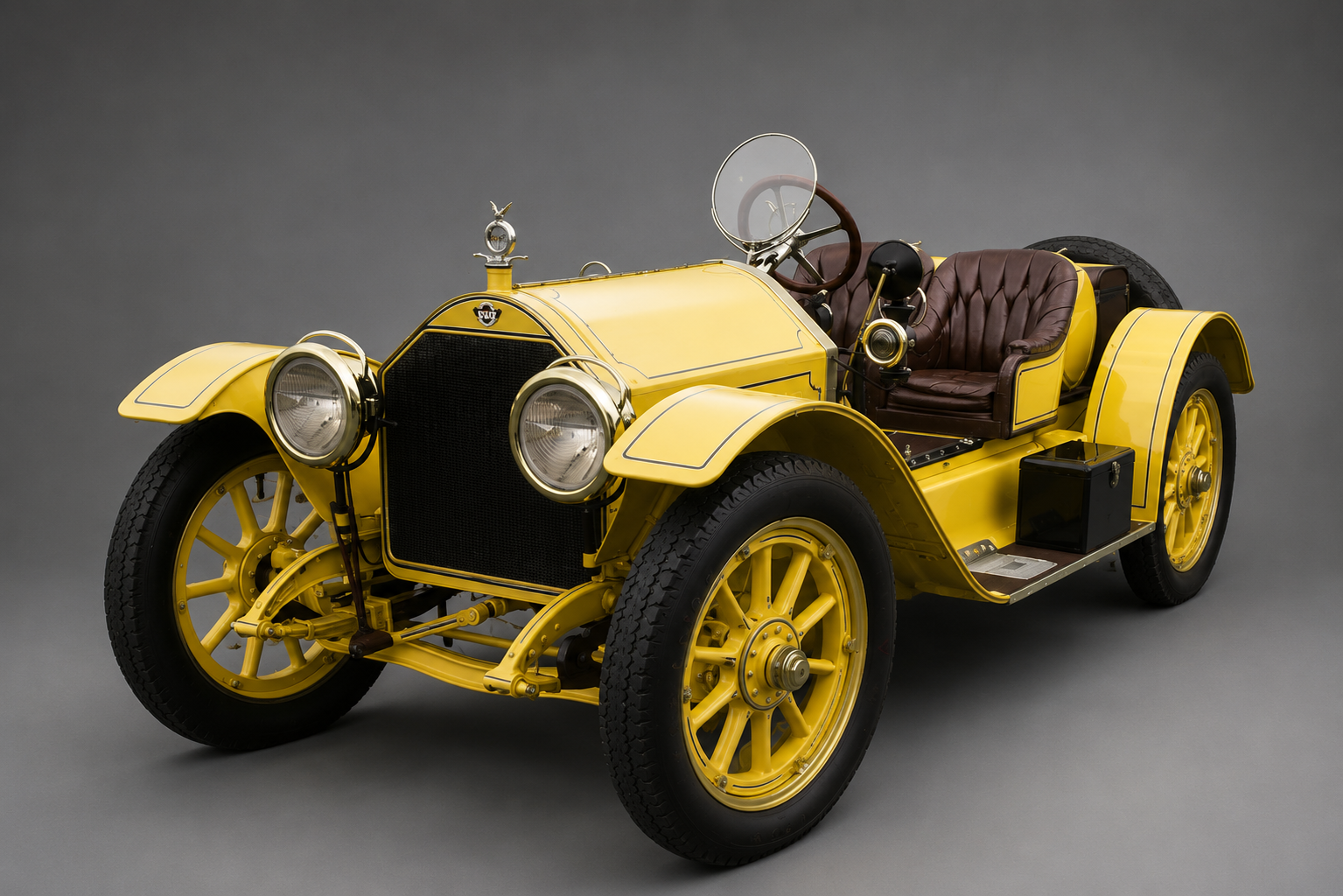
Yellow Stutz Bearcat pre-war speedster, front three-quarter studio view on a plain grey backdrop showing the exposed chassis rails, twin brass headlamps, black vertical grille with Stutz badge, brass Moto-Meter radiator cap, monocle windscreen, deep buttoned brown leather bucket seat, right-hand steering wheel with external gear and brake levers, and yellow-painted wooden artillery wheels.
Overview

Why this car matters

The Stutz Bearcat is America's first true production sports car. Introduced in the Series A of 1912 as a shorter, lighter derivative of Harry Stutz's Indianapolis 500 competition chassis, the Bearcat set the template for the American sporting motor car for a generation: a 120-inch wheelbase, minimal bodywork, a monocle windscreen, open bucket seats and a cylindrical fuel tank on a short rear deck. Through 1915 the Bearcat was catalogued with a Wisconsin Motor Manufacturing Company 389.9 cid (6,388cc) T-head straight-four rated at around 60 bhp, and a six-cylinder Wisconsin was offered as a $250 factory option — from 1916 to 1924 the car was four-cylinder only. The Wisconsin four ran through 1917; the Series S of 1917 introduced Stutz's own 360/361 cid (5.9-litre) T-head four, notable for its sixteen valves (four per cylinder), a single-block casting and a heat-treated nickel crankshaft, and brought a step-over enclosed cockpit on the same short wheelbase. Series G and Series H followed in 1919; the 1921 Series K introduced the DH detachable-head engine, roughly 80 bhp at 2,400 rpm, and closed the classic run. The switch to left-hand drive on the subsequent KLDH ended the model — the narrow Bearcat cockpit could not accommodate the centrally-mounted gear and brake levers. The Bearcat name disappeared from Stutz's lists in 1922, was briefly revived for the 1923 roadster, and vanished again in 1924 (a small number of sources extend the name to 1922 or to 1925, but 1924 is best supported). All pre-war Bearcats are right-hand drive with external gearshift and brake levers and rear-wheel-only mechanical brakes. Total pre-war Bearcat production is not precisely established in the open record and any single headline figure would be invented.

The Bearcat is the archetypal American sports car and the definitive Roaring Twenties motor vehicle. On the racetrack the Stutz White Squadron team won the AAA national championships of 1913 and 1915, a stock Bearcat took Erwin 'Cannonball' Baker across America from California to New York in eleven days, seven hours and fifteen minutes in 1915 — the drive that gave its name to every Cannonball Run since — and the model's cultural imprint, from raccoon coats and college campuses to Sweet Jane, is unmatched by any other American car of its period. It is also the direct predecessor of every subsequent American sporting car, and the founding stone on which the Stutz name still stands.

Variants

Range and production

VariantYearsProductionNotes
Series A / Series E Bearcat1912–1916Doorless open two-seat body on a 120-inch wheelbase. Wisconsin Motor Mfg Co. 389.9 cid (6,388cc) T-head straight-four, ~60 bhp, used through 1917. Series E (1913–1914) added electric lights and starter. Through 1915 a six-cylinder Wisconsin engine was offered as a $250 factory option; from 1916 the Bearcat was four-cylinder only. Right-hand drive, external gearshift and brake levers, rear-wheel mechanical brakes only. The definitive early Bearcat and the leading tier of the pre-war market.
Series S Bearcat1917–1918First major change to the model. Same 120-inch wheelbase but now with a fully enclosed step-over cockpit. New Stutz-designed 360/361 cid (5.9-litre) T-head four with sixteen valves — four per cylinder — cast in a single block with a heat-treated nickel crankshaft. Four-cylinder only from this point onward. Right-hand drive, external gearshift and brake levers retained.
Series G / Series H Bearcat1919Series G early 1919, Series H mid-1919 onward. Series H introduced cut-down cockpit sides to ease entry and a wider colour palette including yellow, royal red and elephant gray. Same 16-valve T-head four; right-hand drive retained.
Series K Bearcat1920–19211920 K continued the earlier specification with a post-war price increase; the 1921 K introduced the new DH detachable-head engine at roughly 80 bhp @ 2,400 rpm — a serious engineering step and materially easier to service. Right-hand drive retained. The subsequent KLDH switched to left-hand drive, which ended the Bearcat: the narrow cockpit could not accommodate the centrally-mounted gear and brake levers.
1923 Bearcat roadster (revival)1923The roadster body was renamed 'Bearcat' for a single model year in 1923 as a nameplate revival; the name disappeared again from Stutz lists in 1924. A footnote to the classic 1912–1921 model rather than a continuation of it.
White Squadron works competition cars1913, 1915Factory racing team cars, not production Bearcats and never catalogued for sale. Included here as historical context: the White Squadron won the AAA national championships of 1913 and 1915 and cemented the Bearcat's reputation on the track.
Buyer's Guide

What to look for

Provenance and originality

For pre-war and vintage cars such as the Stutz Bearcat, provenance is paramount. Chassis and engine number matching, period coachbuilder records, factory build sheets where available, continuous ownership documentation, original handbooks and any competition or concours history are the foundation of value. Original body-to-chassis pairing correct for the series, matching-numbers Wisconsin or Stutz T-head engine, original right-hand-drive layout, documented Stutz Club provenance, continuous ownership history and the depth and standing of any restoration. White Squadron-associated cars, Cannonball Baker–era Series E cars and other documented period-competition or record-attempt chassis are a separate reference tier.

Mechanical inspection priorities

The Series A and Series E cars carry the Wisconsin Motor Manufacturing Company 389.9 cid T-head four; from Series S onward the engine is Stutz's own 360 cid 16-valve T-head four, cast in a single block with a heat-treated nickel crankshaft. Both are robust units on paper but a century of use, indifferent overhauls and dwindling specialist knowledge make a period-correct rebuild a serious specialist commission. Series K of 1921 introduced the DH detachable-head engine — a genuine step forward at the time and useful to service now. On any Bearcat, hot oil pressure, T-head valve gear condition, ignition system (magneto and coil where fitted), carburettor set-up and cooling capacity should be inspected in detail. All pre-war Bearcats are rear-wheel-brake only; that is the correct period specification and not a fault, though it defines how the car must be driven in modern traffic. The rear-axle-mounted transaxle characteristic of the early cars is a specialist item. A pre-purchase inspection by a recognised marque specialist should include compression and leak-down testing, magneto and ignition checks, chassis straightness and frame survey, axle and steering wear assessment, brake system review (mechanical or hydraulic per period), and an extended road test on varied terrain to expose carburation, cooling and gearbox issues that only emerge under sustained running.

Body, chassis and originality of coachwork

Pre-war coachwork is rarely truly original after a century of use. Establish whether the body is original to the chassis (period photographs, build records, coachbuilder plates), whether it has been re-bodied at any point, and the standard of any restoration. Quality of timber framing, ash health, panel beating and paint depth are all critical. Concealed structural rot, re-bodies presented as original, and 'tribute' cars built on later or unrelated chassis must be priced accordingly.

Specification and event eligibility

Series and body style are decisive: Series A and Series E doorless bodies from the pre-1917 era lead, followed by Series S / G / H step-over-cockpit cars from 1917–1919, then Series K cars from 1920–1921. Chassis and engine numbers matched to the Stutz Club register, documented ownership chain, original right-hand-drive layout and factory-specification rear-wheel-only mechanical brakes are the reference. Later re-bodies of tourer or roadster chassis presented as Bearcats, 1960s Howard D. Williams International Scout-based fibreglass revivals, and Barris-built 1971 television replicas on Ford chassis are all separate markets and must be identified and priced accordingly. For vintage cars, event eligibility — Mille Miglia, Goodwood Revival, Pebble Beach, VSCC events, Le Mans Classic — can underwrite a substantial proportion of market value. Verify FIA/FIVA papers, period race history where claimed, and the car's standing with the relevant marque registry before purchase.

Pricing

What to pay

Concours Series A / Series E doorless Bearcat, documented history
USD$1,200,000 – $2,900,000
GBP£900,000 – £2,200,000
EUR€1,000,000 – €2,450,000
Top-tier Series E cars with matching chassis and engine numbers, complete Stutz Club provenance, doorless original body and continuous ownership history. The upper end of the band reflects the recorded aggregate high of $2,920,000 for a 1914 Series 4E Bearcat; cars with any documented White Squadron, Cannonball Baker or period-competition association trade above this band by negotiation.
Excellent Series S / G / H step-over Bearcat
USD$400,000 – $650,000
GBP£300,000 – £490,000
EUR€340,000 – €550,000
Restored 1917–1919 Bearcats with the Stutz 16-valve T-head, original step-over coachwork, matching numbers and Stutz Club register confirmation.
Good Series K / 1923 revival Bearcat
USD$300,000 – $500,000
GBP£225,000 – £375,000
EUR€255,000 – €420,000
Series K cars, including the 1921 DH detachable-head engine, and the 1923 revival roadster. Cars needing recommissioning of the T-head four or transaxle sit at the lower end of the band.
Body-to-chassis mismatch, re-bodied or replica
USD$60,000 – $200,000
GBP£45,000 – £150,000
EUR€50,000 – €170,000
Later re-bodies of tourer or roadster chassis presented as Bearcats, Howard D. Williams 1960s fibreglass Bearcat on the International Scout chassis, or Barris-era television replicas on Ford drivetrains. A separate market entirely and priced against the underlying chassis.

Regional ranges authored independently — each reflects its local market, not an FX conversion

Ownership

Living with it

Typical mileage
300–2,000 miles typical for vintage use; rally cars higher
Service interval
Annual full service; pre-event check before any rally or tour
Annual running cost
$8,000 – $35,000 depending on use, storage and event programme
Fuel economy
10–18 mpg typical; heavy carburetted engines run rich
Insurance
Use a specialist agreed-value vintage policy with declared value reviewed annually. Premiums reflect declared value, storage, event use and driver experience with pre-war machinery.

Maintenance planning

Vintage cars require disciplined preventive maintenance: lubrication regimes, magneto service, carburettor synchronisation, brake adjustment, and timber and trim conservation. A car used regularly and serviced annually by a specialist will outlast a stored example neglected for decades.

Specialist access and parts

The Stutz Club (Indianapolis) is the central network for pre-war Bearcat ownership; specialist restorers are a small international group, and parts fabrication is standing practice for any major mechanical work. Katzell's 'The Splendid Stutz' is the standing reference work. Confirm the availability of marque specialists, period-correct fasteners, coachwork trim, instruments and tyres before committing. A car requiring fabricated one-off parts will absorb time and cost that a similar example with active specialist support will not.

Common Problems

Known issues by system

Engine

Wisconsin T-head four (Series A/E) or Stutz 16-valve T-head four (Series S onward) bottom-end and valve gear wear

Major$25,000 – $70,000 (engine rebuild)
Symptoms — Low hot oil pressure, top-end rattle from the T-head valve gear, dropped compression on individual cylinders.
Inspection — Hot oil pressure test; compression and leak-down on all four cylinders; inspection of the T-head valve gear; specialist Stutz Club-approved engine builder review.
Body

Original doorless coachwork (Series A–E) vs. later step-over cockpit (Series S–K)

CriticalValue impact: 30–60% on any body-to-chassis mismatch
Symptoms — Series A–E cars are doorless with a monocle windscreen; Series S and later cars have an enclosed cockpit with step-over sides. Body style must match the chassis series; roadster-to-Bearcat conversions and later-body-on-earlier-chassis cars trade at meaningful discounts.
Inspection — Verify body style against factory series specification; cross-reference chassis and engine numbers with the Stutz Club registry and the Katzell 'Splendid Stutz' reference.
Identity

Genuine factory Bearcat vs. converted roadster or replica

CriticalValue impact: factory Bearcat vs. tribute or re-body differential can exceed 70%
Symptoms — The Bearcat name has attracted decades of tribute cars, Barris-built TV-show replicas on Ford chassis, and Howard D. Williams International Scout-based fibreglass 1960s revivals. Standard Series tourer or roadster chassis have also been re-bodied as Bearcats.
Inspection — Verify chassis and engine numbers against Stutz Club records; require documented ownership chain and period photographs; independent expert inspection is essential before any deposit.
Transmission

Rear-axle-mounted three-speed transaxle (Series A–H) wear

Major$8,000 – $20,000
Symptoms — Whine on load, jumping out of gear, difficult cold operation on the rear-mounted transaxle characteristic of the early cars.
Inspection — Full road test through all gears cold and hot; inspection of the transaxle for prior repair or replacement; verify presence of the correct period-specification unit.
Brakes

Rear-wheel-only mechanical brakes on all pre-war Bearcats

Moderate$3,000 – $10,000
Symptoms — All pre-war Bearcats use rear-wheel mechanical brakes only; long pedal, uneven pull, and modest ultimate stopping ability are inherent to the period specification and are not a fault. Modern four-wheel-brake conversions do exist and are a documented originality item.
Inspection — Static and dynamic brake test; verify original rear-wheel-only specification; any four-wheel conversion is a reversibility item and should be priced accordingly.
Right-hand drive vs. left-hand drive originality (KLDH transition)

Late Series K to KLDH transition changed the Bearcat from right-hand drive to left-hand drive, which effectively ended the model

CriticalValue impact: converted cars trade at a meaningful discount
Symptoms — 1921 Series K and earlier cars are right-hand drive with external gearshift and brake levers; the switch to left-hand drive on the KLDH was incompatible with the narrow Bearcat cockpit. Any early Bearcat presented in left-hand drive form is a modification and a paperwork item.
Inspection — Verify original hand of drive against series specification and Stutz Club records; any conversion is a documented item.
Parts and specialist support

Pre-war Stutz specialist community is very small

MajorVariable — plan on specialist fabrication cost for any major mechanical work
Symptoms — Engine components (Wisconsin T-head, Stutz 16-valve T-head), transaxle internals and period-correct trim are all specialist-fabrication items with long lead times.
Inspection — Verify Stutz Club network access and standing relationship with a recognised pre-war Stutz engine builder before committing.
Valuation

Current value bands by region

Concours
USD
$1,600,000
GBP
£1,200,000
EUR
€1,350,000
+1% 12-mo
Excellent
USD
$525,000
GBP
£395,000
EUR
€445,000
0% 12-mo
Good
USD
$390,000
GBP
£295,000
EUR
€330,000
0% 12-mo
Fair
USD
$230,000
GBP
£175,000
EUR
€195,000
-1% 12-mo
Project
USD
$90,000
GBP
£70,000
EUR
€78,000
0% 12-mo

Each region quoted in its local currency — independent market readings, not FX conversions

The Bearcat market is small, thinly traded and dominated by identity. Series A and Series E doorless cars sit at the top on the strength of their pre-Great War date, the Wisconsin T-head engine and the model's foundational significance; the 2008 Pebble Beach sale of a Series E Bearcat at $1,375,000 remains the reference open-auction print, and aggregate records extend the ceiling for the very best 1914 Series 4E cars to around $2,920,000 for exceptional, concours-shown examples with full history. Series S / G / H step-over cars trade in a broad middle band and reward matching numbers and Stutz Club register confirmation. Series K cars, including the 1921 DH detachable-head engine, are more usable and trade in a wide range that reflects both condition and how strictly the car has been kept to original right-hand-drive specification. The dominant risk across all series is identity: the Bearcat name has attracted decades of re-bodies, 1960s fibreglass revivals on International Scout chassis and 1971 television-show replicas on Ford drivetrains, and any car offered without a documented ownership chain and Stutz Club register confirmation must be treated on the underlying chassis, not on the badge.

Auctions

Recent results

DateAuctionCarMileageResult
2008-08-16
Gooding & Co.
Pebble Beach
1914 Series E Bearcat (chassis 2177)
$1,375,000
Sold
2016-08-19
Bonhams
Quail Lodge
1921 Series K Bearcat (chassis 10555)
$594,000
Sold
2017-01-20
Gooding & Co.
Scottsdale
1920 Series H Bearcat (chassis 5067)
$451,000
Sold
2019-08-16
Gooding & Co.
Pebble Beach
1918 Series S Bearcat (chassis S-1743)
$257,600
Sold
2023-08-18
Gooding & Co.
Pebble Beach
1921 Series K Bearcat (chassis 10555, same car as the 2016 Bonhams sale)
$368,000
Sold
2025-03-15
Gooding & Co.
The Stan Lucas Collection
1913 Model 6B Bearcat (chassis 1056)
$423,000
Sold
Investment

Long-term outlook

Blue ChipHorizon: 10+ years

The Bearcat is a permanent asset of the American sporting car canon. Series E cars from the doorless-body era are effectively unrepeatable at open auction and trade as museum-class objects; Series S / G / H and Series K cars offer meaningfully broader liquidity at more attainable levels and reward strict originality and Stutz Club register confirmation. The dominant risk is identity — re-bodies, fibreglass revivals and television replicas — which authentication solves rather than mitigates.

Recommended

The trusted network

Specialists

  • Stutz marque specialist
    View →
    UK / Europe
    Stutz Bearcat restoration, mechanical service and originality reviews.
  • Pre-war coachwork specialist
    View →
    International
    Timber framing, ash conservation, panel beating and period-correct paint for pre-war coachwork.
  • Concours preparation studio
    View →
    International
    Concours preparation, detailing and event support for pre-war and vintage cars.
  • Hagerty
    View →
    USA / UK / EU
    Agreed-value collector insurance specialising in pre-war and vintage cars.
  • Lockton Performance
    View →
    UK / EU
    Specialist agreed-value cover for significant pre-war and competition cars.

Storage

  • Windrush Car Storage
    View →
    Cotswolds, UK
    Climate-controlled storage and collection management for pre-war and classic cars.
  • Autovault
    View →
    Bicester, UK
    Secure climate-controlled storage at Bicester Heritage with inspection programmes.
  • Classic Car Club Manhattan
    View →
    New York, NY
    Secure urban storage for collector and pre-war cars.

Transport

  • CARS UK
    View →
    UK & Europe
    Enclosed concours and event transport for pre-war and vintage machinery.
  • Reliable Carriers
    View →
    USA (national)
    Enclosed coast-to-coast transport for pre-war American and European cars.
  • FERRLOG
    View →
    Italy / Europe
    Air-ride enclosed transport for Italian and European collector cars.

Enjoyed this guide?

Get new buyer's guides and collector market intelligence delivered to your inbox. No spam. We respect your inbox.

The valuation figures in this guide are for research purposes only and do not constitute financial or investment advice. See our full disclaimer.