Car Collector International
Modern Classic · 1999–2005

Shelby Series 1

The only car Carroll Shelby designed from the ground up — 249 cars, an Oldsmobile Aurora V8, and a build story more contentious than the car itself.

Car Collector International Editorial
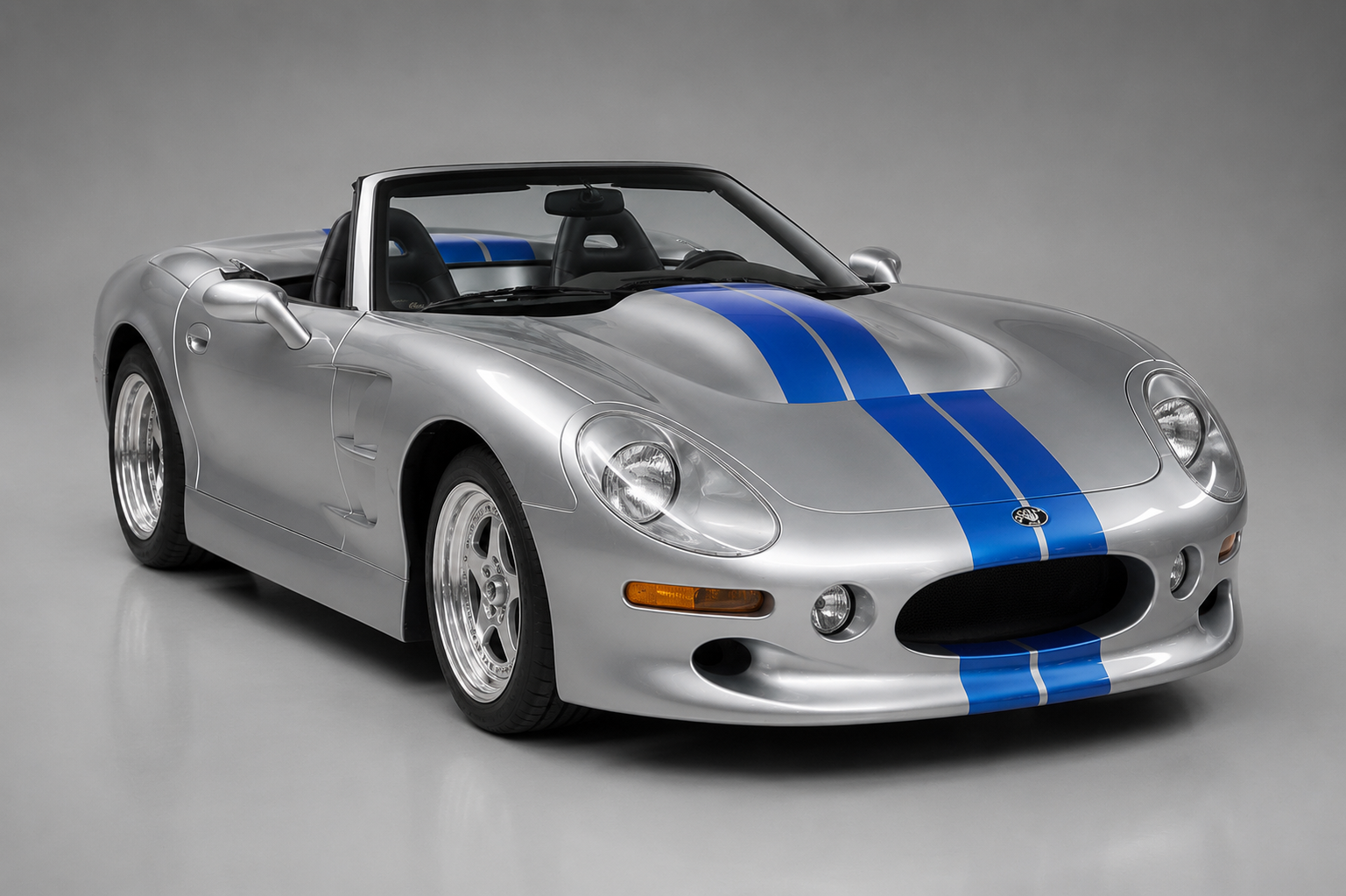
Silver Shelby Series 1 roadster with blue centre stripes, front three-quarter studio view showing the low aluminium body, round quad headlights, oval grille aperture and polished multi-spoke alloy wheels.
Overview

Why this car matters

The Series 1 was Carroll Shelby's late-career project — a clean-sheet roadster designed and built by Shelby American, not an engine transplant into someone else's chassis. The car uses a bonded and riveted aluminium honeycomb chassis with composite bodywork, a 4.0-litre Oldsmobile Aurora DOHC V8 modified for the application, and a rear-mounted ZF 6-speed transaxle for near-50/50 weight distribution. Production ran from 1999 to 2005 at Shelby's Las Vegas facility.

Official production totals 249 cars — the figure Shelby American itself has consistently cited. A separately organised attempted continuation programme in the early-to-mid 2000s produced a small number of additional partially-completed cars, titled and delivered as component kits rather than as certified Series 1 production; those cars are collectable in their own right but are not part of the 249. A Vortech supercharger was offered as a factory-approved upgrade from 2002 (bringing output to roughly 450 bhp); it is an option package rather than a distinct model.

The Series 1 is the only car Carroll Shelby designed from a blank sheet. Fixed low production (249), late-career Shelby involvement, a Ford-independent drivetrain and a distinctly non-Cobra design brief make it a categorically separate entry in the Shelby canon.

Variants

Range and production

VariantYearsProductionNotes
Series 1 (naturally aspirated)1999–2005Original specification; Oldsmobile Aurora 4.0 DOHC V8, approx. 320 bhp; part of the 249-car production run.
Series 1 (Vortech supercharged)2002–2005Factory-approved supercharger upgrade; approx. 450 bhp. Available as new-car option or retrofitted; part of the 249-car production run.
Buyer's Guide

What to look for

Provenance and originality

Start with identity, paperwork and originality. For the Shelby Series 1, the strongest cars have continuous ownership history, matching numbers where applicable, factory build documentation and Shelby American Automobile Club (SAAC) registry entries. One of the 249 official production cars, factory build documentation, supercharger provenance where fitted, and no history of continuation-kit part swaps.

Mechanical inspection priorities

The Aurora 4.0 DOHC V8, as modified for the Series 1, is not the same engine as the base Oldsmobile production unit — Shelby specification includes dry-sump lubrication, uprated internals and its own management. Support requires a Series 1–experienced specialist; standard GM Aurora shops are not equipped for it. A proper pre-purchase inspection includes cold-start behaviour, compression and leak-down testing, underbody photography, chassis inspection for repair and correction, and a long road test to expose heat-related faults. Deferred maintenance on a Shelby is almost always more expensive than paying up for a better-sorted example.

Body, paint and accident history

Shelby cars carry a large proportion of hand-finished, low-volume bodywork — fibreglass panels on the Mustang-based cars, hand-formed aluminium on the Daytona Coupe, and composite panels on the Series 1. Use a paint-depth gauge, lift access and a specialist familiar with the model's factory panel gaps. Value is dramatically affected by structural repairs, refinished panels and missing original trim. Documented cosmetic refresh is acceptable; concealed accident or fire damage must be priced severely.

Specification strategy

Documented factory production cars — the 249 build — with continuous ownership history, complete build documentation and no involvement in the later continuation-kit programme are the target market. Supercharged cars carry a modest premium; supercharger conversions on non-supercharged cars must be documented as period-correct. Specification, colour, options and limited-build variants move values significantly. Buy the best-documented example in the most desirable specification you can justify, not a tired example of a rarer derivative that will need years of corrective work.

Pricing

What to pay

Supercharged, low miles, documented
USD$150,000 – $220,000
GBP£120,000 – £175,000
EUR€135,000 – €200,000
Best examples with supercharger provenance and full factory documentation.
Naturally aspirated, excellent
USD$95,000 – $140,000
GBP£76,000 – £112,000
EUR€85,000 – €125,000
Documented 249-run cars in strong original condition.
Good driver
USD$70,000 – $95,000
GBP£55,000 – £76,000
EUR€63,000 – €85,000
Useable cars with honest history from the official production run.

Regional ranges authored independently — each reflects its local market, not an FX conversion

Ownership

Living with it

Typical mileage
500–3,000 miles typical for collector use
Service interval
12 months; mileage interval varies by model and use
Annual running cost
$5,000 – $18,000
Fuel economy
10–18 mpg depending on use
Insurance
Use an agreed-value collector or specialist policy with limited mileage, secure storage, documented photography and an annual value review. Shelby cars — especially GT350 R-models, KRs and the Daytona Coupe — need a bespoke agreed-value at market, not a book-figure default.

Maintenance planning

Budget annually even if the car is used sparingly. Fluids age, tyres and date-coded rubber components must be replaced regardless of mileage, and stored cars need exercise. A documented maintenance rhythm protects both reliability and resale value.

Parts and specialist access

Extremely narrow specialist network — a small US owner community with Shelby American factory support relationships. Not a car to buy without engaging that community first. Before purchase, confirm parts availability for model-specific bodywork, drivetrain and trim components. A discounted car waiting on unobtainable parts is rarely a saving in Shelby ownership.
Common Problems

Known issues by system

Provenance

Official 249-run vs continuation-kit car

CriticalValue impact
Symptoms — Cars presented as production Series 1 but originating from the later kit programme; missing factory build sheets; irregular VIN sequencing.
Inspection — Full factory build documentation review and Shelby American production-record verification.
Engine

Aurora V8 specialist support and dry-sump service

Major$5,000 – $15,000
Symptoms — Oil consumption; dry-sump pressure faults; sensor and management issues on undocumented cars.
Inspection — Specialist inspection by a Series 1–experienced shop.
Body and chassis

Aluminium honeycomb tub inspection

Major$10,000 – $40,000
Symptoms — Damage to bonded aluminium tub; composite panel-fit issues after any impact.
Inspection — Specialist chassis inspection; documented repair history against factory tub specification.
Valuation

Current value bands by region

Concours
USD
$180,000
GBP
£145,000
EUR
€162,000
+2% 12-mo
Excellent
USD
$120,000
GBP
£96,000
EUR
€108,000
+1% 12-mo
Good
USD
$85,000
GBP
£68,000
EUR
€77,000
0% 12-mo

Each region quoted in its local currency — independent market readings, not FX conversions

A thin but rising market. Series 1 values sat below list for much of the 2010s but the marque story — the only Carroll Shelby ground-up design — is now recognised in a way it wasn't at launch. Supercharged cars with clear factory build documentation lead the market; anything with a hint of continuation-kit lineage trades at a clear discount. Trade is almost entirely through owner-community channels, not mainstream auction rooms.

Auctions

Recent results

DateAuctionCarMileageResult
2024-01-13
Mecum
Kissimmee
1999 Series 1 Roadster
$99,000
Sold
2023-08-19
Mecum
Monterey
1999 Series 1 Roadster (supercharged)
$132,000
Sold
Investment

Long-term outlook

EmergingHorizon: 5–10 years

The only Carroll Shelby clean-sheet car, at a low fixed production, in a market that spent 20 years undervaluing it. Documented supercharged 249-run cars are the accessible collector-grade Shelby of the modern era; the continuation-kit overhang is the single risk to manage on purchase.

Recommended

The trusted network

Specialists

  • SAAC-recognised Shelby specialist
    View →
    United States
    Series 1 inspections, drivetrain overhaul and SAAC-registry-standard originality reviews.
  • Independent Shelby restorer
    View →
    UK / Europe
    Restoration, mechanical service and pre-purchase inspection for the Series 1 in Europe.
  • Concours preparation studio
    View →
    International
    Paint correction, PPF, detailing and preservation for premium American collector cars.
  • Hagerty
    View →
    USA / UK / EU
    Agreed-value collector insurance with strong Shelby-market recognition.
  • Grundy
    View →
    USA
    Agreed-value collector cover specialising in American muscle and pre-war classics.

Storage

  • Windrush Car Storage
    View →
    Cotswolds, UK
    Climate-controlled storage and collection management for high-value classic and supercars.
  • Autovault
    View →
    Bicester, UK
    Secure climate-controlled storage at Bicester Heritage with inspection programmes.
  • Classic Car Club Manhattan
    View →
    New York, NY
    Secure urban storage for collector and modern performance cars.

Transport

  • CARS UK
    View →
    UK & Europe
    Enclosed event, concours and collection transport across Europe.
  • Reliable Carriers
    View →
    USA (national)
    Enclosed coast-to-coast transport for premium supercars and classics.
  • FERRLOG
    View →
    Italy / Europe
    Air-ride enclosed transport for Italian and European collector cars.

Enjoyed this guide?

Get new buyer's guides and collector market intelligence delivered to your inbox. No spam. We respect your inbox.

The valuation figures in this guide are for research purposes only and do not constitute financial or investment advice. See our full disclaimer.