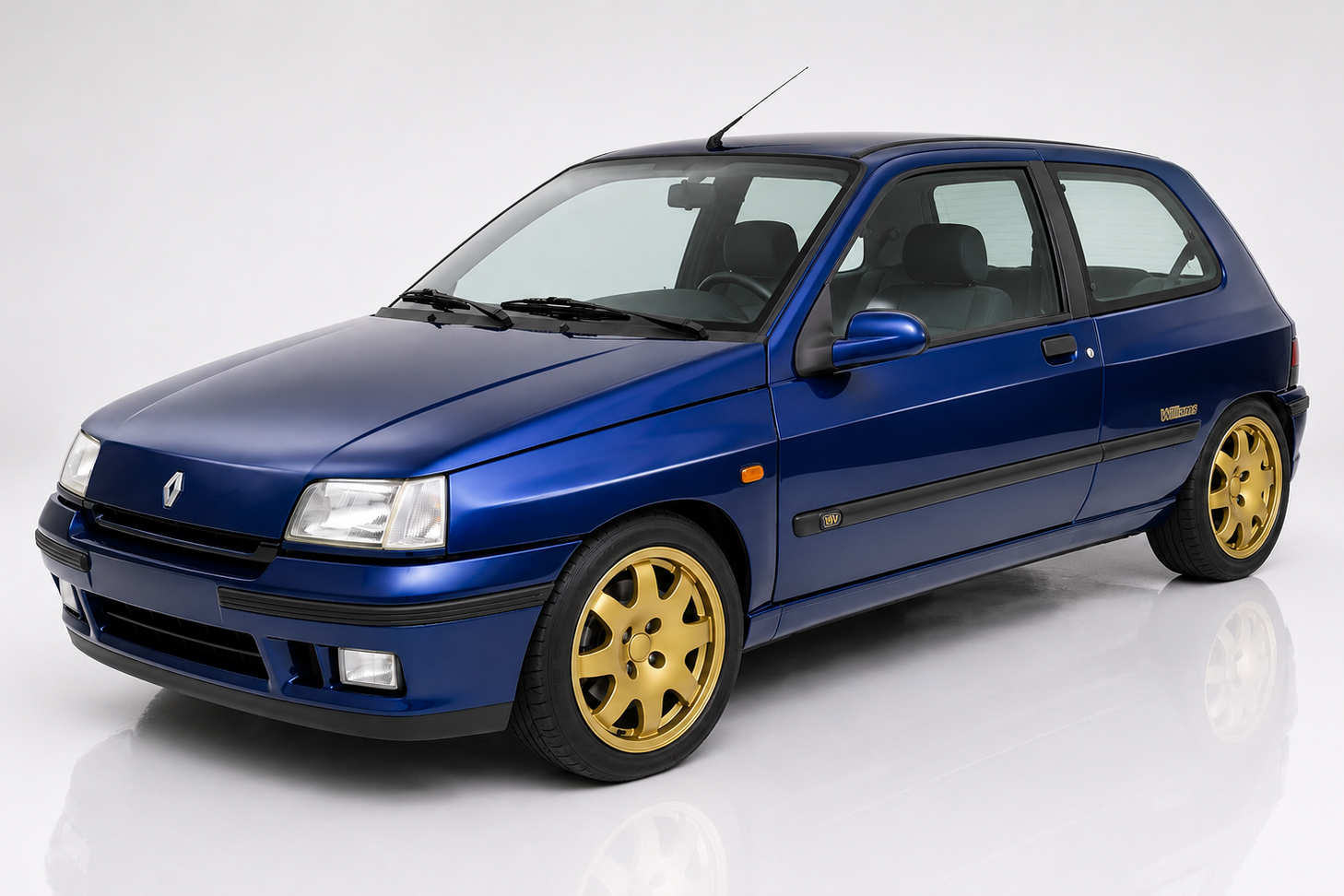
The Renault Clio Williams (1993–1996) is a Group A / Group N rally homologation special developed on the Phase 1 Clio bodyshell. It uses the F7R 2.0-litre 16-valve inline-four producing 147 PS / 145 hp, paired with a JC5 five-speed manual gearbox and front-wheel drive, at a kerb weight of around 1,010 kg. A widened front track (derived from the Clio Cup racers), stiffer suspension, uprated brakes, Sports Blue Metallic paint and gold Speedline alloy wheels are the signature elements.
Production ran to approximately 12,000 units across three series — Williams 1 (approximately 5,400, with a numbered dashboard plaque and no sunroof, and the collector's pick), Williams 2 (approximately 5,000, wider market with sunroof and small trim changes) and Williams 3 (approximately 1,600, primarily export). Per-series splits vary between sources. Williams F1 — Renault's engine partner at the time — had a minimal direct role beyond the branding.
The Clio Williams is a benchmark 1990s European hot hatch and the definitive homologation special of the Phase 1 Clio range. Small production, singular specification (Sports Blue over gold Speedline wheels), F1-linked branding and clear rally lineage give it a defined and rising collector market — especially for numbered-plaque Williams 1 cars.