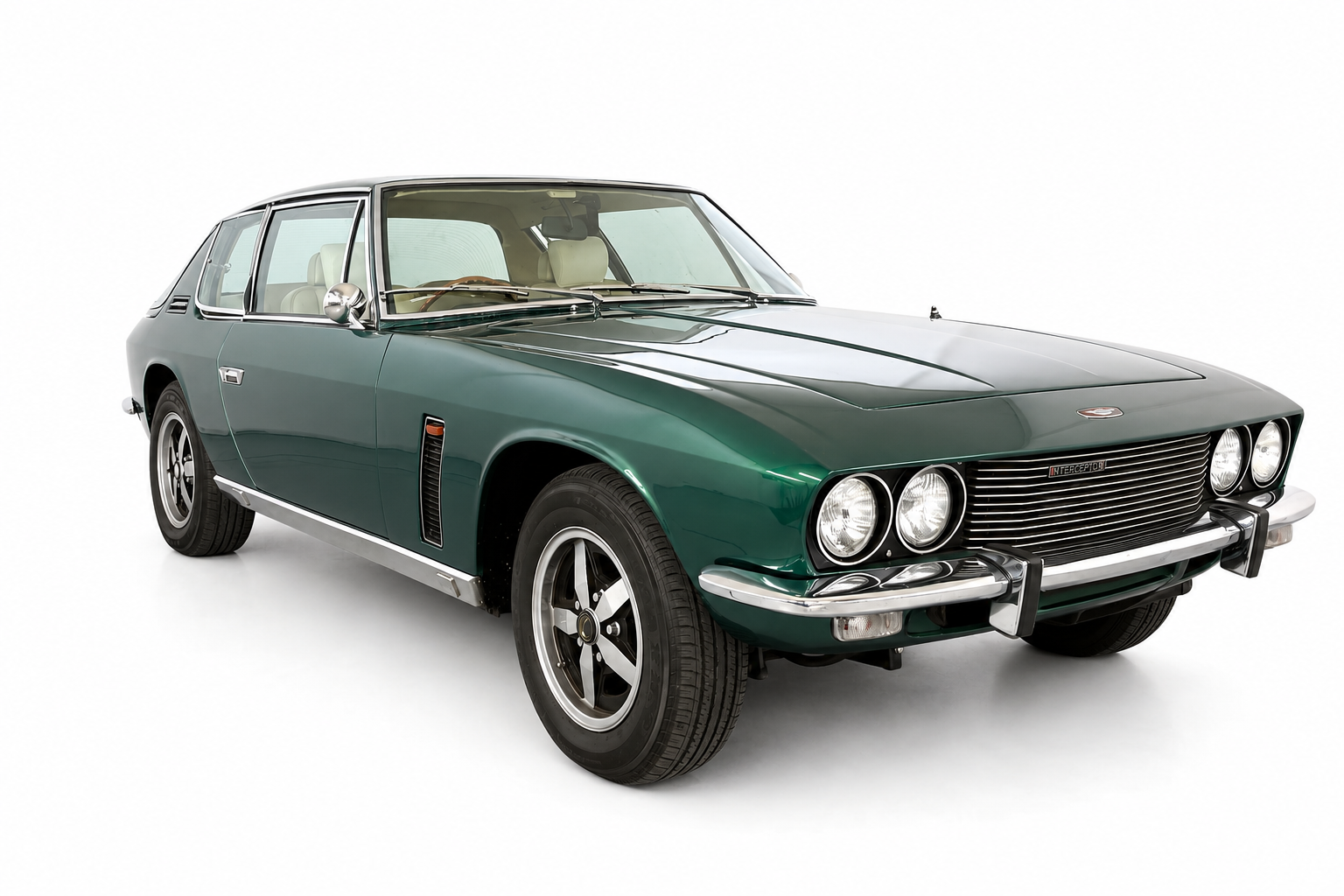
The Jensen Interceptor is the hand-built fastback grand tourer produced by Jensen Motors at West Bromwich from 1966 to 1976. Styled and initially built in Italy by Carrozzeria Touring and Vignale — later manufacture returned to West Bromwich — its signature is the wraparound rear glass hatch that gave the shape its identity.
Under the bonnet sat a series of Chrysler V8s: the 383 (6.3L) to 1971, then the 440 (7.2L) from 1971, with the three-speed TorqueFlite automatic standard and a rare four-speed manual available on early cars. Approximately 6,408 Interceptors were built across three marks (Mk I ~1,024, Mk II ~1,128, Mk III ~4,255), plus two significant sub-variants: the FF, with Ferguson Formula 4WD and Maxaret ABS — the first all-wheel-drive road car, fourteen years before the Audi Quattro; and the SP, powered by the 440 'Six Pack' triple-carburettor V8 producing 385 hp, the most powerful Jensen ever built.
The scope of this guide is the original 1966–1976 car. The subsequent Series 4 (1983–1993), the JIA Interceptor R restoration programme (2011 onwards) and the 2026 GTX revival are noted here for context but are not covered as part of this guide.
The Interceptor is one of the definitive Anglo-Italian-American grand tourers of its era: a Touring-styled body, hand-built at West Bromwich, powered by a rugged Chrysler V8, with the FF variant establishing all-wheel-drive road-car production almost a decade and a half before it became mainstream. Its combination of hand-build character, big-V8 drivetrain and unmistakable silhouette places it as an entry-point serious classic — materially more attainable than a period Aston or Ferrari GT, and with a service story that plays to strong specialist support in the UK.