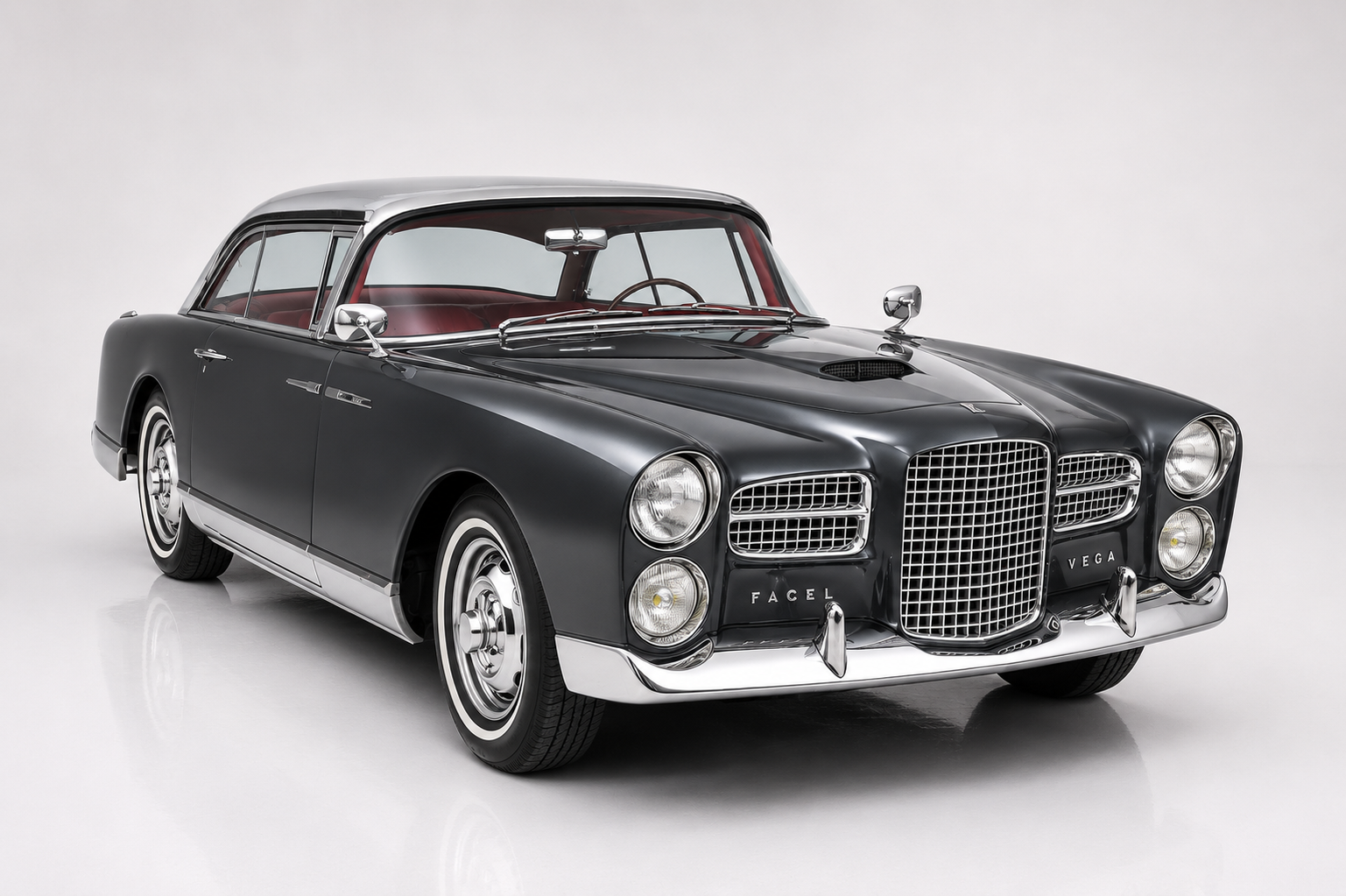
Founded by Jean Daninos in 1939 as Forges et Ateliers de Construction d'Eure-et-Loir, Facel began building special bodies for other marques before launching its own grand tourer, the FV, in 1954. A tubular chassis designed by Lance Macklin, double-wishbone front and leaf-sprung live rear axle carried a hand-built steel body powered — invariably — by a Chrysler or DeSoto V8. Approximately 1,800 kg dry.
Across a decade the same architecture ran through the FV / FVS (1954–58), the definitive HK500 (1959–62) and finally the Facel II (1962–64), gathering displacement and horsepower along the way. The pillarless four-door Excellence (1956/58–64) added a saloon variant. Facellia — the smaller four-cylinder sports car — is not covered here; its troubled in-house engine generated the warranty claims that bankrupted the company in 1964.
The FV / HK500 / Facel II family is the great Franco-American grand tourer: Chrysler drivetrains reliable enough to cross continents inside couture French bodywork built at Colombes. Owners included Stirling Moss, Ava Gardner, Tony Curtis, Ringo Starr, Fred Astaire and Pablo Picasso; Albert Camus died a passenger in an FV2 in January 1960. The marque produced approximately 2,900 vehicles across its entire life — and 77% were exported, thanks to France's punitive tax-horsepower system.
Variants
Range and production
Variant
Years
Production
Notes
FV (1954–1955)
1954–1955
Not separately recorded
Original launch specification. DeSoto Firedome 4.5-litre Hemi V8, 180 hp; Chrysler Powerflite two-speed automatic or Pont-à-Mousson four-speed manual. The subsequent FV1 moved to 4.8 litres and 200 hp on a wheelbase extended by 12 cm.
FV2 / FV2B / FVS (Oct 1955–1958)
1955–1958
Not separately recorded
Panoramic windscreen. FV2 4.8-litre, 250 hp; FV2B 5.4-litre. Sold as FVS (Facel Vega Sport) in the US. FV3 and FV3B used Plymouth polyspheric V8s; the FV4 Typhoon of 1958 brought 5.8 litres, 325 hp and 425 lb-ft. FV/FVS production totalled 357.
HK500 (1959–1962)
1959–1962
Not separately recorded
Renamed, upgraded FVS. 5.8-litre (335 hp), then Chrysler 6.3-litre Typhoon V8 — 330 hp with TorqueFlite automatic, 360 hp with the Pont-à-Mousson four-speed manual. Top speed 147 mph. Around 490 built, 107 of them right-hand drive, with a single convertible across the entire run. Dunlop discs became optional in 1959 and standard from April 1960; early cars retained drums.
Facel II (1962–1964)
1962–1964
Not separately recorded
Successor to the HK500. 383 cu in (6.3-litre) Chrysler Wedge V8 — 355 bhp with a single Carter AFB and the three-speed TorqueFlite; twin four-barrel carburettors and the Pont-à-Mousson four-speed manual raised output. Dunlop discs all round and Hydrosteer power steering. 1,880 kg dry; 135 mph as an automatic, 150 mph as a manual. Advertised as 'Le Coupé 4-places le plus rapide du Monde'. Around 182 built.
Excellence (1956/58–1964)
1956/58–1964
156
Four-door pillarless saloon with rear-hinged doors. Structurally less rigid than the two-door cars and demanding to restore correctly. The rare EX2 sub-variant — eight built — carried a 5,913 cc Chrysler Wedge V8 with 360 bhp and servo-assisted drum brakes; the 1961 Paris Motor Show EX2 was delivered new to the French Ambassador to Morocco.
Buyer's Guide
What to look for
Body, structure and pillarless four-door integrity
Hand-built steel bodies on the Facel tubular chassis rust in the sills, floors, rear arches and — on the coupes — around the wraparound rear glass. For the Facel Vega family specifically, verify the exact variant (FV/FVS, HK500, Facel II or Excellence) and the exact engine against the chassis number and build documentation before pricing — the range covers eight different V8s and materially different brake specifications. On the Excellence, the pillarless four-door body with rear-hinged 'suicide' doors is materially less rigid than the two-doors and demands specific inspection of the sill and floor structure; survivors are rare and structurally-original cars are the priority.
Chrysler / DeSoto V8 identification and originality
Eight different Chrysler / DeSoto V8s were fitted across the FV/FVS, HK500 and Facel II range (plus the Excellence). Verify the exact engine — DeSoto Firedome 4.5L Hemi, Chrysler 5.4L, 5.8L Typhoon, 6.3L Typhoon or Chrysler 413 6.3L — against the chassis and build documentation; power figures were quoted very optimistically for the period and quoted output for the same engine varies between sources. Parts support is excellent through the US Chrysler network.
Brakes — the FVS and early HK500 drum issue
The FV/FVS and early HK500 used drums that drew poor contemporary press (Autocar tested one in 1958 and noted excessive pedal travel and fade). Dunlop discs became optional in 1959 and standard from April 1960. Verify brake specification against the chassis number and delivery documents; an early drum-braked HK500 is not a car to run at its indicated performance without a specialist assessment.
Trim, glass, chrome and interior originality
Signature grille, hand-fitted chrome, glass, wood-effect painted metal dashboard and leather interior are the most expensive elements to restore correctly and are Facel-specific. Verify panel gaps, chrome originality and interior against period photography and the Amicale Facel Vega record. Convertibles are exceptionally rare (11 of 842 FV/HK-series and one HK500) and any convertible offered must be verified against the marque record.
Ownership
Living with it
Typical mileage
1,000–4,000 miles typical
Service interval
12 months by time or 5,000 miles, whichever first
Annual running cost
$6,000 – $18,000 depending on condition and use
Fuel economy
10–13 mpg
Insurance
Agreed-value classic policy with limited mileage and secure storage. Franco-American GTs with Chrysler V8 drivetrains benefit from a specialist underwriter familiar with hand-built low-volume European coupes.
Body and structural corrosion
Hand-built steel bodies on a tubular chassis rust in the sills, floor pans, rear arches and around the wraparound rear glass on the coupes; the Excellence four-door is materially less rigid than the two-doors and its pillarless body is more demanding structurally.
Drivetrain vs coachwork sourcing
Chrysler / DeSoto V8, TorqueFlite / Powerflite and Pont-à-Mousson manual gearbox parts are well-supported. Facel-specific bodywork, chrome trim, glass and interior trim are the expensive-to-restore items and require the Amicale Facel Vega network.
Common Problems
Known issues by system
Body / structure
Sill, floor, arch and rear-glass surround corrosion
Original drum brakes vs 1959/60 Dunlop disc conversion
Major$3,000 – $12,000
Symptoms — Excessive pedal travel, fade under repeated application.
Inspection — Verify brake specification against chassis number and delivery documents; road-test fade behaviour.
Auctions
Recent results
Date
Auction
Car
Mileage
Result
2026-05-16
Broad Arrow Auctions
The Concorso d'Eleganza Villa d'Este Auction, Lot 125
1964 Facel II
—
€218,500
Sold
2026-01-30
Bonhams
The Paris Sale, Lot 115
1962 Facel II
—
€143,750
Sold
2025-09-28
Artcurial
Jean-Pierre Nylin Collection, Lot 26
1959 HK500
—
€104,748
Sold
2024-11-10
Osenat
Epoqu'Auto, Lot 213
1957 FV3B
—
€84,000
Sold
Investment
Long-term outlook
Strong HoldHorizon: 10+ years
Small total production, distinctive Franco-American engineering and a durable owner following via the Amicale Facel Vega network position the FV / HK500 / Facel II family as a defensible long-term collector object. Facel II and manual HK500 cars are the natural focus.
Our view, not advice. This section is Car Collector International's editorial judgement on where this model sits in the collector market, based on the production, specification and market data set out in this guide. It is not a recommendation to buy or sell and it is not investment advice. Values can fall as well as rise.