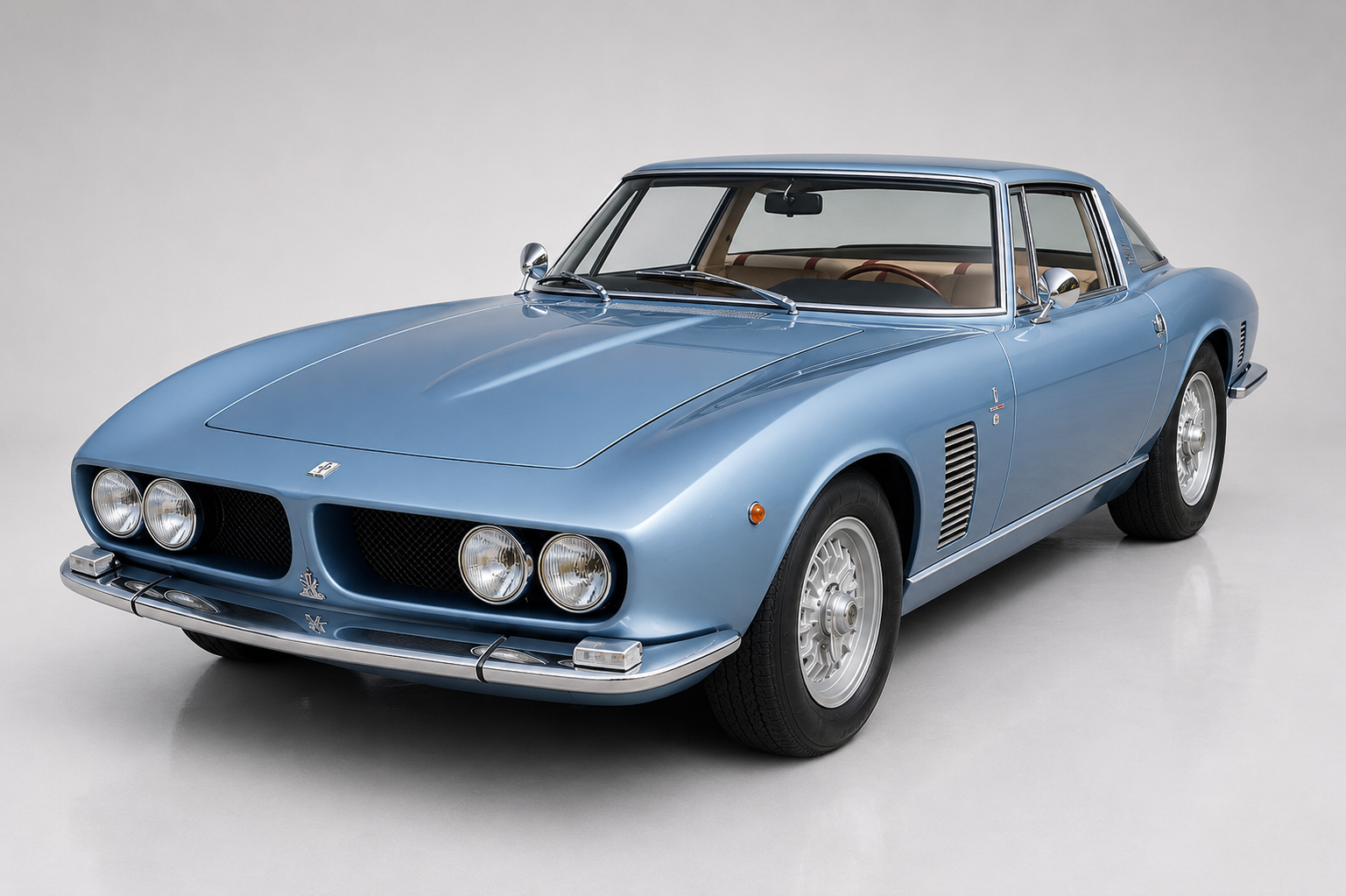
The Grifo is Iso Rivolta's supercar — Giorgetto Giugiaro's first great design at Bertone laid over a Bizzarrini-engineered pressed-steel backbone chassis with a De Dion rear, Watt linkage and Girling discs. At under 2,200 lb with a Chevrolet 327 up front, it was quick — 171 mph in period — and, unusually for the era, both quiet and reliable.
Production ran from 1965 to 1974 across two series and four engine families: Chevrolet 327 small-block (300–350 hp) in the Series I, the 7 Litri with Chevrolet's 427 L71 Tri-Power (435 hp), the Series II / IR-9 Can Am with the 454 big-block, and the IR-8 with Ford's Boss 351. Total production sits in the ~400–413 range across most reference sources.
The Grifo is the archetype of the Anglo-Italian-American GT — Italian design and chassis engineering wrapped around a large-capacity, high-torque American V8 for effortless real-world speed. The story is inseparable from its origin: only 22 Grifo A3/Cs were built before Renzo Rivolta and Giotto Bizzarrini split in 1965. The A3/C then became the Bizzarrini 5300 GT while the more civilised Grifo GL continued at Bresso — the same car, two marques, one of the more consequential partings in the Italian supercar story.
Variants
Range and production
Variant
Years
Production
Notes
Grifo GL — Series I (Chevrolet 327)
1965–1970
Not separately recorded
Series I production ~322–330 cars. Chevrolet 327 small-block, 300 hp base, 350 hp GL350, 365 hp GL365 in later Series I cars. Bertone-built body; ZF five-speed manual optional; Powerglide auto also available.
Grifo GL 7 Litri (427)
1968–1970
~90
Approximately 90 cars built with the Chevrolet 427 L71 Tri-Power, 435 hp. Distinguished by the raised 'penthouse' bonnet bulge required to clear the big-block; the fastest and rarest of the Series I cars.
Grifo Series II (IR-9 Can Am / IR-8)
1970–1974
Not separately recorded
Series II production ~78–83 cars; total production ~400–413 (also quoted as 322+78=400). Restyled nose with hidden headlights. IR-9 Can Am used the Chevrolet 454 big-block; the IR-8 used Ford's Boss 351. Only 23 Series II cars were fitted with the ZF five-speed manual.
Series I Targa
1965–1970
14
13 or 14 cars built. Extremely rare open version of the Series I; sits at the top of the Series I market.
Series II Targa
1970–1974
4
Only 4 cars built. The rarest catalogued Grifo body.
Grifo A3/C (pre-split, 1963–65)
1963–1965
22
22 built before the 1965 Rivolta / Bizzarrini split. Race-focused, Bizzarrini-engineered. Later cars from chassis #0224 onward continued as the Bizzarrini 5300 GT after the split. See the Bizzarrini 5300 GT guide.
Buyer's Guide
What to look for
Provenance — Grifo GL vs Grifo A3/C, Series I vs Series II
The Grifo family is a small and specialist market and paperwork is everything. For the Grifo specifically, note that the 7 Litri (raised bonnet), Series II 5-speed (23 built) and Targa cars (Series I 13–14; Series II 4) sit at the very top of the market — sub-variant authentication must precede any premium. Cross-check the chassis number against the recognised Iso registry, confirm original series and engine specification, and treat any car whose paperwork begins mid-life as a car priced on that history, not the badge.
Pressed-steel backbone chassis and body integrity
The Bizzarrini-designed pressed-steel backbone chassis with De Dion rear and Watt linkage is structural; inspect for accident repair, rail deformation and rear axle geometry drift. Hand-built steel bodies rust in the sills, floors, rear arches and around the rear window; a full lift inspection with paint-depth gauge is required, particularly on cars presented as restored.
Engine identification — 327 vs 427 vs 454 vs Boss 351
Iso used four different V8 architectures across the Grifo's life — Chevrolet 327 small-block (Series I 300/350/365 hp), Chevrolet 427 L71 Tri-Power (7 Litri, 435 hp), Chevrolet 454 (Series II / IR-9 Can Am) and, on the IR-8, Ford's Boss 351. Verify the engine in the car matches the factory build book and the chassis specification; conversions and re-engined cars are priced separately.
Rarity variants — 7 Litri, 5-speed and Targa
Documented sub-figures: ~90 seven-litre 427 cars; only 23 Series II 5-speeds; 4 Series II Targas; 13 or 14 Series I Targas — sources differ on the exact count. These are a very small share of the overall production, sit at the top of the market and require sub-variant-specific authentication before any premium is paid.
Ownership
Living with it
Typical mileage
1,500–4,000 miles typical
Service interval
12 months by time or 5,000 miles, whichever first
Annual running cost
$8,000 – $20,000 depending on condition and use
Fuel economy
11–14 mpg
Insurance
Agreed-value classic policy with limited mileage and secure storage. Low-volume Anglo-Italian-American V8 GTs are well-understood by specialist classic underwriters.
Body and structural corrosion
Hand-built steel bodies on tubular chassis rust in the sills, floors, rear arches and lower windscreen surrounds. Any car with fresh paint should be inspected on a lift with a paint-depth gauge — cosmetic-only restorations that leave structural corrosion untouched are common.
Drivetrain vs coachwork sourcing
Chevrolet 327 / 427 / 454 small- and big-block V8, Ford Boss 351 and their gearboxes are extremely well-supported in the US and internationally. Model-specific bodywork, chrome, glass and interior trim are the expensive-to-restore items and must go through marque specialists.
Common Problems
Known issues by system
Provenance
Grifo GL vs A3/C vs 7 Litri vs Series II identification
Inspection — Lift inspection with geometry check; brake pressure and service history review.
Auctions
Recent results
Date
Auction
Car
Mileage
Result
2026-01-29
Gooding Christie's
Rétromobile Paris, Lot 80
1971 Iso Grifo 7 Litri 'Can-Am'
—
€426,875
Sold
2025-08-15
Gooding Christie's
Pebble Beach Auctions, Lot 143
1968 Grifo Series I
—
$362,500
Sold
2025-01-24
RM Sotheby's
Arizona, Lot 151
1970 Grifo 7 Litri Series I
—
$555,000
Sold
2024-08-15
RM Sotheby's
Monterey, Lot 311
1968 Iso Grifo GL Series I
—
$357,000
Sold
Investment
Long-term outlook
Strong HoldHorizon: 10+ years
Small overall production, well-documented rarity sub-variants and a distinctive founder story position the Grifo as a defensible long-term collector object. The 7 Litri, Series II 5-speed and Targa cars are the natural focus; standard 327 Series I cars remain the accessible entry to the marque.
Our view, not advice. This section is Car Collector International's editorial judgement on where this model sits in the collector market, based on the production, specification and market data set out in this guide. It is not a recommendation to buy or sell and it is not investment advice. Values can fall as well as rise.