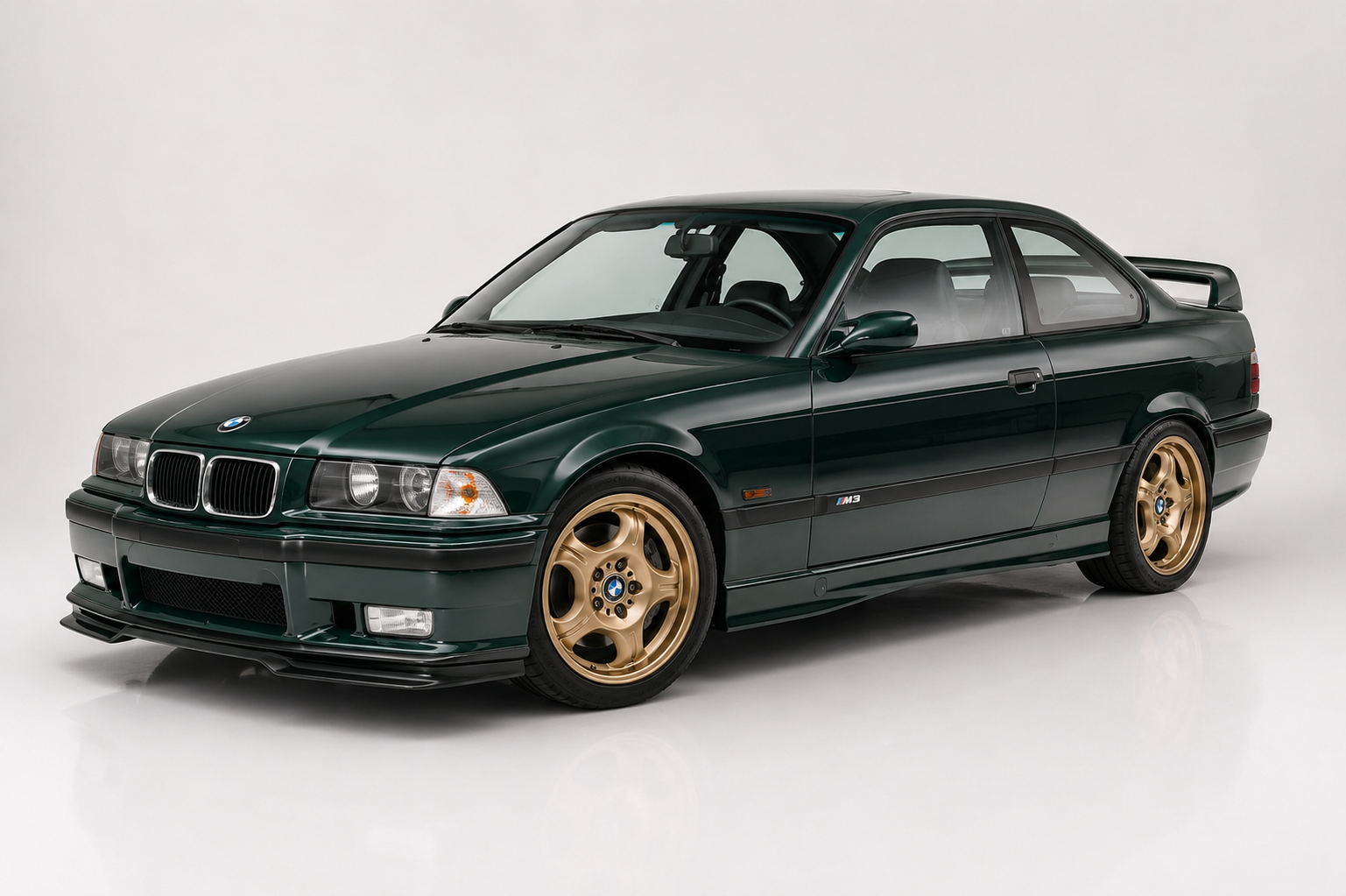
The E36 M3 is the first six-cylinder M3, built between 1992 and 1999 in coupé (from 1992), saloon (from 1994) and convertible bodystyles. Two mechanically distinct engine families define the car and its market. The Euro cars use the S50: the initial S50B30 (1992–95) is a 2,990 cc 24-valve straight-six with individual throttle bodies and single VANOS, producing 286 PS / 282 hp at 7,000 rpm and 320 Nm; the S50B32 Evo (1995–99) grows to 3,201 cc, adds double-VANOS and produces 321 hp at 7,400 rpm and 350 Nm through a six-speed manual (or SMG), and was the first road-going BMW engine to break 100 hp per litre. The US cars use the S50B30US (1994–95) — a 2,990 cc M50-derived unit with no individual throttle bodies, a 10.5:1 compression ratio and 240 hp — and later the S52B32 (1996–99), a 3,152 cc M52-derived unit also producing 240 hp and 236 lb-ft.
All cars are rear-wheel drive. Unlike the E30, the E36 M3 was not a homologation special.
The E36 M3 is the car that redefined the M3 line — not by chasing homologation but by pairing a genuinely usable everyday coupé with the finest inline-six of its era in Euro trim. It was underrated for years against the E30 M3, and is now firmly collectible in every configuration — with Euro S50B32 Evo cars and low-volume special variants leading the market. It also opens the definitive discussion every E36 M3 buyer must resolve: Euro or US, and which specific engine.