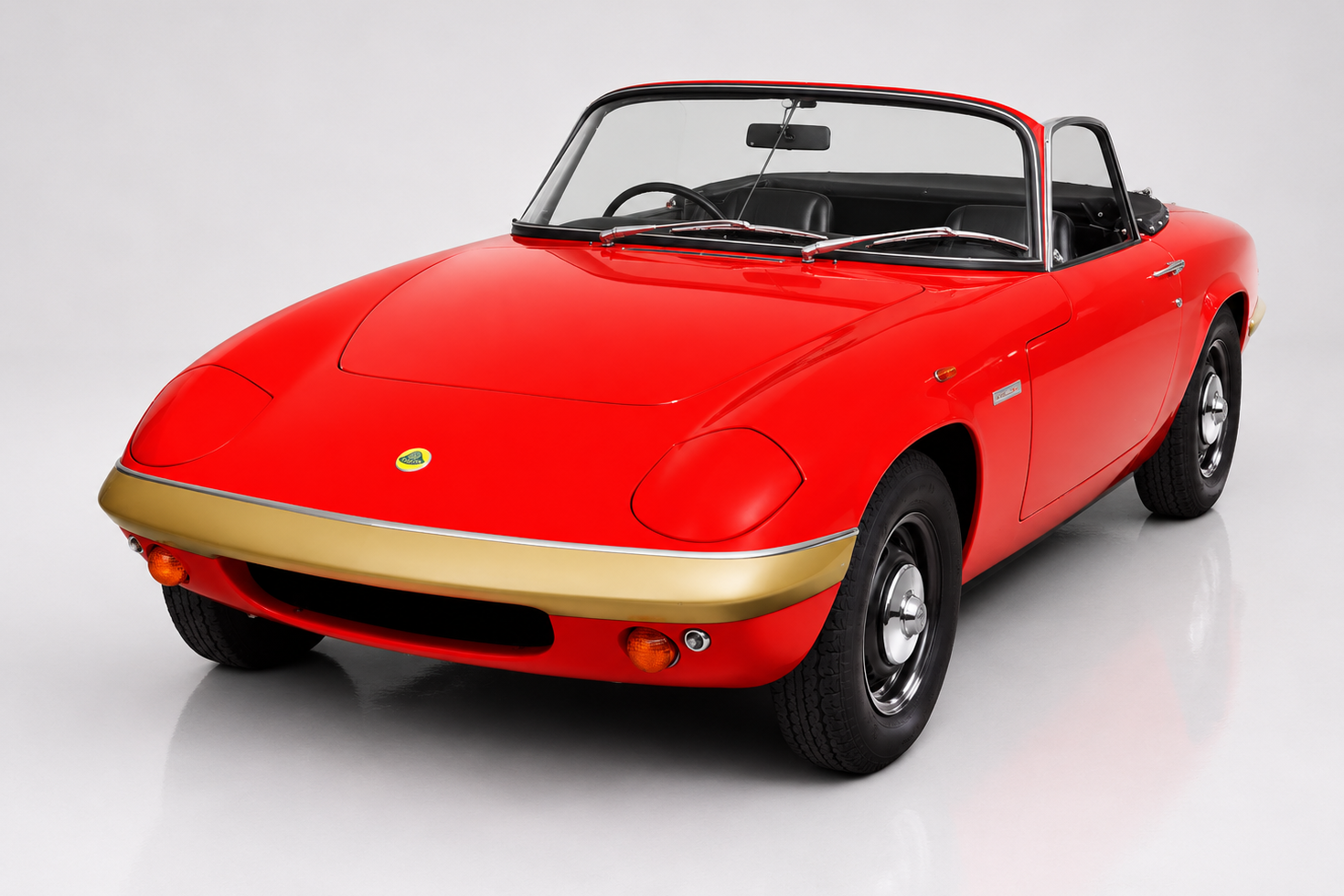
The Lotus Elan is a steel-backbone-chassis, glassfibre-bodied sports car designed by Ron Hickman and John Frayling under Colin Chapman, launched in 1962. It carried four-wheel independent suspension, four-wheel disc brakes with dual-piston calipers, pop-up headlamps and a Ford-derived Lotus twin-cam four (1,498cc at launch, quickly replaced by the 1,558cc unit). Cars were sold fully assembled or, for UK purchase-tax avoidance, as a customer-assembled kit.
Across thirteen years the Elan ran through Type 26 (drophead), Type 36 (fixed-head, from 1965), Type 45 (drophead, from 1966) and the longer-wheelbase Type 50 Elan +2 (1967–75). Special Equipment and Sprint packages added power (up to 126 bhp on the big-valve Sprint from 1971), and the Type 26R was a factory-supported lightweight racing variant producing approximately 160 hp. Production is not definitively known — sources give figures from around 9,000 two-seaters (Robinshaw & Ross, working from Lotus's non-sequential serial numbers) to 12,224 (John Bolster / Lotus itself) to approximately 17,392 across the range.
The Elan is Colin Chapman's masterpiece and Lotus's first commercial success — the car that funded a decade of Grand Prix wins. Its backbone-chassis / glassfibre-body architecture, four-wheel disc brakes and pop-up headlamps set the template for the modern lightweight sports car; the driving characteristics remain the reference point for all subsequent Lotus road cars. It is also emphatically distinct from the 1989–95 M100 Elan, which is a front-wheel-drive, Isuzu-engined car and will get its own guide.