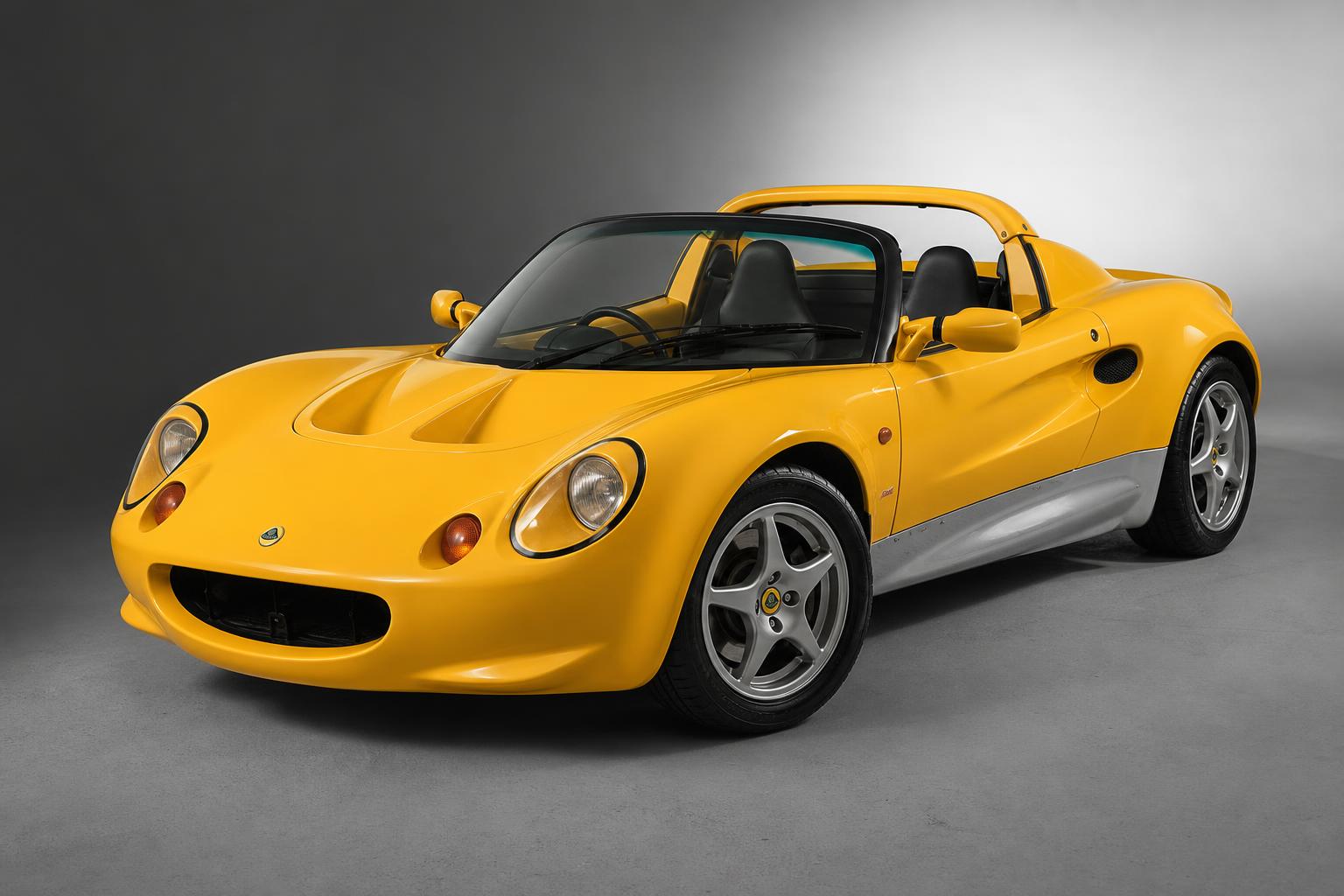
Launched at the 1995 Frankfurt Motor Show and produced from 1996 to 2001, the Series 1 Lotus Elise reset the template for the modern sports car. Designed under chief engineer Richard Rackham and styled by Julian Thomson, it was the first production road car built around a bonded and riveted extruded-aluminium chassis tub, supplied by Hydro Aluminium and assembled at Hethel. Power came from the Rover K-series — a 1.8-litre four-cylinder producing 118 hp at launch — driving the rear wheels through a five-speed manual gearbox. Kerb weight was an extraordinary 725 kg.
The Elise was conceived as a back-to-basics roadster in the spirit of Colin Chapman's earlier Lotus Sevens and Elans, and it succeeded so completely that it saved the company. Over the Series 1's six-year run Lotus produced approximately 10,600 cars, plus the more focused 111S (1999, 143 hp VVC engine), the homologation-special Sport 135 and Sport 160, and the limited-production track-focused 340R and Exige (2000) variants that share the S1 platform.
The Series 1 Elise is now widely regarded as one of the most historically significant British sports cars of the modern era — the car that established bonded-aluminium chassis construction in production and that defined the lightweight, analogue driving philosophy that Lotus, and a generation of imitators, would build on for the next two decades. As the first and most original execution of that template, it occupies a place no later Elise can replicate.