Car Collector International
Modern Classic · 2006; 2012–2013; 2020

Mini John Cooper Works GP (GP1 / GP2 / GP3)

The cult hot-hatch trilogy — supercharged raw (GP1), track-honed (GP2), brute-force (GP3).

Car Collector International Editorial
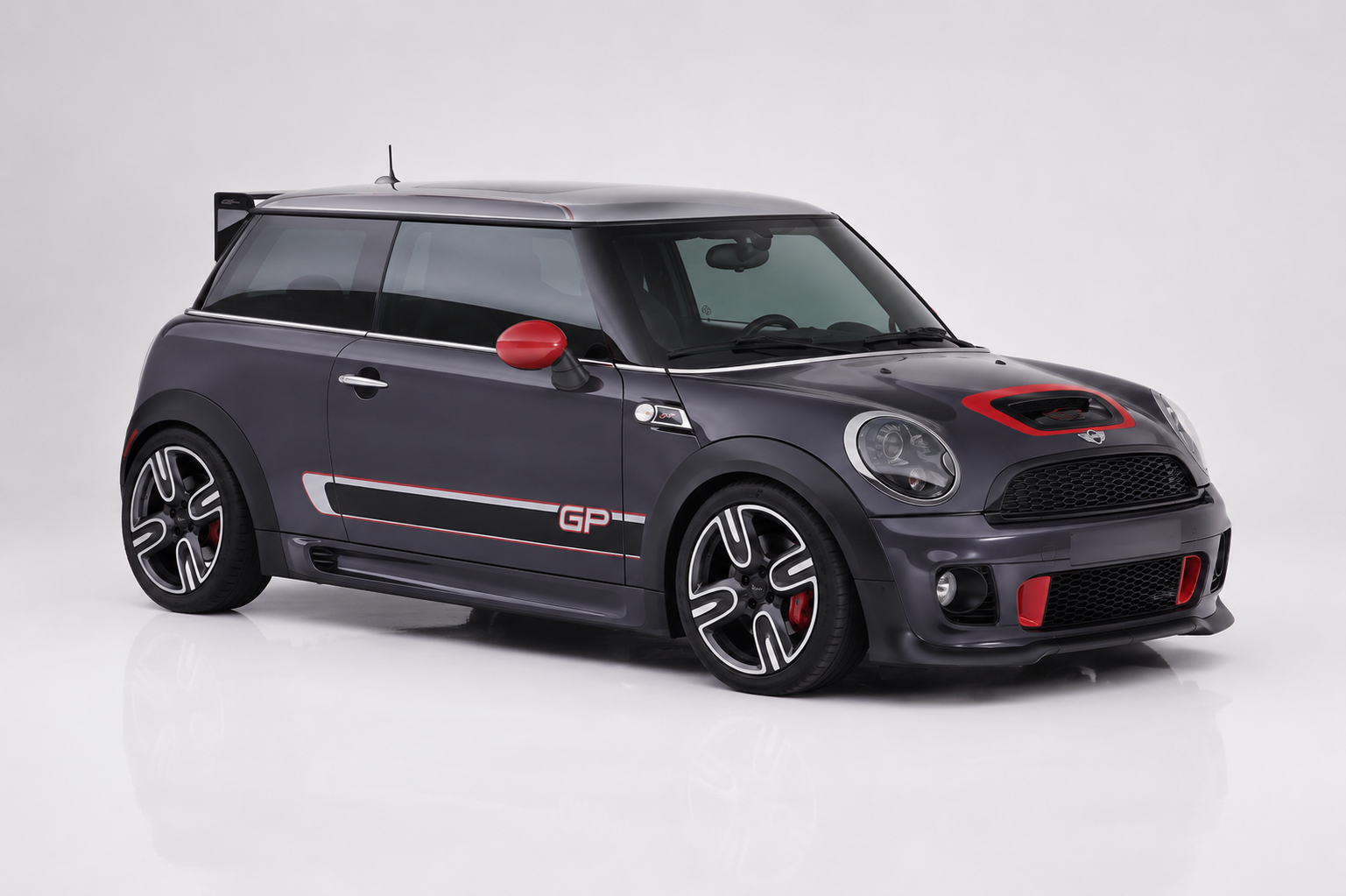
Grey Mini John Cooper Works GP2 hatchback in a studio setting, front three-quarter view showing the two-seat body with rear seats deleted, red-detailed front bumper and mirror caps, GP side graphics, roof-mounted rear wing and multi-spoke alloy wheels.
Overview

Why this car matters

The John Cooper Works GP is Mini's most focused road car of each of its three modern platforms — R53, R56 and F56. Every generation is a front-wheel-drive, two-seat hatchback (the rear seats are deleted), sold in a single high-specification configuration and treated by the collector market as an appreciating trilogy.

GP1 (2006, R53) uses the Eaton-supercharged 1.6-litre inline-four, approximately 218 hp, and a six-speed manual gearbox; approximately 2,000 units, of which approximately 500 came to the UK. GP2 (2012–2013, R56) uses the N18 turbocharged 1.6-litre, 218 hp (214 hp US), with a six-speed manual, Nürburgring-honed coilovers, Brembo six-piston front brakes and Recaro seats; 2,000 units, including 288 UK and 500 US cars. GP3 (2020, F56) uses the BMW B48 turbocharged 2.0-litre (shared with the M135i), 306 PS / 302 hp, 332 lb-ft, an eight-speed automatic only, carbon-fibre fender flares and approximately 1,255 kg; 3,000 units, of which 575 came to the UK. Per-market splits vary between sources.

The JCW GP trilogy is the most focused expression of each modern Mini platform: raw supercharged R53 (GP1), the Nürburgring-honed R56 (GP2) and the automatic-only, brute-force F56 (GP3). All three are appreciating collector-market cars, and together they form a defined limited-production trilogy of the modern Mini era.

Variants

Range and production

VariantYearsProductionNotes
Mini John Cooper Works GP1 (R53)2006Eaton-supercharged 1.6L inline-four, approximately 218 hp; 6-speed manual, FWD; two-seat (rear seats deleted). Approximately 2,000 units built, of which approximately 500 came to the UK. Verify per-market splits.
Mini John Cooper Works GP2 (R56)2012–2013N18 turbocharged 1.6L inline-four, 218 hp (214 hp US); 6-speed manual, FWD; Nürburgring-honed coilovers, Brembo six-piston front brakes, Recaro seats. 2,000 units built, including 288 UK and 500 US cars. Verify remaining per-market splits.
Mini John Cooper Works GP3 (F56)2020BMW B48 turbocharged 2.0L inline-four (shared with the M135i), 306 PS / 302 hp, 332 lb-ft; 8-speed automatic only, FWD; carbon-fibre fender flares; approximately 1,255 kg. 3,000 units built, of which 575 came to the UK. The fastest Mini ever. Verify remaining per-market splits.
Buyer's Guide

What to look for

Generation choice

GP1 is the raw, mechanical, supercharged pick and increasingly the collector's grail; GP2 is the driver's car of the three (Nürburgring-honed, Brembo brakes, Recaro seats, six-speed manual); GP3 is the brute-force, fastest-Mini-ever car, but automatic-only and softer in character. Buy on the character you want, not on paper output alone.

Mechanical inspection priorities

Each generation has generation-specific priorities. On GP1, the supercharger and its service history are non-negotiable, along with cambelt and cooling-system status. On GP2, the N18 timing-chain history is critical. On GP3, verify the B48 service history and cooling / turbo integrity. A marque specialist familiar with the specific generation should lead the PPI.

Originality and modifications

All three GPs are collector-market cars; modifications away from factory specification typically hurt value. Verify original factory paint, badging, wheels and interior trim, and price any deviation accordingly. On GP2 and GP3, cars with limited track use and complete service history command a premium.

Body, paint and use pattern

Track-day use is common on all three generations and is not, on its own, disqualifying — but it should be documented and priced accordingly. Priorities are stone-chip damage, repainted panels and — on the GP1 — corrosion in the usual R53 sills and subframe areas.

Pricing

What to pay

Mini John Cooper Works GP1 (R53, avg ~$25k)
USD≈ $19,000 – $44,000
GBP£15,000 – £35,000
EUR€17,000 – €40,000
Averaging around $25k; best low-mileage cars now reaching high-$50k. Collector-market focus on original specification (Verify).
Mini John Cooper Works GP2 (R56, avg ~$26k)
USD≈ $23,000 – $48,000
GBP£18,000 – £38,000
EUR€21,000 – €44,000
Averaging around $26k; the driver's pick of the trilogy — Nürburgring-honed setup and Brembo brakes command premiums on documented cars (Verify).
Mini John Cooper Works GP3 (F56, avg ~$39k)
USD≈ $35,000 – $57,000
GBP£28,000 – £45,000
EUR€32,000 – €52,000
Averaging around $39k; fastest Mini ever, automatic-only. Low-mileage, original-specification cars carry premiums (Verify).

Regional ranges authored independently — each reflects its local market, not an FX conversion

Ownership

Living with it

Typical mileage
1,000–8,000 miles typical for enthusiast use
Service interval
12 months regardless of mileage; major service on interval
Annual running cost
$1,500 – $6,000 depending on use and specification
Fuel economy
22–34 mpg depending on model and use
Insurance
Agreed-value collector or specialist performance-car policy with limited mileage, secure storage and an annual value review.

Maintenance planning

Even sparingly used cars need annual attention. Fluids age, date-coded rubber and tyres must be replaced, and stored cars need periodic exercise. A documented maintenance rhythm protects both reliability and resale value.

Specialist access

For the JCW GP trilogy, an independent MINI / BMW specialist familiar with the specific generation is usually a better fit than a main dealer for out-of-warranty cars.
Common Problems

Known issues by system

Engine

Generation-specific weak points (R53 supercharger service; R56 N18 timing chain; F56 B48 general robustness)

Major$1,500 – $6,000+
Symptoms — Whining supercharger (R53), rattle at cold start (R56), warning lights.
Inspection — Marque-specialist PPI; verify service history.
Cooling

Water pump, thermostat and coolant-system integrity (turbo cars)

Moderate$500 – $2,500
Symptoms — Fluctuating temperatures, coolant loss.
Inspection — Cooling-system pressure test.
Suspension / brakes

Bushings, dampers, coilover / factory suspension refresh, brake service items

Moderate$800 – $4,000
Symptoms — Untidy tracking, uneven tyre wear, vibration under braking.
Inspection — Lift inspection and geometry check.
Body / paint

Stone-chip damage, repainted panels, tracked-car cosmetic wear

Moderate$1,500 – $8,000
Symptoms — Paint-depth inconsistency, panel-gap variance.
Inspection — Paint-depth gauge and full lift inspection.
Valuation

Current value bands by region

Each region quoted in its local currency — independent market readings, not FX conversions

All limited (2,000 / 2,000 / 3,000). GP1 and GP2 average ~$25–26k, with the best low-mileage cars now reaching high-$50k; GP3 averages ~$39k. A cult trilogy that's steadily appreciating.

Auctions

Recent results

DateAuctionCarMileageResult
2025-12
Classic.com-tracked
Online
2013 Mini JCW GP (GP2)
$59,000
Sold
2025-01
Classic.com-tracked
Online
2006 Mini JCW GP (GP1)
$57,200
Sold
2024-07
Classic.com-tracked
Online
2021 Mini JCW GP (GP3)
$26,500
Sold

Auction results reflect Classic.com-tracked public sales. Original specification and documented service history dominate value across all three generations.

Investment

Long-term outlook

EmergingHorizon: 5–10 years

Three defined, small-run, focused editions of the modern Mini spread across three platforms. Combined trilogy status, distinct character per generation and consistent collector-market appreciation support a steady long-term outlook.

Recommended

The trusted network

Specialists

  • Independent MINI / BMW specialist
    View →
    UK / Europe / USA
    Servicing, diagnostics and pre-purchase inspection for JCW / GP-generation MINI.
  • Fast-Ford / hot-hatch specialist
    View →
    UK
    Chassis setup, suspension refresh and enthusiast-market pre-purchase support.
  • Concours preparation studio
    View →
    International
    Paint correction, PPF and detailing.

Storage

  • Windrush Car Storage
    View →
    Cotswolds, UK
    Climate-controlled storage and collection management for high-value collector cars.
  • Autovault
    View →
    Bicester, UK
    Secure climate-controlled storage at Bicester Heritage with regular inspection programmes.
  • Classic Car Club Manhattan
    View →
    New York, NY
    Secure urban storage for collector and modern performance cars.

Transport

  • CARS UK
    View →
    UK & Europe
    Enclosed event, concours and collection transport across Europe.
  • Reliable Carriers
    View →
    USA (national)
    Enclosed coast-to-coast transport for collector cars.
  • FERRLOG
    View →
    Italy / Europe
    Air-ride enclosed transport for European collector and hypercar cargo.

Enjoyed this guide?

Get new buyer's guides and collector market intelligence delivered to your inbox. No spam. We respect your inbox.

The valuation figures in this guide are for research purposes only and do not constitute financial or investment advice. See our full disclaimer.