
Car Collector International
Classic · 1963–1971

Mini Cooper S (Classic)

The giant-killing Issigonis saloon that won Monte Carlo three times and rewrote small-car performance.

Car Collector International Editorial
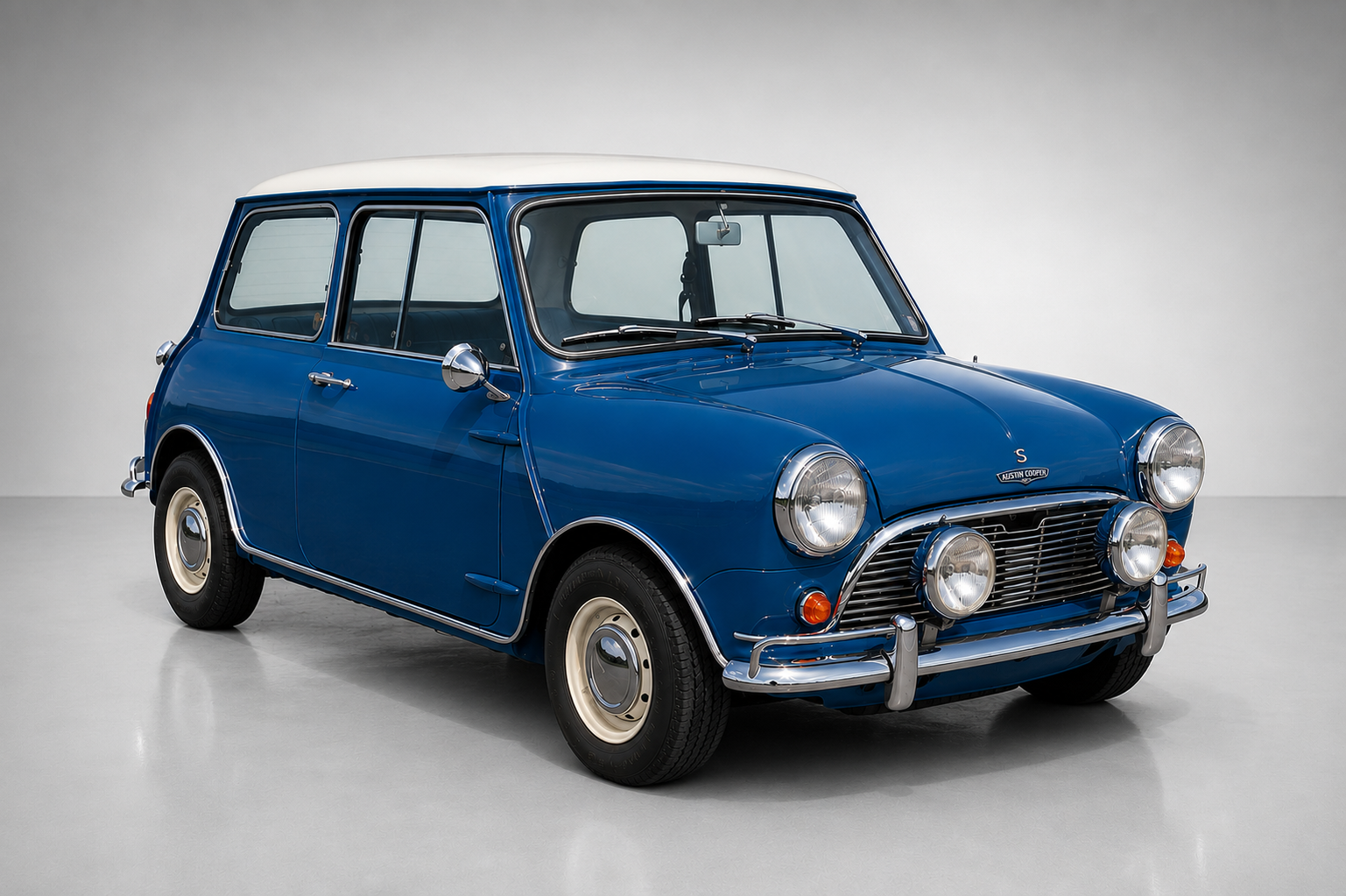
Blue classic Mini Cooper S with white roof in a studio setting, front three-quarter view showing the chrome grille with 'Austin Cooper' badge, chrome bumper with over-riders, round headlamps and body-colour steel wheels with chrome hub caps.
Overview

Why this car matters

John Cooper's hot-rodded Mini began as a 997 cc Cooper in 1961, then evolved into the Cooper S in 1963 with a 1071 cc engine, followed by 970 cc and 1275 cc derivatives. The 1275 cc Cooper S Mk I, Mk II and Mk III ran until 1971 (the Mk III's S badge was dropped in 1971), with the Mk III hailing the move to internal door hinges and wind-up windows.

Its motorsport pedigree — including Monte Carlo Rally wins in 1964, 1965 and 1967 — gives the Cooper S a giant-killer cultural standing that supports values today.

The Cooper S is the most collectable variant of the original Mini and a globally recognised cultural icon.

Variants

Range and production

VariantYearsProductionNotes
Cooper S 10711963–19644,031Original Cooper S; short-lived 1071 cc derivative.
Cooper S 9701964–1965963Homologation special for sub-1000 cc class; rare.
Cooper S 1275 Mk I1964–1967Not separately recordedSliding windows, external door hinges, magic-wand gearshift.
Cooper S 1275 Mk II1967–1969Not separately recordedRevised grille and tail-lights.
Cooper S 1275 Mk III1969–1971Not separately recordedInternal door hinges, wind-up windows, final production.
Collector Variants

Limited & special editions

The models below represent the most significant limited and special edition variants — factory-produced cars that command meaningful premiums over standard examples and warrant specific attention from serious collectors.

Mini Cooper S Sport 500 / Sport LE · 2000

500 (Sport 500)
Distinguishing features
Final classic Mini: 1275 MPI, Cooper S Sport bodykit, alloy wheels, body-coloured arches and numbered plaque. Built to mark the end of classic Mini production at Longbridge.
Value premium
30–60% over a standard 1275 MPI in equivalent condition.
Inspection points
Verify Sport 500 numbered plaque, factory bodykit and the final Longbridge build records.

Mini Cooper S Mk III '1275S' (1970–1971) · 1970–1971

Exact production total not recorded — the final Mk III 1275 Cooper S run was limited
Distinguishing features
Final classic 1275 Cooper S before BL discontinued the Cooper marque, with revised interior and BL/Austin Mini Cooper S badging. Replaced by the cheaper 1275 GT.
Value premium
1.5–2× a Mk I/II 1275 Cooper S in equivalent condition.
Inspection points
Verify Mk III bodyshell, original 1275 S engine and BL/Austin badging.
Buyer's Guide

What to look for

Provenance and originality

Start with identity, paperwork and originality. For the Mini Cooper S (Classic), the strongest cars have a continuous ownership file, matching numbers where applicable, original manuals, invoices and evidence of work by recognised marque specialists. Originality of body, correct date-coded fittings, BMIHT (British Motor Industry Heritage Trust) certification, Cooper Car Co. provenance and period competition history are decisive.

Mechanical inspection priorities

The A-series 1275 cc is durable but oil-tight is the exception, not the rule; gearbox synchros, transfer-case condition and head studs are common ownership items. A proper pre-purchase inspection includes cold-start behaviour, leak-down or compression testing where appropriate, underbody photography, suspension and chassis-point inspection, brake condition and a road test long enough to expose heat-related faults. Deferred maintenance is almost always more expensive than buying a better-sorted car.

Body, paint and accident history

Use a paint-depth gauge, lift access and a specialist familiar with the model's factory seams and panel gaps. Collector value is dramatically affected by structural repairs, poor paintwork, corrosion, incorrect panels and missing factory trim. Documented cosmetic restoration is acceptable; concealed accident repair must be priced severely.

Specification strategy

Period-correct Mk I 1275 S and works-style cars lead; ex-works rally cars trade as separate, very high-value pieces. Specification, colour, transmission and limited-build variants move values significantly. Buy the best-documented example in the most desirable specification you can justify rather than a tired example of a rarer derivative that will need years of corrective work.

Ownership

Living with it

Typical mileage
1,500–4,000 miles typical for collector use
Service interval
12 months; mileage interval varies by model and use
Annual running cost
$4,000 – $12,000
Fuel economy
15–24 mpg depending on use
Insurance
Use an agreed-value collector policy with limited mileage, secure storage, documented photography and an annual value review. Premiums vary sharply by age, storage location and declared value.

Maintenance planning

Budget annually even if the car is used sparingly. Fluids age, tyres date out, fuel systems suffer from ethanol, batteries fail and stored cars need exercise. A documented maintenance rhythm protects both reliability and resale value.

Parts and specialist access

A Mini specialist is essential; correct trim, fittings and bodyshell stampings are specific to year and market and frequently incorrect on modified or rebuilt cars. Before purchase, confirm parts availability for model-specific trim, suspension, fuel system, electronics and engine components. A cheap car waiting on unobtainable parts is rarely cheap in collector ownership.
Common Problems

Known issues by system

Body

Comprehensive corrosion (subframes, sills, A-panels, floors, scuttle)

Critical$15,000 – $50,000 for proper body and subframe restoration
Symptoms — Filler, bubbling, sagging doors, rust through floors and around the front subframe.
Inspection — Lift inspection; tap test sills and floors; magnet survey throughout.
Engine / Transmission

Gearbox synchro and shared-sump oil contamination

Major$3,000 – $7,000 for a correct rebuild
Symptoms — Crunch into gear, baulking on downshift, metallic content in oil.
Inspection — Cold and hot road test; gearbox oil inspection.
Identity

Re-tubbed bodyshells and incorrect stampings

MajorPricing impact only
Symptoms — Replacement bodyshells without correct date-coded panels or chassis stampings.
Inspection — BMIHT certificate cross-check; specialist body inspection.
Auctions

Recent results

DateAuctionCarMileageResult
2026-05-10
H&H Classics
Classic Motorcars
1964 Morris Mini Cooper S 1071
£27,562
Sold
2026-01-29
Gooding Christie's
Rétromobile Paris
1966 Morris Mini Cooper S
€43,700
Sold
2025-02-22
Iconic Auctioneers
The Iconic Sale at Race Retro
1963 Morris Mini Cooper S
£49,667
Sold
2025-02-15
Broad Arrow
The Academy of Art University Collection
1970 Morris Mini Cooper S
US$28,000
Sold
2023-09-01
Gooding Christie's
London Auction
1965 Morris Mini Cooper S
£42,750
Sold
Investment

Long-term outlook

Strong HoldHorizon: 5–10 years

Mk I 1275 cars and BMIHT-documented examples should hold value well; later cars will track condition. Ex-works rally cars sit in a separate ultra-collector tier driven by chassis history.

Our view, not advice. This section is Car Collector International's editorial judgement on where this model sits in the collector market, based on the production, specification and market data set out in this guide. It is not a recommendation to buy or sell and it is not investment advice. Values can fall as well as rise.

Recommended

The trusted network

Specialists

  • Mini marque specialist
    View →
    UK / Europe
    Mini Cooper S (Classic) inspections, servicing and originality reviews.
  • Model-focused independent
    View →
    United States
    Pre-purchase inspections, major service planning and market-correct preparation for the Cooper S (Classic).
  • Concours preparation studio
    View →
    International
    Paint correction, detailing, preservation and sale preparation for premium collector cars.

Storage

  • Windrush Car Storage
    View →
    London & Cotswolds, UK
    Climate-controlled storage and collection management for high-value collector cars.
  • AutoVault
    View →
    Essex, UK
    Dehumidified storage at 55% RH in purpose-built sealed buildings, with maintenance programmes and individual motor-trade insurance cover.
  • Classic Car Club Manhattan
    View →
    New York, NY
    Secure urban storage for collector and modern-classic performance cars.

Transport

  • CARS UK
    View →
    UK & Europe
    Enclosed event, concours and collection transport across Europe.
  • Reliable Carriers
    View →
    USA (national)
    Enclosed coast-to-coast transport for premium and collector cars.
  • FERRLOG
    View →
    Italy / Europe
    Air-ride enclosed transport for Italian and European collector cars.

Enjoyed this guide?

Get new buyer's guides and collector market intelligence delivered to your inbox. No spam. We respect your inbox.

The valuation figures in this guide are for research purposes only and do not constitute financial or investment advice. See our full disclaimer.