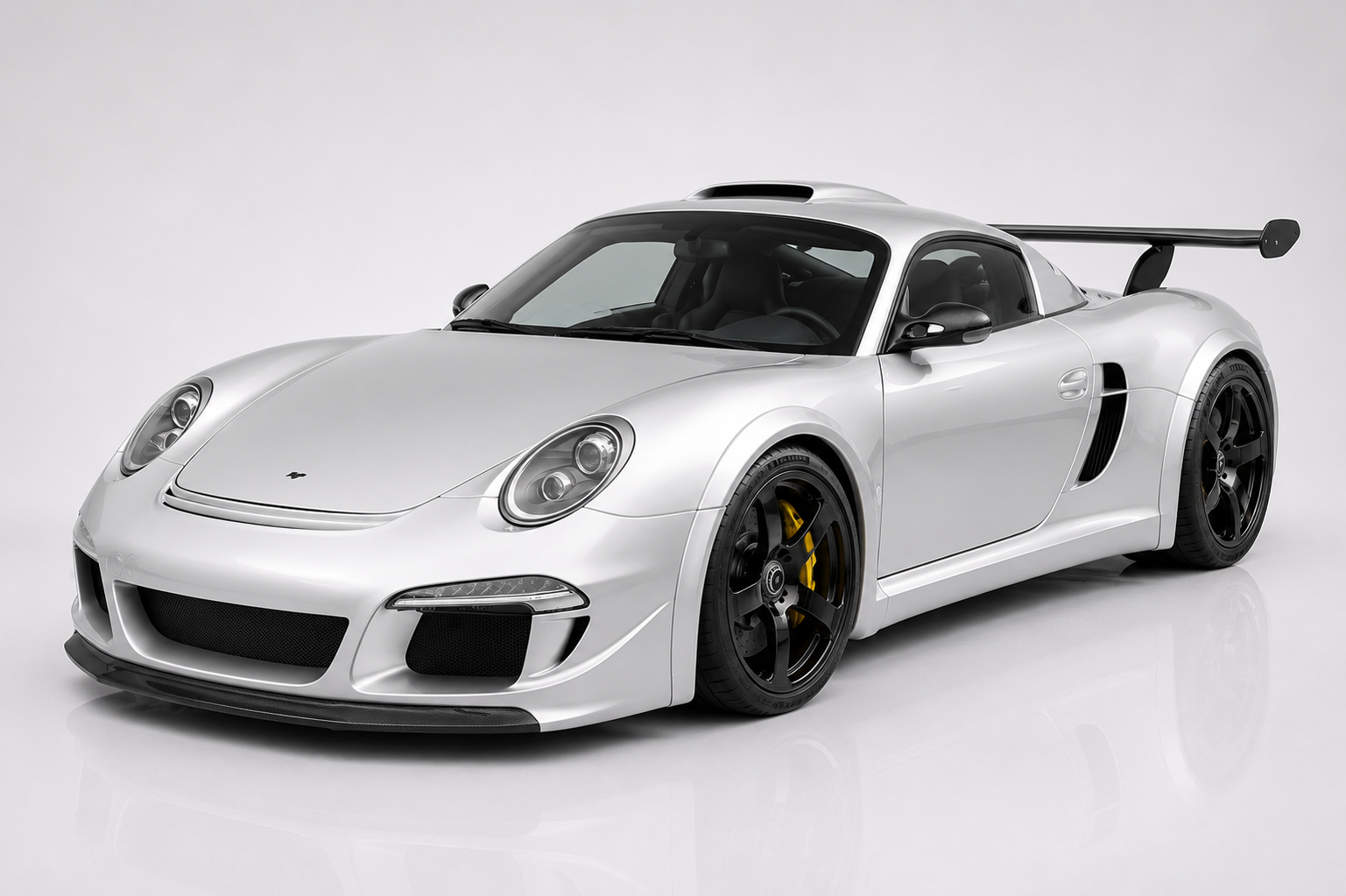
The RUF CTR3, launched in 2007, is RUF's first bespoke ground-up supercar and its only mid-engine road car. The chassis was developed with Multimatic and combines a 997-derived front section with a billet-aluminium 'Birdcage' rear space frame — an approach that decouples the CTR3 mechanically from any Porsche production shell.
Power comes from a 3,746 cc twin-turbocharged flat-six producing 700 PS / 691 bhp at 7,000 rpm in standard specification, driving the rear wheels through a six-speed sequential gearbox. The CTR3 Clubsport of 2012 raised output to 777 PS and offered an optional seven-speed dual-clutch gearbox, and the 2023 CTR3 Evo added 800 PS / 789 bhp at 7,100 rpm with 990 Nm, a redesigned body with an automatically deploying rear wing and a revised diffuser, driving through a seven-speed dual-clutch gearbox. Kerb weight is approximately 1,400 kg. Around 30 CTR3s are understood to have been built in total, of which about seven were built or later converted to Clubsport specification, plus the later Evo.
The CTR3 is genuinely distinct from the 911-based CTR and CTR2: not a modified Porsche but a bespoke Pfaffenhausen-developed platform with a specific engine-development lineage that RUF shared with the Lykan HyperSport programme.
The CTR3 is the pivot on which RUF moved from tuner-manufacturer of 911-based cars to bespoke mid-engine supercar builder. It is the first RUF built on its own chassis rather than a Porsche shell, and it re-set the ceiling for what RUF could sell alongside the 911-based CTR / CTR2 lineage. Small production and a genuinely distinct mechanical proposition support its long-term position within modern RUF collecting.