
Car Collector International
Supercar · 1995–1997

RUF CTR2

The 993-generation Yellowbird successor — twin-turbo, up to 702 hp, and a Pikes Peak podium car.

Car Collector International Editorial
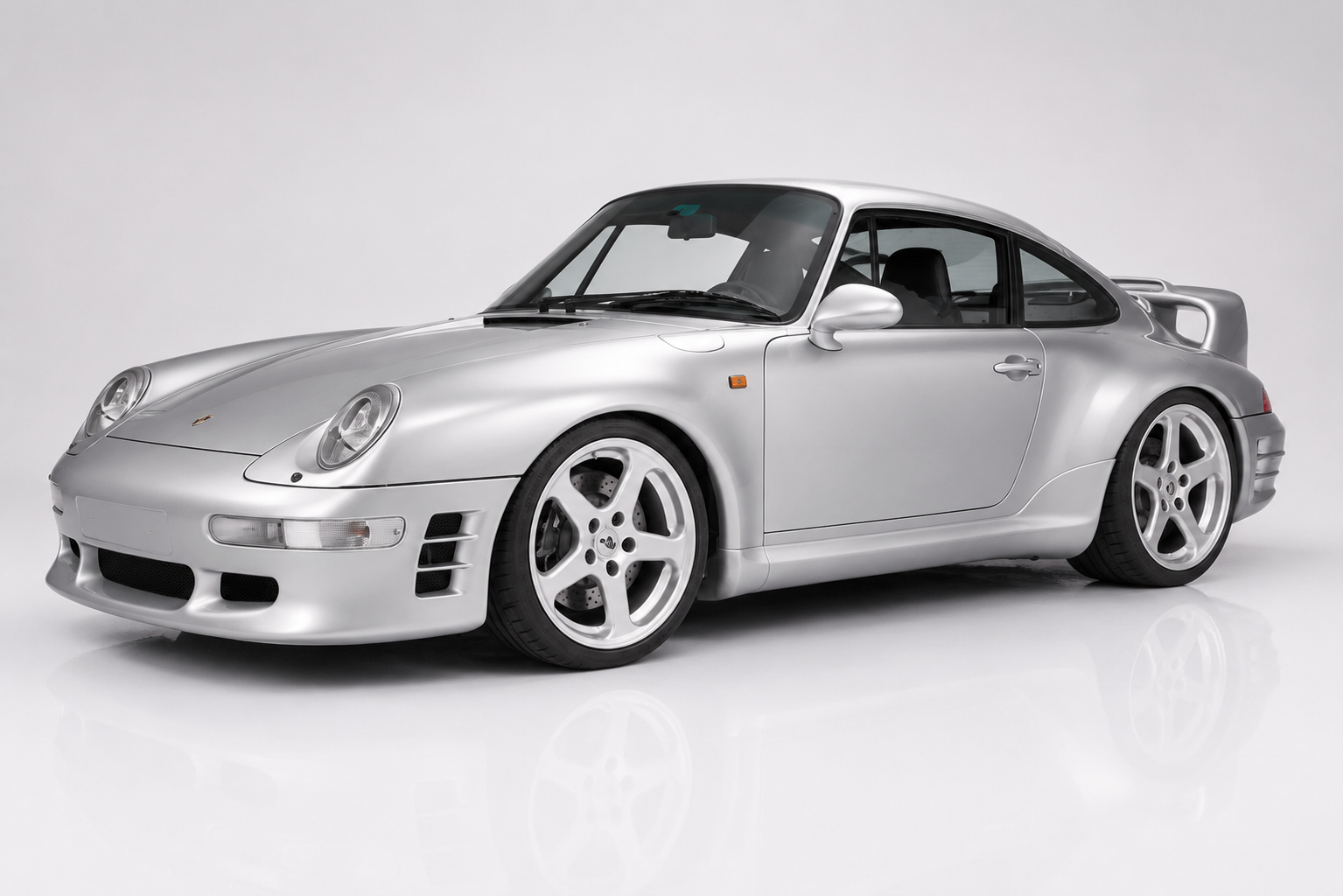
Silver RUF CTR2 in a studio setting, front three-quarter view showing the 993-generation 911 silhouette with RUF-specific front bumper and side inlets, RUF five-spoke wheels and integrated rear spoiler — the twin-turbocharged 993-based successor to the Yellowbird.
Overview

Why this car matters

The RUF CTR2 is the 993-generation successor to the CTR Yellowbird. Built at Pfaffenhausen from bare Porsche 911 (993) Turbo shells and issued RUF VINs, it uses twin turbochargers on a 3.6-litre flat-six, RUF's own six-speed gearbox and either RWD or optional AWD.

Standard cars produced 520 hp; the CTR2 Sport — RUF's Pikes Peak specification, campaigned to second overall in 1997 — produced 702 hp. Production totals are reported at approximately 16 standard cars and 12 Sport cars, for a total of around 29 CTR2s from Pfaffenhausen.

The CTR2 is the rarest of the RUF Yellowbird lineage and the direct link between the original CTR and the 993-Turbo-based RUF Turbo R (1998, 490 hp, AWD, 1998 model year only) that followed it. Its Pikes Peak result gives it competition provenance beyond any of its 993-based contemporaries.

Variants

Range and production

VariantYearsProductionNotes
CTR2 (standard)1995–1997Approximately 16 factory-built standard CTR2s on RUF VINs from bare Porsche 993 Turbo shells. Twin-turbo 3.6L flat-six, 520 hp. RUF 6-speed manual; RWD standard, AWD optional. Verify per-year build split against RUF factory records.
CTR2 Sport1997Approximately 12 factory-built CTR2 Sport cars on RUF VINs. Twin-turbo 3.6L flat-six, 702 hp; Pikes Peak specification, campaigned to 2nd overall at the 1997 Pikes Peak International Hill Climb by Steve Beddor. Included aerodynamic and cooling revisions vs the standard car. Verify individual car histories against RUF factory records and Pikes Peak entry lists.
RUF Turbo R (1998, context only — not a CTR2 variant)1998Context-only entry: the 1998 RUF Turbo R was a 993 Turbo-based stopgap successor to the CTR2 (approximately 490 hp, AWD, 1998 model year only, small number built). Noted here as part of the 993-RUF lineage; it is NOT a CTR2 variant and NOT the subject of a separate CCI buyer's guide at this review date. Verify total production and specification.
Buyer's Guide

What to look for

Provenance — factory RUF vs RUF-converted

The single most important question on any RUF is provenance. Cars built from a bare Porsche shell at Pfaffenhausen carry a RUF VIN (WO9…) and are treated as separate manufacturer vehicles; customer 911s converted at RUF retain their Porsche VIN. Both are legitimate — but they are not equivalent in the market. Demand the factory build documentation, RUF certificate and full history file. For the CTR2 specifically, confirm build variant (standard vs Sport) and drivetrain (RWD vs AWD) against the RUF factory build file. Sport cars carry Pikes Peak provenance and materially higher values; the RUF Turbo R (1998) is a distinct successor and should not be conflated.

Chassis, body and shell integrity

Air-cooled 911 shells rust in the usual places — inner wings, torsion-tube mounts, sill closing panels, battery box and window surrounds. A RUF shell that has been apart for turbo, brake and suspension work deserves a lift inspection with a torch and mirror. Look for evidence of accident repair around the front bulkhead and torsion-tube tunnels; RUF cars were driven hard when new.

Engine, turbo hardware and cooling

RUF's own turbo hardware (single or twin), intercooler routing, exhaust manifolds and management are car-specific. Any deviation from factory RUF spec should be identified and priced accordingly. Cold-start behaviour, oil pressure, boost signature under load and evidence of tuning to non-RUF specification are all diagnostic. Cambelt and top-end service history is essential on any high-boost air-cooled six.

Gearbox, driveline and suspension

RUF's own five- and six-speed gearboxes are strong but rely on correct oil and clutch service. Uneven shift quality, driveline shunt on trailing throttle and worn synchros are the typical wear items. Suspension bushings, dampers and geometry all move under high torque — a full geometry check and lift inspection are non-negotiable on any RUF pre-purchase.

Pricing

What to pay

CTR2 (all specs)
USD$1,500,000 – $3,000,000+
GBP£1,200,000 – £2,350,000+
EUR€1,375,000 – €2,750,000+
Verify. Standard cars trade around $1.5M–$2.2M; Sport cars carry a material premium and can exceed $3M.

Regional ranges authored independently — each reflects its local market, not an FX conversion

Ownership

Living with it

Typical mileage
500–3,000 miles typical
Service interval
12 months regardless of mileage; major service on interval
Annual running cost
$5,000 – $20,000+ depending on specification and use
Fuel economy
14–20 mpg
Insurance
Agreed-value collector policy with limited mileage, secure storage and annual value review. Factory-built RUF cars (with RUF VIN) command a materially different insured value than converted 911s and should be documented as such.

Factory RUF vs conversion

Only cars produced from a bare Porsche shell at Pfaffenhausen and issued a RUF VIN are 'factory' RUF cars. Customer 911s converted at RUF retain their Porsche VIN and are usually described as 'RUF-converted' — a materially different proposition for insurance, market value and provenance.

Parts and specialist access

RUF-specific hardware (turbochargers, intercoolers, exhaust systems, RUF gearboxes and body panels) is best sourced through the factory or its authorised network. Independent 911 specialists can handle service items but should defer to RUF for RUF-specific work.
Common Problems

Known issues by system

Provenance

Factory RUF vs converted 911 mis-representation

CriticalNot applicable — market impact only
Symptoms — VIN prefix, factory documentation, RUF certificate, chassis-plate stampings.
Inspection — RUF Pfaffenhausen authentication or specialist review of build file.
Body / chassis

Air-cooled 911 corrosion (inner wings, torsion mounts, sills, battery box)

Major$5,000 – $30,000+
Symptoms — Bubbling paint, sill corrosion, torsion-mount deformation.
Inspection — Lift inspection with torch, mirror and paint-depth gauge.
Engine / turbo

RUF turbo hardware wear, cambelt / top-end service

Major$5,000 – $25,000+
Symptoms — Boost fluctuation, smoke, oil consumption, cold-start smoke.
Inspection — Compression / leak-down, boost-log road test, service-history verification.
Gearbox / driveline

RUF gearbox synchro and clutch wear

Moderate$3,000 – $12,000
Symptoms — Baulky shifts, driveline shunt, clutch judder.
Inspection — Road test through all gears; inspect clutch pedal weight.
Valuation

Current value bands by region

Each region quoted in its local currency — independent market readings, not FX conversions

~29 built (standard + ~12–14 'Sport'). A standard CTR2 made $2,645,000 (Broad Arrow, 2024), up from ~$736,500 (2019); a 1-of-14 CTR2 Sport carried a $3.0–3.5M estimate at Monterey 2025 (unsold). The RUF Turbo R noted in this guide made $626,500 (2019).

Auctions

Recent results

DateAuctionCarMileageResult
2024-04-01
Broad Arrow
Costa Mesa 2024
1997 CTR2
$2,645,000
Sold

No recent public auction results currently meet our verification standard. We publish sale figures only from verified examples, and will update this guide as qualifying results become available.

Investment

Long-term outlook

Blue ChipHorizon: 10+ years

Very low production, direct lineage from the CTR, and competition provenance from Pikes Peak underpin the CTR2's long-term position. Sport cars in particular occupy a small and defensible niche within air-cooled tuner collecting.

Recommended

The trusted network

Specialists

  • RUF Automobile GmbH (factory)
    View →
    Pfaffenhausen, Germany
    Factory servicing, restoration, authentication and RUF-specific hardware for all RUF cars.
  • RUF-authorised air-cooled 911 specialist
    View →
    International
    Air-cooled 911 servicing, mechanical assessment and RUF-informed pre-purchase inspection.
  • Concours preparation studio
    View →
    International
    Paint correction, PPF and detailing for sale and event preparation.

Storage

  • Windrush Car Storage
    View →
    Cotswolds, UK
    Climate-controlled storage for high-value collector cars.
  • Autovault
    View →
    Bicester, UK
    Secure climate-controlled storage at Bicester Heritage.
  • Hagerty Garage + Social
    View →
    USA (multiple locations)
    Climate-controlled storage in key US collector markets.

Transport

  • CARS UK
    View →
    UK & Europe
    Enclosed event and concours transport across Europe.
  • Reliable Carriers
    View →
    USA (national)
    Enclosed coast-to-coast transport for collector cars.
  • Intercity Lines
    View →
    USA
    Enclosed transport with dedicated supercar handling.

Enjoyed this guide?

Get new buyer's guides and collector market intelligence delivered to your inbox. No spam. We respect your inbox.

The valuation figures in this guide are for research purposes only and do not constitute financial or investment advice. See our full disclaimer.