
Car Collector International
Modern Classic · 1994–1998

Porsche 911 (993)

The last air-cooled 911 — and arguably the most desirable.

Car Collector International Editorial
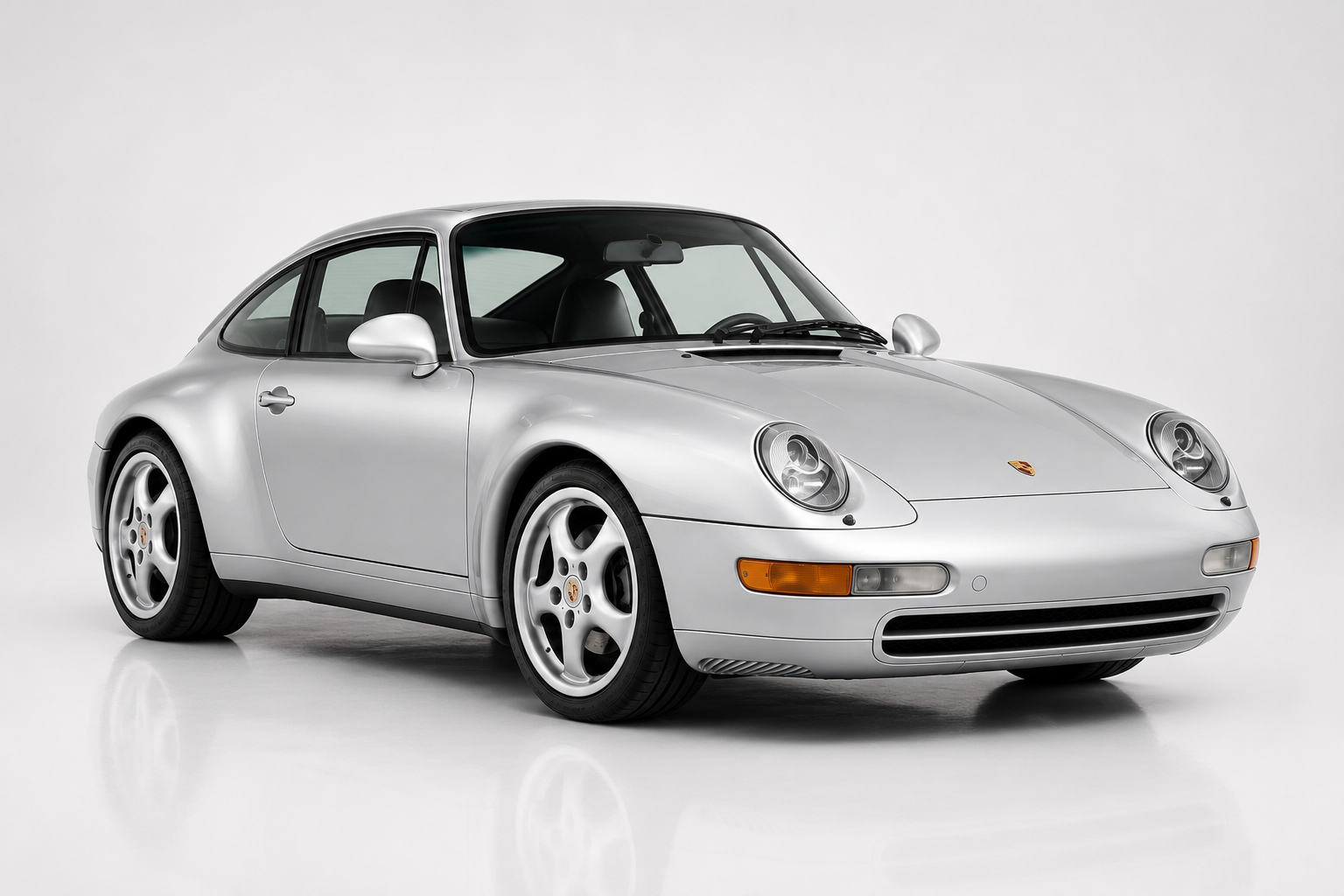
Silver Porsche 911 (993) coupe photographed in a studio, front three-quarter view showing the rounded oval headlamps, integrated bumpers, low nose and factory five-spoke alloy wheels of the last air-cooled 911.
Overview

Why this car matters

Launched in late 1993 and produced until 1998, the Porsche 911 type 993 represents the final evolution of the air-cooled 911 — a 34-year arc that began in 1963. Visually it retained the silhouette every Porsche enthusiast recognises, but underneath sat a comprehensively re-engineered car: multi-link rear suspension, integrated bumpers, hydraulically-tensioned timing chains and, on later cars, a six-speed gearbox. It was, in Porsche's own words, the 911 that finally drove the way it had always looked.

The 993 is now the dividing line between vintage Porsche ownership and the modern era. For many collectors it is the sweet spot: usable enough for long touring, mechanically robust enough to run for decades, and rare enough — only 68,881 cars were built — to be unambiguously appreciating.

No air-cooled 911 came after it, and no 911 before it combined the analogue charm of the original car with the engineering discipline of the modern company. The 993 is the bridge between two Porsches, and its values reflect that — a clean Carrera 2 manual today commands more than a brand-new GT4. For long-term collectors the question is rarely whether to own a 993, but which one.

Variants

Range and production

VariantYearsProductionNotes
Carrera1994–199814,855Base coupe, RWD, 272 hp (later 285 hp Varioram).
Carrera 41994–199811,522Lighter, viscous-coupling AWD; rare manual option.
Carrera S1997–19983,714Wide Turbo body, RWD — the connoisseur's pick.
Carrera 4S1995–19986,948Wide body + AWD + Turbo brakes; modern-classic blue chip.
Targa1995–19984,583Glass-roof Targa; controversial then, collectable now.
Turbo1995–19985,978First twin-turbo 911; 408 hp, AWD, 6-speed.
Turbo S1997–1998345450 hp; auction blue chip.
GT21995–1998194Rear-wheel-drive homologation special — now seven-figure.
Collector Variants

Limited & special editions

The models below represent the most significant limited and special edition variants — factory-produced cars that command meaningful premiums over standard examples and warrant specific attention from serious collectors.

911 Carrera RS (993) · 1995–1996

1,014 (all bodystyles, including Clubsport)
Distinguishing features
Lightweight 3.8-litre Varioram flat-six (300 hp), stripped interior, single-mass flywheel, fixed bi-plane rear wing and forged 18" wheels. RS-specific seam-welded bodyshell, deleted sound deadening and shorter final drive. Sold in Europe and Japan only — never officially imported to the United States.
Value premium
Roughly 3–4× a comparable manual Carrera 2; Clubsport versions trade above standard RS.
Inspection points
Confirm the lightweight bodyshell stamping and the 3.8 RS engine number against the Porsche Kardex. Check that the underbonnet plaque, RS sill decals, single-mass flywheel and seat shells are all original.
Authentication
Many 'RS-look' replicas exist. A genuine 993 RS has unique chassis numbering (WP0ZZZ99ZTS39xxxx range), specific build sticker codes (M002/M003) and a Porsche Production Specification (Kardex / Certificate of Authenticity) listing the M codes for RS, Clubsport or Touring trim.

911 Turbo S (993) · 1997–1998

345 units worldwide
Distinguishing features
Factory-uprated 3.6 twin-turbo to 450 hp via larger turbos, additional intercoolers and a revised ECU. Yellow brake calipers, carbon-fibre cabin trim, Turbo S-specific seats and unique rear wing with side intakes. Of the 345 built, 183 were delivered to the United States — the largest single national market for the model.
Value premium
Approximately 2–3× a standard 993 Turbo of equivalent condition and provenance.
Inspection points
Confirm both additional fender-mounted intercoolers are present, the carbon dash and door trim are factory items, and the Turbo S wing is the original casting. Cross-check the M-code 450 build sheet.
Buyer's Guide

What to look for

Provenance is everything

On a 993, history files are worth more than miles. Look for a continuous service record, ideally including the £5–8k 'major service' completed within the last 30,000 miles. Cars with original tools, books, spare key, window sticker and matching-numbers engine command 15–25% premiums and are far easier to resell.

Body & accident history

Inspect the front bumper support, inner wings and floor pans with a paint-depth gauge. A 993 that has been off the road is not necessarily disqualified, but the work must be specialist-grade and fully documented. Check the windscreen surround and Targa roof seal for corrosion bubbles — a leaking Targa is a five-figure restoration.

Variant strategy

Carrera 2 manuals offer the purest driving experience and the best value/usability ratio. Carrera 4S cars are the modern-classic blue chip — wide body, AWD, Turbo brakes. Turbos are rocketing in value and increasingly bought as investments. Tiptronic cars trade at a meaningful discount and represent the best value entry point for owners who genuinely prefer two pedals.

The pre-purchase inspection

Budget £600–£1,200 ($800–$1,500) for a PPI by a recognised 993 specialist (Autofarm, Tuthill, Canford Classics, RUF, Cantech Automotive, GMG, etc.). Do not skip this even on a dealer car. The inspection should include a compression and leak-down test, full underbody photography, and an OBD-II scan of the DME for fault codes.

Ownership

Living with it

Typical mileage
3,000–6,000 miles typical
Service interval
12 months / 6,000 miles (minor); 24 months / 12,000 miles (major)
Annual running cost
$4,500 – $9,000 (excluding depreciation; appreciating asset)
Fuel economy
18–22 mpg combined (Carrera); 14–17 mpg (Turbo)
Insurance
Agreed-value policies from Hagerty, Adrian Flux, or Lockton typically run $900–$2,400/yr for a $150k Carrera with limited mileage.

Annual service expectations

An annual minor service at a specialist runs $900–$1,500. Every 24 months expect a major service ($2,500–$4,500) covering valve clearance check, full fluids, plugs, brake fluid, and inspection of secondary air system and exhaust manifolds.

Storage & exercise

Air-cooled engines suffer from prolonged inactivity. Plan for monthly fluid-circulation drives and a battery tender. Climate-controlled storage extends paint and interior life materially — see recommended providers below.
Common Problems

Known issues by system

Engine — Secondary Air Injection

SAI passages clog and trigger emissions codes (1996+ OBD-II cars)

Moderate$1,800 – $3,500 (cylinder head removal required)
Symptoms — P0411 / P0412 codes, MOT/emissions failure, slight cold-start roughness.
Inspection — Read DME codes during PPI. Visible carbon in cylinder head ports is a tell.
Engine — Distributor Belt

Internal distributor drive belt fatigue (twin-distributor 993s)

Major$650 – $1,200
Symptoms — Misfire, melted cap contacts, eventual hard failure.
Inspection — Confirm belt has been replaced within the last 25,000 miles or 5 years.
Engine — Top-end oil leaks

Valve cover gasket and chain tensioner seepage

Minor$400 – $1,400 depending on extent
Symptoms — Oil mist on undertray; drips on garage floor.
Inspection — Visual under the car with the engine warm.
Drivetrain — Clutch & DMF

Dual-mass flywheel rattle and clutch wear

Moderate$3,500 – $6,500 (clutch + DMF + RMS)
Symptoms — Idle rattle, juddery take-up, high biting point.
Inspection — Listen at idle in neutral; test for clutch slip in 3rd at 2,500 rpm under load.
Body — Targa Roof

Mechanism failure and water ingress

Major$2,500 – $12,000+
Symptoms — Roof jams partway, water in footwells, corroded surround.
Inspection — Cycle the roof fully on a PPI; lift carpets and check for moisture staining.
Suspension — Rear axle

Multi-link bushing wear

Minor$1,200 – $2,800
Symptoms — Vague rear end, uneven tyre wear, MOT advisory.
Inspection — Lift the rear and check each link by hand; look for cracking in the rubber.
Body — Sunroof drains

Blocked drains causing footwell flooding

Moderate$200 – $600 (if caught early)
Symptoms — Damp carpets, musty smell, electrical faults.
Inspection — Pour water into the sunroof tray and check drainage at all four corners.
Turbo only — KKK K16 Turbochargers

Bearing wear and shaft play

Major$6,000 – $12,000 (pair, OEM rebuilt)
Symptoms — Smoke under boost, whining, oil consumption.
Inspection — Inspect compressor wheels through intake; check oil for metallic glitter.
Auctions

Recent results

DateAuctionCarMileageResult
2025-08-15
RM Sotheby's
Monterey 2025
1997 Turbo S
One of 183 US-market cars. Black over Rubicon Grey.
<6,900 mi
$758,500
Sold
2025-03-06
Gooding & Co.
Amelia Island 2025
1997 Turbo S
One of 182 NA cars; Arctic Silver over Boxster Red.
$643,000
Sold
2025-03-06
Gooding & Co.
Amelia Island 2025
1997 Carrera S
Blue Turquoise over Midnight Blue, ROW car.
~26,000 km
$246,400
Sold
2025-02-06
Bonhams
The Grand Palais Historique (Lot 133)
1995 Carrera RS Coupé
Black over black.
€345,000
Sold
2025-01-24
RM Sotheby's
Arizona 2025
1997 Turbo S
Arena Red Metallic over Chestnut Brown.
$500,000
Sold
2024-08-15
RM Sotheby's
Monterey 2024 (Lot 222)
1997 Carrera 4S
32,400 mi
$291,000
Sold
Investment

Long-term outlook

Blue ChipHorizon: 10+ years

The 993 occupies the same structural position in the 911 market that the 275 GTB occupies in the Ferrari hierarchy: it is the last of an era, with a fixed production number and a permanent narrative. Downside risk is limited by a deeply liquid global market and an aging collector base unlikely to deaccession.

Within the range, Carrera S and 4S wide-body cars and all Turbo variants offer the strongest risk-adjusted appreciation. GT2 sits in a market of its own and behaves more like a hypercar than a 993.

Our view, not advice. This section is Car Collector International's editorial judgement on where this model sits in the collector market, based on the production, specification and market data set out in this guide. It is not a recommendation to buy or sell and it is not investment advice. Values can fall as well as rise.

Recommended

The trusted network

Specialists

  • Autofarm
    Oxfordshire, UK
    Air-cooled specialist; PPIs, restoration, servicing.
  • Tuthill Porsche
    Banbury, UK
    Motorsport-grade prep and historic rally builds.
  • Canford Classics
    Dorset, UK
    Concours restoration and bare-metal repaints.
  • GMG Racing
    Santa Ana, CA
    Air-cooled service, suspension and forced induction.
  • Cantech Automotive
    Mississauga, ON
    PPIs and full mechanical restoration.

Storage

  • Windrush Car Storage
    London & Cotswolds, UK
    The benchmark UK collection facility.
  • AutoVault
    Essex, UK
    Dehumidified storage at 55% RH in purpose-built sealed buildings, with maintenance programmes and individual motor-trade insurance cover.
  • Classic Remise
    Düsseldorf, DE
    Showroom-style enthusiast storage.

Transport

  • Reliable Carriers
    USA (national)
    Enclosed coast-to-coast transport.
  • CARS UK
    UK & Europe
    Enclosed event and concours transport.
  • FERRLOG
    Italy / Europe
    Air-ride enclosed transport across the EU.
Related

Enjoyed this guide?

Get new buyer's guides and collector market intelligence delivered to your inbox. No spam. We respect your inbox.

The valuation figures in this guide are for research purposes only and do not constitute financial or investment advice. See our full disclaimer.