
Car Collector International
Modern Classic · 1976–1988

Porsche 924

Porsche's first water-cooled, front-engined production car — the platform that began the transaxle generation and led directly to the 944 and 968.

Coupe
Car Collector International Editorial
Porsche 924
Overview

Why this car matters

Launched in late 1975 for the 1976 model year, the 924 was developed by Porsche on Volkswagen's behalf, then taken back in-house when VW declined to put it into production. It pioneered the front-engine, rear-transaxle layout that would define Porsche's four-cylinder family for the next decade and a half, and was built at the former NSU plant in Neckarsulm. Early cars used an Audi-derived 2.0-litre inline-four; later 924 S models from 1986 adopted a detuned version of the 944's 2.5-litre Porsche unit.

Production ran from 1976 to 1988, with around 150,000 cars built across the standard 924, the rare 924 Turbo (931/932), the homologation 924 Carrera GT and the late 924 S — making it the highest-volume Porsche of its era and the foundation on which the entire transaxle family was built.

The 924 is the entry point to the transaxle generation and the car that kept Porsche's volume business viable through the late 1970s and early 1980s. Long dismissed as the 'cheap Porsche', it is now recognised as a genuinely important model — and the 924 Turbo and Carrera GT have moved decisively into collector territory.

Variants

Range and production

VariantYearsProductionNotes
924 (2.0L)1976–1985Audi-derived 2.0L; the volume car.
924 Turbo (931/932)1979–198212,365Porsche-developed turbocharged 2.0L; 170 hp; significantly rarer than the standard car.
924 Carrera GT1980–1981406Homologation special for Le Mans; intercooled 210 hp; flared arches; aluminium bonnet — the collector benchmark of the family.
924 Carrera GTS / GTR198159Even rarer evolution of the Carrera GT; lightweight road and competition derivatives.
924 S1986–198816,669Detuned 944 2.5L Porsche engine in the 924 body; the connoisseur's daily-driver pick.
Collector Variants

Limited & special editions

The models below represent the most significant limited and special edition variants — factory-produced cars that command meaningful premiums over standard examples and warrant specific attention from serious collectors.

Porsche 924 Carrera GT · 1980–1981

406 total — 400 road cars plus 6 prototypes and press cars. Of the 400 road cars, 75 were right-hand drive for the UK market (type 938); the remaining 325 were left-hand drive (type 937).
Distinguishing features
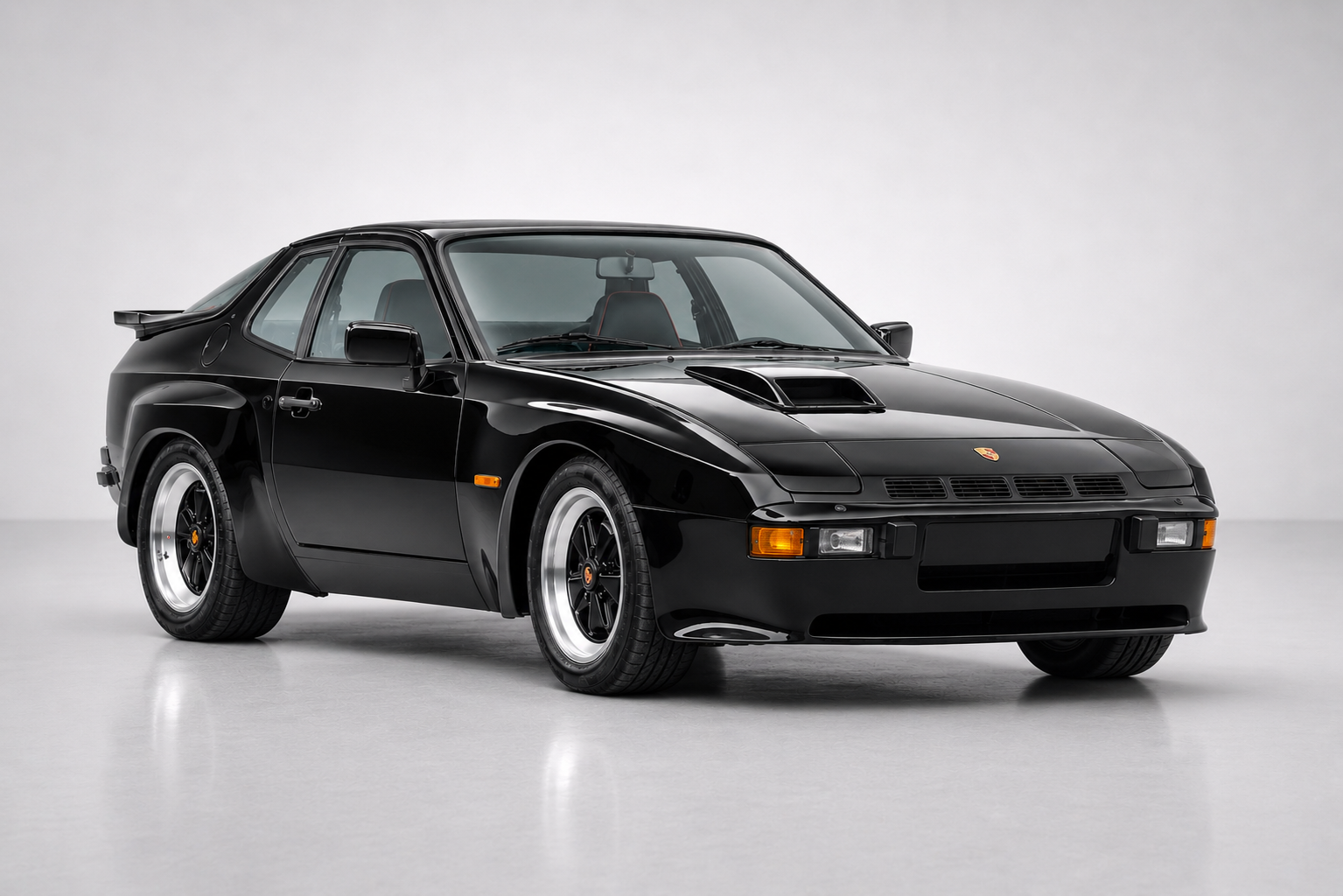
Turbocharged 1,984cc four-cylinder producing 210 hp (up from 125 hp on the standard 924), NACA-duct bonnet, prominent front air dam, flared wheelarches, rear spoiler, BBS alloy wheels, and a stripped, lightened interior with no rear seats as standard. Built specifically to homologate the 924 Carrera GTR for FIA Group 4 racing, and visually and mechanically distinct from every other 924 variant.
Value premium
Approximately 5–8× a comparable standard 924 in equivalent condition; the Carrera GT trades as a separate collector car in its own right rather than as a premium-specification 924.
Inspection points
Verify the NACA-duct bonnet is the factory item and not a replica fitted to a standard car; confirm flared wheelarches are factory original; check turbocharger condition and service history given the significant performance uplift over the standard engine; verify BBS wheel specification; confirm interior is correct Carrera GT specification.
Authentication
Production records are documented; verify via Porsche Certificate of Authenticity (CoA) and cross-reference against the international 924 Carrera GT register. Several standard 924s have been cosmetically modified to resemble Carrera GTs — the CoA and engine number are the only reliable authentication. The Carrera GT was never offered for sale in the USA — any car claiming US market delivery should be treated with particular caution. Original colours were limited to Guards Red, Black and Silver only; any other colour is either a repaint or incorrect.

Production figures sourced from official marque records and specialist registers. Verify chassis documentation with the relevant marque register before purchase.

Buyer's Guide

What to look for

Provenance and originality

Start with identity, paperwork and originality. For the Porsche 924, the strongest cars have continuous ownership history, matching numbers where applicable, original books and tools, factory build documentation and evidence of work by manufacturer-approved specialists. Documented cambelt service, original paint, unmodified bodywork, manual gearbox and verified specification — especially on Turbo and Carrera GT cars.

Mechanical inspection priorities

Early 2.0L Audi-derived units are durable but timing-belt service every 4 years / 60,000 km is non-negotiable; later 924 S uses the 944's Porsche 2.5L unit with the same belt discipline. 924 Turbo cars demand documented turbo and head-stud history. A proper pre-purchase inspection includes cold-start behaviour, ECU diagnostics and fault-code history (where applicable), leak-down or compression testing, underbody photography, suspension and chassis inspection, brake condition and a long enough road test to expose heat-related faults. Deferred maintenance on a car of this class is almost always more expensive than buying a better-sorted example.

Body, paint and accident history

Use a paint-depth gauge, lift access and a specialist familiar with the model's factory panel gaps and finish standards. Collector value is dramatically affected by structural repairs, refinished panels, poor paintwork and missing factory trim or option content. Documented cosmetic refresh is acceptable; concealed accident or fire damage must be priced severely.

Specification strategy

924 Carrera GT and 924 Turbo lead. 924 S coupes are the best balance of usability and Porsche-built drivetrain; standard early 2.0L cars are the analogue value entry point. Specification, colour, options and limited-build variants move values significantly. Buy the best-documented example in the most desirable specification you can justify, rather than a tired example of a rarer derivative that will need years of corrective work.

Pricing

What to pay

Project / needy
USD$3,500 – $7,000
GBP£2,500 – £5,500
EUR€3,000 – €6,500
Running standard 2.0L cars needing belts, paint and interior; viable basis for a restoration.
Driver 924 / 924 S
USD$8,000 – $16,000
GBP£6,000 – £12,500
EUR€7,000 – €14,500
Honest standard 2.0L and 924 S coupes with documented service and manual gearbox.
Excellent 924 S
USD$18,000 – $28,000
GBP£14,000 – £22,000
EUR€16,000 – €26,000
Low-mileage 924 S in original colours with continuous history and unmodified specification.
924 Turbo
USD$22,000 – $45,000
GBP£17,500 – £35,000
EUR€20,000 – €42,000
Documented 931/932 Turbo cars with verified specification, original turbo system and complete history.
924 Carrera GT
USD$110,000 – $210,000
GBP£90,000 – £170,000
EUR€100,000 – €195,000
Concours-grade Carrera GT examples — small-volume homologation cars increasingly traded at specialist auction.

Regional ranges authored independently — each reflects its local market, not an FX conversion

Ownership

Living with it

Typical mileage
1,000–4,000 miles typical for collector use
Service interval
12 months; mileage interval varies by model and use
Annual running cost
$3,500 – $10,000
Fuel economy
15–28 mpg depending on use
Insurance
Use an agreed-value collector or specialist supercar policy with limited mileage, secure storage, documented photography and an annual value review. Premiums vary sharply by age, storage location, declared value and driver profile.

Maintenance planning

Budget annually even if the car is used sparingly. Fluids age, tyres and date-coded rubber components must be replaced regardless of mileage, and stored cars need exercise. A documented maintenance rhythm protects both reliability and resale value.

Parts and specialist access

Porsche transaxle specialists in the UK, Germany and US support the 924 family alongside the 944 and 968; parts supply is good for mechanical components and improving for trim. Before purchase, confirm parts availability for model-specific bodywork, electronics, gearbox and engine components. A discounted car waiting on unobtainable parts or a factory service slot is rarely a saving in collector ownership.

Common Problems

Known issues by system

Engine

Cambelt and balance-shaft belt neglect (924 S)

Critical$1,200 – $2,800
Symptoms — No record of recent belt service; risk of valve-to-piston contact on 924 S.
Inspection — Demand documented belt and tensioner service within 4 years / 60,000 km.
Engine (Turbo)

Head-stud failure and turbocharger wear on 931/932

Major$3,500 – $9,000
Symptoms — Coolant loss, blown head gasket, oil under boost, soft boost build.
Inspection — Compression and leak-down test; confirm head-stud upgrade history and inspect turbo cartridge play.
Body

Front strut tower, sill and rear hatch corrosion

Major$3,000 – $15,000
Symptoms — Bubbling around strut tops, sills, rear hatch surround and battery tray.
Inspection — Specialist body inspection with the car on a lift; remove battery tray cover to inspect underlying metal.
Electrical

Age-related wiring and dashboard faults

Moderate$400 – $2,500
Symptoms — Intermittent gauges, failed central locking, dim instrument lighting, brittle insulation.
Inspection — Full electrical sweep on the PPI — every switch, every light, every gauge.
Interior

Dash cracking and cloth/leather trim wear

Minor$500 – $3,500
Symptoms — Split top-pad, fading, brittle plastics; difficult to source NOS trim.
Inspection — Inspect dash, door cards and seat bolsters; price replacement accordingly.
Drivetrain

Transaxle bearing and clutch wear

Moderate$2,000 – $5,500
Symptoms — Whining gearbox in 3rd / 4th, juddery clutch take-up, sloppy shift.
Inspection — Long road test through every gear; listen for bearing noise on the over-run.
Valuation

Current value bands by region

Concours
USD
$32,000
GBP
£25,500
EUR
€29,500
+4% 12-mo
Excellent
USD
$18,000
GBP
£14,500
EUR
€16,500
+3% 12-mo
Good
USD
$11,000
GBP
£8,800
EUR
€10,000
+1% 12-mo
Fair
USD
$6,500
GBP
£5,200
EUR
€6,000
0% 12-mo
Project
USD
$3,000
GBP
£2,400
EUR
€2,800
-2% 12-mo

Each region quoted in its local currency — independent market readings, not FX conversions

Long the 'cheap Porsche', the 924 has been re-rated steadily as the wider transaxle market has matured. 924 Turbo and 924 S cars now trade well above the standard 2.0L car, and the Carrera GT has moved into clear collector territory at specialist auction. Standard 2.0L examples remain the most accessible analogue Porsche on the market, with measured upside concentrated in original-paint, documented cars.

Auctions

Recent results

DateAuctionCarMileageResult
2025-09-18
Bring a Trailer
Online
1987 924 S
63,000 mi
$17,250
Sold
2025-07-22
Collecting Cars
Online (UK)
1981 924 Turbo
78,500 mi
£21,000
Sold
2024-10-12
RM Sotheby's
London
1981 924 Carrera GT
41,200 km
£140,625
Sold
Investment

Long-term outlook

EmergingHorizon: 5–10 years

Standard 924s remain at the accessible end of the Porsche market with condition-sensitive upside. 924 Turbo cars are firmly collector and rising; the 924 Carrera GT is now an unambiguous blue-chip transaxle Porsche. The wider re-rating of the transaxle family continues to lift the 924's floor, but the lower production variants — Turbo, S and Carrera GT — are doing the work.

Recommended

The trusted network

Specialists

  • Porsche factory-approved specialist
    View →
    UK / Europe
    Porsche 924 inspections, major service planning and originality reviews.
  • Model-focused independent
    View →
    United States
    Pre-purchase inspections, scheduled service and market-correct preparation for the 924.
  • Concours preparation studio
    View →
    International
    Paint correction, PPF, detailing, preservation and sale preparation for premium collector cars.
  • Hagerty
    View →
    USA / UK / EU
    Agreed-value collector and supercar insurance with global recognition.
  • Lockton Performance
    View →
    UK / EU
    Specialist agreed-value cover for modern hypercars and limited-production supercars.

Storage

  • Windrush Car Storage
    View →
    Cotswolds, UK
    Climate-controlled storage and collection management for high-value classic and supercars.
  • Autovault
    View →
    Bicester, UK
    Secure climate-controlled storage at Bicester Heritage with inspection programmes.
  • Classic Car Club Manhattan
    View →
    New York, NY
    Secure urban storage for collector and modern performance cars.

Transport

  • CARS UK
    View →
    UK & Europe
    Enclosed event, concours and collection transport across Europe.
  • Reliable Carriers
    View →
    USA (national)
    Enclosed coast-to-coast transport for premium supercars and classics.
  • FERRLOG
    View →
    Italy / Europe
    Air-ride enclosed transport for Italian and European collector cars.

Own a Porsche 924?

Join Car Collector International's owners register for valuation updates, auction alerts and members-only events.

Register interest

The valuation figures in this guide are for research purposes only and do not constitute financial or investment advice. See our full disclaimer.