
Car Collector International
Classic · 1969–1976

Porsche 914

Porsche's first mid-engine road car — long dismissed as 'the VW-Porsche', now a respected classic.

Car Collector International Editorial
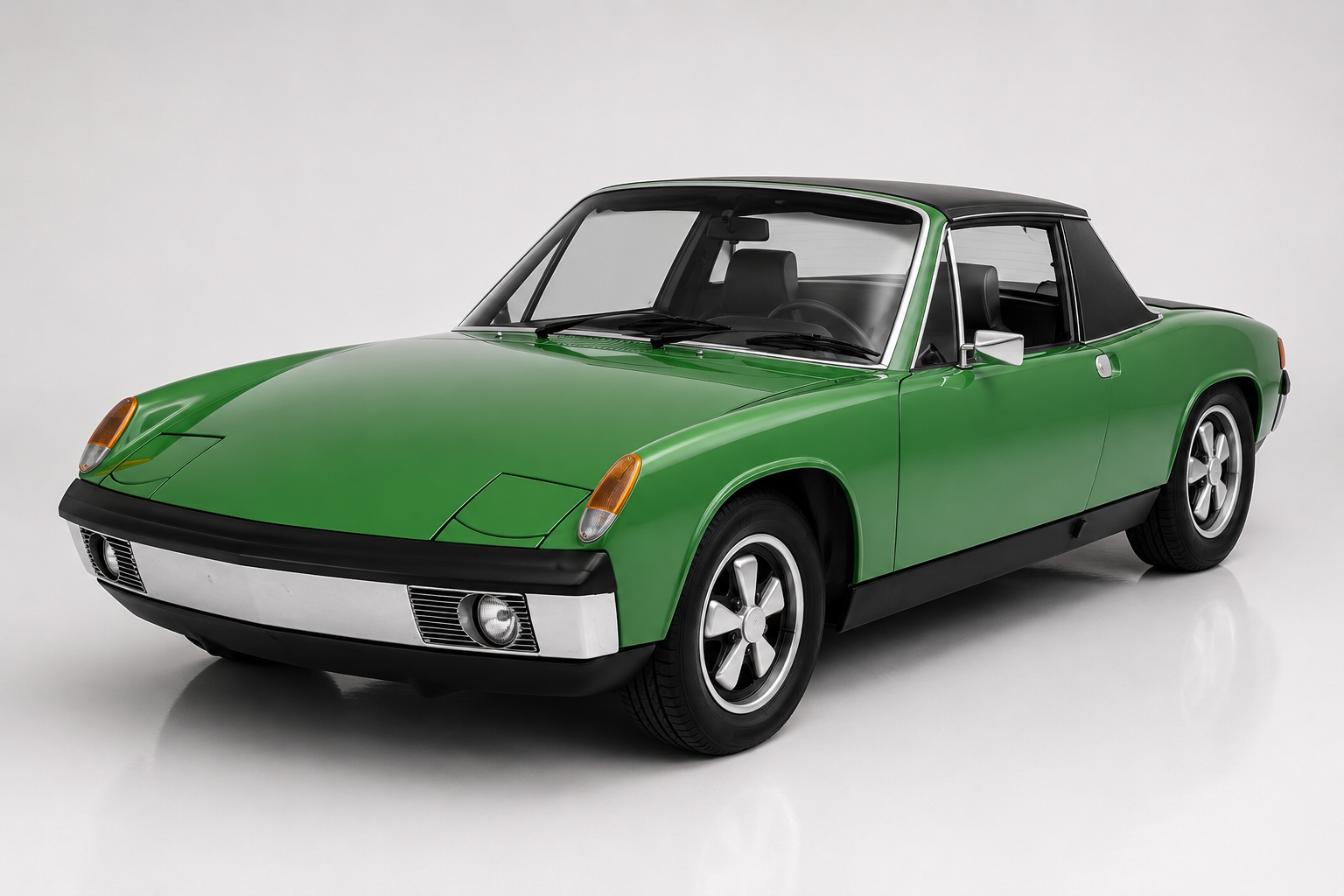
Green Porsche 914 in a studio setting, front three-quarter view showing the low targa two-seater bodywork with black nose section, pop-up headlamps, black targa roof panel and alloy wheels.
Overview

Why this car matters

The 914, launched in 1969, is Porsche's first mid-engine road car and the product of a joint programme with Volkswagen; bodies were built by Karmann in Osnabrück. It was offered in two distinct engine families — the four-cylinder 914/4 with a Volkswagen-derived flat-four (1.7L, 1.8L and 2.0L across the run) and the collectible 914/6 with the Porsche 2.0-litre flat-six derived from the 911T. Total production across all variants ran to approximately 119,000 units, making it the best-selling Porsche of its era.

The 914/4 was produced through 1976 (US-market sales continued into 1976; European sales ended earlier). The 914/6 was built only from 1970 to 1972, in a run of approximately 3,300 units, and is the model that carries the serious collector market today.

The 914 is Porsche's first mid-engine road car and the template — mid-engined, targa two-seater, purpose-built for balance — that the Boxster, Cayman, 987 and 981 would later refine. Long dismissed as the 'VW-Porsche', it has re-emerged over the past decade as a respected air-cooled Porsche with a rising, documented collector market, led by the 914/6.

Variants

Range and production

VariantYearsProductionNotes
914 1.7 (914/4)1969–1973VW-derived 1.7L flat-four, 80 hp (US net); 5-speed manual; targa roof. Launch engine of the range.
914 1.8 (914/4)1974–1976VW-derived 1.8L flat-four, 85 hp (US net). US-market emissions-era replacement for the 1.7.
914 2.0 (914/4)1973–1976VW-derived 2.0L flat-four, 95–100 hp depending on year and market. Best of the four-cylinder cars.
914/61970–1972Porsche 2.0L flat-six (Type 901/36) derived from the 911T, 110 hp / 112 PS; approx. 950 kg; approx. 3,300 built. Verify. The collector-market car.
914/6 GT (reference)1970–1971Homologation-focused competition variant with steel flared arches, revised suspension and larger brakes. Le Mans 1970 class win. Very small production. Reference variant — not folded into the standard 914/6 count.
914/8 (reference)1969Two 3.0L flat-eight prototypes built as gifts / show cars. Reference only — not a production variant and not part of the 914 range for collector market purposes.
Buyer's Guide

What to look for

Provenance and originality

Start with identity, paperwork and originality. The strongest cars carry a continuous Porsche or recognised-specialist service file, matching numbers, both keys, complete books and tools and — where available — the Porsche Certificate of Authenticity and factory build documentation. For the 914/6, focus on matching-numbers cars with continuous history, documented flat-six installation from new and no rust in the hell hole (the closed section behind the driver's door where water collects). For 914/4 cars, condition, originality and rust status dominate over specification.

Mechanical inspection priorities

Inspection should be led by a Porsche or VW air-cooled specialist. On 914/6 cars, verify original 2.0-litre flat-six installation and factory records; on 914/4 cars, verify engine-family history and confirm the car has not been converted or heavily re-shelled. A proper pre-purchase inspection includes cold-start behaviour, an undertray-off inspection of the engine and gearbox, chassis and suspension survey, brake condition and a long enough road test to expose heat- and load-related faults. Deferred maintenance on a specialist Porsche is almost always more expensive than buying a better-sorted example.

Body, paint and history

Use a paint-depth gauge and a lift inspection. Confirm any PPF history; inspect splitters, sills and undertrays for evidence of contact; and price concealed accident or corrosion damage severely. Rust in wheel arches, sills, floors and battery-tray areas is the primary body concern on the earlier cars.

Specification strategy

Specification, colour and factory options move values meaningfully. Buy the best-documented example in the most desirable specification you can justify rather than a tired car of a rarer derivative that will need years of corrective work.

Pricing

What to pay

914/4 (drivers to excellent)
USD$15,000 – $45,000
GBP£12,000 – £36,000
EUR€14,000 – €42,000
Broad market across the 1.7, 1.8 and 2.0 four-cylinder cars; rust status and originality dominate over year and displacement. Verify.
914/6 (documented, unmodified)
USD$60,000 – $175,000
GBP£48,000 – £140,000
EUR€55,000 – €160,000
Matching-numbers 914/6 with continuous history; average around $87k, concours cars at the top of the range. Verify.
914/6 GT (halo — separate tier)
USD$400,000 – $700,000
GBP£320,000 – £560,000
EUR€370,000 – €640,000
Documented factory 914/6 GT competition cars are a separate racing market, not a standard 914/6. Public record sits around $665k. Verify.

Regional ranges authored independently — each reflects its local market, not an FX conversion

Ownership

Living with it

Typical mileage
1,000–5,000 miles typical for enthusiast use
Service interval
12 months regardless of mileage; major service on interval
Annual running cost
$3,000 – $10,000 depending on use and specification
Fuel economy
18–25 mpg depending on model and use
Insurance
Use an agreed-value collector or specialist Porsche policy with limited mileage, secure storage, documented photography and an annual value review.

Maintenance planning

Budget annually even if the car is used sparingly. Fluids age, date-coded rubber and tyres must be replaced regardless of mileage, and stored cars need periodic exercise. A documented maintenance rhythm protects both reliability and resale value.

Parts and specialist access

Porsche Classic and the wider Porsche specialist network support parts supply well for most generations. For low-volume or period-specific components, a knowledgeable marque specialist is essential to source correctly and preserve originality.
Common Problems

Known issues by system

Body / chassis

Rust in floors, sills, battery tray and wheel arches

Major$5,000 – $40,000+ depending on scope
Symptoms — Bubbling paint, corroded seams, soft floors, scale in wheel arches.
Inspection — Full lift inspection with paint-depth gauge; probe suspect areas.
Engine

Deferred maintenance and heat-cycled service items

Major$3,000 – $25,000+
Symptoms — Uneven idle, oil misting, driveability faults.
Inspection — Marque-specialist PPI; compression and leak-down; verify service history.
Electrical / trim

Period-specific wiring, switchgear and interior trim degradation

Moderate$1,500 – $10,000
Symptoms — Intermittent gauges, failing switchgear, faded plastics.
Inspection — Full electrical function test; interior condition survey.
Suspension / brakes

Bushings, dampers and brake service items

Moderate$1,500 – $8,000
Symptoms — Untidy tracking, uneven tyre wear, vibration under braking.
Inspection — Lift inspection and geometry check.
Valuation

Current value bands by region

Concours
USD
$60,000
GBP
£48,000
EUR
€55,000
+2% 12-mo
Excellent
USD
$35,000
GBP
£28,000
EUR
€32,000
0% 12-mo
Good
USD
$22,000
GBP
£18,000
EUR
€20,000
0% 12-mo
Fair
USD
$12,000
GBP
£10,000
EUR
€11,000
0% 12-mo

Each region quoted in its local currency — independent market readings, not FX conversions

914/6 averages ~$87k (range ~$33k–$174k); 914/4 stays attainable (~$15k–$45k). Many 914/4s have been converted to six-cylinder — verify originality carefully. The 914/6 GT is a separate competition market, not a standard 914/6.

Auctions

Recent results

DateAuctionCarMileageResult
2024-08
Classic.com-tracked (BaT)
Online
1970 914/6
$173,600
Sold
2021-08
Classic.com-tracked
Online
1970 914/6 GT
Racing GT variant — a separate market, not a standard 914/6.
$665,000
Sold

Auction results reflect Classic.com-tracked public sales. The 914/6 GT is a distinct competition model and not comparable to standard 914/6 road cars.

Investment

Long-term outlook

EmergingHorizon: 5–10 years

Porsche's first mid-engine road car with a re-rating market for the 914/6 and a stable, condition-led market for the 914/4. The 914/6 GT sits in a permanently separate tier.

Recommended

The trusted network

Specialists

  • Porsche Centre / factory-approved workshop
    View →
    UK / Europe / USA
    Factory-standard servicing, PIWIS diagnostics and originality reviews.
  • Independent Porsche specialist
    View →
    International
    Pre-purchase inspections, mechanical and cosmetic assessment for collector Porsches.
  • Concours preparation studio
    View →
    International
    Paint correction, PPF, detailing and sale preparation for collector Porsches.

Storage

  • Windrush Car Storage
    View →
    Cotswolds, UK
    Climate-controlled storage and collection management for high-value collector cars.
  • Autovault
    View →
    Bicester, UK
    Secure climate-controlled storage at Bicester Heritage with regular inspection programmes.
  • Classic Car Club Manhattan
    View →
    New York, NY
    Secure urban storage for collector and modern performance cars.

Transport

  • CARS UK
    View →
    UK & Europe
    Enclosed event, concours and collection transport across Europe.
  • Reliable Carriers
    View →
    USA (national)
    Enclosed coast-to-coast transport for collector cars.
  • FERRLOG
    View →
    Italy / Europe
    Air-ride enclosed transport for European collector and hypercar cargo.
Related

Enjoyed this guide?

Get new buyer's guides and collector market intelligence delivered to your inbox. No spam. We respect your inbox.

The valuation figures in this guide are for research purposes only and do not constitute financial or investment advice. See our full disclaimer.