
Car Collector International
Modern Classic · 2001–2005

Porsche 911 GT2 (996)

The first water-cooled GT2 — rear-drive, twin-turbo, six-speed manual, and an early adopter of PCCB ceramic brakes.

Car Collector International Editorial
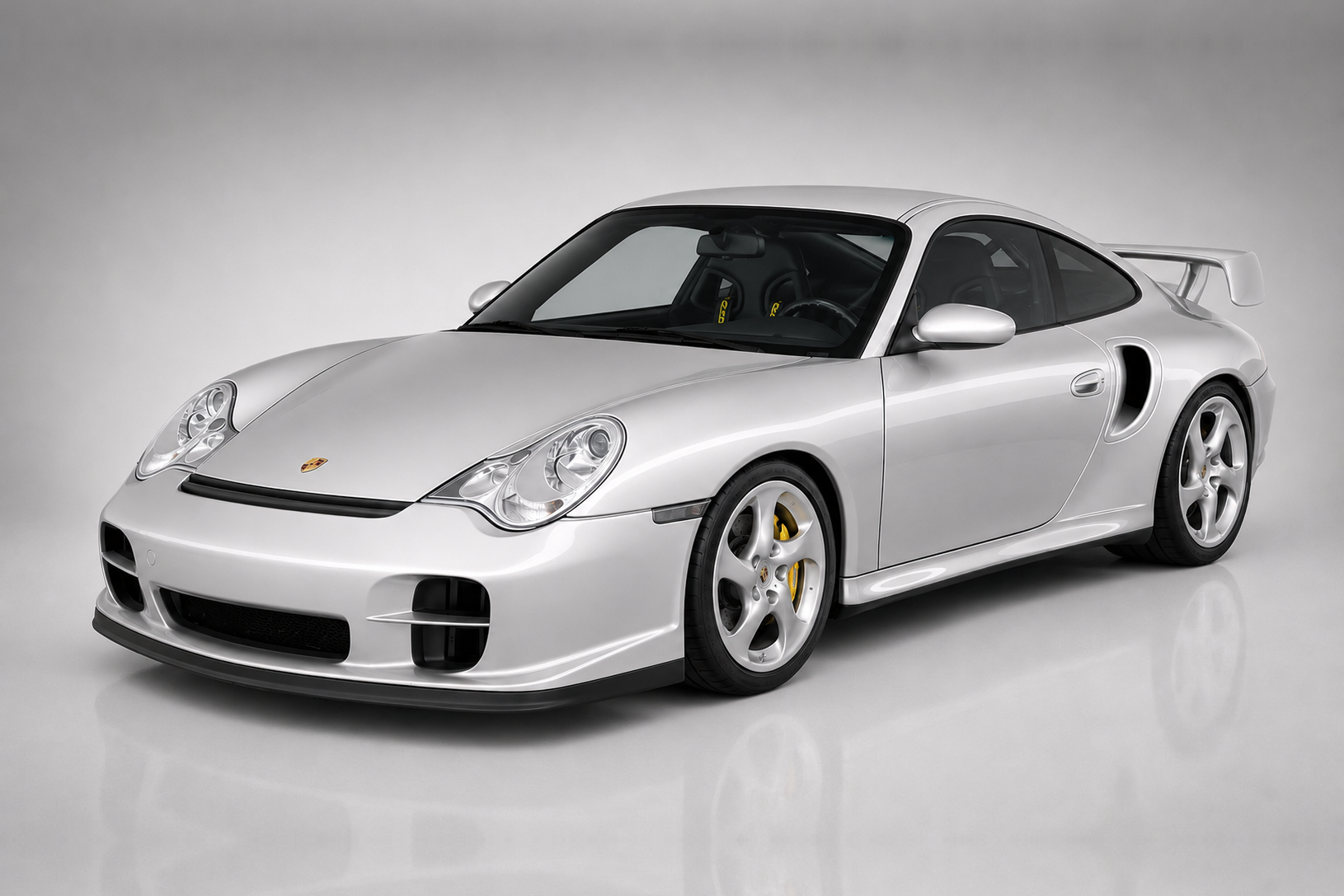
Silver Porsche 911 GT2 (996) in a studio, front three-quarter view showing the deep front bumper with brake cooling ducts, side intercooler intakes, fixed rear wing and multi-spoke silver wheels.
Overview

Why this car matters

The 996 GT2 was introduced for 2001 as a rear-drive, twin-turbo, manual-only sibling to the 996 Turbo. It used the water-cooled 3.6-litre twin-turbo M96/70S flat-six, a six-speed manual gearbox and stripped-out cabin, and was one of the first road cars offered with Porsche Ceramic Composite Brakes (PCCB) as standard.

A 2004 update (commonly referred to as 996.2 or 'MY05') raised output and added detail revisions. The 996 GT2 remained a manual, rear-drive, no-PSM turbo car throughout its production run — a specification Porsche would not offer on a GT2 again after the 997 GT2 RS.

The first water-cooled GT2 and one of the earliest road cars offered with Porsche's ceramic composite brakes. It kept the GT2 recipe intact through the water-cooled transition: rear drive, twin turbos and a manual gearbox, without stability control.

Variants

Range and production

VariantYearsProductionNotes
996.1 GT22001–2003First water-cooled GT2: 3.6L twin-turbo M96/70S flat-six, ~456 bhp / 462 PS, six-speed manual, rear-wheel drive; PCCB standard, no PSM. Approx. 247 units per production-number aggregators (Verify).
996.2 GT2 (MY04–05 update)2004–2005Updated GT2: ~476 bhp / 483 PS from the same twin-turbo M96 architecture, revised software and detail changes; approx. 1,040 units per aggregators (Verify). Approx. 1,287 GT2 total across both phases per production-number aggregators; Verify — no single clean Porsche-published total.
Buyer's Guide

What to look for

Provenance and originality

Start with identity, paperwork and originality. For the Porsche 911 GT2 (996), the strongest cars have a continuous Porsche or recognised GT-specialist service file, original paint, matching numbers, both keys, complete books and tools, and — where available — the Porsche Certificate of Authenticity and factory build documentation. Original paint, low ownership count, continuous documented history, both keys and books, unrefreshed PCCBs within Porsche spec, and (US-market cars) a clean import and title history.

Mechanical inspection priorities

The M96/70S twin-turbo flat-six is a Mezger-derived unit and does not share the wider 996 Carrera's IMS-bearing concern; the practical variables are turbocharger health, PCCB disc wear and coolant-system integrity. Any car without documented turbo and PCCB service history should be inspected accordingly. A proper pre-purchase inspection includes a full PIWIS diagnostic scan, cold-start behaviour, borescope inspection of the cylinder bores where age or history justify it, compression and leak-down testing where appropriate, an undertray-off inspection of the flat-six and gearbox, chassis and suspension survey, brake condition (including PCCB weight/thickness measurement where fitted) and a long enough road test to expose heat-related faults. Deferred maintenance on a GT-department turbocharged car is almost always more expensive than buying a better-sorted example.

Body, paint and track history

The GT2 is a track-capable rear-drive turbo car and a meaningful proportion have seen circuit use or hard road use. Track use is not itself a problem — it must simply be documented and reflected in the price. Use a paint-depth gauge, a lift inspection and a specialist familiar with the model's factory panel gaps. Inspect splitter, diffuser, undertrays and roll-cage mounts for evidence of contact; confirm any PPF history; and price concealed accident, fire or heat damage severely.

Specification strategy

Original-paint, matching-numbers 996 GT2 with continuous Porsche or GT-specialist history leads. The 996.2 update (2004–05) trades at a clear premium to the 996.1; complete PCCB and turbocharger history is a hard prerequisite. Specification, colour, options and factory build documentation move values significantly on GT2 cars. Buy the best-documented example in the most desirable specification you can justify rather than a tired car of a rarer derivative that will need years of corrective work.

Pricing

What to pay

Good driver 996 GT2
USD$150,000 – $200,000
GBP£120,000 – £160,000
EUR€140,000 – €185,000
Documented driver cars with continuous history; indicative — Verify against current comparable sales.
Excellent / low-mileage 996.2
USD$200,000 – $280,000
GBP£160,000 – £225,000
EUR€185,000 – €260,000
Clean low-mileage 996.2 examples with complete PCCB and turbocharger history; indicative — Verify.

Regional ranges authored independently — each reflects its local market, not an FX conversion

Ownership

Living with it

Typical mileage
1,000–4,000 miles typical for enthusiast use
Service interval
12 months regardless of mileage; major service every 4 years / 24,000 miles
Annual running cost
$5,000 – $15,000 excluding track-day tyres, brakes and setup
Fuel economy
13–19 mpg depending on use
Insurance
Use an agreed-value collector or specialist supercar policy with limited mileage, secure storage, documented photography and an annual value review. Track-day cover is a separate conversation; declared values should be reviewed annually as the market moves.

Maintenance planning

Budget annually even if the car is used sparingly. Fluids age, date-coded rubber and tyres must be replaced regardless of mileage, and stored turbocharged cars need exercise. The GT-department flat-six prefers regular use to long static storage; a documented maintenance rhythm protects both reliability and resale value.

Parts and specialist access

Restrict inspection and servicing to Porsche Centres and recognised 996-era GT-specialist independents; general Porsche workshops without GT-department and PCCB experience are not appropriate for this car. Porsche Classic and the GT-specialist network support parts supply well for most generations, but generation-specific turbochargers, carbon panels, centre-lock wheel hardware and PCCB components sit outside general availability and need a knowledgeable specialist to source correctly.
Common Problems

Known issues by system

Turbochargers

K24 twin-turbo wear and boost-related driveability faults

Major$8,000 – $18,000 for a correctly rebuilt pair
Symptoms — Shaft play, boost leaks, smoke on overrun, uneven power delivery.
Inspection — Boost-leak test; shaft-play inspection; verify rebuild or replacement history.
Brakes (PCCB)

Ceramic disc wear and replacement cost

Major$12,000 – $20,000 for a full PCCB refresh
Symptoms — Disc thickness or weight approaching Porsche minima; cracking beyond spec.
Inspection — Weigh and measure discs during PPI; verify replacement history.
Cooling / plumbing

Coolant-system pipe and radiator condition

Moderate$1,500 – $6,000 depending on scope
Symptoms — Coolant loss, front-mounted radiator debris damage, aging plastic fittings.
Inspection — Undertray-off inspection at PPI; pressure test.
Body / paint

Front-end stone damage and refinished panels

Moderate$3,000 – $9,000
Symptoms — Stone chips, refinished nose or arches, PPF residue.
Inspection — Paint-depth gauge, lift inspection, PPF-history review.
Valuation

Current value bands by region

Each region quoted in its local currency — independent market readings, not FX conversions

The 996 GT2 is re-evaluated as the first water-cooled GT2 and, importantly, the first Porsche road car offered with PCCB. Clean low-mileage cars trade ~$200k–$280k; average-condition ~£123k; ~300 US-market cars reported. Documented, original-paint 996.2 cars with clean PCCB and turbocharger histories trade at clear premiums to 996.1 cars.

Auctions

Recent results

DateAuctionCarMileageResult
2025-04-01
PCARMARKET
Online auction
2003 996 GT2
Verified PCARMARKET result.
~10,000 mi
$201,000
Sold
2024-10-01
Bonhams
The Zoute Sale
2004 996 GT2
Verified public auction result.
€161,000
Sold
Investment

Long-term outlook

EmergingHorizon: 5–10 years

The first water-cooled GT2, offered only as a manual and only as a rear-drive twin-turbo — a specification later GT2 RS models moved decisively away from. As the modern-classic 996 GT-department market matures, documented original 996.2 GT2 cars have a durable long-term case.

Recommended

The trusted network

Specialists

  • Porsche Centre / factory-approved workshop
    View →
    UK / Europe / USA
    Factory-standard servicing, PIWIS diagnostics and originality reviews for the 911 GT2 (996).
  • Independent GT-department specialist
    View →
    International
    GT2 pre-purchase inspections, borescope surveys, turbocharger health and geometry for the 911 GT2 (996).
  • Concours preparation studio
    View →
    International
    Paint correction, PPF, detailing and sale preparation for collector Porsches.

Storage

  • Windrush Car Storage
    View →
    Cotswolds, UK
    Climate-controlled storage and collection management for high-value collector and modern Porsches.
  • Autovault
    View →
    Bicester, UK
    Secure climate-controlled storage at Bicester Heritage with regular inspection programmes.
  • Classic Car Club Manhattan
    View →
    New York, NY
    Secure urban storage for collector and modern performance cars.

Transport

  • CARS UK
    View →
    UK & Europe
    Enclosed event, concours and collection transport across Europe.
  • Reliable Carriers
    View →
    USA (national)
    Enclosed coast-to-coast transport for collector and modern Porsches.
  • FERRLOG
    View →
    Italy / Europe
    Air-ride enclosed transport for European collector cars.
Related

Enjoyed this guide?

Get new buyer's guides and collector market intelligence delivered to your inbox. No spam. We respect your inbox.

The valuation figures in this guide are for research purposes only and do not constitute financial or investment advice. See our full disclaimer.