
Supercar · 1986–1993

Porsche 959

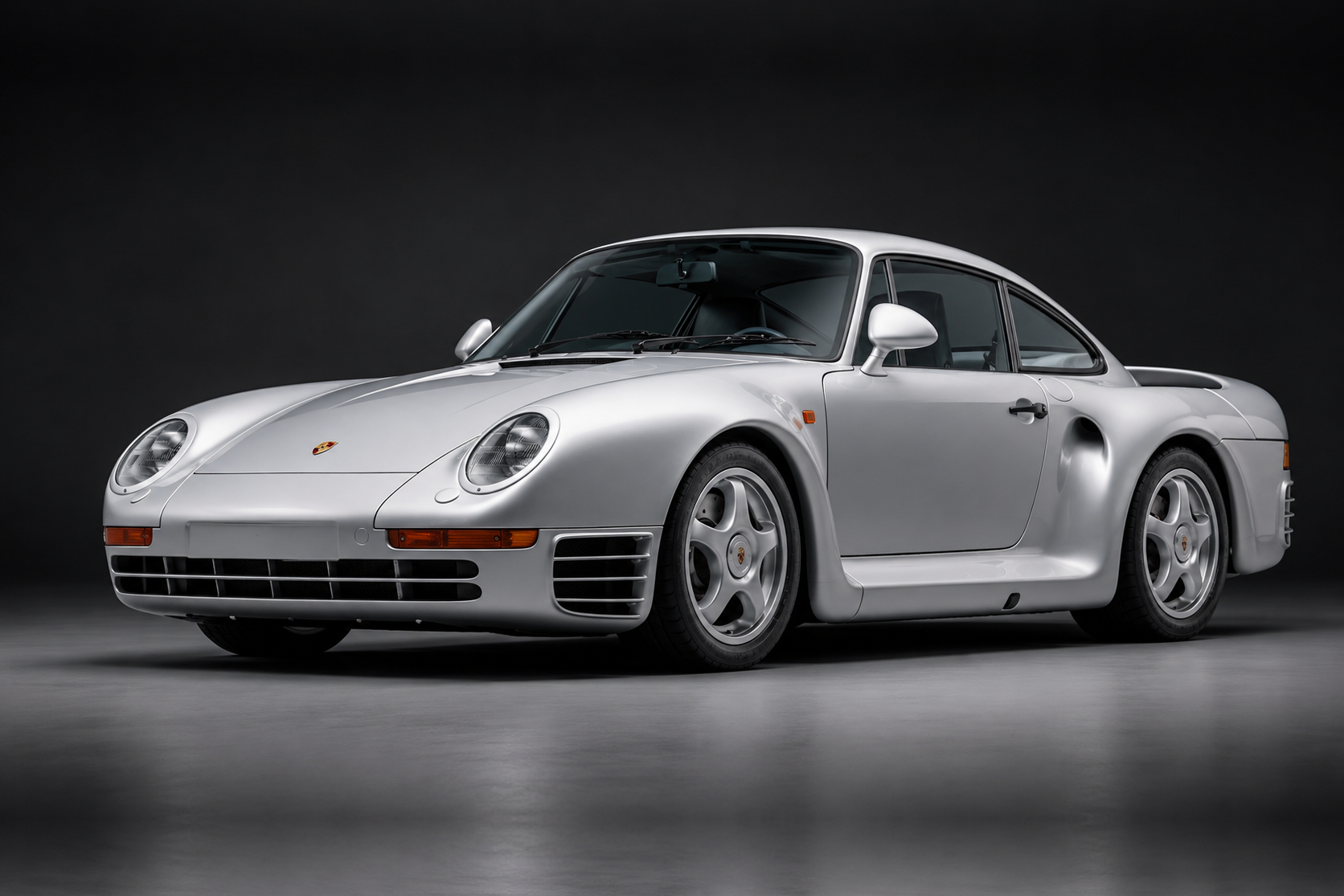
Porsche's Group B homologation supercar — twin-turbo flat-six, electronically controlled AWD, 197 mph in 1986.

Coupe
Car Collector International Editorial
Porsche 959
Overview

Why this car matters

The 959 was Porsche's Group B homologation programme: a twin-sequential-turbo 2.85-litre flat-six, six-speed manual gearbox, electronically controlled all-wheel-drive, magnesium wheels and an aerodynamically refined Kevlar/aluminium body on the 911 platform. 292 production cars were built across 1986–88 ('Komfort' and 'Sport' specifications), with a small number of further cars completed from spares between 1992–93.

The 959 is the founding modern Porsche supercar and one of the most important German cars of the 1980s.

The 959 is the foundation of Porsche's modern supercar lineage and one of the most technologically advanced cars of its era; values are driven by tiny production and continuous Porsche Classic-grade history.

Variants

Range and production

VariantYearsProductionNotes
959 Komfort1986–1988263Standard-trim road specification with full creature comforts.
959 Sport1986–198829Lightweight specification with stripped interior and competition-style trim.
959 (later spares-built)1992–1993Small number of cars completed from factory spares post-production.
Buyer's Guide

What to look for

Provenance and originality

Start with identity, paperwork and originality. For the Porsche 959, the strongest cars have a continuous ownership file, matching numbers where applicable, original manuals, invoices and evidence of work by recognised marque specialists. Porsche Classic / Porsche Klassik documentation, matching numbers, original colour, complete books and tools and continuous documented history are decisive.

Mechanical inspection priorities

The twin-turbo flat-six is robust when correctly maintained by Porsche Classic-equipped specialists; turbo health, cooling and engine-management calibration are core items. A proper pre-purchase inspection includes cold-start behaviour, leak-down or compression testing where appropriate, underbody photography, suspension and chassis-point inspection, brake condition and a road test long enough to expose heat-related faults. Deferred maintenance is almost always more expensive than buying a better-sorted car.

Body, paint and accident history

Use a paint-depth gauge, lift access and a specialist familiar with the model's factory seams and panel gaps. Collector value is dramatically affected by structural repairs, poor paintwork, corrosion, incorrect panels and missing factory trim. Documented cosmetic restoration is acceptable; concealed accident repair must be priced severely.

Specification strategy

Komfort cars are the more usable majority; Sport cars (29 built) sit in a separate higher tier. US-import 959s (originally not federalised) are a small but distinct market. Specification, colour, transmission and limited-build variants move values significantly. Buy the best-documented example in the most desirable specification you can justify rather than a tired example of a rarer derivative that will need years of corrective work.

Pricing

What to pay

Driver Komfort
USD$1,500,000 – $1,800,000
GBP£1,200,000 – £1,440,000
EUR€1,385,000 – €1,660,000
Usable matching-numbers Komfort cars with documented history.
Excellent Komfort
USD$1,900,000 – $2,400,000
GBP£1,520,000 – £1,920,000
EUR€1,750,000 – €2,215,000
Concours-grade Komfort cars with Porsche Classic service history.
Sport
USD$2,800,000 – $4,500,000
GBP£2,240,000 – £3,600,000
EUR€2,585,000 – €4,150,000
959 Sport (29 built) — separate ultra-blue-chip tier.

Regional ranges authored independently — each reflects its local market, not an FX conversion

Ownership

Living with it

Typical mileage
1,500–4,000 miles typical for collector use
Service interval
12 months; mileage interval varies by model and use
Annual running cost
$3,500 – $10,000
Fuel economy
10–18 mpg depending on use
Insurance
Use an agreed-value collector policy with limited mileage, secure storage, documented photography and an annual value review. Premiums vary sharply by age, storage location and declared value.

Maintenance planning

Budget annually even if the car is used sparingly. Fluids age, tyres date out, fuel systems suffer from ethanol, batteries fail and stored cars need exercise. A documented maintenance rhythm protects both reliability and resale value.

Parts and specialist access

959 service is essentially limited to Porsche Classic-equipped specialists worldwide; non-marque shops should not be relied upon. Before purchase, confirm parts availability for model-specific trim, suspension, fuel system, electronics and engine components. A cheap car waiting on unobtainable parts is rarely cheap in collector ownership.

Common Problems

Known issues by system

Engine

Twin-turbo system wear and engine-management issues

Major$30,000 – $100,000 for a correct refresh
Symptoms — Boost lag, smoke on start-up, fault codes from the original Bosch system.
Inspection — Compression and leak-down test; engine-management scan; Porsche Classic recent paperwork.
Trim / Interior

Magnesium wheel and bespoke trim issues

Moderate$5,000 – $40,000 depending on scope
Symptoms — Wheel cracks/corrosion, aged interior plastics.
Inspection — Detailed inspection by a 959-experienced specialist.
Identity

Non-matching engine or replacement bodyshell

CriticalMaterial pricing impact
Symptoms — Numbers not matching Porsche Klassik records.
Inspection — Porsche Klassik cross-check.
Valuation

Current value bands by region

Concours
USD
$2,400,000
GBP
£1,920,000
EUR
€2,215,000
+2% 12-mo
Excellent
USD
$2,000,000
GBP
£1,600,000
EUR
€1,850,000
+1% 12-mo
Good
USD
$1,650,000
GBP
£1,320,000
EUR
€1,525,000
0% 12-mo
Fair
USD
$1,400,000
GBP
£1,120,000
EUR
€1,290,000
0% 12-mo
Project
USD
$1,150,000
GBP
£920,000
EUR
€1,060,000
0% 12-mo

Each region quoted in its local currency — independent market readings, not FX conversions

959 values are anchored by 292-car production and the car's position as the founding modern Porsche supercar. Sport cars trade in a separate market; US-import cars (originally not federalised, now over 25 years old) are increasingly mainstream.

Auctions

Recent results

DateAuctionCarMileageResult
2025-08-16
RM Sotheby's
Monterey
1987 959 Komfort
$2,065,000
Sold
2024-08-17
Gooding & Co.
Pebble Beach
1988 959 Sport
$3,030,000
Sold
2024-02-02
RM Sotheby's
Paris
1988 959 Komfort
€1,635,000
Sold
Investment

Long-term outlook

Blue ChipHorizon: 10+ years

Matching-numbers 959s with Porsche Classic history should remain durable. Sport cars sit in a separate ultra-blue-chip market driven by tiny production.

Recommended

The trusted network

Specialists

  • Porsche marque specialist
    View →
    UK / Europe
    Porsche 959 inspections, servicing and originality reviews.
  • Model-focused independent
    View →
    United States
    Pre-purchase inspections, major service planning and market-correct preparation for the 959.
  • Concours preparation studio
    View →
    International
    Paint correction, detailing, preservation and sale preparation for premium collector cars.

Storage

  • Windrush Car Storage
    View →
    Cotswolds, UK
    Climate-controlled storage and collection management for high-value collector cars.
  • Autovault
    View →
    Bicester, UK
    Secure storage at Bicester Heritage with regular inspection programmes.
  • Classic Car Club Manhattan
    View →
    New York, NY
    Secure urban storage for collector and modern-classic performance cars.

Transport

  • CARS UK
    View →
    UK & Europe
    Enclosed event, concours and collection transport across Europe.
  • Reliable Carriers
    View →
    USA (national)
    Enclosed coast-to-coast transport for premium and collector cars.
  • FERRLOG
    View →
    Italy / Europe
    Air-ride enclosed transport for Italian and European collector cars.

Own a Porsche 959?

Join Car Collector International's owners register for valuation updates, auction alerts and members-only events.

Register interest