Car Collector International
Classic · 1967–1969

Alfa Romeo 33 Stradale (1967)

Routinely called the most beautiful car ever built — and the first modern supercar.

Car Collector International Editorial
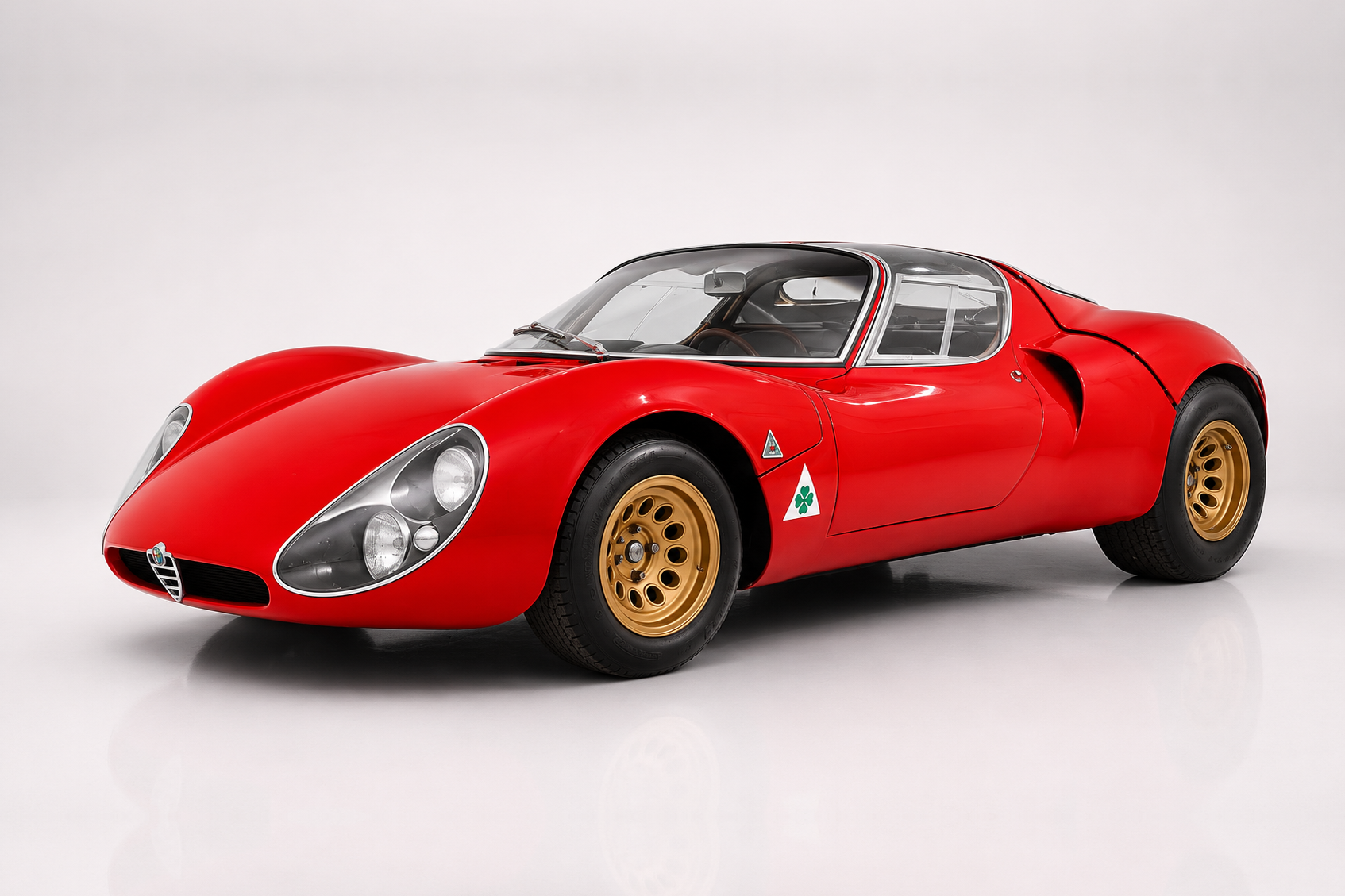
Red 1967 Alfa Romeo 33 Stradale in a studio setting, front three-quarter view showing the low, curvaceous Franco Scaglione-designed aluminium body, single production headlights, delicate rear-quarter intake and gold Campagnolo magnesium wheels — the mid-engine road version of the Tipo 33 racing prototype.
Overview

Why this car matters

The Alfa Romeo 33 Stradale is the mid-engine road version of the Tipo 33 racing prototype, hand-built between 1967 and 1969. It uses an all-aluminium 1,995 cc V8 designed by Carlo Chiti (bore/stroke 78 × 52.2 mm) with dry-sump lubrication, SPICA fuel injection, twin plugs per cylinder, four chain-driven cams and a 10,000 rpm redline; power at launch is quoted at 230 PS / 227 hp at 8,800 rpm with 206 Nm at 7,000 rpm. Drive is through a six-speed Colotti manual transaxle. Body and chassis are aluminium — the body designed by Franco Scaglione and built by Carrozzeria Marazzi, the chassis an aluminium tubular structure. Kerb weight is quoted at approximately 700 kg; top speed at approximately 260 km/h (162 mph).

Only 18 examples were built. The two prototypes (105.33.01, 105.33.12) carried the dual-headlight arrangement Scaglione originally drew; production chassis (750.33.1xx) reverted to a single-headlight nose on ride-height regulations. Cars differ in detail throughout the run — wiper position, later cars gained brake-cooling vents — because each was hand-built with per-car drivetrain and trim variations. At launch it was the fastest commercially available car over the standing kilometre, and the most expensive car of its day at approximately US$17,000 (1967).

The 33 Stradale is routinely called the most beautiful car ever built. It is also, defensibly, the first modern supercar — mid-engined, race-derived, road-legal and among the first production cars anywhere with butterfly doors. Every serious mid-engine road car of the following decade owes it a design and engineering debt, and its collector status is undisputed at the top of the market.

Variants

Range and production

VariantYearsProductionNotes
33 Stradale (1967–1969)1967–19691818 built total across prototypes and production. HP/PS: 230 PS at launch = 227 hp — present both. Hand-built drivetrains vary per car: the first production Stradale (750.33.101) is factory-datasheeted at 243 PS at 9,400 rpm with the street exhaust and 254 PS with the open exhaust; race trim ~270 PS. WEIGHT DISPUTED: 700 kg is the claimed kerb figure; 905 kg is the heaviest verified in-running-order weight. Verify per-car. Body designed by Franco Scaglione and built by Carrozzeria Marazzi. The two prototypes (105.33.01, 105.33.12) have the dual-headlight arrangement Scaglione drew; production chassis (750.33.1xx) reverted to a single-headlight nose on ride-height regulations. Later cars gained brake-cooling vents and other detail changes. One of the first production cars with butterfly doors. Fastest commercially available car over the standing kilometre at launch; most expensive car of its day (~US$17,000, 1967). Five concept cars were built on 33 Stradale chassis (Carabo, Iguana, P33 Roadster, Cuneo, 33/2 Coupé Speciale) — note only, do NOT count in the 18. ROAD-CAR COUNT DISPUTED — Verify: 18 chassis total, but sources differ on how many were completed as road cars: 8 (Commody), ~10 (TopSpeed — two prototypes plus six chassis converted to concepts), or 11 two-headlight production cars built by Marazzi 1968–69 (Classic Driver). REPLICAS: continuation cars exist and can be convincing — Coys offered one built on the front and rear chassis sections of Stradale #2 with an original crankcase, cylinder heads and six-speed gearbox. These are NOT one of the 18; verify chassis provenance (750.33.1xx). Dealer claims of '$30M+ last recorded sales' originate in replica-seller marketing and are unverified — do not use.
Buyer's Guide

What to look for

Provenance — factory build sheet and Autodelta records

On any 33 Stradale, provenance is the entire market. For the 1967 33 Stradale specifically, hand-built per-car drivetrain and trim variation is the norm — no two cars are identical, and any prospective purchase should be reconciled against the factory record and the recognised owners' registry before pricing. Insist on the factory build sheet, chassis-plate numbering, continuous ownership records and cross-checking against the recognised owners' registry before pricing. A car whose history is not fully paper-trailed is priced against that history, not the badge.

Chassis and body originality

Alloy tubular chassis and Scaglione-designed Marazzi bodywork are the car's structural core. Cars differ in detail (wiper position, later-car brake-cooling vents); verify every original detail against period photography and the factory record, and treat any structural or body repair as material to pricing.

V8 drivetrain, SPICA injection and Colotti transaxle

The Chiti-designed dry-sump V8 with SPICA injection, twin-plug ignition and chain-driven cams is a race-derived unit hand-built per car. Verify cold-start behaviour, oil pressure at temperature, injection calibration and cambelt / timing-chain history. The Colotti transaxle requires an Autodelta-competent specialist for any driveline work.

Interior originality and per-car detail

Cars are hand-built with per-car interior and switchgear detail. Verify originality against period photography and the factory build sheet; prioritise cars with sympathetic, original interiors over cars re-trimmed in modern materials. Butterfly-door hardware is bespoke and any repair must be documented.

Pricing

What to pay

33 Stradale (1967) — condition-based
USD$11,000,000 – $22,000,000
GBP£8,000,000 – £16,000,000
EUR€10,000,000 – €20,000,000
Verify. Hagerty UK's valuation tool places the model at roughly €15–17M by condition; broader estimates span €10–20M. Almost all trading is private and museum-level.

Regional ranges authored independently — each reflects its local market, not an FX conversion

Ownership

Living with it

Typical mileage
500–2,000 miles typical
Service interval
12 months by time or 3,000 miles, whichever first; hand-built race-derived drivetrain
Annual running cost
$15,000 – $60,000+ depending on use
Fuel economy
10–14 mpg
Insurance
Agreed-value seven-figure classic policy with limited mileage, secure storage, dedicated transport and annual value review. The 33 Stradale (1967) sits at the top of the collector-Alfa underwriting band.

Factory / Autodelta relationship

Servicing and any drivetrain work must be through an Autodelta-competent specialist with direct experience of the Tipo 33 family. Independent classic shops are not equipped for the twin-plug, SPICA-injected, dry-sump V8 or the Colotti transaxle.

Provenance and per-car documentation

Only 18 cars were built and drivetrains vary per car. Reconcile every service, restoration and mechanical rework against the factory build sheet and the owners' registry; a car whose history is not fully paper-trailed is priced on that history, not the badge.
Common Problems

Known issues by system

Provenance

Factory build sheet, Autodelta record and registry cross-check

CriticalNot applicable — market impact only
Symptoms — Missing build sheet, incomplete ownership record, unverified chassis number.
Inspection — Factory / Autodelta authentication and registry cross-check before any transaction.
Chassis / body

Alloy tubular chassis and Marazzi-built aluminium body originality

CriticalNot applicable — market impact only
Symptoms — Evidence of structural repair, non-original panels, deviation from period photography.
Inspection — Specialist inspection with body-shop documentation review.
Engine / injection

Chiti-designed dry-sump V8; SPICA injection; twin-plug ignition

Major$25,000 – $80,000+
Symptoms — Cold-start difficulty, injection calibration drift, ignition timing drift, oil-pressure irregularity.
Inspection — Autodelta-competent specialist diagnosis; cold- and warm-run test; compression / leak-down.
Transaxle

Colotti six-speed manual — bespoke, per-car build

Major$15,000 – $50,000+
Symptoms — Baulky shifts, driveline shunt, weeping seals.
Inspection — Road test through all gears; Autodelta-competent specialist strip-inspection where warranted.
Valuation

Current value bands by region

Each region quoted in its local currency — independent market readings, not FX conversions

Public auction appearances are vanishingly rare; almost all trading is private and museum-level. Hagerty's UK valuation tool places the model at roughly €15–17M depending on condition, with broader estimates spanning €10–20M. In period it cost 9,750,000 lire — around 20% more than a Lamborghini Miura P400 at 7,700,000 lire — making it the most expensive road car in the world at launch. A prototype resides in the Museo Storico Alfa Romeo at Arese.

Auctions

Recent results

DateAuctionCarMileageResult

No recent public auction results currently meet our verification standard. We publish sale figures only from verified examples, and will update this guide as qualifying results become available.

Investment

Long-term outlook

Blue ChipHorizon: 10+ years

18 cars, race-derived Chiti V8, Scaglione bodywork and the historical status as the first modern supercar make the 33 Stradale one of the most defensible long-hold positions in the collector market. Long-term appreciation is driven by scarcity, design canonisation and Alfa's continued institutional recognition of the car — including the 2023 modern homage that shares only the name.

Recommended

The trusted network

Specialists

  • Autodelta-competent specialist
    View →
    Italy / UK / USA
    Servicing and inspection of Tipo 33 / Autodelta drivetrain family; dry-sump, twin-plug, SPICA-injected V8 and Colotti transaxle.
  • FCA Heritage / Alfa Romeo Classiche
    View →
    Arese, Italy
    Factory-side authentication and provenance research for pre-1970 Alfa competition cars.
  • Concours preparation studio
    View →
    International
    Paint correction and detailing for sale and event preparation.

Storage

  • Windrush Car Storage
    View →
    Cotswolds, UK
    Climate-controlled storage for high-value collector cars.
  • Autovault
    View →
    Bicester, UK
    Secure climate-controlled storage at Bicester Heritage.
  • Hagerty Garage + Social
    View →
    USA (multiple locations)
    Climate-controlled storage in key US collector markets.

Transport

  • CARS UK
    View →
    UK & Europe
    Enclosed event and concours transport across Europe.
  • Reliable Carriers
    View →
    USA (national)
    Enclosed coast-to-coast transport for collector cars.
  • Intercity Lines
    View →
    USA
    Enclosed transport with dedicated supercar handling.

Enjoyed this guide?

Get new buyer's guides and collector market intelligence delivered to your inbox. No spam. We respect your inbox.

The valuation figures in this guide are for research purposes only and do not constitute financial or investment advice. See our full disclaimer.