
Car Collector International
Classic · 1966–1994

Alfa Romeo Spider (105/115)

Pininfarina's last personally-signed design and Alfa Romeo's longest-lived production car — twenty-eight years of the same Battista-drawn body.

Convertible
Car Collector International Editorial
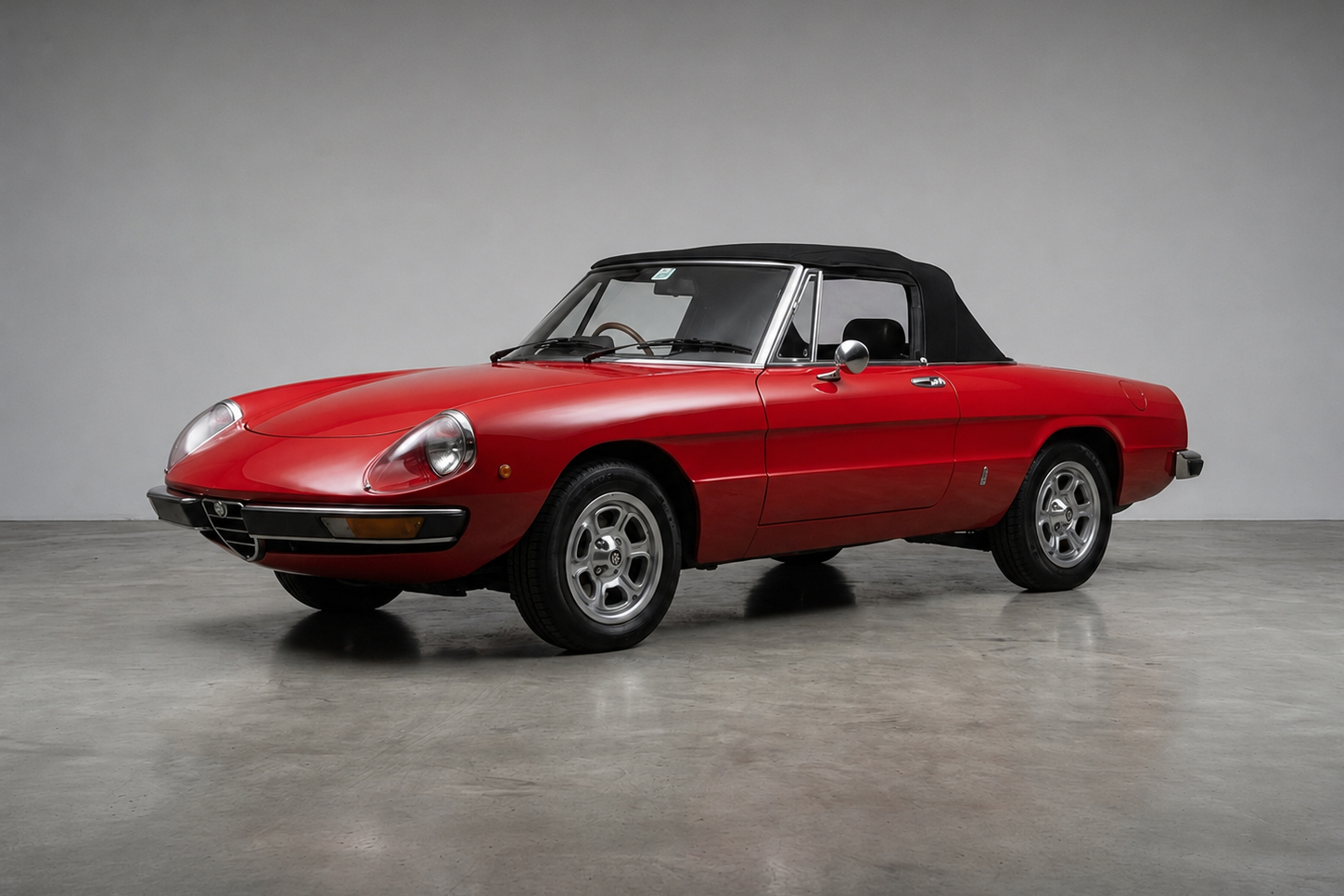
Red Alfa Romeo Spider Series 1 (round-tail 'Duetto' / 1750 Veloce) with black hood raised, photographed front three-quarter on a gravel path with parkland fencing and lake behind — UK registered 'WMM 41G'.
Overview

Why this car matters

Launched at the 1966 Geneva Motor Show as the replacement for the Giulia Spider, the 105/115-series Spider carried the same twin-cam four and rear-drive platform through four distinct body series and twenty-eight production years. The round-tail Series 1 — sold in the United States as the 'Duetto' following a naming competition — was Pininfarina's last personally-signed body design; Battista Pinin Farina died months after the car was launched.

Series 2 (1970–1982) introduced the shortened Kamm 'coda tronca' tail and included the numbered 1978 Niki Lauda Special Edition (350 US-market cars, launched at the Long Beach Grand Prix with chassis #001 driven by Lauda). Series 3 (1983–1989) added rubber bumpers and a subtle rear spoiler under Alfa Romeo's federalisation of the car for its principal US market, and Series 4 (1990–1994) restored the smoother nose, added a body-coloured bumper and Bosch Motronic fuel injection. Engine capacity moved from 1.6 to 1.75, 1.8 and 2.0 litres over the run, with a lower-power 1300 Junior sold in Italy for tax reasons.

The Series 1 Duetto — round-tail, chrome-bumpered, pedal-box under the dash — is the definitive collector car of the range; later series are useable, honest classics rather than appreciating assets.

The final Pininfarina body drawn under Battista's own hand, and the last mass-production Alfa Romeo to use the traditional twin-cam, rear-drive layout. The round-tail Duetto is the reference car; the whole range benefits from Alfa Romeo's twin-cam mechanical simplicity.

Variants

Range and production

VariantYearsProductionNotes
Duetto 1600 (Series 1, round-tail)1966–19676,324The reference Series 1; 1,570 cc twin-cam, 109 bhp, round rear, sliding pedal-box; sold as Duetto in the US after the naming competition. 6,324 units per Wikipedia's cited factory total.
1750 Spider Veloce (Series 1, round-tail) — Verify1967–19694,027Larger 1,779 cc twin-cam, 118 bhp; round-tail body retained; hinged pedals from 1968. Production figure is not settled: Wikipedia cites 4,027; Supercar Nostalgia cites 4,672 (4,039 LHD + 633 RHD). Both sit around 4,000–4,700 — roughly half the 8,722 figure that circulates in some earlier references. Flagged Verify pending an ARCD or AROC-cited definitive total.
1300 Junior (round-tail)1968–19692,680Italian-market low-power 1,290 cc car; round-tail body retained on the Junior for one further year after Series 2 launched.
Series 2 'Coda Tronca' (1300/1600/1750/2000 Veloce)1970–198225,500Kamm-tail restyle by Pininfarina; SPICA mechanical fuel injection on US 1750/2000 cars, Dell'Orto or Weber carburettors elsewhere; the volume series (approx. figure). Includes the 1978 Niki Lauda Special Edition (350 units, US market) — see Collector Variants.
Series 3 (Aerodinamica)1983–198922,000Rubber bumpers, rear ducktail spoiler, restyled dashboard; Bosch L-Jetronic on US Quadrifoglio Verde; the least-loved series today (approx. figure).
Series 41990–199419,000Pininfarina restyle: body-coloured bumpers, smoother nose, twin airbags on late US cars, Bosch Motronic 2.0 litre; the last of the line, closed the run in 1994 (approx. figure).
Collector Variants

Limited & special editions

The models below represent the most significant limited and special edition variants — factory-produced cars that command meaningful premiums over standard examples and warrant specific attention from serious collectors.

Duetto 1600 (Series 1, round-tail) · 1966–1967

6,324
Distinguishing features
The launch specification and Pininfarina's last personally-signed body: rounded 'boat-tail' rear, chrome bumpers, sliding pedal-box under the dash, 1,570 cc Nord twin-cam producing 109 bhp, five-speed gearbox and covered headlamps behind Perspex fairings. Sold in the US as the 'Duetto' after Alfa Romeo's public naming competition; the only Spider generation Battista Pinin Farina saw into production before his death later in 1966.
Value premium
Roughly 2–3× a comparable Series 2 Coda Tronca in equivalent condition; the highest values in the entire 105/115 Spider range.
Inspection points
Confirm the round-tail body is original to the chassis — check rear-quarter weld lines under the boot floor, inside the rear arches and behind the fuel tank for evidence of a Series 2 or 3 clip transplant. Verify sliding-pedal box, correct 1600 engine number stamping, covered headlamps and original round tail-light housings. Rust in sills, floors, boot floor and inner rear arches is where Series 1 cars are lost.
Authentication
Cross-reference chassis number against the Alfa Romeo Centro Documentazione (ARCD) archive in Arese, which issues Certificates of Origin confirming the original body type, engine number, colour and delivery market. Genuine Duetto 1600 chassis numbers fall in the AR 66xxxxx range with 'AR 00526' engine prefix; ARCD paperwork is the only defensible authentication.

1750 Spider Veloce (Series 1, round-tail) — Verify · 1967–1969

Verify — c. 4,027 (Wikipedia) or 4,672 (Supercar Nostalgia; 4,039 LHD + 633 RHD)
Distinguishing features
Larger 1,779 cc Nord twin-cam producing 118 bhp, taller final drive, dual-circuit brakes and — from mid-1968 — conventional hinged pedals in place of the Duetto's under-dash pedal box. The round-tail Pininfarina body was retained for two further years alongside the launch of the Kamm-tail Series 2 on the 1300 Junior and 1750 saloon platforms. The last of the round-tail Spiders and the definitive driver's-car specification of the Series 1.
Value premium
Roughly 1.5–2× a comparable Series 2 2000 Veloce; sits just below the Duetto 1600 in the round-tail hierarchy but is the more useable of the two.
Inspection points
Same rear-clip transplant checks as the Duetto — the round-tail body is the value; a Series 2 chassis carrying a round tail is not a 1750 Veloce. Confirm hinged pedal box on 1968-onwards cars, correct 1750 engine number, and the presence of the twin-choke Weber or Dell'Orto carburettors as originally fitted (US-market cars carried SPICA mechanical injection from 1969 and are worth less than the European carburettor cars).
Authentication
ARCD Certificate of Origin is the reference. Genuine 1750 Spider Veloce chassis numbers fall in the AR 148xxxxx range with 'AR 00548' engine prefix. Cross-check the engine number against the chassis-plate stamping and the Alfa Romeo Owners Club register; carburettor European-spec cars carry a clear premium over SPICA-injected US cars. Production figure is not settled between the two credible public sources (Wikipedia: 4,027; Supercar Nostalgia: 4,672, split 4,039 LHD / 633 RHD), so the total is flagged Verify pending an ARCD- or AROC-cited definitive figure; both real sources sit around 4,000–4,700 and neither matches the 8,722 figure that circulates in some earlier references.

1978 Niki Lauda Special Edition (Series 2, US market) · 1978

350
Distinguishing features
US-market Series 2 Spider 2000 Iniezione launched to mark Niki Lauda joining the Brabham–Alfa Romeo Formula 1 team for 1978. Debuted at the 1978 Long Beach Grand Prix with chassis #001 driven on the circuit by Lauda himself. Numbered edition of exactly 350 cars with cosmetic changes only over the standard car: Niki Lauda badging, specific graphics and the addition of a rear spoiler. Mechanical specification is the standard SPICA-injected 2.0-litre US Series 2.
Value premium
Modest — typically 15–30% over a comparable standard Series 2 2000 Spider Veloce in equivalent condition, driven almost entirely by the numbered special-edition status and Lauda association rather than any mechanical uplift. Well-documented cars with intact Lauda badging, original spoiler and confirmed edition-plate command the top of that range; refinished or unbadged cars sit at the standard Series 2 level.
Inspection points
Confirm the edition plate and chassis number correspond to the 350-car Niki Lauda run rather than a standard Series 2 dressed with reproduction badges — reproduction Lauda badging and rear spoilers are widely available in the US aftermarket and are the dominant authentication risk. Verify original SPICA injection (or documented specialist rebuild), rear spoiler mounting integrity, and originality of the Lauda-specific graphics. Standard Series 2 corrosion checks (sills, floors, rear arches, boot floor) apply.
Authentication
Cross-reference chassis and edition-plate numbers against the Alfa Romeo Owners Club (AROC) Niki Lauda register and, where possible, obtain an ARCD Certificate of Origin confirming the car was delivered new as a Niki Lauda Special Edition. The 350-car total, 1978 Long Beach launch and chassis-#001 Lauda demonstration are documented on Wikipedia's Alfa Romeo Spider article and by contemporary US dealer references; the numbered plate is the defensible marker.

Production figures sourced from official marque records and specialist registers. Verify chassis documentation with the relevant marque register before purchase.

Buyer's Guide

What to look for

Provenance and originality

Start with identity, paperwork and originality. For the Alfa Romeo Spider (105/115), the strongest cars have continuous ownership history, matching numbers where applicable, original books and tools, factory build documentation and evidence of work by manufacturer-approved specialists. Round-tail bodywork with no evidence of rear-clip transplant, matching engine and chassis numbers, correct chrome bumpers and grille, and — on Series 1 — pedal-box under the dash rather than floor-hinged.

Mechanical inspection priorities

The Nord twin-cam is fundamentally robust but bottom-end wear, chain rattle, and — on SPICA-injected US Series 2/3 cars — injection pump condition are the priority items. SPICA overhauls are specialist work; conversion to Weber carburettors is common but hurts originality on collector-tier cars. A proper pre-purchase inspection includes cold-start behaviour, ECU diagnostics and fault-code history (where applicable), leak-down or compression testing, underbody photography, suspension and chassis inspection, brake condition and a long enough road test to expose heat-related faults. Deferred maintenance on a car of this class is almost always more expensive than buying a better-sorted example.

Body, paint and accident history

Use a paint-depth gauge, lift access and a specialist familiar with the model's factory panel gaps and finish standards. Collector value is dramatically affected by structural repairs, refinished panels, poor paintwork and missing factory trim or option content. Documented cosmetic refresh is acceptable; concealed accident or fire damage must be priced severely.

Specification strategy

Round-tail Series 1 cars — Duetto 1600 and 1750 Veloce — carry the specification and originality premium. Later series are bought on condition and history rather than variant. Specification, colour, options and limited-build variants move values significantly. Buy the best-documented example in the most desirable specification you can justify, rather than a tired example of a rarer derivative that will need years of corrective work.

Pricing

What to pay

Duetto 1600 — concours
USD$70,000 – $95,000
GBP£45,000 – £62,000
EUR€52,000 – €72,000
Documented, matching-numbers round-tail Series 1 in original colour with correct trim; the reference tier.
1750 Veloce round-tail — excellent
USD$50,000 – $70,000
GBP£32,000 – £48,000
EUR€38,000 – €55,000
Honest, well-restored or preserved round-tail 1750 with full history and correct bumpers.
Series 2 Coda Tronca — good driver
USD$22,000 – $38,000
GBP£14,000 – £24,000
EUR€16,000 – €28,000
Sound, useable Kamm-tail cars; SPICA-injected US 2000 Veloce firmer than European carburettor cars.
Series 3 / Series 4 — good driver
USD$12,000 – $22,000
GBP£8,000 – £16,000
EUR€9,000 – €18,000
The volume-availability tier; rubber-bumper Series 3 the softest, restyled Series 4 firmer than Series 3.
Project / rust repair required
USD$6,000 – $15,000
GBP£4,000 – £10,000
EUR€5,000 – €12,000
Any series; rust repair budget will exceed the purchase price on a poor car.

Regional ranges authored independently — each reflects its local market, not an FX conversion

Ownership

Living with it

Typical mileage
1,000–4,000 miles typical for collector use
Service interval
12 months; mileage interval varies by model and use
Annual running cost
$5,000 – $18,000
Fuel economy
15–28 mpg depending on use
Insurance
Use an agreed-value collector or specialist supercar policy with limited mileage, secure storage, documented photography and an annual value review. Premiums vary sharply by age, storage location, declared value and driver profile.

Maintenance planning

Budget annually even if the car is used sparingly. Fluids age, tyres and date-coded rubber components must be replaced regardless of mileage, and stored cars need exercise. A documented maintenance rhythm protects both reliability and resale value.

Parts and specialist access

Alfa Romeo specialists in the UK, Italy, Germany and the US support the model well; mechanical parts are broadly available. Series-specific trim, chrome and correct interior fabrics are the pinch points. Before purchase, confirm parts availability for model-specific bodywork, electronics, gearbox and engine components. A discounted car waiting on unobtainable parts or a factory service slot is rarely a saving in collector ownership.

Common Problems

Known issues by system

Body

Sill, floor and rear arch corrosion

Major$4,000 – $18,000
Symptoms — Bubbling paint at sill seams, arches and behind rear wheels; soft floorpans and boot floor.
Inspection — Lift the car; probe sills, jacking points, floors, spare-wheel well and the front chassis rails behind the wheels; a magnet is essential.
Body

Rear-clip transplant (Series 1 round-tail on Series 2/3 chassis)

CriticalValue impact: 30–60%
Symptoms — Round-tail bodywork on a car whose VIN or build plate does not correspond to a 1966–1969 chassis.
Inspection — Confirm chassis number and Alfa Romeo Centro Documentazione (ARCD) certificate; inspect rear-quarter weld lines under the boot floor and inside the rear arches.
Engine

Nord twin-cam chain rattle and bottom-end wear

Moderate$2,500 – $7,000
Symptoms — Timing-chain rattle from cold, low hot oil pressure, tapping from bottom end on load.
Inspection — Cold-start audio, oil-pressure gauge reading at idle when hot, and a compression / leak-down test.
Fuel system

SPICA mechanical injection wear (US Series 2/3 1750/2000)

Major$3,500 – $8,000
Symptoms — Poor cold-start, uneven idle, flat spots, black smoke; owners often convert to Webers as a workaround.
Inspection — Confirm SPICA pump has been overhauled by a recognised specialist (Wes Ingram in the US is the reference); test drive across the rev range.
Electrics

Original wiring degradation and earth faults

Moderate$1,500 – $4,500
Symptoms — Intermittent lighting, wiper and fuel-gauge faults; scorched fuse box.
Inspection — Full lighting, wiper and instrument test; inspect fuse box and behind dashboard for evidence of past fires or rework.
Interior

Hood, seat and dashboard degradation

Moderate$2,000 – $6,000
Symptoms — Cracked dashboard top, split seat vinyl, damp or torn hood.
Inspection — Physical inspection of dashboard, seat frames and hood mechanism; test hood operation.
Suspension

Bushes, kingpins and rear-axle wear

Minor$1,500 – $3,500
Symptoms — Vague steering, clunks from rear axle over bumps.
Inspection — Test drive over rough surfaces; inspect front kingpins and rear-axle mounts on a lift.
Valuation

Current value bands by region

Concours
USD
$85,000
GBP
£55,000
EUR
€65,000
+3% 12-mo
Excellent
USD
$55,000
GBP
£38,000
EUR
€44,000
+1% 12-mo
Good
USD
$30,000
GBP
£20,000
EUR
€24,000
0% 12-mo
Fair
USD
$16,000
GBP
£11,000
EUR
€13,000
-1% 12-mo
Project
USD
$8,000
GBP
£5,500
EUR
€6,500
-3% 12-mo

Each region quoted in its local currency — independent market readings, not FX conversions

Round-tail Series 1 Duettos and 1750 Veloces continue to firm slowly on the back of pop-culture recognition (The Graduate) and Pininfarina provenance; the best-documented, matching-numbers, original-colour cars are the only tier showing clear positive movement over the last twelve months. Series 2 Coda Tronca cars are stable at the top of their range and softer in the middle, with SPICA-injected US 2000 Veloces firmer than European carburettor cars. Series 3 rubber-bumper cars remain the softest tier of the range; Series 4 cars are firming modestly as the entry point to Spider ownership for younger buyers.

Auctions

Recent results

DateAuctionCarMileageResult

Auction results were withheld from this guide pending house-page verification. The four candidate results assembled for the initial draft (RM Sotheby's Monterey 2025 1967 Duetto $95,200; Bonhams Scottsdale 2025 1969 1750 Veloce $61,600; Gooding & Company Pebble Beach 2024 1967 Duetto $78,400; Silverstone Auctions Race Retro 2025 1972 2000 Spider Veloce £28,125) could not be individually corroborated against the auction houses' own lot pages with verbatim listing quotes to the standard used elsewhere in this project, and have been dropped rather than published on trust. Verified sales will be added in the next editorial pass. For directional public benchmarks in the interim, refer to the Hagerty Price Guide '105/115 Spider' entry and Classic.com's '1600 Duetto' and '1750 Spider Veloce' pages.

Investment

Long-term outlook

Strong HoldHorizon: 10+ years

The round-tail Series 1 Duetto and 1750 Veloce sit firmly in established collector territory: Pininfarina's last personally-drawn body, small-window production (approximately 17,700 round-tail cars across three model years), and enduring cultural recognition. Later series remain useable classics rather than appreciating assets and should be bought on condition. The principal risks are rear-clip transplants misrepresenting Series 2/3 cars as Series 1, SPICA-injection cars converted to Webers losing originality, and the general corrosion overhead of a monocoque built in 1960s Italian steel.

Recommended

The trusted network

Specialists

  • Alfa Romeo factory-approved specialist
    View →
    UK / Europe
    Alfa Romeo Spider (105/115) inspections, major service planning and originality reviews.
  • Model-focused independent
    View →
    United States
    Pre-purchase inspections, scheduled service and market-correct preparation for the Spider (105/115).
  • Concours preparation studio
    View →
    International
    Paint correction, PPF, detailing, preservation and sale preparation for premium collector cars.
  • Hagerty
    View →
    USA / UK / EU
    Agreed-value collector and supercar insurance with global recognition.
  • Lockton Performance
    View →
    UK / EU
    Specialist agreed-value cover for modern hypercars and limited-production supercars.

Storage

  • Windrush Car Storage
    View →
    Cotswolds, UK
    Climate-controlled storage and collection management for high-value classic and supercars.
  • Autovault
    View →
    Bicester, UK
    Secure climate-controlled storage at Bicester Heritage with inspection programmes.
  • Classic Car Club Manhattan
    View →
    New York, NY
    Secure urban storage for collector and modern performance cars.

Transport

  • CARS UK
    View →
    UK & Europe
    Enclosed event, concours and collection transport across Europe.
  • Reliable Carriers
    View →
    USA (national)
    Enclosed coast-to-coast transport for premium supercars and classics.
  • FERRLOG
    View →
    Italy / Europe
    Air-ride enclosed transport for Italian and European collector cars.

Own a Alfa Romeo Spider (105/115)?

Join Car Collector International's owners register for valuation updates, auction alerts and members-only events.

Register interest

The valuation figures in this guide are for research purposes only and do not constitute financial or investment advice. See our full disclaimer.