
Car Collector International
Classic · 1974–1978

Ford Mustang (Mustang II)

The downsized, Pinto-based Mustang of the malaise era — modest performance, strong sales, and a small collector niche in the Cobra II and 1978 King Cobra.

Car Collector International Editorial
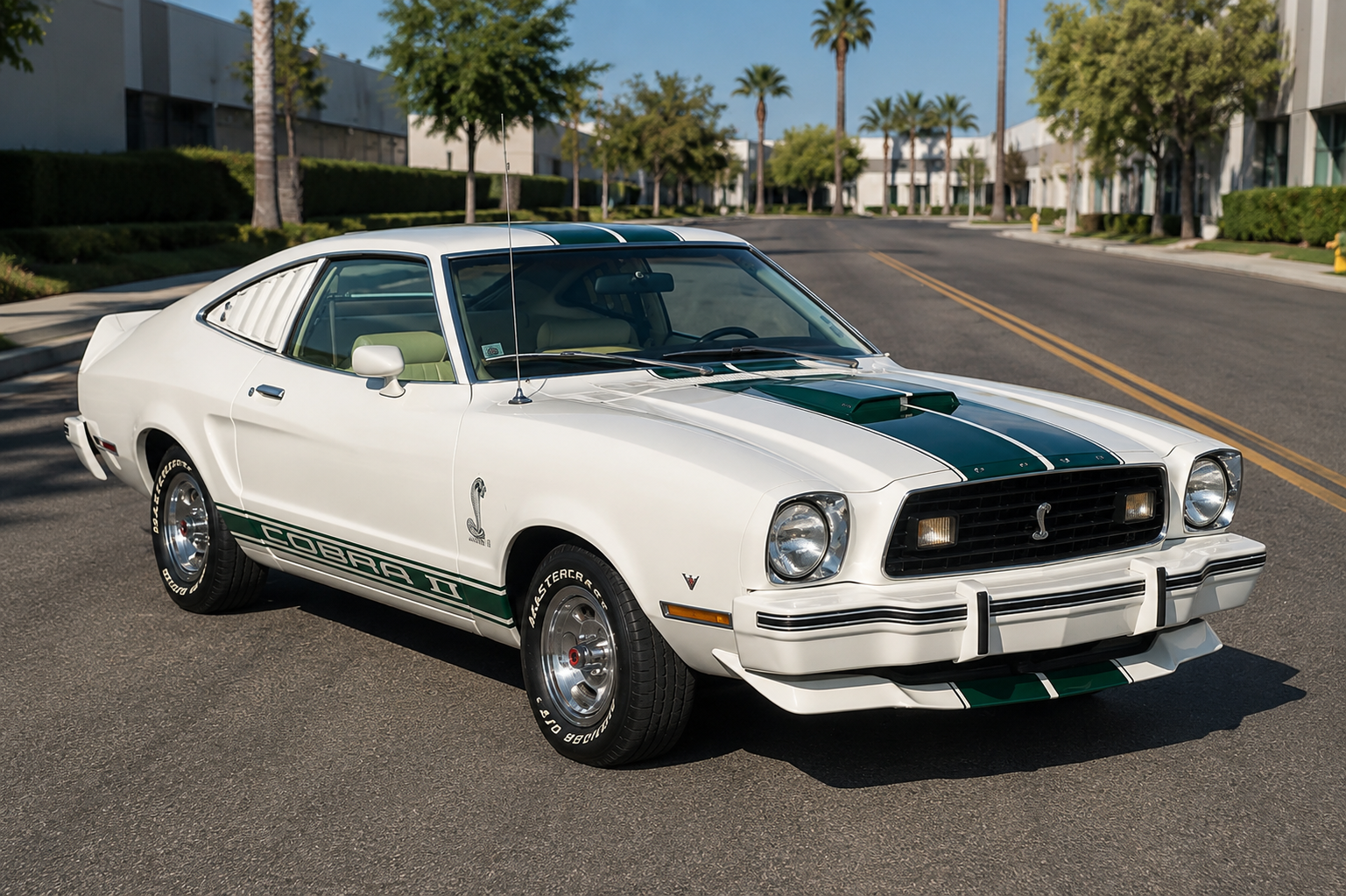
Second-generation Ford Mustang II in a studio setting, front three-quarter view, showing the compact 1970s pony-car proportions, quad rectangular headlights and body-colour bumpers.
Overview

Why this car matters

The Mustang II arrived for 1974 as a comprehensive downsize onto the Pinto platform, with a base 2.3-litre four and an optional 2.8-litre Cologne V6; a 302 cu in (5.0-litre) Windsor V8 was added from 1975 (Verify: some sources place V8 availability from mid-1975 only). Body styles were a two-door hardtop coupe and a three-door hatchback (2+2), with Ghia trim, Mach 1 hatchback and — from 1976 — the Cobra II appearance package. The 1978-only King Cobra was the generation's halo car.

Mustang II was commercially successful (Motor Trend Car of the Year 1974) but is generally regarded as the least-collected Mustang generation. Values are compressed except for Cobra II, King Cobra and clean V8 Mach 1 survivors.

The Mustang II kept the nameplate alive through the 1970s fuel-crisis and emissions transition, and its chassis architecture went on to underpin countless American hot-rod and kit-car projects.

Variants

Range and production

VariantYearsProductionNotes
Base coupe / hatchback1974–19782.3L I4 standard; 2.8L V6 optional; 302 V8 from 1975.
Ghia1974–1978Luxury-trim two-door hardtop with vinyl roof and upgraded interior.
Mach 11974–1978Hatchback-only performance-trim package. Total approx. 89,000 units across the generation (Verify against per-year registry totals).
Cobra II1976–1978Appearance package on the hatchback: stripes, non-functional hood scoop, spoilers. Per-year: 1976: 25,259; 1977: 11,948; 1978: approx. 4,049. No agreed combined generation total across sources.
King Cobra19781978-only V8 halo variant (approx. 139 hp 302 V8); hood snake decal, air dam, pinstriping. Production genuinely disputed across sources: 4,313 (Mustang Attitude / registry-derived) vs 4,960 (mustangii.org / Ford-derived). Verify: no reconciled figure.
Buyer's Guide

What to look for

Provenance and originality

Start with identity, paperwork and originality. For the Ford Mustang (Mustang II), the strongest cars have a continuous ownership file, VIN and door-tag consistency, a Marti Report where available, original window sticker where possible, and evidence of major service work by recognised Mustang specialists. Original paint, correct decal and stripe schemes (Cobra II / King Cobra), documented V8 build, unmolested interior and complete original wheels and trim are decisive; reproduction stripe kits and tribute cars trade well below documented originals.

Mechanical inspection priorities

The 2.3-litre Lima I4, 2.8-litre Cologne V6 and 302 cu in Windsor V8 are all mechanically straightforward, but early smog-era emissions gear, thermal-reactor exhaust manifolds and California-spec calibrations vary sharply year to year — verify what is fitted against the original build sheet. A proper pre-purchase inspection includes cold-start behaviour, compression or leak-down testing where appropriate, factory-tool diagnostic scans on later cars, underbody photography, suspension and chassis-point inspection, brake condition and a road test long enough to expose heat-related faults. Deferred maintenance is almost always more expensive than buying the better-sorted car.

Body, paint and accident history

Mustang bodyshells are unibody steel and vulnerable to hidden collision repair and (on earlier cars) corrosion in floors, torque boxes, cowl and rear frame rails. Use a paint-depth gauge, a lift inspection and a specialist familiar with the generation. Documented cosmetic restoration is acceptable; concealed accident or structural repair must be priced severely, and modified cars must be judged on the quality and documentation of the build.

Specification strategy

1978 King Cobra V8 with the four-speed manual, and clean 1976 first-year Cobra II hatchbacks in the original white-and-blue scheme, are the two clearest collector tiers. V8 Mach 1 cars, particularly with T-tops (available 1976–78), form a secondary tier; base I4/V6 Ghia and hardtop cars are the everyday-user pool. Colour, transmission, option packages and limited-build variants move values significantly. Buy the best-documented example in the most desirable specification you can justify rather than a tired example of a rarer derivative that will need years of corrective work.

Pricing

What to pay

Driver (base I4 / V6)
USD$4,000 – $10,000
GBP£3,500 – £8,500
EUR€4,000 – €10,000
Usable coupes and hatchbacks in honest cosmetic condition.
Excellent V8 Mach 1 / Cobra II
USD$12,000 – $25,000
GBP£10,000 – £20,000
EUR€11,000 – €23,000
Original-paint V8 Mach 1 and documented Cobra II hatchbacks with correct trim.
1978 King Cobra (V8 / 4-speed)
USD$28,000 – $55,000+
GBP£22,000 – £45,000+
EUR€26,000 – €52,000+
Documented original King Cobra in concours or high #2 condition.

Regional ranges authored independently — each reflects its local market, not an FX conversion

Ownership

Living with it

Typical mileage
1,500–5,000 miles typical for collector use
Service interval
12 months; mileage interval varies by model and use
Annual running cost
$2,500 – $7,000
Fuel economy
14–26 mpg depending on model and use
Insurance
Use an agreed-value collector policy with limited mileage, secure storage, documented photography and an annual value review. Premiums vary sharply by variant (Shelby / SVT / GT500 command higher), storage location and declared value.

Maintenance planning

Budget annually even if the car is used sparingly. Fluids age, tyres date out, batteries fail, and stored cars need exercise. Mustangs reward a documented maintenance rhythm — it protects both reliability and resale value.

Parts and specialist access

A Mustang II specialist is essential: reproduction Cobra II and King Cobra tribute cars are common, and originality verification via VIN, cowl-tag and (where available) Marti Auto Works documentation is the key defence against overpaying. Aftermarket support for most Mustang generations is exceptionally strong, but originality-critical trim, correct-date-coded components and variant-specific parts (SVO turbo hardware, LT5/Voodoo/Predator internals, GT500 supercharger components) sit outside general availability and need a knowledgeable specialist.
Common Problems

Known issues by system

Body / chassis

Corrosion in floors, rear quarters, shock towers and cowl

Critical$4,000 – $15,000
Symptoms — Rust through floor pans, bubbling at rear wheel arches, water ingress at windscreen base.
Inspection — Lift inspection; borescope of cowl; magnet-test of lower panels.
Engine (V8)

Emissions-era carburettor / thermal-reactor faults on 302

Moderate$800 – $3,500
Symptoms — Poor running when hot, exhaust manifold cracking, hesitation.
Inspection — Cold and hot restart; visual manifold survey; carburettor tune verification.
Trim / identity

Reproduction Cobra II / King Cobra decals presented as original

MajorValue adjustment only
Symptoms — Inconsistent VIN vs. build sheet; incorrect stripe positioning; unavailable colours.
Inspection — VIN / cowl-tag verification; specialist inspection of decal application and factory door-jamb markings.
Suspension

Front bushing and rack wear (Pinto-derived architecture)

Moderate$700 – $2,000
Symptoms — Vague steering, wander, clunks over expansion joints.
Inspection — Play test at ends, rack survey on lift.
Valuation

Current value bands by region

Concours
USD
$40,000
GBP
£32,000
EUR
€37,000
+1% 12-mo
Excellent
USD
$20,000
GBP
£16,000
EUR
€18,000
0% 12-mo
Good
USD
$10,000
GBP
£8,000
EUR
€9,000
0% 12-mo
Fair
USD
$5,500
GBP
£4,500
EUR
€5,000
0% 12-mo
Project
USD
$2,500
GBP
£2,000
EUR
€2,300
-2% 12-mo

Each region quoted in its local currency — independent market readings, not FX conversions

Driver-quality Mustang IIs and Cobra IIs trade in the teens to around $25,000; clean low-mileage King Cobras command more. Verify pending discrete auction results.

Auctions

Recent results

DateAuctionCarMileageResult

No recent public auction results currently meet our verification standard. We publish sale figures only from verified examples, and will update this guide as qualifying results become available.

Investment

Long-term outlook

StableHorizon: 5–10 years

The 1978 King Cobra is a genuinely rare, documentable variant and has room to appreciate on nostalgia demand; the balance of Mustang II production is unlikely to move meaningfully.

Recommended

The trusted network

Specialists

  • Mustang marque specialist
    View →
    United States
    Mustang Second generation (Mustang II) inspections, servicing and originality reviews; Marti Report interpretation where applicable.
  • Model-focused independent
    View →
    UK / Europe
    Pre-purchase inspections, major service planning and market-correct preparation for the Mustang (Mustang II) in Europe.
  • Concours preparation studio
    View →
    International
    Paint correction, detailing, preservation and sale preparation for collector Mustangs.

Storage

  • Windrush Car Storage
    View →
    Cotswolds, UK
    Climate-controlled storage and collection management for high-value collector cars.
  • Autovault
    View →
    Bicester, UK
    Secure storage at Bicester Heritage with regular inspection programmes.
  • Classic Car Club Manhattan
    View →
    New York, NY
    Secure urban storage for collector and modern-classic performance cars.

Transport

  • Reliable Carriers
    View →
    USA (national)
    Enclosed coast-to-coast transport for premium and collector cars.
  • Passport Transport
    View →
    USA (national)
    Enclosed transport for collector and performance cars across the United States.
  • CARS UK
    View →
    UK & Europe
    Enclosed event, concours and collection transport across Europe.

Enjoyed this guide?

Get new buyer's guides and collector market intelligence delivered to your inbox. No spam. We respect your inbox.

The valuation figures in this guide are for research purposes only and do not constitute financial or investment advice. See our full disclaimer.