
Car Collector International
Classic · 1964–1969

Ford GT40 (original)

Le Mans four-time winner — the original mid-engined Ford that defeated Ferrari at Le Mans from 1966 to 1969.

Car Collector International Editorial
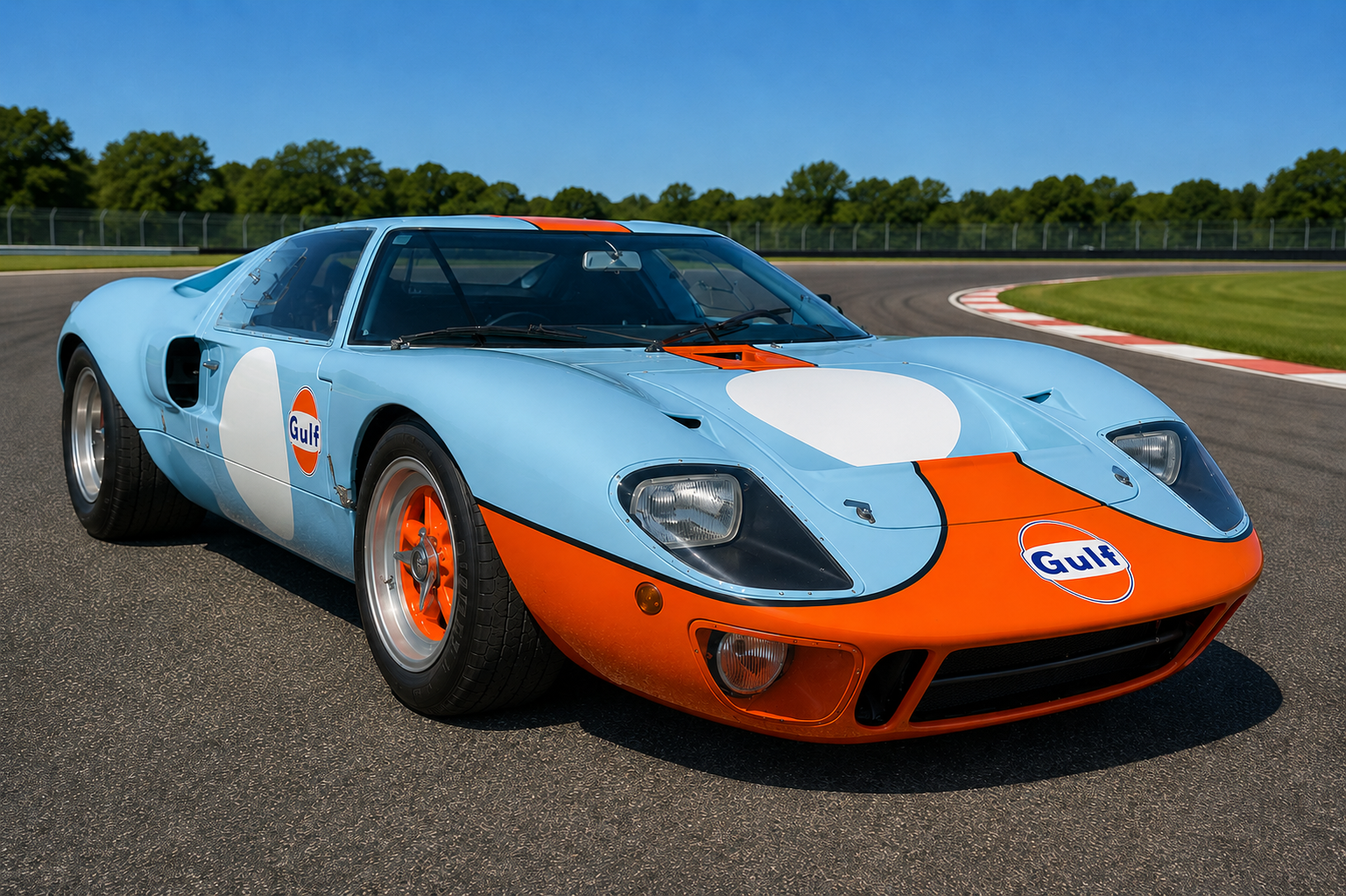
Light blue and orange Gulf-liveried Ford GT40 with race number 6, front three-quarter view on a race circuit under a clear blue sky, showing the low aerodynamic bodywork, silver alloy wheels and orange nose stripe.
Overview

Why this car matters

The Ford GT40 was developed in the early 1960s as Ford's answer to Ferrari's dominance at Le Mans. The Mk I (small-block 4.7L V8) and later Mk II and Mk IV (big-block 7.0L V8) won Le Mans outright in 1966, 1967, 1968 and 1969. A small number of Mk III road cars were built (seven units, 1966–1969) to satisfy homologation and bespoke road-car customers.

Approximately 105 GT40s were built in total across all racing and road variants. Continuation and homage production by Safir, CAV, Superformance and Ford Authorized Continuation Series is a separate market.

Defining four-time Le Mans-winning sports prototype; one of the most significant racing cars of the 20th century.

Variants

Range and production

VariantYearsProductionNotes
GT40 Mk I (road)1964–1969Not separately recordedSmall-block 4.7L V8 cars; some road-converted from racing chassis.
GT40 Mk II / Mk IV1965–1967Not separately recordedBig-block 7.0L racing chassis; Le Mans-winning specification.
GT40 Mk III1966–19697Road-specific Mk III; bespoke production.
Buyer's Guide

What to look for

Provenance and originality

Start with identity, paperwork and originality. For the Ford GT40 (original), the strongest cars have continuous ownership history, matching numbers where applicable, original books and tools, factory build documentation and evidence of work by manufacturer-approved specialists. Original chassis number, racing provenance, Le Mans participation and continuous documented history.

Mechanical inspection priorities

Period 4.7L and 7.0L Ford V8s are well-supported by historic racing specialists; matching-numbers engines are decisive. A proper pre-purchase inspection includes cold-start behaviour, ECU diagnostics and fault-code history (where applicable), leak-down or compression testing, underbody photography, suspension and chassis inspection, brake condition and a long enough road test to expose heat-related faults. Deferred maintenance on a car of this class is almost always more expensive than buying a better-sorted example.

Body, paint and accident history

Use a paint-depth gauge, lift access and a specialist familiar with the model's factory panel gaps and finish standards. Collector value is dramatically affected by structural repairs, refinished panels, poor paintwork and missing factory trim or option content. Documented cosmetic refresh is acceptable; concealed accident or fire damage must be priced severely.

Specification strategy

Original FIA / FIVA chassis with documented Wyer Engineering / J.W. Automotive provenance set the ceiling. Continuation cars are a separate market. Specification, colour, options and limited-build variants move values significantly. Buy the best-documented example in the most desirable specification you can justify, rather than a tired example of a rarer derivative that will need years of corrective work.

Ownership

Living with it

Typical mileage
1,000–4,000 miles typical for collector use
Service interval
12 months; mileage interval varies by model and use
Annual running cost
$5,000 – $18,000
Fuel economy
15–28 mpg depending on use
Insurance
Use an agreed-value collector or specialist supercar policy with limited mileage, secure storage, documented photography and an annual value review. Premiums vary sharply by age, storage location, declared value and driver profile.

Maintenance planning

Budget annually even if the car is used sparingly. Fluids age, tyres and date-coded rubber components must be replaced regardless of mileage, and stored cars need exercise. A documented maintenance rhythm protects both reliability and resale value.

Parts and specialist access

Historic motorsport specialists (Hall & Hall, Roush, period restorers) support the model; service is bespoke and event-led. Before purchase, confirm parts availability for model-specific bodywork, electronics, gearbox and engine components. A discounted car waiting on unobtainable parts or a factory service slot is rarely a saving in collector ownership.
Common Problems

Known issues by system

Originality

Continuation vs original chassis

CriticalCatastrophic value implications
Symptoms — Marketed as 'GT40' but Safir / Superformance / CAV chassis.
Inspection — Period chassis-number verification and Le Mans / FIA records review.
Auctions

Recent results

DateAuctionCarMileageResult
2026-01-06
Mecum
Kissimmee 2026
1966 GT40 Mk II Factory Lightweight (Lot F188)
$12,375,000
Sold
2025-02-27
RM Sotheby's
Miami
1966 GT40 Mk II (Lot 102)
$13,205,000
Sold
2024-08-15
Mecum
Monterey 2024
1969 GT40 Lightweight (Lot S90)
$7,865,000
Sold
2024-03-01
Broad Arrow
The Amelia Auction 2024
1967 GT40 (Lot 229)
$4,405,000
Sold
2024-01-02
Mecum
Kissimmee 2024
1966 GT40 Mk I Road Car (Lot F155)
$6,930,000
Sold
Investment

Long-term outlook

Blue ChipHorizon: 10+ years

Defining sports-prototype racing chassis; documented period cars sit at the top of the historic motorsport market.

Our view, not advice. This section is Car Collector International's editorial judgement on where this model sits in the collector market, based on the production, specification and market data set out in this guide. It is not a recommendation to buy or sell and it is not investment advice. Values can fall as well as rise.

Recommended

The trusted network

Specialists

  • Ford factory-approved specialist
    View →
    UK / Europe
    Ford GT40 (original) inspections, major service planning and originality reviews.
  • Model-focused independent
    View →
    United States
    Pre-purchase inspections, scheduled service and market-correct preparation for the GT40 (original).
  • Concours preparation studio
    View →
    International
    Paint correction, PPF, detailing, preservation and sale preparation for premium collector cars.
  • Hagerty
    View →
    USA / UK / EU
    Agreed-value collector and supercar insurance with global recognition.
  • Lockton Performance
    View →
    UK / EU
    Specialist agreed-value cover for modern hypercars and limited-production supercars.

Storage

  • Windrush Car Storage
    View →
    London & Cotswolds, UK
    Climate-controlled storage and collection management for high-value classic and supercars.
  • AutoVault
    View →
    Essex, UK
    Dehumidified storage at 55% RH in purpose-built sealed buildings, with maintenance programmes and individual motor-trade insurance cover.
  • Classic Car Club Manhattan
    View →
    New York, NY
    Secure urban storage for collector and modern performance cars.

Transport

  • CARS UK
    View →
    UK & Europe
    Enclosed event, concours and collection transport across Europe.
  • Reliable Carriers
    View →
    USA (national)
    Enclosed coast-to-coast transport for premium supercars and classics.
  • FERRLOG
    View →
    Italy / Europe
    Air-ride enclosed transport for Italian and European collector cars.

Enjoyed this guide?

Get new buyer's guides and collector market intelligence delivered to your inbox. No spam. We respect your inbox.

The valuation figures in this guide are for research purposes only and do not constitute financial or investment advice. See our full disclaimer.