
Car Collector International
Classic · 1965–1973

Ford Mustang (Classic 1965–1973)

America's pony car at its peak — from the original 1965 hardtop to the 1969–70 Boss derivatives and the Shelby GT350/GT500.

Car Collector International Editorial
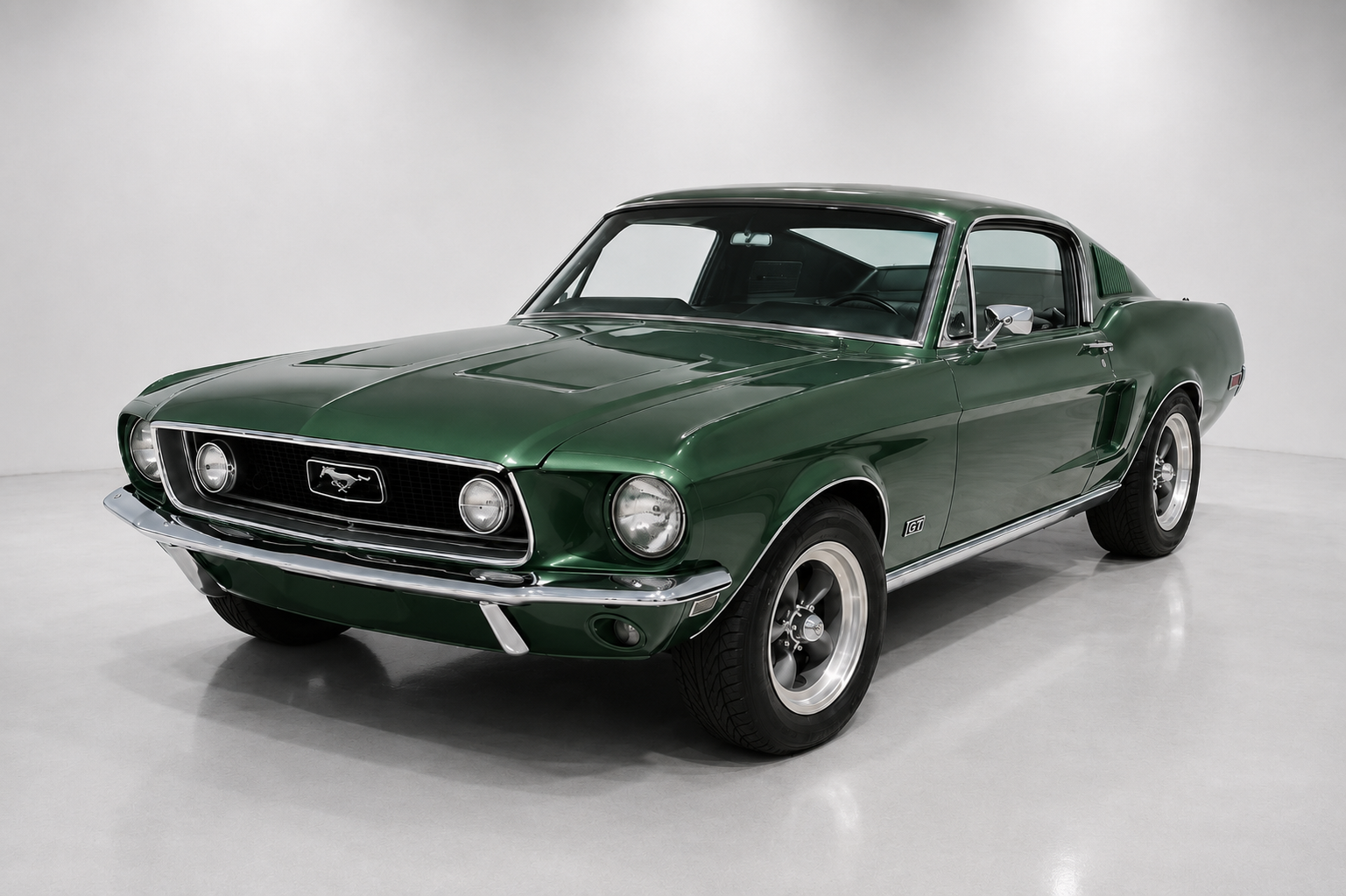
Green 1967 Ford Mustang GT fastback in a studio setting, showing the chrome grille with running-horse badge, quad headlights, GT side badge and silver wheels with white-wall tyres.
Overview

Why this car matters

Launched in April 1964 as a '1964½' model, the Mustang created the pony-car class. The first generation grew substantially through 1969–70 to accommodate Boss 302, Boss 429 and large-block 428 Cobra Jet engines, before downsizing again for the final 1971–1973 cars.

Mustang collecting is sharply tiered. Shelby GT350/GT500, Boss 302, Boss 429 and 428 Cobra Jet cars are blue-chip. Standard 1965–66 V8 cars are the most usable entry; mid-production 1967–68 GT cars are the sweet spot for usable collectability.

The Mustang is the most collected American car of its era; performance derivatives sit in a much higher market driven by Marti Reports and originality.

Variants

Range and production

VariantYearsProductionNotes
1965–1968 standard1965–1968Not separately recordedHardtop, convertible and fastback; 200 cu in six and 260/289/302 V8s.
GT package1965–1968Not separately recordedPerformance trim option; original GT-equipped cars trade at a premium.
Shelby GT350 / GT5001965–1970Not separately recordedShelby-American-modified Mustangs; major collector tier.
Boss 302 / Boss 429 / Mach 11969–1970Not separately recordedTrans-Am and NASCAR homologation derivatives; ultra-blue-chip Boss cars.
428 Cobra Jet / Super Cobra Jet1968–1970Not separately recordedDrag-racing-orientated big-block; major performance-collector tier.
1971–1973 final cars1971–1973Not separately recordedLarger bodies; Boss 351 and 429 SCJ derivatives notable; market quietly improving.
Buyer's Guide

What to look for

Provenance and originality

Start with identity, paperwork and originality. For the Ford Mustang (Classic 1965–1973), the strongest cars have a continuous ownership file, matching numbers where applicable, original manuals, invoices and evidence of work by recognised marque specialists. Marti Report, original Window Sticker, matching numbers, period-correct trim and (for Shelby cars) SAAC documentation are decisive.

Mechanical inspection priorities

Small-block 289/302 and big-block 390/427/428/429 engines are durable when properly assembled; correct date-coded components, intake, carburettor and ignition are decisive on performance derivatives. A proper pre-purchase inspection includes cold-start behaviour, leak-down or compression testing where appropriate, underbody photography, suspension and chassis-point inspection, brake condition and a road test long enough to expose heat-related faults. Deferred maintenance is almost always more expensive than buying a better-sorted car.

Body, paint and accident history

Use a paint-depth gauge, lift access and a specialist familiar with the model's factory seams and panel gaps. Collector value is dramatically affected by structural repairs, poor paintwork, corrosion, incorrect panels and missing factory trim. Documented cosmetic restoration is acceptable; concealed accident repair must be priced severely.

Specification strategy

Shelby and Boss cars are the collector apex; GT-spec 1965–1968 V8 cars are the usable sweet spot; 1971–73 cars are quietly improving. Specification, colour, transmission and limited-build variants move values significantly. Buy the best-documented example in the most desirable specification you can justify rather than a tired example of a rarer derivative that will need years of corrective work.

Ownership

Living with it

Typical mileage
1,500–4,000 miles typical for collector use
Service interval
12 months; mileage interval varies by model and use
Annual running cost
$4,000 – $12,000
Fuel economy
15–24 mpg depending on use
Insurance
Use an agreed-value collector policy with limited mileage, secure storage, documented photography and an annual value review. Premiums vary sharply by age, storage location and declared value.

Maintenance planning

Budget annually even if the car is used sparingly. Fluids age, tyres date out, fuel systems suffer from ethanol, batteries fail and stored cars need exercise. A documented maintenance rhythm protects both reliability and resale value.

Parts and specialist access

Marti Auto Works and SAAC are the standard documentation sources; restoration must be done to a recognised judging standard to preserve value. Before purchase, confirm parts availability for model-specific trim, suspension, fuel system, electronics and engine components. A cheap car waiting on unobtainable parts is rarely cheap in collector ownership.
Common Problems

Known issues by system

Body / chassis

Comprehensive corrosion (torque boxes, floors, frame rails, shock towers)

Critical$15,000 – $60,000 for correct body and structural restoration
Symptoms — Sagging suspension, panel-gap inconsistency, rust through floors and frame rails.
Inspection — Lift inspection by a Mustang specialist; torque-box and shock-tower survey.
Engine

Non-original engine / wrong stamping (Shelby/Boss/CJ)

CriticalMaterial pricing impact
Symptoms — Stamping inconsistencies; non-matching date codes; reproduction parts presented as original.
Inspection — Marti Report and SAAC cross-check; date-code inspection.
Trim / Identity

Re-VIN'd cars and reproduction trim

MajorPricing impact only
Symptoms — Inconsistent VIN locations, mismatched data plates, reproduction trim presented as original.
Inspection — Marti Report and judging-level inspection by a Mustang specialist.
Auctions

Recent results

DateAuctionCarMileageResult
2026-05-16
Mecum
Indianapolis
1970 Boss 429 (Lot F138)
$660,000
Sold
2026-05-16
Mecum
Indianapolis
1969 Boss 429 (Lot F182)
$528,000
Sold
2026-05-16
Mecum
Indianapolis
1969 Boss 429 Fastback (Lot S239)
$418,000
Sold
2024-10-10
Barrett-Jackson
Barrett-Jackson
1969 Mustang Boss 429 (Lot 749)
$462,000
Sold
2024-08-16
Bonhams
Bonhams
1965 Mustang Convertible (Lot 165)
$224,000
Sold
2024-04-14
Bonhams
Bonhams
1967 Mustang GT390 Fastback (Lot 136)
£93,150
Sold
2023-01-21
Barrett-Jackson
Scottsdale 2023
1969 Mustang Boss 429 (Lot 1399)
$605,000
Sold
Investment

Long-term outlook

StableHorizon: 5–10 years

Shelby and Boss cars remain blue-chip. Standard V8 Mustangs will track condition and the demographic shape of the buyer pool; 1971–73 cars are quietly improving.

Our view, not advice. This section is Car Collector International's editorial judgement on where this model sits in the collector market, based on the production, specification and market data set out in this guide. It is not a recommendation to buy or sell and it is not investment advice. Values can fall as well as rise.

Recommended

The trusted network

Specialists

  • Ford marque specialist
    View →
    UK / Europe
    Ford Mustang (Classic 1965–1973) inspections, servicing and originality reviews.
  • Model-focused independent
    View →
    United States
    Pre-purchase inspections, major service planning and market-correct preparation for the Mustang (Classic 1965–1973).
  • Concours preparation studio
    View →
    International
    Paint correction, detailing, preservation and sale preparation for premium collector cars.

Storage

  • Windrush Car Storage
    View →
    London & Cotswolds, UK
    Climate-controlled storage and collection management for high-value collector cars.
  • AutoVault
    View →
    Essex, UK
    Dehumidified storage at 55% RH in purpose-built sealed buildings, with maintenance programmes and individual motor-trade insurance cover.
  • Classic Car Club Manhattan
    View →
    New York, NY
    Secure urban storage for collector and modern-classic performance cars.

Transport

  • CARS UK
    View →
    UK & Europe
    Enclosed event, concours and collection transport across Europe.
  • Reliable Carriers
    View →
    USA (national)
    Enclosed coast-to-coast transport for premium and collector cars.
  • FERRLOG
    View →
    Italy / Europe
    Air-ride enclosed transport for Italian and European collector cars.

Enjoyed this guide?

Get new buyer's guides and collector market intelligence delivered to your inbox. No spam. We respect your inbox.

The valuation figures in this guide are for research purposes only and do not constitute financial or investment advice. See our full disclaimer.