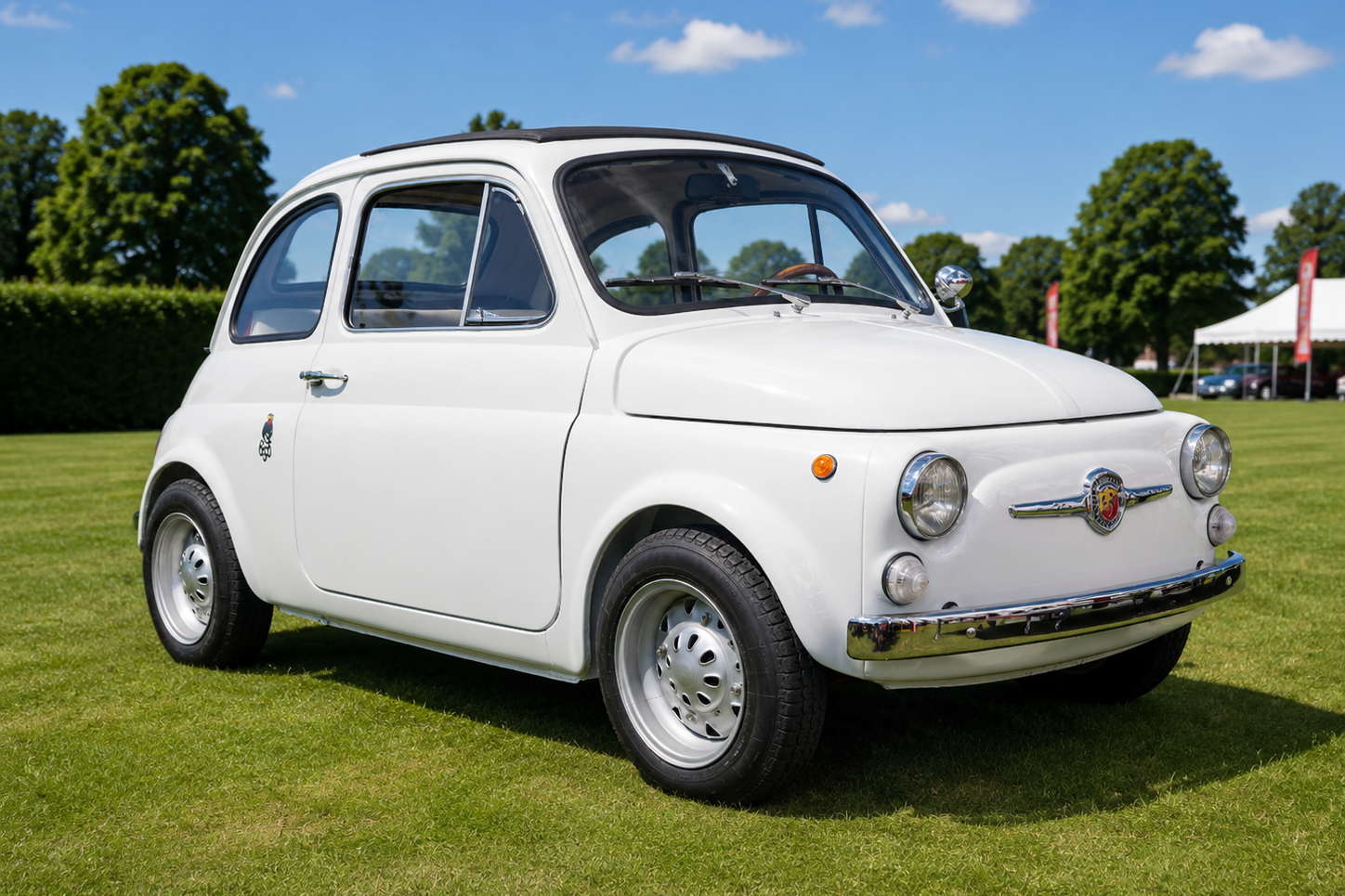
The Fiat Abarth 695 SS (esse esse) is the definitive high-performance version of Carlo (Karl) Abarth's Fiat 500 conversion series and the top of the 500-based Abarth road-car range through the mid-1960s. Introduced in 1964 as the ultimate 'Berlina' evolution of the earlier 595 and standard 695, it took the rear-mounted Fiat air-cooled twin out to 689 cc via a longer-stroke crank and larger bore, a re-worked cylinder head, a larger Solex or Weber carburettor, a free-flow Abarth exhaust and a re-mapped ignition, producing a factory-quoted 38 PS — a very substantial jump over the ~18 PS of a period Fiat 500 F/L and enough to give a car weighing well under 600 kg a genuine 87 mph / 140 km/h top speed.
Production was small and, on the surviving specialist record, difficult to pin to a single confirmed figure. The most-cited number is 'approximately 1,000' — used in the RM Sotheby's Paris 2020 lot text for chassis 110F 1060634 ('one of approximately 1,000 SS examples built') and again in the Bring a Trailer catalogue for a 1965 car sold on 30 May 2023 ('one of approximately 1,000 examples produced'). The same RM Sotheby's lot text also notes that 'perhaps only 150 examples of the 695 SS remain in existence today' — a survival figure that materially sharpens the scarcity picture even if the original-build total is taken at the full ~1,000. Because Abarth was a small tuner, not a large-series manufacturer, and because many cars were built from customer-supplied Fiat 500 donors under an Abarth conversion programme, no single primary factory ledger for the SS is in the public record. The RM Sotheby's Paris 2020 lot text is unusually candid on the point: 'Many Abarth 695 SS' prove to be of questionable authenticity.' Verified provenance is therefore the single most important factor in valuation, ahead of specification, colour or mileage.
Most cars are Berlina saloons on the Fiat 500-derived Tipo 110F platform, retained the standard 500's four-speed non-synchro (early) or synchro (later) gearbox, and are visually distinguished from a standard 500 chiefly by a raised, propped-open engine cover for cooling, a lower ride height, wider steel or optional Cromodora alloy wheels, front disc brakes on later cars, and Abarth scorpion badging front and side. Production ran through 1971, tapering as the Fiat 500 itself moved through its final variants before its 1975 discontinuation.
The 695 SS is the point at which Carlo Abarth's small-capacity tuning philosophy — take a mass-market economy car, keep the weight, extract dramatic percentage gains in power and cornering ability, homologate for class racing — reaches its most collectable road-car form. It sits at the intersection of three collector currents that have all strengthened since 2020: pre-1975 Italian micro-classics, factory-tuner cars with a genuine motorsport lineage, and small-capacity, low-weight cars whose driving reward is out of all proportion to their outputs. The '~1,000-built / perhaps 150 surviving' scarcity, the visual honesty of the propped engine lid, and the fact that a properly documented SS is objectively rare — because so many purported cars are conversions of standard Fiat 500s with a scorpion badge — make provenance the market. Cars with unbroken Italian libretto, period Abarth stamps in the correct font, and continuous ownership documentation trade at a substantial premium to visually identical but paperwork-thin examples.
Variants
Range and production
Variant
Years
Production
Notes
695 SS Berlina — approximate total production
1964–1971
1,000
Approximately 1,000 SS examples built is the specialist consensus figure — the most-cited number in auction catalogues and used directly in the RM Sotheby's Paris 2020 lot text for chassis 110F 1060634 and in the Bring a Trailer catalogue for the 1965 car sold on 30 May 2023 (BaT Lot #109,007). No public primary Abarth factory ledger for the SS Berlina alone has been surfaced; treat the number as specialist consensus, not a factory-confirmed total.
695 SS — approximate survival today
As at 2020 (RM Sotheby's Paris)
150
Sourced. RM Sotheby's Paris 2020 lot text for chassis 110F 1060634 states directly: 'perhaps only 150 examples of the 695 SS remain in existence today.' A survival, not a build, figure — reported here alongside (not in place of) the ~1,000-built number.
695 SS Assetto Corsa — racing configuration
1964–1971 (built and converted throughout the SS production run)
Not separately recorded
The Assetto Corsa is a racing SPECIFICATION rather than a strictly numbered factory variant: stiffer suspension, competition seats, Plexiglass side windows, weight-saving trim, uprated pistons/valves, front disc brakes and — on many cars — a Weber twin-choke. Cars were both factory-built and specialist-converted into Assetto Corsa configuration for Italian and European class racing. Bonhams Paris 2 February 2023 Lot 505 catalogued a 1970 example (title spelled 'Assetto Corse'; chassis 2497485). Total Assetto Corsa numbers are not publicly documented as a single confirmed factory figure and specialist sources give conflicting totals — treat as more numerous than the Radiale by a wide margin, but still small, and chassis-by-chassis identity remains contested.
695 SS Radiale — experimental hemispherical head
Mid-1960s (experimental)
5
Ultra-rare. The Radiale is a specific EXPERIMENTAL engine specification — a Weber-carburetted hemispherical (radial-finned) cylinder head — not a bodyshell or trim package. Per the Abarth Register, sourced from former Abarth technical director Mario Colucci, no more than FIVE examples of the Radiale engine were built by the factory. The '5 examples' figure applies to the Radiale ENGINE specifically, not to Assetto Corsa cars generally. The two variants are frequently conflated in auction catalogues and press coverage — including RM Sotheby's Miami 2024 Lot 207, which catalogued its car as a '695 SS Assetto Corsa Radiale' — but the correct reading is that a Radiale is a car (usually in Assetto Corsa racing spec) fitted with the ultra-rare Radiale head.
Collector Variants
Limited & special editions
The models below represent the most significant limited and special edition variants — factory-produced cars that command meaningful premiums over standard examples and warrant specific attention from serious collectors.
695 SS Assetto Corsa (racing configuration) · 1964–1971 (built and converted throughout the SS production run)
small but materially more numerous than the Radiale; no publicly-confirmed factory total
Distinguishing features
A racing SPECIFICATION rather than a strictly numbered factory variant. Cars in Assetto Corsa configuration carry stiffer suspension, competition bucket seats, Plexiglass side windows, weight-saving interior trim, uprated pistons and valves, revised camshaft, front disc brakes and — on many cars — a Weber twin-choke carburettor. Cars were both factory-built and specialist-converted for Italian and European saloon-car class racing. Externally distinguished by the raised, propped engine cover, lower ride height and, on many cars, period race numbers and roll-cage mounting points.
Value premium
Broadly parity with, or a modest premium to, the very best documented Berlina cars — Bonhams Paris 2 February 2023 Lot 505 (1970) sold €42,550 inc. premium without reserve — rather than a large multiple. Documented period race history moves the number materially; an undocumented Assetto Corsa claim moves it very little.
Inspection points
Verify the front disc brake fitment, cylinder head type, sump capacity and carburetion against period Assetto Corsa specification for the car's build year. Documentation of period race entries (start numbers, results, timing sheets, period photographs) is decisive. Do NOT assume a Radiale head — that is a separate, much rarer specification (see below).
Authentication
Cross-reference chassis and engine numbers against period race records where available; require period photographs of the car in race trim and continuous ownership documentation from the car's competition career forward. Auction catalogues from RM Sotheby's and Bonhams publish chassis and engine numbers of Assetto Corsa cars — treat their catalogue text as a starting point, not confirmation, and require independent supporting documentation. Note the spelling inconsistency in the market: Bonhams's own lot titles frequently use 'Assetto Corse', but the correct Italian is 'Assetto Corsa' (used by RM Sotheby's, Classic Driver and the Abarth factory record).
695 SS Radiale (experimental hemispherical head) · Mid-1960s (experimental)
No more than 5 examples of the Radiale engine built (Abarth Register, sourced from former Abarth technical director Mario Colucci)
Distinguishing features
The Radiale is a specific EXPERIMENTAL ENGINE specification — a Weber-carburetted hemispherical (radial-finned) cylinder head developed by Abarth in the mid-1960s. It is not a bodyshell, not a trim package and not the same thing as the Assetto Corsa racing configuration, despite the two being routinely conflated in press and auction copy. A Radiale is almost always found on a car already in Assetto Corsa racing spec, but the '5 examples' figure applies specifically to the Radiale ENGINE, not to Assetto Corsa cars as a group.
Value premium
Ultra-scarcity should command a very substantial multiple over a standard SS Berlina in principle. In practice, public throughput is so limited that price discovery is thin: RM Sotheby's Miami 2024 Lot 207 (1965 Abarth 695 SS Assetto Corsa Radiale, chassis 110F 0835654) sold US$47,600 inc. premium — a modest result for a nominally five-off engine, reflecting the market's continued suspicion of Radiale claims without deep documentation.
Inspection points
Verify head architecture directly on the engine (hemispherical, radial-finned combustion chambers) rather than accepting a catalogue label. Confirm Weber carburetion is period-correct to the Radiale specification. Cross-reference the engine number against the Abarth Register.
Authentication
Given fewer than five engines were ever built, provenance must be effectively airtight: engine number cross-referenced against the Abarth Register, continuous period documentation, and expert inspection of the head itself. A car offered as a Radiale without documentation from the Abarth Register or equivalent primary Colucci-era source should be treated as an Assetto Corsa with a claimed Radiale head, not as a confirmed Radiale.
Buyer's Guide
What to look for
Provenance and originality — the single most important test
The 695 SS market is defined by authenticity. Because the car is mechanically a Fiat 500 with an Abarth conversion package, and because scorpion badges, propped engine lids and correct-look wheels are all easily fitted to a standard 500, a large share of cars offered publicly as '695 SS' are of questionable origin — RM Sotheby's said so in print in its Paris 2020 lot text. Insist on: continuous Italian libretto or equivalent period registration document showing the car as an Abarth from new; the correct Abarth chassis stamp in the characteristic Abarth font (an important tell used by auction catalogues); period Abarth factory stickers where they survive (bonnet interior, door jamb, US importer sticker on cars delivered new to the United States); consistent engine and body numbering; and photographs and correspondence of the car in period. A visually perfect but paperwork-thin car is worth a fraction of a properly documented example.
Mechanical inspection priorities
The 689 cc twin is closely related to the standard Fiat 500 unit but runs to higher outputs on smaller-capacity, more highly stressed internals. Priorities at PPI: compression across both cylinders (weak cylinder or valve seat wear is common on cars that have sat), cold-start behaviour and warm oil pressure, correct Abarth carburettor (Solex or Weber depending on year — a Fiat unit is a strong signal of a conversion), correct free-flow Abarth exhaust and manifolding, evidence of the correct Abarth camshaft and head work, and a road test long enough to bring the air-cooled engine up to steady oil temperature. Gearbox synchromesh (or lack of it — early cars) should match the car's build year. Any deviation from period Abarth specification, especially a modern replacement carburettor or a Fiat exhaust, needs to be priced against sourcing the correct parts, which are scarce and expensive.
Body, paint and structural condition
The Fiat 500 shell rusts in the sills, floors, front boot floor, front wing bottoms, A-pillar bases, engine bay and battery tray. On a 60-year-old car with a rear-mounted engine, moisture ingress and battery-acid corrosion are the two structural problems that matter most. Use a magnet and a paint-depth gauge; lift the carpets; inspect the sills from underneath; look at the seams inside the front luggage compartment and around the fuel tank; check the engine cover hinge area for filler. Serious structural repair is neither cheap nor visually invisible on a small monocoque body — a car needing full sill and floor repair is a five-figure job before paint. Concealed structural repair on a 695 SS is a material value hit; documented, sympathetic bodywork by a recognised Fiat 500 / Abarth specialist is not.
Specification and colour strategy
Values respond to: chassis provenance first, factory-correct specification second, then colour and options. A car with the correct period Abarth engine internals, correct carburettor, correct exhaust, correct wheels (period steels with Abarth caps, or period-correct Cromodora alloys), correct front discs on late cars and correct interior trim is materially more valuable than a mechanically-correct but visually-modified car, and vastly more valuable than a converted standard 500. Colour is secondary but Italian factory colours (Rosso, Bianco, and period two-tone schemes) attract more interest at auction than repaints in non-period shades. Any RHD conversion, engine swap to a later Fiat 126 unit, or fitment of non-Abarth carburetion is a permanent value cap.
Ownership
Living with it
Typical mileage
300–2,000 miles typical for collector use; the SS is genuinely usable in slow traffic but not motorway-natural.
Service interval
12 months / 2,500 miles at a recognised Fiat 500 or Abarth specialist; annual service is not optional on a rear-mounted air-cooled twin.
Annual running cost
$1,800 – $4,000
Fuel economy
~40–45 mpg imperial combined at gentle use; hard use materially lower.
Insurance
Use an agreed-value policy with limited mileage and secure storage. UK premiums typically £220–£450/yr on limited-mileage agreed-value cover. US and EU rates vary widely; documented provenance is the single biggest factor for agreed values above the market median.
Maintenance planning
The 689 cc twin is straightforward but tolerates neglect poorly. Budget for annual oil and filter, valve clearances every 6,000 miles, ignition service (points, condenser, plugs, timing), carburettor rebuild every three to five years and a full cooling-airflow inspection (fan belt, ducting, engine-bay seals) at every service. Even at very low mileage, brake fluid, fuel hoses and rubber engine mounts age and should be renewed on time-not-mileage schedules.
Parts and specialist access
Standard Fiat 500 parts are cheap and abundant through the Italian 500-specialist trade (Ricambi Fiat 500, Axel Gerstl in Germany, Mr Fiat and similar). Abarth-specific parts — correct carburettor, exhaust, manifolds, valve gear, badging, period Cromodora wheels — are neither cheap nor easy to source, and are the parts most often quietly substituted on converted or restored cars. Confirm parts sourcing before purchase, especially for any car with missing or incorrect Abarth-specific hardware.
Common Problems
Known issues by system
Body — sills, floors and front luggage bay
Structural corrosion in sills, floor pans, front boot floor, A-pillar bases and battery tray
Critical$6,000 – $18,000 (full sill/floor/battery-tray repair with paintwork at a recognised specialist)
Symptoms — Bubbling paint at the base of the A-pillar, sagging or spongy sills under load, visible rust at seams inside the front boot, damp underlay, battery-acid pitting on the tray and surrounding metalwork.
Inspection — Full underbody inspection on a lift; magnet and paint-depth gauge on sills, floors and inner wings; lift the front boot carpet; inspect the battery tray directly. A car with concealed structural repair should be priced as a project.
Engine — top-end wear and valve seats
Weak cylinder, receding valve seats, top-end wear on cars run on modern unleaded without hardened seats
Major$2,500 – $5,500 (top-end rebuild with hardened seats)
Symptoms — Poor compression on one cylinder, misfiring under load, difficulty holding tune, uneven idle, oily plug on one side.
Inspection — Compression test at PPI; cold and warm running; check whether hardened valve seats were fitted at the last rebuild (the 689 cc unit was designed for leaded fuel).
Engine — oil leaks and crankcase breather
Oil weep from rocker cover, sump gasket and crankcase breather
Moderate$200 – $800 (gaskets and seals) — much more if the main seal or a sump repair is needed.
Symptoms — Persistent oil film on underside of engine, misted rear panel, drips on the drive after a run.
Inspection — Inspect the whole engine cold and after a road test; small weeps are almost universal on a 60-year-old air-cooled twin, but heavy leakage from the sump or main seal is a rebuild trigger.
Carburetion — non-original or worn carburettor
Replacement of correct Abarth Solex/Weber with a period Fiat or aftermarket unit; jetting drift on the original
Major$800 – $2,500 (source and fit correct Abarth-specification carburettor); much more for a NOS unit.
Symptoms — Poor cold-start behaviour, flat spots on the throttle, poor economy, incorrect exhaust note, incorrect part number visible on the carburettor body.
Inspection — Inspect carburettor make, model and part number against the car's specification; the correct Abarth carburettor is a material value contributor and its absence should be priced.
Major$600 – $1,800 (full hydraulic overhaul, shoes, drums as required)
Symptoms — Long pedal, pulling under braking, uneven pad wear, fluid weep at wheel cylinders, poor cold performance.
Inspection — Full brake inspection at PPI; on a car with drum brakes at all four corners, a fresh hydraulic overhaul is not optional — verify when it was last done.
Electrical — earthing, wiring insulation and 6/12V conversion
Perished cloth-wrapped wiring, poor earths, non-period 12V conversion on cars that were originally 6V
Moderate$1,200 – $3,000 (full rewire to correct pattern)
Symptoms — Dim lights, intermittent instruments, weak starter, ammeter behaviour that changes with electrical load.
Inspection — Verify the car's original electrical system voltage; inspect wiring visually for perished insulation; test all lights and instruments. A period-correct rewire is preferable to a bodged 12V conversion.
Gearbox — synchromesh wear and non-synchro first
Worn synchromesh (on later cars); wear on non-synchro first-gear teeth from mis-shifting
Symptoms — Baulking into second and third; whine or crunch into first at rest; jumping out of gear on the overrun.
Inspection — Road test through all four gears cold and warm; verify which gearbox variant the car should have for its build year; a specialist rebuild is available but is not cheap.
Interior — trim age, dashboard fascia and correct Abarth details
Minor$800 – $3,500 (seat re-trim); $200 – $1,200 (correct period wheel, badges and small trim items)
Symptoms — Cracked seat vinyl at the driver's bolster, dashboard fascia bubbling under the sun, a non-period aftermarket steering wheel fitted, missing Abarth interior badges.
Inspection — Photographic inspection of every interior surface; verify the presence of period Abarth trim details; a correct-look interior is a material value contributor.
Auctions
Recent results
Date
Auction
Car
Mileage
Result
2025-01-25
Bonhams
The Scottsdale Auction, Lot 162
1965 Fiat-Abarth 695 SS Berlina (chassis 110F 0866463, body 0492, engine ABA206/110D 000 567905)
Offered without reserve; a driver-quality result typical of Berlinas without deep provenance or a period competition story.
—
US$24,640 inc. premium
Sold
2024-03-01
RM Sotheby's
Miami 2024, Lot 207
1965 695 SS Assetto Corsa Radiale (chassis 110F 0835654, engine ABA 206 1/83041)
Documented with Italian libretto and a 1995 bill of sale. The Radiale is the rare experimental hemispherical-head, Weber-carburetted engine — no more than five were built — fitted here to a car in Assetto Corsa racing configuration.
—
US$47,600 inc. premium
Sold
2023-02-02
Bonhams
Les Grandes Marques du Monde à Paris, Lot 505
1970 695 SS Assetto Corsa (chassis 2497485, engine 3067366)
Racing configuration with documented history; offered without reserve.
—
€42,550 inc. premium
Sold
Investment
Long-term outlook
Strong HoldHorizon: 5–10 years
The 695 SS market rewards documentation and punishes uncertainty. Well-provenanced Berlinas and correctly-catalogued Assetto Corsa cars have moved into a €40,000+ / $45,000+ band that looks stable rather than speculative, supported by four independent primary-source auction data points across RM Sotheby's, Bonhams and Bring a Trailer between 2020 and 2025. The upside case is straightforward: '~1,000 built' is a real scarcity number for a car with a genuine Carlo Abarth story and a visible period-racing lineage, and the collector base for pre-1975 Italian tuner cars is still growing. The downside case is provenance risk — the market openly discounts cars whose Abarth authenticity cannot be independently proven, and that discount has widened rather than narrowed over the last five years. Best buys are documented, matching-numbers Berlinas with continuous Italian libretto or equivalent, honest cosmetic condition, and correct Abarth-specific mechanical hardware. Cars offered on a scorpion badge and a story should be priced as standard Fiat 500s until proven otherwise.
Our view, not advice. This section is Car Collector International's editorial judgement on where this model sits in the collector market, based on the production, specification and market data set out in this guide. It is not a recommendation to buy or sell and it is not investment advice. Values can fall as well as rise.