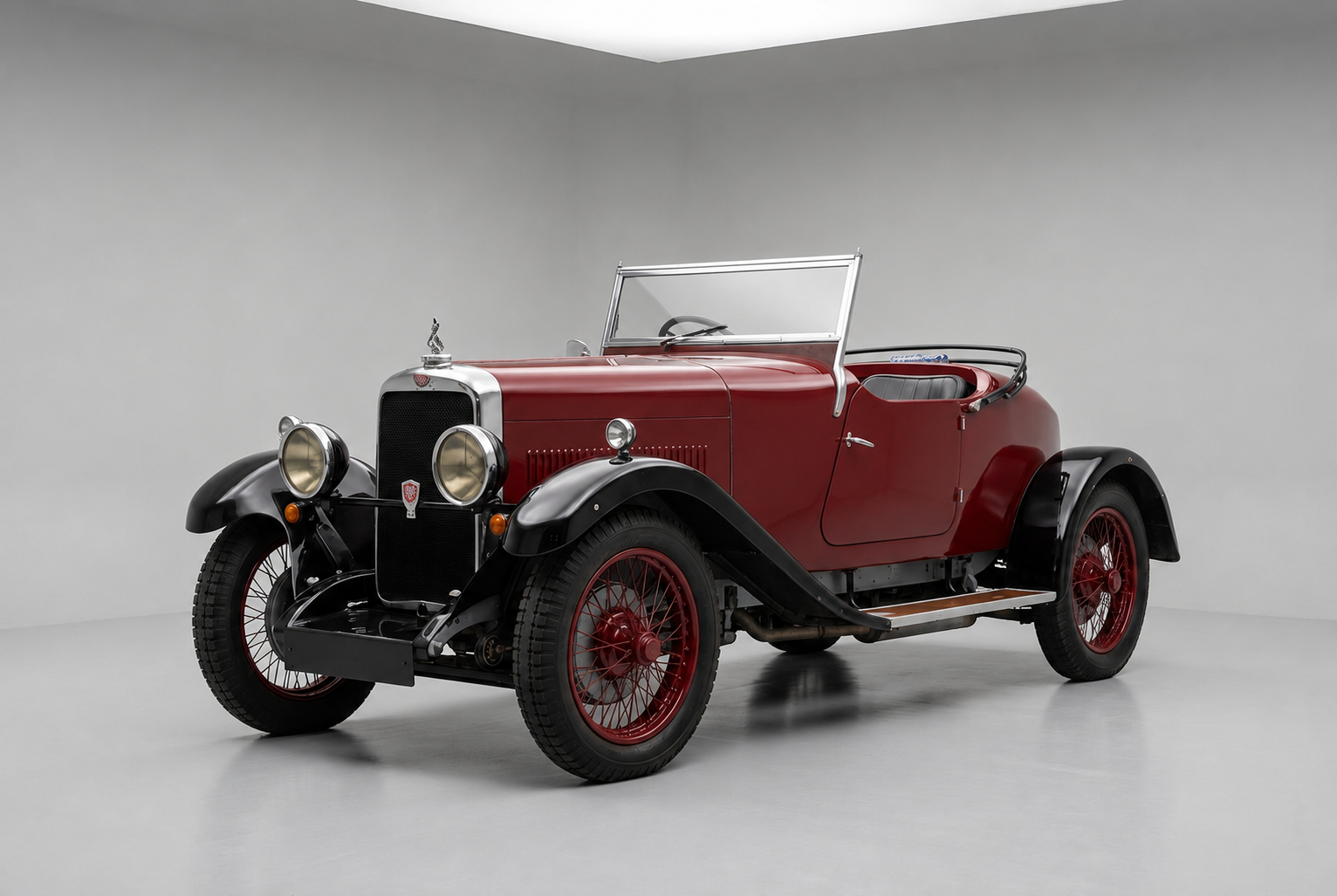
The 12/50, introduced late 1923 for the 1924 model year, was the car that established Alvis as a serious maker; chief engineer Captain G.T. Smith-Clarke's pushrod OHV four-cylinder engine of 1,496 cc (later 1,598 cc and 1,645 cc) was quieter, more powerful and notably strong and reliable. A tuned example won the 1923 Brooklands 200-Mile Race.
All 12/50s used a four-speed non-synchromesh gearbox with right-hand change; right-hand drive; front-wheel brakes from 1924. Early SA cars carried the classic "duck's back" pointed-tail two-seater body; later a "beetleback" style and a wide range of tourers, saloons and drophead coupés followed. Bodies by Carbodies and Cross & Ellis.
The 12/50 was discontinued in 1929 when Alvis committed to front-wheel-drive models; when those found limited acceptance it was hastily reinstated, and is credited with saving the firm. It sold in larger numbers than any comparable British 1.5-litre car. The high-compression, twin-SU 12/60 sporting variant (chassis types TK and TL) arrived towards the end of production, sold alongside the 12/50 until 1932. Total 12/50 (and 12/60) production 3,705 (1923–1932). Chassis-type nomenclature: subframe cars SA/SB/SC; platform-chassis SD, TE, TF, TG, TH, TJ (12/50) and TK, TL (12/60).
A quintessential vintage British sports car with strong club support and eligibility for premier historic events.