
Car Collector International
Classic · 1936–1937

Auto Union Type C

Ferdinand Porsche's mid-engined Silver Arrow — 520 bhp from a supercharged V16 in a 1936 Grand Prix car.

Car Collector International Editorial
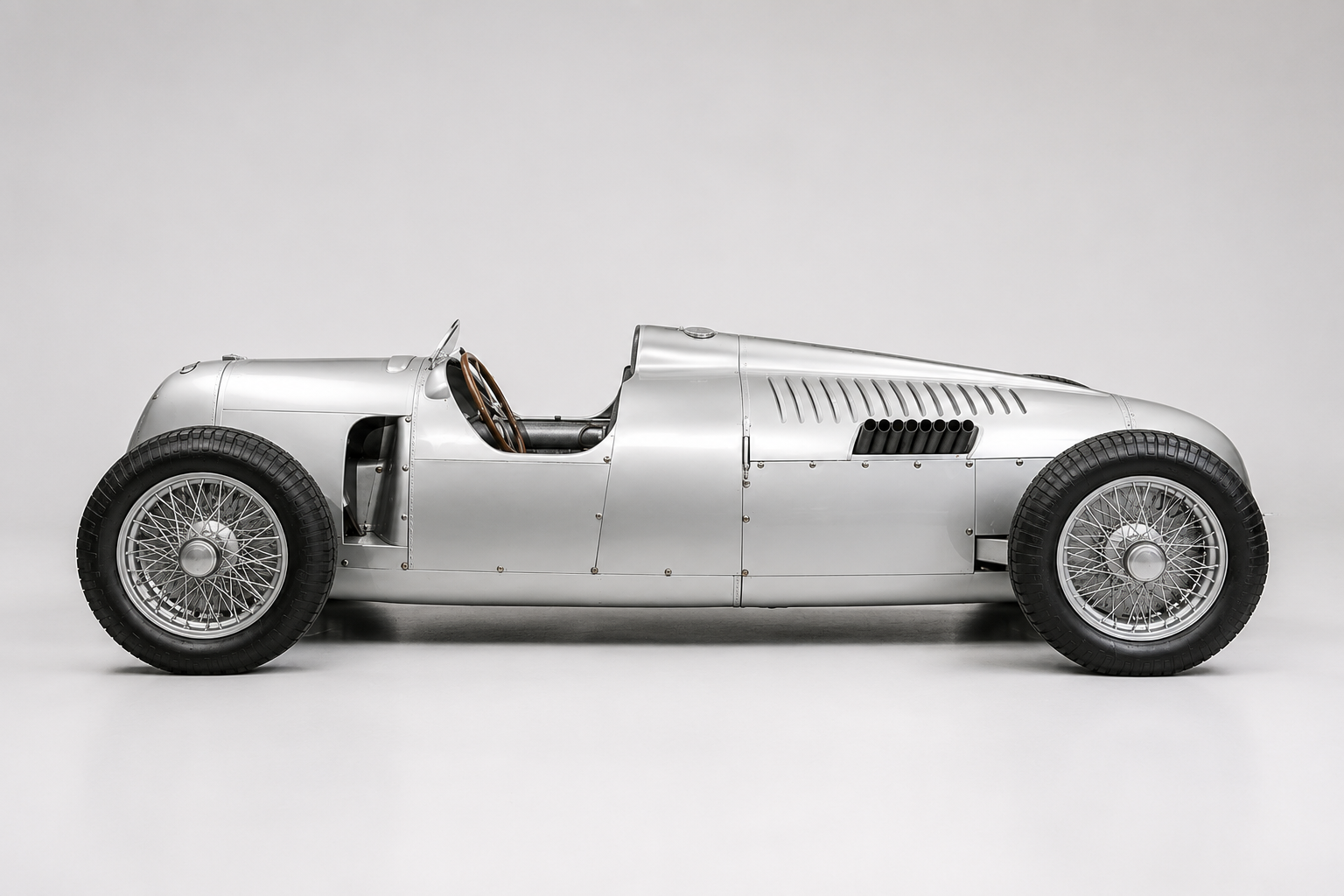
Silver Auto Union Type C grand prix car in side profile in a studio, showing the mid-engined streamlined body, louvred engine cover, exposed exhaust stubs and chrome wire wheels.
Overview

Why this car matters

The Auto Union Type C was the 1936–1937 evolution of Ferdinand Porsche's revolutionary mid-engined Grand Prix design. Powered by a 6,005cc supercharged V16 producing approximately 520 bhp, it won the 1936 European Championship in the hands of Bernd Rosemeyer. The mid-engined layout was unique in Grand Prix racing at the time and was not widely adopted until the 1950s. Most Type Cs were destroyed in WWII or absorbed into the Soviet Union after the war; only a tiny number of authentic chassis or factory parts have survived.

Engineering far ahead of its time; recognisably the foundation of modern racing-car architecture.

Variants

Range and production

VariantYearsProductionNotes
Type C1936–1937Not separately recorded6.0L supercharged V16; 1936 European Champion.
Type C/D Hillclimb1937–1939Not separately recordedTwin-rear-wheel variant; legendary photographs.
Buyer's Guide

What to look for

Provenance and originality

For pre-war and vintage cars such as the Auto Union Type C, provenance is paramount. Chassis and engine number matching, period coachbuilder records, factory build sheets where available, continuous ownership documentation, original handbooks and any competition or concours history are the foundation of value. Verified pre-war Auto Union identity; almost all market activity is reconstruction-grade.

Mechanical inspection priorities

The supercharged V16 is operated only by Audi Tradition; private operation of an original car is unprecedented in modern times. Any assessment of a Type C — original or reconstruction — is a specialist archive and engineering exercise rather than a conventional pre-purchase inspection: full rebuild documentation, component provenance for every major assembly, and Audi Tradition's own records are the reference. The engine is a single-purpose racing unit; its condition is established from the rebuild file, not from a road test.

Body, chassis and originality of coachwork

Type C bodywork is hand-formed aluminium panelling over a tubular chassis — there is no coachbuilt timber framing on this car. The central questions are which period components, if any, survive in the specific car; how the chassis and body panels were sourced or fabricated during any reconstruction; and how completely that work is documented. Establish the provenance of every major structural element against Audi Tradition's archive and the car's own build file, and treat undocumented panelwork or chassis repair as a question of identity, not merely condition.

Specification and event eligibility

Verified original survivors are in museum collections (Audi Tradition, Russian museums and a handful of private collectors). Reconstructed cars exist and are clearly identified as such. Public appearances are demonstration runs at major historic events under expert stewardship rather than competitive entries; a Type C's standing rests on the documented provenance of its components and its recognition by Audi Tradition, not on race-eligibility paperwork.

Ownership

Living with it

Typical mileage
Demonstration use only — a handful of event miles per year under expert stewardship
Service interval
Full technical preparation before any demonstration run, by Audi Tradition or equivalent specialist support
Annual running cost
Not meaningfully comparable to conventional collector-car ownership; every running hour is a specialist-supported event
Fuel economy
Not a relevant ownership consideration on a Grand Prix demonstration car
Insurance
Use a specialist agreed-value vintage policy with declared value reviewed annually. Premiums reflect declared value, storage, event use and driver experience with pre-war machinery.

Maintenance planning

A Type C is maintained as a working museum piece: conservation of original components, meticulous documentation of every intervention, and full technical preparation before any public running. The reference standard is Audi Tradition's own stewardship of its cars; any privately held example should be maintained to the same documentary discipline.

Specialist access and parts

Audi Tradition is the global reference; almost no private specialists exist. Confirm the availability of marque specialists, period-correct fasteners, coachwork trim, instruments and tyres before committing. A car requiring fabricated one-off parts will absorb time and cost that a similar example with active specialist support will not.
Common Problems

Known issues by system

Originality

Audi Tradition reconstructions vs. surviving chassis

CriticalValue impact: original vs. reconstruction is fundamental
Symptoms — Almost no period Type C cars exist; most public cars are Audi Tradition rebuilds from period components.
Inspection — Verify provenance through Audi Tradition archive; reconstructions have explicit provenance.
Engine

Mid-mounted V16 supercharger and bearing wear

CriticalEngine rebuild $300,000+
Symptoms — Cars rebuilt to operating standard by Audi Tradition; private rebuilds rare.
Inspection — Demand full rebuild documentation; engine is essentially a single-purpose racing unit.
Chassis

Tubular chassis cracks at suspension mounts

Major$25,000 – $60,000
Symptoms — Cracks at front and rear suspension mounting points.
Inspection — Specialist motorsport fabricator inspection; dye-penetrant test.
Handling

Notorious oversteer with rear-mounted engine and swing axles

CriticalOperational risk only
Symptoms — Car requires highly experienced driver; insurance and event eligibility reflect this.
Inspection — Driver competence and event briefing essential before any running.
Auctions

Recent results

No verified public auction results are currently available for this model. We publish sale figures only from examples we have confirmed against auction house records, and will update this guide as results appear.

Investment

Long-term outlook

Blue ChipHorizon: 10+ years

The most revolutionary pre-war Grand Prix car. Original survivors are essentially national-heritage objects.

Our view, not advice. This section is Car Collector International's editorial judgement on where this model sits in the collector market, based on the production, specification and market data set out in this guide. It is not a recommendation to buy or sell and it is not investment advice. Values can fall as well as rise.

Recommended

The trusted network

Specialists

  • Auto Union marque specialist
    View →
    UK / Europe
    Auto Union Type C restoration, mechanical service and originality reviews.
  • Audi Tradition
    View →
    Ingolstadt, Germany
    The sole operator and reference authority for original and reconstructed Auto Union Grand Prix cars; archive, provenance and technical stewardship.
  • Concours preparation studio
    View →
    International
    Concours preparation, detailing and event support for pre-war and vintage cars.
  • Hagerty
    View →
    USA / UK / EU
    Agreed-value collector insurance specialising in pre-war and vintage cars.
  • Lockton Performance
    View →
    UK / EU
    Specialist agreed-value cover for significant pre-war and competition cars.

Storage

  • Windrush Car Storage
    View →
    London & Cotswolds, UK
    Climate-controlled storage and collection management for pre-war and classic cars.
  • AutoVault
    View →
    Essex, UK
    Dehumidified storage at 55% RH in purpose-built sealed buildings, with maintenance programmes and individual motor-trade insurance cover.
  • Classic Car Club Manhattan
    View →
    New York, NY
    Secure urban storage for collector and pre-war cars.

Transport

  • CARS UK
    View →
    UK & Europe
    Enclosed concours and event transport for pre-war and vintage machinery.
  • Reliable Carriers
    View →
    USA (national)
    Enclosed coast-to-coast transport for pre-war American and European cars.
  • FERRLOG
    View →
    Italy / Europe
    Air-ride enclosed transport for Italian and European collector cars.

Enjoyed this guide?

Get new buyer's guides and collector market intelligence delivered to your inbox. No spam. We respect your inbox.

The valuation figures in this guide are for research purposes only and do not constitute financial or investment advice. See our full disclaimer.