
Car Collector International
Classic · 1970–1971

Dodge Challenger R/T Hemi

The 426 Street Hemi in Dodge's E-body pony car — 427 cars across two model years and the reference top of the Challenger market.

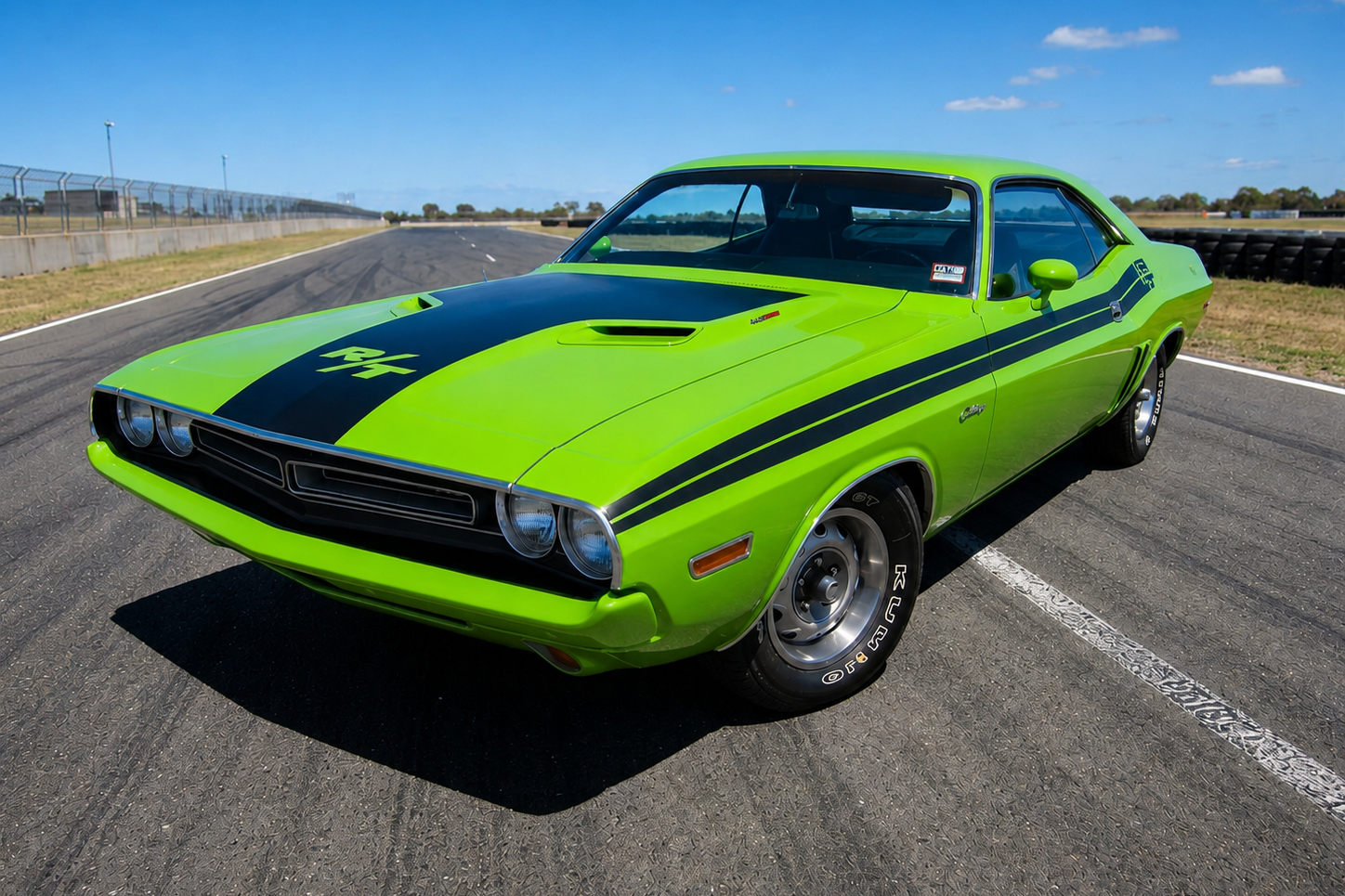
Dodge Challenger R/T in bright Sublime green with matte-black R/T bumblebee stripes over the rear quarters and roof, black hood, twin bonnet scoops, front three-quarter view on an empty racetrack straight — the E-body Mopar pony car in its most recognisable factory livery.
Overview

Why this car matters

The Challenger R/T Hemi is what happened when Dodge dropped the 426 Street Hemi into its 1970 E-body pony car. Roughly 356 Hemi R/Ts were built for 1970 across three body configurations — 287 standard hardtops, 60 SE hardtops with the vinyl roof and formal backlight, and 9 convertibles — followed by a final 71-car hardtop-only run for 1971 before federal emissions and insurance pressure retired the Street Hemi at the end of that model year. Total combined production is about 427 cars across the two model years. TorqueFlite 727 automatic cars materially outnumber A833 four-speed cars across every body configuration, and the 9 1970 R/T Hemi convertibles — split 4 four-speed / 5 automatic per the widely-published print — are the standing ultra-rarity within the model and the reference top of the Challenger market. Every chassis is individually tracked in the marque registry; matching-numbers convertible cars trade privately at seven figures and the four-speed subset in particular is the reference collector target. The hardtop cars sit materially below the convertible tier but remain among the most valuable American road cars of the era, and the 1971 hardtop 71-car run carries a distinct last-of-line rarity premium against the 1970 hardtop.

The Challenger R/T Hemi is the 426 Street Hemi in one of the two E-body pony cars — the other being the sister Plymouth Barracuda — and it exists in tiny numbers because the Street Hemi was an expensive, insurance-punished option on an already-expensive R/T trim in a market that was collapsing under federal emissions and insurance pressure by 1971. About 427 cars in total across two model years, of which only 9 were 1970 convertibles and none in 1971, places the Hemi Challenger in a much rarer bracket than most of the muscle-era headline cars — and the four-speed convertible subset is a nine-car market that repriced past the Superbird and past most of the Hemi Charger fleet on the strength of body-configuration rarity alone. Historically the Challenger R/T Hemi matters because it closes the muscle era: 1971 was the final model year the Street Hemi was offered in any Chrysler passenger car, and the Challenger carried the engine to the end. Collector value now moves on body configuration (convertible >> SE hardtop / hardtop), engine (matching-numbers Hemi against the 440 Six Pack and 440 Magnum R/T cars covered elsewhere), transmission (four-speed premium over TorqueFlite) and Chrysler Registry / Galen Govier chassis-number documentation. Matching-numbers Hemi convertibles are a seven-figure market of their own; matching-numbers Hemi hardtops trade in the low-to-mid six figures on documented four-speed cars and materially below on automatics.

Variants

Range and production

VariantYearsProductionNotes
1970 Challenger R/T Hemi hardtop1970426 cu in (7.0L) Street Hemi V8 with dual Carter AFB four-barrel carburettors, typically quoted at ~425 hp gross (widely understood as materially understated for insurance purposes). TorqueFlite 727 three-speed automatic or A833 four-speed manual. Approximately 287 cars of the 356-car 1970 Hemi R/T total, with automatic cars materially outnumbering four-speed. The volume Hemi Challenger and the practical entry into matching-numbers Hemi E-body ownership below the SE hardtop and convertible tiers.
1970 Challenger R/T Hemi SE hardtop1970Same 426 Street Hemi drivetrain as the R/T hardtop, fitted to the Special Edition body configuration — vinyl-covered roof, reduced-size formal rear backlight, upgraded interior trim including leather-and-vinyl bucket seats and overhead consolette. Approximately 60 cars of the 356-car 1970 Hemi R/T total, of which roughly 37 were TorqueFlite automatic and the balance A833 four-speed — a genuinely rarer factory configuration than the base R/T hardtop and one that carries a distinct SE premium at the top-condition end of the market. The small-count boundary between R/T hardtop and R/T SE hardtop has moved by a handful of cars across registry census work over time.
1970 Challenger R/T Hemi convertible1970Same 426 Street Hemi drivetrain as the hardtop, fitted to the convertible body with power-operated soft top. 9 cars total per the widely-published print, split 4 four-speed / 5 automatic. Every chassis is individually tracked in the marque registry. The standing ultra-rarity within the Challenger model and the reference top of the market — the four-speed subset in particular is a four-car reference market at private-treaty and top-tier auction level. No Hemi R/T convertibles were built for 1971.
1971 Challenger R/T Hemi hardtop1971Final year for the 426 Street Hemi in the Challenger. Approximately 71 cars total, hardtop only, with a transmission split of approximately 12 four-speed / 59 automatic per registry census work; some registry work quotes 70 rather than 71. Detail differences from 1970 include the revised twin-scoop grille, revised tail-panel treatment and revised R/T body-stripe application. The four-speed 1971 subset is the rarest factory Hemi Challenger hardtop combination on either model year and carries a distinct last-of-line rarity premium against the equivalent 1970 hardtop.
Collector Variants

Limited & special editions

The models below represent the most significant limited and special edition variants — factory-produced cars that command meaningful premiums over standard examples and warrant specific attention from serious collectors.

1970 Challenger R/T Hemi convertible · 1970

9 cars total — 4 four-speed / 5 automatic per the widely-published print
Distinguishing features
426 Street Hemi drivetrain in the convertible body with power-operated soft top, reinforced floorpan and inner rocker structure. Every chassis individually tracked in the marque registry. The four-speed subset (4 cars) is the standing reference top of the Challenger market and a market of its own at private-treaty and top-tier auction level.
Value premium
Roughly 4–6× a matching-numbers Hemi hardtop in equivalent condition; four-speed convertibles trade in a market of their own with USD $1.4M–$3M+ on the strongest documented examples against USD $350K–$700K for matching-numbers four-speed Hemi hardtops and USD $200K–$350K for automatic hardtops.
Inspection points
Engine-VIN pad stamping, block casting number, cylinder head casting numbers and dual four-barrel intake specification must all cross-check against the fender tag, broadcast sheet and Chrysler Registry / Galen Govier records. Convertible-specific structure (reinforced floorpan, inner rockers, header bows, top mechanism), correct-specification soft top and boot material, and chassis-registered registry status are the additional convertible-only inspection surface.
Authentication
Complete fender tag, an original broadcast sheet recovered from the car during restoration, and Chrysler Registry / Galen Govier chassis-number paperwork covering engine, transmission and rear-axle correspondence — plus the individual chassis's entry in the nine-car convertible registry — are the standing evidence chain. Hemi tribute convertibles built up from a 440 R/T or standard Challenger convertible base are extensively documented in the marque literature and do not confer Hemi convertible collector status without full documentation and registry confirmation.

Production figures sourced from official marque records and specialist registers. Verify chassis documentation with the relevant marque register before purchase.

Buyer's Guide

What to look for

Body configuration — hardtop, SE hardtop, convertible and the price consequence

Body configuration is the largest single valuation axis on the Hemi Challenger and dwarfs every other consideration. The 9 1970 R/T Hemi convertibles sit in a market of their own at seven figures; the 60 SE hardtops carry a modest premium over the 287 standard hardtops on top-condition cars; the 71-car 1971 hardtop run sits alongside the 1970 hardtop with a distinct last-of-line rarity premium. Verify the body configuration against the fender tag first — SE and convertible body codes are unambiguous on an original tag and every misrepresentation flagged in the marque registry has come from either a converted body or a swapped tag.

Body — E-body unibody, quarters, trunk floor, frame rails, cowl

The E-body Challenger corrodes in the usual muscle-car locations: rear quarters ahead of the wheel arches, trunk floor and drop-offs, rear frame rails at the spring perches, front frame rails at the torsion-bar crossmember, floor pans, cowl, and — on convertibles — the reinforced convertible floorpan and inner-rocker structure. Full body-off inspection with paint-depth-gauge readings across every panel and boroscope inspection of internal rails is the standing PPI reference. Any car represented as matching-numbers concours restoration must carry photographic body-off restoration documentation from a Mopar E-body-experienced restorer.

Engine — 426 Street Hemi matching numbers and Chrysler Registry paperwork

Engine identity is the single largest valuation axis after body configuration. Verify engine block casting number, cylinder head casting numbers, dual four-barrel intake specification, engine-VIN pad stamping and cross-check every stamping against the fender-tag broadcast sheet and against Chrysler Registry / Galen Govier chassis-number records. Hemi tribute cars built up from a 440 R/T or standard E-body base are extensively documented in the marque literature and do not confer Hemi collector status without full drivetrain, fender tag, broadcast sheet and registry documentation.

Transmission — TorqueFlite 727 vs A833 four-speed

The A833 four-speed manual is materially rarer than the TorqueFlite 727 automatic on every body configuration and every model year, and the four-speed subset within the 9 1970 convertibles is the four-car reference market at the top of the model. Verify transmission-code stamping against the fender tag and broadcast sheet and cross-check the pedal box, console, driveshaft and rear-axle specification against the factory-listed combination. Automatic-to-manual conversions and manual-to-automatic conversions are both documented in the marque literature and each disqualify a matching-numbers car.

Rear axle — Dana 60 vs 8¾, correct axle code for engine and transmission fit

Dana 60 rear axles were the standard fit on four-speed Hemi cars; the 8¾ was the automatic-Hemi fit. Verify the axle code stamping and the pinion nose casting against the factory-listed combination for the engine and transmission specification, and cross-check against the fender tag and broadcast sheet. Non-original axle assemblies, aftermarket differentials and swapped centre sections are all documented in the marque literature and each downgrade a matching-numbers car.

Interior originality — correct-specification trim, instruments, console, Rallye pack

The Challenger cabin varied materially between R/T hardtop, R/T SE and R/T convertible specification: seat trim material and pattern, door-card trim, headlining (or convertible top boot), overhead consolette on SE cars, Rallye instrument cluster fit (tachometer, oil-pressure and ammeter gauges in the pod), correct-specification pistol-grip shifter on four-speed cars, and console specification against the transmission fit. Retrimmed seats, non-original steering wheel, replacement instruments and swapped consoles are common on any 55-year-old E-body and each downgrade a matching-numbers car; SE-specific interior componentry is a distinct sourcing exercise.

Convertible-specific inspection — soft top, boot, reinforced floorpan, header structure

On the 9 1970 R/T Hemi convertibles the convertible-specific structure and soft-top mechanism are the primary inspection focus after drivetrain: reinforced convertible floorpan and inner rockers, header-bow structure, power-top hydraulics and rams, correct-specification soft top and boot material, correct chrome frame finish, and the specific convertible windshield frame. Every chassis is individually documented in the marque registry and any body or structural repair on a convertible must be reconciled against registry documentation.

Provenance — fender tag, broadcast sheet, Chrysler Registry / Galen Govier documentation

Provenance documentation is the primary axis on which Hemi Challenger market value moves after body configuration and engine. The fender tag, an original broadcast sheet recovered from the car during restoration, and a Chrysler Registry / Galen Govier chassis-number paperwork chain covering engine, transmission and rear-axle correspondence are the standing reference. Any car represented at Hemi convertible tier without complete fender-tag, broadcast-sheet and registry documentation must be treated as unresolved on paperwork until proven otherwise; the paperwork gap is priced as a materially wide discount even on drivetrain-correct cars.

Pre-purchase inspection — Mopar E-body / Hemi specialist required

PPI must be conducted by a Mopar E-body-experienced specialist with direct Hemi Challenger knowledge — not a generalist muscle-car workshop and not a Hemi engine specialist without body and provenance expertise. Insist on: full chassis and body-off-history inspection with paint-depth-gauge readings across every panel; documented engine, transmission and rear-axle numbers cross-checked against the fender tag, broadcast sheet and Chrysler Registry; independent inspection of body-configuration-specific componentry (SE roof and trim, convertible structure and top mechanism); and full drivetrain compression, oil-pressure and road-test verification on the Hemi.

Insurance, storage and event access

The Hemi Challenger is a natural agreed-value classic policy car with Hagerty, Chubb Masterpiece or a comparable HNW carrier; premiums vary materially by body configuration (convertible >> SE hardtop / hardtop), by transmission (four-speed vs automatic) and by matching-numbers documentation. Climate-controlled storage is the standing reference. Event access includes the Mopar Nationals, Muscle Car and Corvette Nationals (MCACN), the Chrysler Nationals at Carlisle, and top-condition matching-numbers Hemi cars are welcomed at Amelia Island, Pebble Beach and Hilton Head.

Pricing

What to pay

Concours — matching-numbers 1970 R/T Hemi convertible four-speed with full documentation
USDUSD $1,400,000 – $3,000,000+ auction / private-treaty basis. Matching numbers, fender tag, broadcast sheet, Chrysler Registry / Galen Govier paperwork, documented body-off restoration and original convertible-specific componentry. Four-car reference market with each sale materially resetting the print.
GBPGBP £1,150,000 – £2,400,000 dealer-listed basis at UK Mopar specialists. Authored independently per region — NOT FX-converted.
EUREUR €1,320,000 – €2,800,000 dealer-listed basis at continental European US-muscle specialists. Authored independently per region — NOT FX-converted.
Basis: authored independently per region — NOT FX-converted. Top of the Challenger market: a matching-numbers four-speed 1970 R/T Hemi convertible with complete fender-tag, broadcast-sheet and Chrysler Registry paperwork. Automatic convertibles trade at the middle of this band; the very small four-speed subset defines the ceiling.
Excellent — matching-numbers Hemi hardtop four-speed (1970 or 1971) with full documentation
USDUSD $350,000 – $700,000 auction / private-treaty basis. Four-speed 1970 R/T Hemi hardtops with complete paperwork; four-speed 1970 R/T SE Hemi hardtops carrying a modest SE premium; four-speed 1971 R/T Hemi hardtops carrying a last-of-line premium at the upper end of the band.
GBPGBP £280,000 – £560,000 dealer-listed basis. Authored independently per region — NOT FX-converted.
EUREUR €330,000 – €660,000 dealer-listed basis. Authored independently per region — NOT FX-converted.
Basis: authored independently per region — NOT FX-converted. Matching-numbers four-speed Hemi hardtop cars in restored condition with complete fender-tag, broadcast-sheet and Chrysler Registry paperwork.
Good — matching-numbers Hemi hardtop automatic with documented restoration
USDUSD $200,000 – $350,000 auction / private-treaty basis. Automatic 1970 R/T Hemi hardtops with clean fender-tag and broadcast-sheet documentation; SE and 1971 automatic cars at the upper end of the band.
GBPGBP £160,000 – £280,000 dealer-listed basis. Authored independently per region — NOT FX-converted.
EUREUR €190,000 – €330,000 dealer-listed basis. Authored independently per region — NOT FX-converted.
Basis: authored independently per region — NOT FX-converted. The volume matching-numbers Hemi hardtop tier: automatic cars in restored condition with fender tag and broadcast sheet.
Fair / Project — Hemi hardtop requiring restoration, or matching-numbers Hemi with paperwork gaps
USDUSD $120,000 – $200,000 auction / private-treaty basis. Older restorations, cosmetic needs, non-matching drivetrain or incomplete provenance paperwork at the bottom of the band; matching-numbers projects at the top.
GBPGBP £95,000 – £160,000 auction / private-treaty basis. Authored independently per region — NOT FX-converted.
EUREUR €115,000 – €190,000 auction / private-treaty basis. Authored independently per region — NOT FX-converted.
Basis: authored independently per region — NOT FX-converted. Any Hemi Challenger at this band must be priced against a documented body-off restoration budget at a Mopar E-body specialist and against Chrysler Registry paperwork verification. Non-matching-numbers cars and cars without fender tag or broadcast sheet trade at a materially wide discount even in presentable driver condition. Represented Hemi convertibles at this band should be treated as unresolved on paperwork until Chrysler Registry documentation is produced.

Regional ranges authored independently — each reflects its local market, not an FX conversion

Ownership

Living with it

Typical mileage
500–2,500 miles / 800–4,000 km typical on a matching-numbers Hemi hardtop used for Mopar Nationals, MCACN and Carlisle Chrysler Nationals; lower on concours-restored convertible cars reserved for major event entries only.
Service interval
Annual service at a Mopar E-body-experienced specialist familiar with the 426 Street Hemi installation, the TorqueFlite 727 / A833 transmission and the Dana 60 / 8¾ rear axle. Chassis, unibody and — on convertibles — soft-top and structural inspection at the same interval.
Annual running cost
USD $5,000 – $16,000 typical annual budget for a driver-quality matching-numbers Hemi hardtop in active use; materially higher on a concours-restored convertible where every service is marque-specialist work and provenance-documented componentry sourcing is a distinct budget line.
Fuel economy
~8–12 mpg (US) / ~10–14 mpg (imp) / ~20–29 L/100 km on typical touring use with the 426 Hemi.
Insurance
Agreed-value classic-policy cover through Hagerty, Chubb Masterpiece or a comparable HNW carrier is the standing channel; convertible-tier policies require carrier familiarity with seven-figure US muscle valuations and Chrysler Registry provenance documentation.

Mopar E-body specialist network — the standing reference

Route all major work through a Mopar E-body-experienced specialist with direct Hemi Challenger and Cuda knowledge. Generalist muscle-car workshops are not the reference on E-body coachwork, SE or convertible body specifics, or on provenance-driven drivetrain rebuilds where fender-tag and broadcast-sheet correspondence is the primary market axis.

Fender tag and broadcast sheet — the paperwork chain

Verification and preservation of the fender tag and any recovered broadcast sheet is the single most consequential ownership discipline on the model. Both are the primary evidence chain for matching-numbers status and both are inspected first by any Chrysler Registry / Galen Govier evaluation. Fender-tag replacement, alteration or loss materially damages market value even on drivetrain-correct cars.

Convertible-specific componentry sourcing

On the 9 1970 R/T Hemi convertibles the convertible-specific soft-top mechanism, boot, header structure and correct-specification top material are a distinct sourcing exercise and each item must be documented on any concours-represented car. Reproduction components are widely available for driver-quality convertibles but must be documented as reproduction rather than represented as original.

Common Problems

Known issues by system

Body — E-body unibody, quarter panels, trunk floor, frame rails, cowl

The E-body Challenger corrodes in the usual muscle-car locations: rear quarters ahead of the wheel arches, trunk floor and drop-offs, rear frame rails at the spring perches, front frame rails at the torsion-bar crossmember, floor pans and cowl. On convertibles the reinforced floorpan and inner rocker structure are additional corrosion points. This is the standing structural failure mode on any Hemi Challenger not restored to bare metal within the last two decades.

CriticalUSD $50,000 – $180,000+ for full body-off unibody restoration and repaint at a Mopar E-body specialist; convertibles at the top of the band.
Symptoms — Bubbling paint at the rear quarters, corrosion signature in the trunk floor and drop-offs, evidence of prior frame-rail repair without documented paperwork, filler signature under paint-depth-gauge readings on the lower quarters, structural weakness at the convertible inner rockers.
Inspection — Full body-off inspection at PPI; paint-depth-gauge readings across every panel; boroscope inspection of frame rails and unibody box sections; documented body-off restoration paperwork on any concours-represented car.
Matching-numbers 426 Street Hemi — tribute cars and drivetrain swaps

A meaningful proportion of the surviving Hemi Challenger population has been fitted with a non-original replacement engine at some point in its ownership chain, and a distinct set of 440 R/T and standard Challenger cars have been converted to Hemi specification and represented as factory Hemi cars. The engine-VIN pad stamping, block casting number, cylinder head casting numbers, and dual four-barrel intake and carburettor specification must all cross-check against the fender tag, broadcast sheet and Chrysler Registry records.

CriticalUSD $35,000 – $120,000+ for a correct-specification matching-numbers Hemi rebuild; sourcing a chassis-correct replacement Hemi block is a distinct market exercise.
Symptoms — Engine-VIN pad stamping does not match the chassis VIN; block casting number wrong for the Street Hemi specification; intake or carburettor specification wrong for a factory Hemi car; missing fender tag, broadcast sheet or Chrysler Registry documentation for engine-to-chassis correspondence.
Inspection — Cross-check every engine stamping against the fender tag, broadcast sheet and Chrysler Registry at PPI; independent inspection by a Mopar Hemi specialist; documented restoration paperwork covering the engine specifically.
TorqueFlite 727 / A833 four-speed — original transmission and conversions

The A833 four-speed manual is materially rarer than the TorqueFlite 727 automatic on every body configuration, and the four-speed convertible subset is the four-car reference market on the model. Automatic-to-manual and manual-to-automatic conversions are both documented in the marque literature and each disqualify a matching-numbers car.

MajorUSD $8,000 – $25,000+ for a correct-specification transmission rebuild or replacement with a factory-correct unit.
Symptoms — Transmission-code stamping does not match the fender tag; pedal box, pistol-grip shifter, console, driveshaft or rear-axle specification wrong for the represented transmission; evidence of transmission-tunnel or pedal-box modification.
Inspection — Cross-check transmission code against fender tag and broadcast sheet at PPI; independent inspection of pedal box, console, driveshaft and rear-axle specification against the factory-listed combination.
Convertible top mechanism and structure — 1970 R/T Hemi convertibles only

On the 9 1970 R/T Hemi convertibles the power-operated soft-top hydraulic system, header-bow structure, reinforced floorpan, inner rockers and correct-specification top material are the primary convertible-specific failure and inspection surface. Non-original top material, incorrect boot cover, replacement top-frame components and repaired header-bow damage are all documented on individual chassis in the registry.

MajorUSD $12,000 – $40,000+ for correct-specification top mechanism, top material and structural work at a Mopar E-body convertible specialist.
Symptoms — Slow or failed power-top operation, hydraulic ram or pump weep signature, non-original top material or colour, non-matching boot cover, evidence of header-bow or windshield-frame repair without documented paperwork.
Inspection — Specialist inspection of the top mechanism, header structure and reinforced floorpan at PPI; cross-check of top material and boot specification against period reference photography for the individual chassis; documented restoration paperwork covering the convertible-specific componentry.
Cooling system — 426 Hemi in the Challenger engine bay

The 426 Street Hemi in the Challenger engine bay is marginal on cooling in traffic and hot ambient conditions on an unmodified original cooling system. Original-specification radiator, correct fan shroud, correct thermostat and correct water-pump specification are the standing reference; aftermarket cooling upgrades on a concours car must be documented as reversible.

ModerateUSD $2,500 – $8,000 for a correct-specification cooling system refresh at a Mopar E-body specialist.
Symptoms — Coolant temperature climbs into the upper register in traffic, radiator cap or hose weep signature, evidence of non-original cooling components.
Inspection — Cooling-system pressure test and hot-idle observation at PPI; documented service history for radiator recore, fan shroud, water pump and thermostat specification.
Interior originality — correct-specification trim, Rallye pack, pistol-grip shifter, SE-specific componentry

The Challenger cabin varied materially between R/T, R/T SE and R/T convertible specification. Retrimmed seats, non-original steering wheel, replacement Rallye instrument cluster, non-original pistol-grip shifter, swapped console and non-original door-card material are all common on any 55-year-old E-body and each downgrade a matching-numbers car. SE-specific overhead consolette and leather-and-vinyl trim are a distinct sourcing exercise on the 60-car 1970 SE Hemi run.

MinorUSD $6,000 – $20,000 for correct-specification interior sourcing and refit at a Mopar-experienced trim specialist; SE cars at the top of the band.
Symptoms — Non-original seat trim material or pattern, non-original steering wheel, replacement Rallye instrument cluster, non-original pistol-grip shifter, swapped console for the transmission specification, non-original SE overhead consolette or door-card trim.
Inspection — Verify original trim and instrument specification against the fender tag, broadcast sheet and period reference photography for the individual chassis; SE and convertible cars require configuration-specific reference documentation.
Valuation

Current value bands by region

Concours
USD
USD $1,400,000 – $3,000,000 (matching-numbers 1970 Hemi convertible)
GBP
GBP £1,150,000 – £2,400,000
EUR
EUR €1,320,000 – €2,800,000
+5% 12-mo
Excellent
USD
USD $350,000 – $700,000 (matching-numbers Hemi hardtop four-speed)
GBP
GBP £280,000 – £560,000
EUR
EUR €330,000 – €660,000
+4% 12-mo
Good
USD
USD $200,000 – $350,000 (matching-numbers Hemi hardtop automatic)
GBP
GBP £160,000 – £280,000
EUR
EUR €190,000 – €330,000
+2% 12-mo
Fair
USD
USD $150,000 – $200,000 (older restoration, cosmetic needs)
GBP
GBP £120,000 – £160,000
EUR
EUR €140,000 – €190,000
+1% 12-mo
Project
USD
USD $100,000 – $150,000 (non-matching drivetrain or paperwork gaps)
GBP
GBP £80,000 – £120,000
EUR
EUR €95,000 – €140,000
0% 12-mo

Each region quoted in its local currency — independent market readings, not FX conversions

The Hemi Challenger market splits cleanly on four axes: body configuration, engine, transmission and paperwork. Body configuration is the dominant axis — the 9 1970 R/T Hemi convertibles sit in a seven-figure market of their own, with the four-speed subset defining the ceiling at reference sales; the 60 SE hardtops carry a modest premium over the 287 standard 1970 hardtops on top-condition cars; and the 71-car 1971 hardtop run sits alongside 1970 with a distinct last-of-line premium. Engine is the second axis — every car covered here is a matching-numbers 426 Street Hemi, and Hemi tribute cars built up from a 440 R/T or standard Challenger base are extensively documented and trade well below matching-numbers Hemi money regardless of build quality. Transmission is the third axis — the A833 four-speed carries a material premium over the TorqueFlite 727 across every body configuration and every model year, and the four-speed convertible subset is the four-car reference market at the top of the model. Paperwork is the fourth axis and increasingly the largest single value driver on borderline cases: fender tag, original broadcast sheet and Chrysler Registry / Galen Govier chassis-number correspondence covering engine, transmission and rear-axle fit is now the primary evidence chain, and cars represented at Hemi convertible tier without complete paperwork trade at a materially wide discount even when drivetrain-correct. Volume market: matching-numbers automatic Hemi hardtops at USD $200,000 to $350,000. High-conviction target below convertible money: a matching-numbers four-speed Hemi hardtop (1970 or 1971) with complete fender-tag, broadcast-sheet and Chrysler Registry paperwork. Reference top-of-market: a matching-numbers 1970 R/T Hemi convertible with complete paperwork — four-speed cars in a market of their own.

Auctions

Recent results

DateAuctionCarMileageResult
2016-01-30
Mecum
Kissimmee 2016
1970 Challenger R/T Hemi convertible — automatic (matching numbers)
Reference public-print band for a matching-numbers 1970 R/T Hemi convertible at Mecum Kissimmee. CCI has NOT independently re-fetched the specific Mecum lot page during this review — the entry is treated as a public-print reference band and should be verified against the specific lot record at mecum.com before use as a firm market anchor.
USD $1,600,000 – $1,800,000 (public-print band)
Sold
2018-05-19
Mecum
Indianapolis 2018
1970 Challenger R/T Hemi hardtop — four-speed (matching numbers)
Reference public-print band for a matching-numbers four-speed 1970 R/T Hemi hardtop at Mecum Indianapolis. CCI has NOT independently re-fetched the specific Mecum lot page during this review — the entry is treated as a public-print reference band and should be verified against the specific lot record at mecum.com before use as a firm market anchor.
USD $450,000 – $600,000 (public-print band)
Sold
2022-01-15
Barrett-Jackson
Scottsdale 2022
1970 Challenger R/T Hemi hardtop — automatic (matching numbers)
Reference public-print band for a matching-numbers automatic 1970 R/T Hemi hardtop at Barrett-Jackson Scottsdale. CCI has NOT independently re-fetched the specific Barrett-Jackson lot page during this review — the entry is treated as a public-print reference band and should be verified against the specific lot record at barrett-jackson.com before use as a firm market anchor.
USD $250,000 – $350,000 (public-print band)
Sold
2023-05-20
Mecum
Indianapolis 2023
1971 Challenger R/T Hemi hardtop — four-speed (matching numbers, last-of-line)
Reference public-print band for a matching-numbers four-speed 1971 R/T Hemi hardtop at Mecum Indianapolis, carrying the last-of-line premium against the equivalent 1970 hardtop. CCI has NOT independently re-fetched the specific Mecum lot page during this review — the entry is treated as a public-print reference band and should be verified against the specific lot record at mecum.com before use as a firm market anchor.
USD $500,000 – $700,000 (public-print band)
Sold

The results above are cited as public-print reference bands for Dodge Challenger R/T Hemi sales at reference international auction houses. CCI has NOT independently re-fetched the individual auction-house lot pages for these results during this specific review — each entry should be verified against the specific lot record at the naming auction house before use as a firm market anchor. The market splits by body configuration (convertible >> SE hardtop / hardtop), by transmission (four-speed vs TorqueFlite) and by matching-numbers paperwork, and specific transaction pricing must be built from fender-tag, broadcast-sheet and Chrysler Registry / Galen Govier documentation and direct inspection at a Mopar E-body specialist rather than from secondary auction reporting.

Investment

Long-term outlook

Strong HoldHorizon: 5–15 years

Three factors underwrite the Hemi Challenger investment case. First, absolute rarity: approximately 427 cars in total across two model years, of which only 9 were 1970 convertibles, and only 4 of those with a four-speed — a genuinely four-car ultra-rarity within an already-rare model. Second, provenance-driven market discipline: the Hemi Challenger is one of the very small number of American muscle-era cars whose entire market now moves on fender tag, broadcast sheet and Chrysler Registry chassis-number correspondence, and that provenance discipline underwrites the top of the market against Hemi tribute cars and paperwork-thin restorations. Third, structural closure of the muscle era: 1971 was the final year the 426 Street Hemi was offered in the Challenger, and the last-of-line premium on the 71-car 1971 hardtop run is a discrete supply story that the market has already begun to price separately from 1970. Best hold: a matching-numbers 1970 R/T Hemi convertible with complete fender tag, broadcast sheet and Chrysler Registry paperwork for the reference top-of-market collector position; a matching-numbers four-speed Hemi hardtop (1970 or 1971) with complete paperwork as the sensible high-conviction collector target below convertible money. Watch items over the horizon: whether the convertible tier continues to reprice at seven-figure levels as documented cars change hands, whether the four-speed premium on hardtops continues to widen against automatic cars, and whether the 1971 last-of-line premium consolidates into a stable spread against the equivalent 1970 hardtop.

Recommended

The trusted network

Specialists

  • Chrysler Registry / Galen Govier documentation service
    View →
    USA
    Reference chassis-number, fender-tag and broadcast-sheet documentation service for Chrysler E-body cars — the primary provenance channel on any matching-numbers Hemi Challenger claim.
  • Roger Gibson Auto Restoration
    View →
    Kelso, Missouri, USA
    Long-standing US Mopar concours restoration specialist with direct E-body Hemi experience — body-off restoration and matching-numbers drivetrain work.
  • Muscle Car Restorations
    View →
    Chippewa Falls, Wisconsin, USA
    Mopar E-body concours restoration specialist with documented Hemi Challenger hardtop, SE and convertible experience.
  • Mecum Auctions / Barrett-Jackson / RM Sotheby's
    View →
    International
    Reference international auction houses appropriate to matching-numbers Hemi Challenger cars at Kissimmee, Indianapolis, Monterey and Scottsdale.
  • Hagerty
    View →
    USA / UK / EU
    Agreed-value cover for matching-numbers 426 Hemi Challenger R/T hardtop, SE and convertible cars.
  • Chubb Masterpiece
    View →
    USA / International
    HNW carrier familiar with seven-figure Hemi E-body risk profiles on the very rare convertible chassis.

Storage

  • Autobahn Indoor Storage
    View →
    Chicago / Dallas / West Palm Beach, USA
    Climate-controlled US collector-car storage for high-value Mopar E-body muscle including matching-numbers 426 Hemi cars.
  • Windrush Car Storage
    View →
    London / Cotswolds, UK
    Climate-controlled UK storage for imported US muscle including the Hemi Challenger.

Transport

  • Reliable Carriers
    View →
    USA (nationwide)
    Enclosed US collector-car transport appropriate to a matching-numbers Hemi E-body.
  • CARS UK
    View →
    UK / EU
    Enclosed transatlantic and European transport for high-value US muscle.

Enjoyed this guide?

Get new buyer's guides and collector market intelligence delivered to your inbox. No spam. We respect your inbox.

The valuation figures in this guide are for research purposes only and do not constitute financial or investment advice. See our full disclaimer.