Car Collector International
Classic · 1962–1968

AC Cobra

Carroll Shelby's Anglo-American roadster — 998 original CSX-chassis cars built 1961–1968, from the 260-powered founding run to the big-block 427 S/C.

Roadster
Car Collector International Editorial
AC Cobra
Overview

Why this car matters

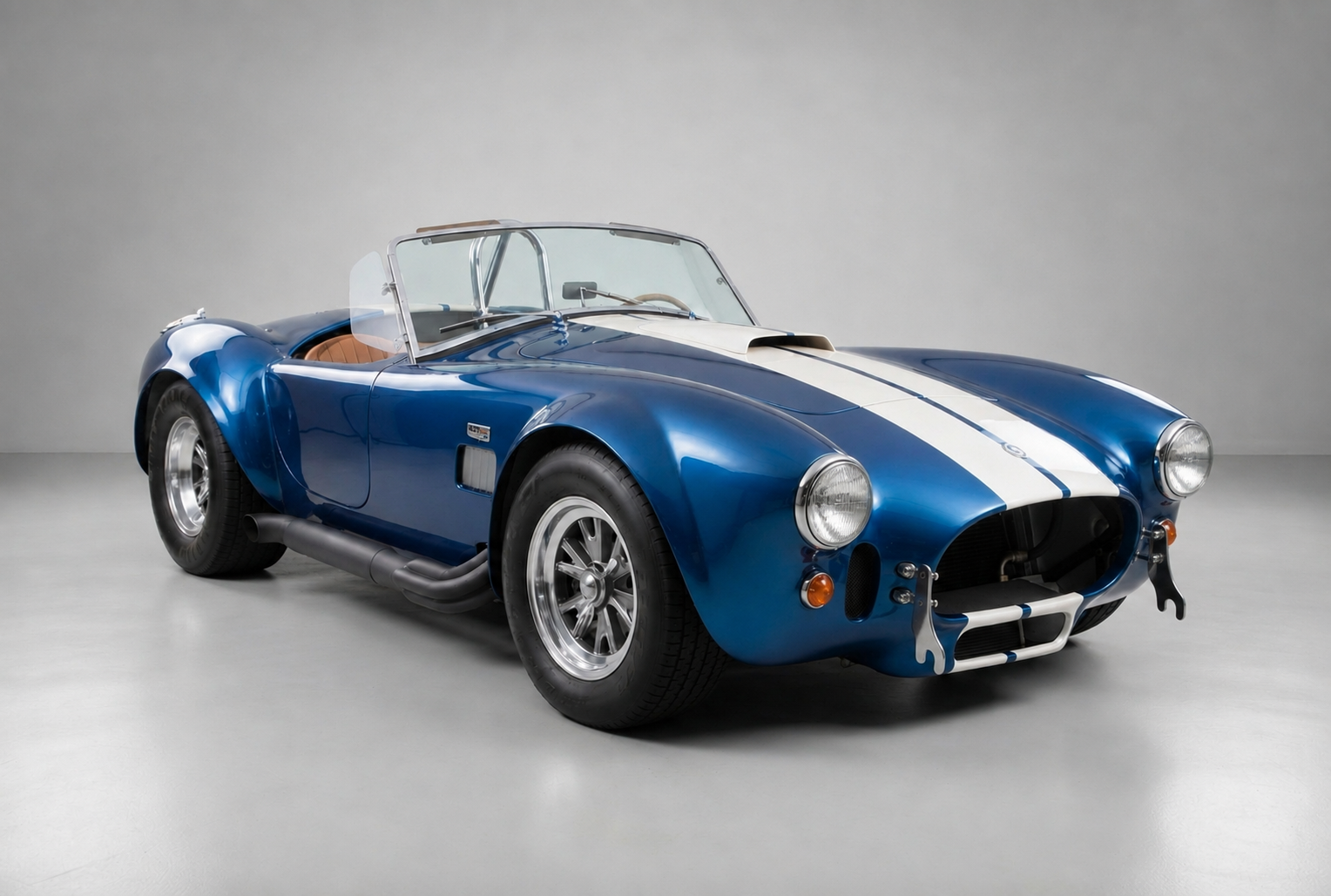
The AC Cobra was the result of a 1961 collaboration between Carroll Shelby and AC Cars of Thames Ditton, taking the AC Ace's Tojeiro-derived ladder chassis and installing Ford's 260 cu in small-block V8. Production ran across two distinct chassis architectures: the leaf-spring 289-family (1962–1965, CSX2000-series) and the coil-spring 427-family (1965–1968, CSX3000-series). Cobra Authority — the SAAC-aligned specialist reference — puts total original production at 998 CSX-chassis cars: 655 leaf-spring 289-family and 343 coil-spring 427-family, built 1961–1968.

The leaf-spring era begins with the 260 Cobra (1962–1963, 75 cars — the founding production run), transitions through the 289 Mk I (Worldcat Registry indicates 126 cars, with a competing SAAC-sourced figure of 127; the one-car discrepancy is a Verify against ongoing chassis-by-chassis registry work), and settles on the 289 Mk II (1963–1965, 528 cars — the definitive leaf-spring Cobra). A further 27 coil-spring narrow-body cars were built by AC in the UK between 1966 and 1969 as the 'AC 289', after Shelby American ended small-block production for the US market.

The coil-spring 427-family (1965–1968) was Shelby's response to the 289's limitations: a Ken Miles / Bob Negstad-developed wider chassis, big-block Ford FE V8 (427 side-oiler and, late in the run, 428) and dramatically flared coachwork. It includes the road 427 street cars, the 31 factory-converted 427 S/C (Semi-Competition) cars built from unsold FIA chassis, the 427 Competition cars with period race history, and late 428-engined cars built after 427 side-oiler supply dried up.

The Cobra market is unique in that the continuation and replica market dwarfs original CSX production. Buyers must understand the difference between an original CSX2000/CSX3000-series Shelby American car and a CSX4000, CSX6000, CSX7000 or CSX8000 continuation, and between either of those and an aftermarket kit car with no CSX chassis at all.

The Cobra is the definitive Anglo-American sports car — 998 original cars underpinning a market of tens of thousands of continuations and replicas. Every purchase begins with authentication.

Variants

Range and production

VariantYearsProductionNotes
260 Cobra (Mk I)1962–196375The founding production run, 260 cu in Ford small-block, worm-and-sector steering. Cobra Authority / SAAC Registry: 75 cars (corroborated across five independent references).
289 Cobra Mk I (leaf-spring)1963Transitional leaf-spring narrow-body cars with 289 cu in Windsor V8 and worm-and-sector steering. SAAC-sourced total: 127 cars (with Cobra Authority indicating 126 — one-car discrepancy is a Verify against ongoing chassis-by-chassis registry work).
289 Cobra Mk II (leaf-spring)1963–1965528The definitive leaf-spring Cobra: 289 Windsor V8, rack-and-pinion steering from CSX2126 onward. Cobra Authority / SAAC Registry: 528 cars (corroborated across five independent references).
289 Competition (FIA)1963–196519Purpose-built FIA competition cars on 289 leaf-spring chassis; the racing counterpart to the road 289.
289 Mk III (AC 289, coil-spring narrow-body)1966–196927UK-only continuation of the small-block Cobra using the 427-family coil-spring chassis with narrow 289 bodywork, built by AC at Thames Ditton after Shelby American stopped small-block production. AC's own factory-history page: 27 cars.
427 Cobra (street)1965–1967Coil-spring wide-body road specification on CSX3000 chassis. 427 FE V8, later cars 428.
427 S/C (Semi-Competition)1965–196631Unsold FIA competition chassis converted by Shelby American to street specification with side-exit exhausts, larger fuel tank and competition interior. SAAC-documented list of 31 factory cars.
427 Competition1965–1967Full race specification; period race history is decisive on value.
428 Cobra1966–1967Late-production coil-spring cars with 428 cu in FE engine after 427 side-oiler supply dried up.
Collector Variants

Limited & special editions

The models below represent the most significant limited and special edition variants — factory-produced cars that command meaningful premiums over standard examples and warrant specific attention from serious collectors.

260 Cobra (Mk I) · 1962–1963

75 (SAAC World Registry / Cobra Authority; corroborated across five independent references)
Distinguishing features
Founding-run Cobra: Ford 260 cu in Windsor V8 in the AC Ace-derived leaf-spring chassis, worm-and-sector steering, narrow bodywork, minimal Shelby-American cosmetic changes over the AC Ace donor. CSX2000-series chassis, starting with CSX 2000 (the prototype, retained by the Carroll Hall Shelby Trust and sold at RM Sotheby's Monterey 2016 for $13.75m).
Value premium
Concours-tier only; standalone market at the top of the 289-family ladder.
Inspection points
CSX 2000-series chassis number in the 2000–2075 range (approx); SAAC World Registry lookup on the specific CSX number; 260 Windsor block casting and date codes consistent with 1962–1963 production; period-correct worm-and-sector steering.
Authentication
260 Cobras are individually documented in the SAAC World Registry. Any 260 without a SAAC-registered CSX number in the 2000-series is not an original factory 260.

289 Mk III (AC 289, coil-spring narrow-body) · 1966–1969

27 (AC Cars factory-history page)
Distinguishing features
UK-only continuation of the small-block Cobra after Shelby American stopped exporting to the US, built by AC at Thames Ditton. Uses the wider 427-family coil-spring chassis with narrower 289 leaf-spring-era bodywork — a genuinely transitional car with the small-block Windsor V8 in the big-block platform. CSX2500-series chassis range.
Value premium
Standalone specialist-market tier — thin open-auction record; pricing largely set by UK marque trade.
Inspection points
CSX2500-series chassis stamping; coil-spring rear suspension under narrow bodywork; AC (not Shelby American) build documentation; 289 Windsor V8 date codes consistent with UK 1966–1969 assembly.
Authentication
AC 289 chassis are individually documented by AC and cross-referenced in the SAAC World Registry. Do not confuse with either a 289 Mk II leaf-spring car or a 427 that has been re-bodied.

289 Competition (FIA) · 1963–1965

19
Distinguishing features
Purpose-built FIA competition cars on 289 leaf-spring chassis: hotter 289 engine, cooling upgrades, flared wheel arches, competition interior, larger fuel tank. The competition counterpart to the road 289.
Value premium
Ultra-blue-chip standalone tier — separate from road 289 pricing entirely. Period race history decisive on value.
Inspection points
CSX chassis number in the SAAC-documented 289 Competition list; period race documentation; correct competition chassis and body specification.
Authentication
All 19 chassis are individually catalogued in the SAAC World Registry. Any 289 Competition without an SAAC-registered CSX chassis number is not an original factory FIA car.

Cobra 427 S/C (Semi-Competition) · 1965–1966

31 (SAAC-documented factory conversions; excludes later continuation cars in the CSX4000/6000 ranges)
Distinguishing features
Race-spec 427 with side-exit exhausts, larger fuel tank, FIA-style wheel arches and competition interior. Built by Shelby American from unsold FIA-homologation race chassis after Cobra's withdrawal from international competition.
Value premium
Multi-million dollar; standalone market versus road 427.
Inspection points
Verify SAAC documentation; chassis numbers for all 31 factory S/C cars are individually catalogued and publicly known.
Authentication
Many 427s have been converted to S/C spec since the 1970s. Only the 31 SAAC-documented factory-converted chassis are genuine period S/C cars — any other CSX3000 in S/C spec is a later conversion regardless of quality.

427 Competition · 1965–1967

Approximately 23 (SAAC World Registry, including the S/C-precursor competition chassis)
Distinguishing features
Full FIA / SCCA race specification 427 Cobra: competition suspension, brake and cooling upgrades, side-exit exhausts, competition interior. Period race history is decisive on value.
Value premium
Ultra-blue-chip tier — separate from 427 street and 427 S/C markets on documented period race history.
Inspection points
CSX3000-series chassis number in the SAAC-documented Competition list; period race entries and results; correct competition drivetrain and chassis specification.
Authentication
SAAC World Registry cross-check on the specific CSX number and period race documentation are non-negotiable. Provenance from a named period team and driver adds a further step on value.

Cobra Daytona Coupe · 1964–1965

6
Distinguishing features
Pete Brock-designed long-tail aerodynamic GT body over 289 Cobra leaf-spring chassis. Won the 1965 FIA Manufacturers' Championship — the only American car to win a world sports-car title.
Value premium
Multi-tens-of-millions; the highest-value Cobra derivative.
Inspection points
All 6 cars (CSX 2286, 2287, 2299, 2300, 2601, 2602) are individually catalogued and continuously tracked; demand SAAC documentation and continuous chassis history.
Authentication
Every one of the six Daytona Coupes is publicly known and traceable. Any 'Daytona Coupe' outside this six-car list is a replica.

Production figures sourced from official marque records and specialist registers. Verify chassis documentation with the relevant marque register before purchase.

Buyer's Guide

What to look for

Provenance and originality

Start with identity, paperwork and originality. For the AC Cobra, the strongest cars have a continuous ownership file, matching numbers where applicable, original manuals, invoices and evidence of work by recognised marque specialists. Original CSX chassis number (2000-series for 289-family, 3000-series for 427-family, plus the 27 UK-built AC 289 coil-spring cars in the CSX2500 range), full SAAC World Registry documentation, original engine and continuous chassis history are the four decisive value drivers. Period race history on Competition cars adds a further step.

Mechanical inspection priorities

289 cars use Ford's small-block Windsor (260 or 289 cu in) with Holley or Weber carburetion — robust when properly cooled and correctly jetted. 427-family cars use the Ford FE big-block (427 side-oiler; late cars 428) — a stronger, heavier engine that transforms the car's character. Originality of block casting, date codes, heads and intake is decisive on value across the full range; a period-correct engine block is often worth six figures on its own. A proper pre-purchase inspection includes cold-start behaviour, leak-down or compression testing where appropriate, underbody photography, suspension and chassis-point inspection, brake condition and a road test long enough to expose heat-related faults. Deferred maintenance is almost always more expensive than buying a better-sorted car.

Body, paint and accident history

Use a paint-depth gauge, lift access and a specialist familiar with the model's factory seams and panel gaps. Collector value is dramatically affected by structural repairs, poor paintwork, corrosion, incorrect panels and missing factory trim. Documented cosmetic restoration is acceptable; concealed accident repair must be priced severely.

Specification strategy

Two distinct collector propositions. The 289-family (260 / 289 Mk I / 289 Mk II / 289 Mk III narrow-body) is the leaf-spring lineage, headlined by the 260 founding run and the transitional 27-car AC 289. The 427-family (427 street / 427 S/C / 427 Competition / 428) is the coil-spring big-block lineage, headlined by the 31 factory S/C cars. SAAC World Registry documentation is decisive across both. Specification, colour, transmission and limited-build variants move values significantly. Buy the best-documented example in the most desirable specification you can justify rather than a tired example of a rarer derivative that will need years of corrective work.

Pricing

What to pay

260 Cobra (Mk I)
USD$1,400,000 – $2,400,000
GBP£1,120,000 – £1,900,000
EUR€1,300,000 – €2,200,000
Founding-run 260 cars with SAAC documentation. 75 built; low-CSX-number cars command clear premiums.
289 Cobra Mk II (leaf-spring, street)
USD$900,000 – $1,400,000
GBP£720,000 – £1,120,000
EUR€830,000 – €1,300,000
SAAC-documented original 289 Mk II cars. Anchored by RM Sotheby's Arizona 2024 CSX 2044 sold $1,215,000 and RM Sotheby's Monterey 2024 CSX 2227 'Snake Charmer' sold $2,287,500 (single-family provenance).
289 Cobra Mk II (leaf-spring, driver / good)
USD$500,000 – $900,000
GBP£400,000 – £720,000
EUR€460,000 – €830,000
Original 289 Mk II cars with restoration history or later maintenance. Anchored by RM Sotheby's Miami 2025 CSX 2134 sold $478,000 and Gooding Pebble Beach 2025 CSX 2289 sold $900,000.
289 Mk III (AC 289, coil-spring narrow-body)
USD$700,000 – $1,100,000
GBP£560,000 – £880,000
EUR€650,000 – €1,020,000
One of only 27 UK-built cars. Thin public-sale record; pricing set by specialist trade rather than open auction.
289 Competition (FIA)
USD$3,500,000 – $6,000,000+
GBP£2,800,000 – £4,800,000+
EUR€3,225,000 – €5,550,000+
Period FIA race cars with documented history; one of only 19.
427 Cobra (street)
USD$1,400,000 – $2,000,000
GBP£1,120,000 – £1,600,000
EUR€1,300,000 – €1,850,000
Original CSX3000-series 427 street cars with SAAC documentation.
427 S/C
USD$2,300,000 – $3,800,000
GBP£1,840,000 – £3,040,000
EUR€2,120,000 – €3,500,000
Semi-competition derivative — separate, much higher tier. Anchored by RM Sotheby's Monterey 2024, Lot 335, CSX 3036 sold $3,030,000.
427 Competition
USD$3,500,000 – $6,000,000+
GBP£2,800,000 – £4,800,000+
EUR€3,225,000 – €5,550,000+
Race-specification with period race history. Anchored by Mecum Kissimmee 2024, Lot F231.1 sold $4,180,000.

Regional ranges authored independently — each reflects its local market, not an FX conversion

Ownership

Living with it

Typical mileage
1,500–4,000 miles typical for collector use
Service interval
12 months; mileage interval varies by model and use
Annual running cost
$4,000 – $12,000
Fuel economy
15–24 mpg depending on use
Insurance
Use an agreed-value collector policy with limited mileage, secure storage, documented photography and an annual value review. Premiums vary sharply by age, storage location and declared value.

Maintenance planning

Budget annually even if the car is used sparingly. Fluids age, tyres date out, fuel systems suffer from ethanol, batteries fail and stored cars need exercise. A documented maintenance rhythm protects both reliability and resale value.

Parts and specialist access

The SAAC World Registry (compiled and maintained by the Shelby American Automobile Club) is the single authoritative source on original Cobra production; never buy an original Cobra without a SAAC lookup and a chassis-stamp inspection by a specialist experienced with 1960s Shelby American cars. Cross-check any purchase against Cobra Authority's chassis-by-chassis archive. Before purchase, confirm parts availability for model-specific trim, suspension, fuel system, electronics and engine components. A cheap car waiting on unobtainable parts is rarely cheap in collector ownership.

Common Problems

Known issues by system

Identity (critical)

Continuation, replica or re-bodied car presented as original

CriticalMaterial pricing impact — the market between an original CSX2000/CSX3000 car and a continuation is measured in millions
Symptoms — CSX number outside the original 2000-series (289-family) or 3000-series (427-family) ranges; CSX4000 / CSX6000 / CSX7000 / CSX8000 numbers are continuation chassis and are a separate market entirely; absence of SAAC documentation; non-period stampings; missing or altered chassis plates.
Inspection — SAAC World Registry cross-check on the specific CSX number; Cobra Authority archive lookup; chassis-stamp and body-buck inspection by a specialist experienced with 1960s Shelby American cars.
Identity

289 Mk II presented as earlier 289 Mk I or 260, or 427 presented as S/C

CriticalSignificant pricing impact between adjacent variants
Symptoms — Chassis number inconsistent with claimed variant; body or drivetrain evidence of a later or lesser variant beneath the claimed spec.
Inspection — SAAC Registry check on the exact CSX number and factory-build date; the 31 factory S/C chassis are individually catalogued and public.
Chassis

Frame corrosion / accident repair

Major$60,000 – $200,000+ for correct restoration
Symptoms — Asymmetric body lines, evidence of weld repair to main tubes, structural corrosion at the outriggers.
Inspection — Lift inspection by a Cobra specialist; jig measurement where appropriate.
Engine

Non-original block / heads

MajorSignificant pricing impact
Symptoms — Date codes and casting numbers inconsistent with build date; incorrect Windsor variant on a 289 or non-side-oiler block on a 427.
Inspection — Block and head date-code inspection by a Ford small-block or FE specialist.
Bodywork

Aluminium panel repair, filler and non-original body panels

Major$30,000 – $90,000 for correct panel restoration
Symptoms — Ripples in aluminium, panel-gap inconsistency, evidence of body-off restoration without period-correct panel work.
Inspection — Specialist aluminium panel inspection; correct hand-formed panels versus modern reproductions.
Valuation

Current value bands by region

289-family (leaf-spring, 1962–1965 + AC 289 coil-spring narrow-body 1966–1969)

260 (75 cars) sits at the top of the 289-family ladder as the founding run — concours-tier only, US ~$2.0m+ / UK ~£1.6m+ / EU ~€1.85m+. 289 Mk II (528 cars) is the definitive collector 289 and the deepest public-auction market — the ladder below is for Mk II. 289 Mk III / AC 289 (27 cars) is a thin specialist-set market. 289 Competition FIA cars (19 cars) are a separate ultra-blue-chip tier.

Concours
USD
$1,400,000
GBP
£1,120,000
EUR
€1,300,000
+2% 12-mo
Excellent
USD
$1,100,000
GBP
£880,000
EUR
€1,020,000
+1% 12-mo
Good
USD
$750,000
GBP
£600,000
EUR
€695,000
0% 12-mo
Fair
USD
$500,000
GBP
£400,000
EUR
€460,000
-1% 12-mo

427-family (coil-spring, 1965–1968)

427 street cars anchor the ladder; 427 S/C (31 cars) and 427 Competition trade in separate, much higher tiers driven by originality and period race history. Late 428-engined cars price broadly with 427 street examples where documentation supports the substitution.

Concours
USD
$2,250,000
GBP
£1,800,000
EUR
€2,075,000
+2% 12-mo
Excellent
USD
$1,700,000
GBP
£1,360,000
EUR
€1,570,000
+1% 12-mo
Good
USD
$1,300,000
GBP
£1,040,000
EUR
€1,200,000
0% 12-mo
Fair
USD
$1,000,000
GBP
£800,000
EUR
€925,000
0% 12-mo
Project
USD
$700,000
GBP
£560,000
EUR
€645,000
-2% 12-mo

Each region quoted in its local currency — independent market readings, not FX conversions

Two chassis architectures, two markets, one guide. The 289-family (leaf-spring) has firmed materially since 2020, with SAAC-documented 289 Mk II cars now trading in a wide $478k–$2.29m public-auction band depending on documentation, colour, chassis history and provenance halo — the RM Sotheby's Monterey 2024 'Snake Charmer' (CSX 2227, single-family provenance) at $2,287,500 is a provenance-driven outlier rather than a market-anchor for standard 289s. The 27-car AC 289 (coil-spring narrow-body) is a specialist-set market with almost no open auction record. On the 427-family side, road cars have stabilised at high levels; 427 S/C and Competition derivatives continue to draw outsized demand and trade as a separate ultra-blue-chip tier. Across the entire range, the continuation/replica market (CSX4000/6000/7000/8000 chassis) trades as a separate driver-grade segment and should not be confused with original CSX2000 or CSX3000 cars. Verification against the SAAC World Registry is the single most important step in any purchase.

Auctions

Recent results

DateAuctionCarMileageResult
2024-08-16
RM Sotheby's
Monterey 2024, Lot 341
1964 Shelby 289 Cobra 'Snake Charmer' (CSX 2227, single-family)
$2,287,500
Sold
2024-01-25
RM Sotheby's
Arizona 2024, Lot 153
1963 Shelby 289 Cobra (CSX 2044, first 289-engined chassis)
27,200 mi
$1,215,000
Sold
2025-08-16
RM Sotheby's
Monterey 2025, Lot 141
1965 Shelby 289 Cobra (CSX 2496)
$1,000,000 – $1,300,000 (Not Sold)
Not Sold
2025-02-28
RM Sotheby's
Miami 2025, Lot 268
1963 Shelby 289 Cobra (CSX 2134, SAAC-registered)
$478,000
Sold
2025-08-15
Gooding & Company
Pebble Beach 2025, Lot 11
1964 Shelby 289 Cobra (CSX 2289, rack-and-pinion)
$900,000
Sold
2025-03-07
Gooding & Company
Amelia Island 2025, Lot 126
1964 Shelby 289 Cobra (CSX 2220, Jay Sebring provenance)
$857,500
Sold
2024-08-16
Gooding & Company
Pebble Beach 2024, Lot 10
1964 Shelby 289 Cobra (CSX 2540)
$857,500
Sold
2024-08-17
RM Sotheby's
Monterey 2024, Lot 335
1966 Shelby 427 S/C Cobra (CSX 3036, SAAC-documented)
$3,030,000
Sold
2024-08-17
RM Sotheby's
Monterey 2024, Lot 356
1966 Shelby 427 Cobra street (CSX 3259, ex-Frank Sytner)
$995,000
Sold
2024-01-12
Mecum
Kissimmee 2024, Lot F231.1
1965 Shelby 427 Competition Cobra
$4,180,000
Sold
Investment

Long-term outlook

Blue ChipHorizon: 10+ years

Original CSX2000-series 289s and CSX3000-series 427s with SAAC documentation are durable stores of value. 260 (75 cars), 289 Mk III / AC 289 (27 cars), 289 Competition FIA (19 cars), 427 S/C (31 cars) and 427 Competition derivatives should continue to outperform standard road cars on rarity and racing provenance. Verification against the SAAC World Registry is the single most important value driver across the entire range.

Recommended

The trusted network

Specialists

  • AC marque specialist
    View →
    UK / Europe
    AC Cobra inspections, servicing and originality reviews.
  • Model-focused independent
    View →
    United States
    Pre-purchase inspections, major service planning and market-correct preparation for the Cobra.
  • Concours preparation studio
    View →
    International
    Paint correction, detailing, preservation and sale preparation for premium collector cars.

Storage

  • Windrush Car Storage
    View →
    Cotswolds, UK
    Climate-controlled storage and collection management for high-value collector cars.
  • Autovault
    View →
    Bicester, UK
    Secure storage at Bicester Heritage with regular inspection programmes.
  • Classic Car Club Manhattan
    View →
    New York, NY
    Secure urban storage for collector and modern-classic performance cars.

Transport

  • CARS UK
    View →
    UK & Europe
    Enclosed event, concours and collection transport across Europe.
  • Reliable Carriers
    View →
    USA (national)
    Enclosed coast-to-coast transport for premium and collector cars.
  • FERRLOG
    View →
    Italy / Europe
    Air-ride enclosed transport for Italian and European collector cars.

Own a AC Cobra?

Join Car Collector International's owners register for valuation updates, auction alerts and members-only events.

Register interest

The valuation figures in this guide are for research purposes only and do not constitute financial or investment advice. See our full disclaimer.