
Car Collector International
Classic · 1953–1963

AC Ace

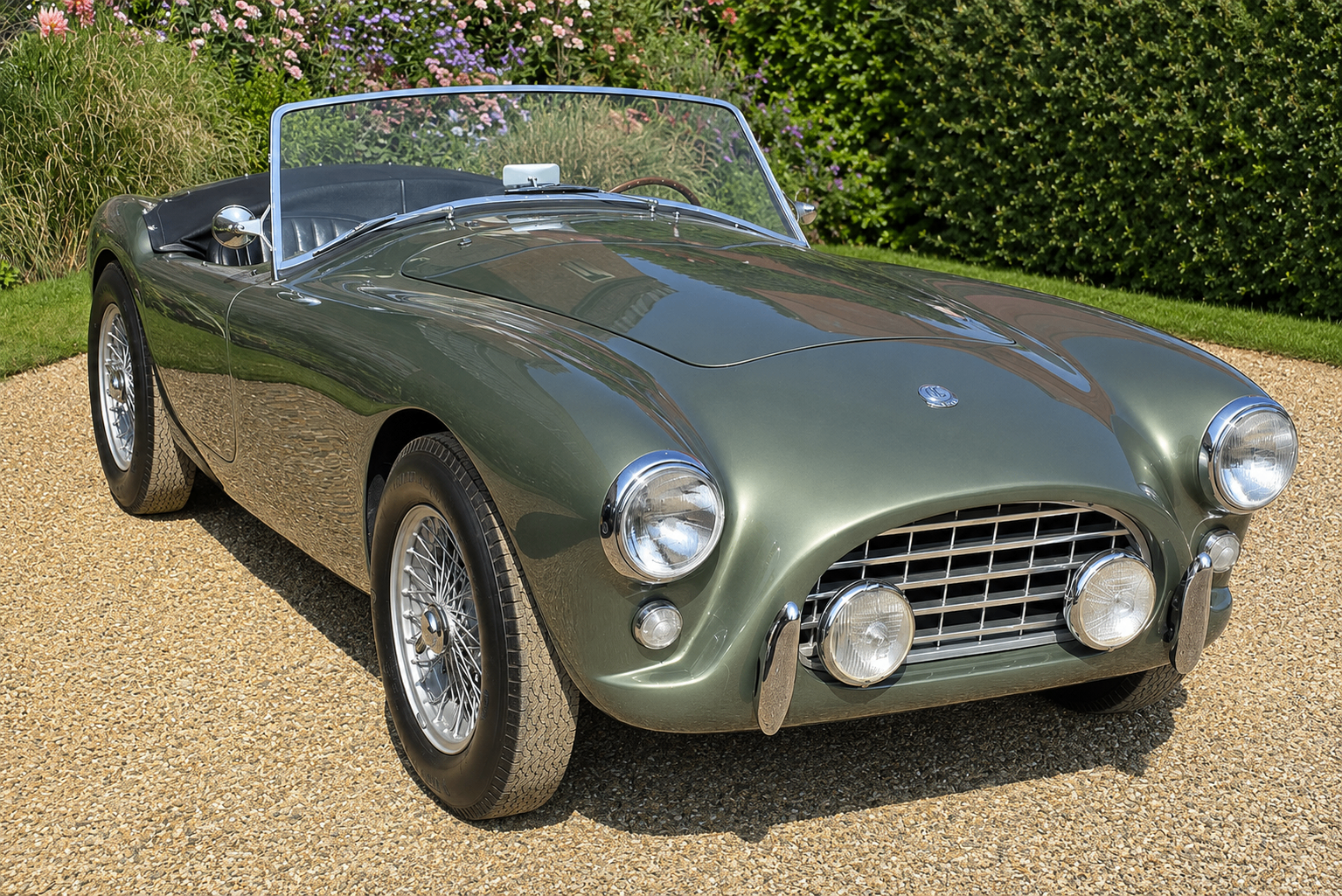
The Tojeiro-designed AC roadster that became the Cobra's donor car — three engine families across a decade, roughly 723 cars in total.

Roadster
Car Collector International Editorial
AC Ace
Overview

Why this car matters

The AC Ace was designed by John Tojeiro around a slim ladder chassis with all-round independent suspension by transverse leaf springs, bodied in hand-formed aluminium in a Ferrari 166 barchetta idiom, and put into production by AC Cars of Thames Ditton after its debut at the 1953 Earls Court Motor Show (source: AC Owners Club, ac-models/ac-aces). It ran until 1963 in three distinct engine families: the original AC-engined Ace with the pre-war 'long-stroke' 2.0-litre single-overhead-cam six, the Ace-Bristol using the ex-BMW 328-derived 2.0-litre Bristol BS1 straight-six, and the final Ace 2.6 with Ken Rudd's 'Ruddspeed'-tuned Ford Zephyr 2.6-litre pushrod six.

Production totals are consistently cited across independent sources: Wikipedia (en.wikipedia.org/wiki/AC_Ace) records 'about 220 AC Aces and 466 Ace-Bristol cars', with SCM's 1957 AC Ace-Bristol market profile giving 732 for all types combined (Sports Car Market). The final Ford 2.6-litre run is the rarest of the three: Bonhams' own catalogue notes for the 1961 Ace 2.6-Litre Roadster RSX 5006 (Bond Street Sale, 19 May 2021, Lot 16) state 'Only 36 examples of the Ford-powered Ace 2.6 were made, making it by far the rarest of the three engine types offered', while Conceptcarz's chassis profile of RS 5030 gives 37. That one-car discrepancy is flagged as Verify; both figures come from serious secondary sources.

The Ace is a genuinely important historic road car in its own right — the AC Owners Club records period competition success including class wins at Le Mans, and it was the car Carroll Shelby ordered from AC and re-engined with Ford's 260 V8 in 1962 to create the CSX2000-series Cobra. Ace values today sit well below Cobra values but are firmly established in the collector market, with the Ace-Bristol as the most tradable variant, the Ace 2.6 as the standalone rarity tier, and the original AC-engined cars as the founding, most-difficult-to-source examples.

The Ace is the AC design that Shelby chose to base the Cobra on. Originality, correct engine family, matching numbers and continuous ownership history matter more than mileage; the market clearly separates AC-engined, Bristol-engined and Ford 2.6-litre cars into three distinct tiers.

Variants

Range and production

VariantYearsProductionNotes
AC Ace (AC-engined)1953–1963Approximately 220–223 units (Wikipedia states 'about 220 AC Aces'; sources vary by one to two cars — Verify). Original variant with pre-war-derived AC 2.0-litre SOHC 'long-stroke' six, Moss 4-speed gearbox. AEX-prefix chassis for LHD export cars. Founding version of the model.
AC Ace-Bristol1956–1963466466 units per Wikipedia; corroborated by RM Sotheby's, Gooding & Company and Bonhams lot descriptions across multiple sales. Definitive Ace: 2.0-litre Bristol BS1 Mk II straight-six (ex-BMW 328 design) with three Solex carburettors, Bristol 4-speed gearbox. BEX-prefix chassis for LHD export cars. Front disc brakes from 1957.
AC Ace 2.6 (Ruddspeed / Ford Zephyr)1961–196336 units per Bonhams RSX 5006 catalogue (Bond Street Sale, 19 May 2021, Lot 16) vs 37 per Conceptcarz chassis profile of RS 5030 — Verify one-car discrepancy. Final variant: Ford Zephyr 2.6-litre OHV pushrod six with Ken Rudd 'Ruddspeed' aluminium head developed by Raymond Mays (ERA/BRM); triple SU or Weber carburettors; up to 170 hp on Stage 4 Weber tune. RS-prefix RHD and RSX-prefix LHD chassis. Restyled lowered nose over the AC-engined and Bristol cars.
Collector Variants

Limited & special editions

The models below represent the most significant limited and special edition variants — factory-produced cars that command meaningful premiums over standard examples and warrant specific attention from serious collectors.

AC Ace 2.6 (Ruddspeed / Ford Zephyr) · 1961–1963

36 per Bonhams catalogue notes for RSX 5006 (Bond Street Sale, 19 May 2021, Lot 16 — 'Only 36 examples of the Ford-powered Ace 2.6 were made, making it by far the rarest of the three engine types offered'); 37 per Conceptcarz chassis profile of RS 5030. Verify one-car discrepancy — both figures come from serious secondary sources.
Distinguishing features
Final and rarest Ace variant: Ford Zephyr 2.6-litre OHV pushrod inline-six with Ken Rudd 'Ruddspeed' aluminium 12-port head developed by Raymond Mays (ERA/BRM); triple SU or Weber DCOE carburettors; up to 170 hp on Stage 4 Weber tune per Bonhams RSX 5006 notes. Restyled lowered nose over the AC-engined and Bristol cars. RS-prefix RHD and RSX-prefix LHD chassis series.
Value premium
Standalone rarity tier above the Ace-Bristol ladder. Anchored by RM Sotheby's Monterey 2021 Lot 307 (RS 5030) at $500,000 Sold and Bonhams Bond Street 19 May 2021 Lot 16 (RSX 5006) at £287,500 Sold — both pre-date the current review window; no fresh public benchmark this session.
Inspection points
RS/RSX-prefix chassis stamping; Ruddspeed alloy head casting marks and Stage identifier; correct triple SU or Weber carburettor set-up per period specification; Zephyr block date codes consistent with 1961–1963 production; verify Ford 2.6 has not been substituted with a later Zephyr block during previous rebuilds.
Authentication
AC Owners Club registry lookup on the specific RS/RSX chassis number is the decisive step. A non-original Ruddspeed head or a wrong-block Zephyr substantially reduces value even where the car is chassis-correct.

Production figures sourced from official marque records and specialist registers. Verify chassis documentation with the relevant marque register before purchase.

Buyer's Guide

What to look for

Provenance and originality

Start with identity, paperwork and originality. For the AC Ace, the strongest cars have a continuous ownership file, matching numbers where applicable, original manuals, invoices and evidence of work by recognised marque specialists. Correct engine for the chassis series (AEX / BEX / RS / RSX prefix), original body panels, presence of the original 4-speed gearbox for the family (Moss on AC-engined cars, Bristol on Ace-Bristols) and AC Owners Club registry entries with the specific chassis number.

Mechanical inspection priorities

Three completely different engines: the pre-war AC 'long-stroke' 2.0-litre SOHC six is fragile and slow-revving; the Bristol BS1 Mk II is a jewel-like ex-BMW 328 development requiring genuine specialist knowledge; the Ford Zephyr 2.6 with Ruddspeed aluminium head is the fastest but the most-often modified. All three respond badly to non-specialist assembly. A proper pre-purchase inspection includes cold-start behaviour, leak-down or compression testing where appropriate, underbody photography, suspension and chassis-point inspection, brake condition and a road test long enough to expose heat-related faults. Deferred maintenance is almost always more expensive than buying a better-sorted car.

Body, paint and accident history

Use a paint-depth gauge, lift access and a specialist familiar with the model's factory seams and panel gaps. Collector value is dramatically affected by structural repairs, poor paintwork, corrosion, incorrect panels and missing factory trim. Documented cosmetic restoration is acceptable; concealed accident repair must be priced severely.

Specification strategy

The Ace-Bristol is the definitive Ace and the deepest market — pricing driven by originality, engine correctness (BS1 Mk II with three Solex carburettors) and UK/US export history. The Ace 2.6 (Ruddspeed) is the standalone rarity tier at 36–37 cars. Original AC-engined cars trade thinly but are the founding version of the model. Specification, colour, transmission and limited-build variants move values significantly. Buy the best-documented example in the most desirable specification you can justify rather than a tired example of a rarer derivative that will need years of corrective work.

Pricing

What to pay

Ace (AC-engined) — driver
USD$185,000 – $260,000
GBP£150,000 – £210,000
EUR€170,000 – €240,000
Presentable, correct-engine AC-engined Ace with continuous history. Basis: AC Owners Club and specialist UK trade quotations reviewed against limited public auction record.
Ace-Bristol — driver
USD$230,000 – $310,000
GBP£180,000 – £245,000
EUR€210,000 – €280,000
Usable, matching-numbers Ace-Bristol with UK or US history and correct BS1 Mk II. Basis: RM Sotheby's, Gooding and Bonhams recent hammer results per region.
Ace-Bristol — concours / preservation
USD$310,000 – $450,000
GBP£245,000 – £360,000
EUR€280,000 – €410,000
Restored to concours or best-preserved unrestored specification. Basis: BaT sale of 1956 AC Ace-Bristol at $410,000 (Lot #150,053, 14 Jun 2024) and Bonhams Paris Feb 2025 result €218,500 for a mid-market car.
Ace 2.6 (Ruddspeed)
USD$400,000 – $650,000
GBP£300,000 – £500,000
EUR€355,000 – €580,000
Standalone rarity tier — 36–37 cars total. Basis: Bonhams Bond Street 19 May 2021 £287,500 (RSX 5006) and RM Monterey 2021 $500,000 (RS 5030), adjusted for four subsequent years of Ace-Bristol tier appreciation. Regional bands authored independently against specialist trade quotations; not FX-converted.

Regional ranges authored independently — each reflects its local market, not an FX conversion

Ownership

Living with it

Typical mileage
1,500–4,000 miles typical for collector use
Service interval
12 months; mileage interval varies by model and use
Annual running cost
$4,000 – $12,000
Fuel economy
15–24 mpg depending on use
Insurance
Use an agreed-value collector policy with limited mileage, secure storage, documented photography and an annual value review. Premiums vary sharply by age, storage location and declared value.

Maintenance planning

Budget annually even if the car is used sparingly. Fluids age, tyres date out, fuel systems suffer from ethanol, batteries fail and stored cars need exercise. A documented maintenance rhythm protects both reliability and resale value.

Parts and specialist access

Ace ownership requires a UK or US specialist who genuinely understands the three engine families. Aces have thin parts networks for AC-specific body and trim components; Bristol BS1 engine work in particular is a small-shop specialty. Before purchase, confirm parts availability for model-specific trim, suspension, fuel system, electronics and engine components. A cheap car waiting on unobtainable parts is rarely cheap in collector ownership.

Common Problems

Known issues by system

Chassis / body

Hidden chassis-tube corrosion beneath aluminium panels

Critical$20,000 – $70,000+ for correct chassis and aluminium body restoration
Symptoms — Sagging doors, wrinkled paint at bulkhead and outriggers, filler under sills, mismatched panel gaps.
Inspection — Full lift inspection by an AC or Cobra specialist; borescope down chassis tubes if possible; paint-depth gauge across every panel; check chassis-plate stamping against AC Owners Club registry.
Engine (Bristol BS1)

Head gasket, valve gear and carburettor synchronisation on Bristol BS1 Mk II

Major$12,000 – $28,000 for a correct Bristol BS1 rebuild by a marque specialist
Symptoms — Poor idle, oil consumption, blue smoke on the overrun, uneven Solex synchronisation, difficult cold starting.
Inspection — Cold-and-hot leak-down, oil-pressure gauge, evidence of Bristol-specialist work in the file (heads on the BS1 are not conventional Chevy-shop territory).
Engine (AC 2.0 SOHC)

'Long-stroke' AC six wear and parts scarcity

Major$15,000 – $30,000 — parts availability is the constraint, not machining
Symptoms — Low oil pressure hot, top-end noise, blue smoke, incorrect replacement components.
Inspection — Confirm original AC engine matches chassis via AC Owners Club records; leak-down, oil-pressure survey; inspect for correct SU carburettors and original manifold.
Engine (Ford 2.6 Ruddspeed)

Non-original Ruddspeed heads, incorrect carburettor set-ups, and later Ford engine substitutions

Major$10,000 – $25,000 to return to correct Ruddspeed specification if a non-original head or wrong Zephyr block has been fitted
Symptoms — Missing Ruddspeed alloy 12-port head casting marks; wrong-diameter Weber DCOEs; non-Zephyr blocks fitted during previous rebuilds.
Inspection — Cross-check engine number to chassis; verify Ruddspeed head casting and Stage marking; confirm triple SU or Weber set-up matches period specification.
Identity

Wrong engine family for the chassis prefix (AEX / BEX / RS / RSX)

CriticalPricing impact only — a Bristol-engined AEX chassis or an AC-engined BEX chassis trades at a significant discount and can be extremely difficult to sell at retail
Symptoms — Chassis plate does not correspond to the engine currently fitted; documentation gaps; missing AC Owners Club registry entry.
Inspection — AC Owners Club registry lookup on the specific chassis number; cross-check engine and gearbox numbers against period build records.
Brakes / suspension

Front discs (Bristol) versus drums (early AC-engined) and tired transverse leaf springs

Moderate$3,500 – $9,000
Symptoms — Poor stopping, pulling under braking, sagging ride height, worn kingpins.
Inspection — Pedal feel, drum/disc measurement, ride-height check against factory dimension, kingpin play test.
Valuation

Current value bands by region

Concours
USD
$450,000
GBP
£355,000
EUR
€410,000
+2% 12-mo
Excellent
USD
$310,000
GBP
£245,000
EUR
€280,000
+1% 12-mo
Good
USD
$230,000
GBP
£180,000
EUR
€210,000
0% 12-mo
Fair
USD
$155,000
GBP
£120,000
EUR
€140,000
-2% 12-mo
Project
USD
$85,000
GBP
£68,000
EUR
€78,000
-4% 12-mo

Each region quoted in its local currency — independent market readings, not FX conversions

The Ace market is defined by engine family: Ace-Bristols dominate liquidity and set the ladder, while original AC-engined cars and Ace 2.6 Ruddspeeds trade thinly at either end. Recent public results — the BaT 1956 Ace-Bristol at $410,000 (14 Jun 2024), RM Miami 2025 Lot 249 (BEX 275) at $291,000, Gooding Amelia Island 2025 Lot 108 (BEX 494) at $246,400, RM Monterey 2024 Lot 212 (BEX 389) at $201,600 and Bonhams Paris 6 Feb 2025 Lot 120 (BEX 281) at €218,500 — show a $200k–$410k Ace-Bristol band that separates on originality, engine correctness and ownership documentation, not on mileage alone. The Ace 2.6 remains a standalone rarity tier with a thin public record; the last well-documented public sales are Bonhams Bond Street 19 May 2021 Lot 16 (RSX 5006) at £287,500 and RM Monterey 2021 Lot 307 (RS 5030) at $500,000. Because the Ace-Bristol has firmed materially in the four years since, current Ace 2.6 pricing plausibly sits meaningfully above those 2021 anchors, but is not yet reset by a fresh public transaction. Cobra continuation-market pressure does not spill into original Ace pricing — the two markets are firmly separate.

Auctions

Recent results

DateAuctionCarMileageResult
2024-06-14
Bring a Trailer
Online, Lot #150,053
1956 AC Ace-Bristol Roadster (LHD, one of approx. 463 Bristol roadsters per BaT listing)
$410,000
Sold
2025-02-28
RM Sotheby's
Miami 2025, Lot 249
1957 AC Ace-Bristol (BEX 275, ex-Jim Feldman)
$291,000
Sold
2025-03-07
Gooding & Company
Amelia Island 2025, Lot 108
1958 AC Ace Bristol (BEX 494, matching-numbers engine 100D2 864)
$246,400
Sold
2024-08-16
RM Sotheby's
Monterey 2024, Lot 212
1958 AC Ace-Bristol (BEX 389, engine 100 D 738, preserved unrestored)
$201,600
Sold
2025-02-06
Bonhams
Les Grandes Marques du Monde à Paris, Lot 120
1957 AC Ace Bristol Roadster (BEX 281, engine 100D 528)
€218,500
Sold
Investment

Long-term outlook

Strong HoldHorizon: 10+ years

Original AC-engined Aces, matching-numbers Ace-Bristols and the 36–37 Ace 2.6 Ruddspeeds are historically important, mechanically fragile and reward long-term specialist ownership rather than active trading. Ace-Bristols with continuous UK or US history and correct BS1 Mk II drivetrains are the most liquid segment; Ace 2.6 cars are a genuine rarity tier at fewer than forty cars worldwide.

Recommended

The trusted network

Specialists

  • AC marque specialist
    View →
    UK / Europe
    AC Ace inspections, servicing and originality reviews.
  • Model-focused independent
    View →
    United States
    Pre-purchase inspections, major service planning and market-correct preparation for the Ace.
  • Concours preparation studio
    View →
    International
    Paint correction, detailing, preservation and sale preparation for premium collector cars.

Storage

  • Windrush Car Storage
    View →
    Cotswolds, UK
    Climate-controlled storage and collection management for high-value collector cars.
  • Autovault
    View →
    Bicester, UK
    Secure storage at Bicester Heritage with regular inspection programmes.
  • Classic Car Club Manhattan
    View →
    New York, NY
    Secure urban storage for collector and modern-classic performance cars.

Transport

  • CARS UK
    View →
    UK & Europe
    Enclosed event, concours and collection transport across Europe.
  • Reliable Carriers
    View →
    USA (national)
    Enclosed coast-to-coast transport for premium and collector cars.
  • FERRLOG
    View →
    Italy / Europe
    Air-ride enclosed transport for Italian and European collector cars.

Own a AC Ace?

Join Car Collector International's owners register for valuation updates, auction alerts and members-only events.

Register interest

The valuation figures in this guide are for research purposes only and do not constitute financial or investment advice. See our full disclaimer.