
Car Collector International
Classic · 1929–1932

Cord L-29

The first American front-wheel-drive car — Auburn's radical 1929 flagship, engineered from Harry Miller's Indianapolis racing patents and now a CCCA Full Classic.

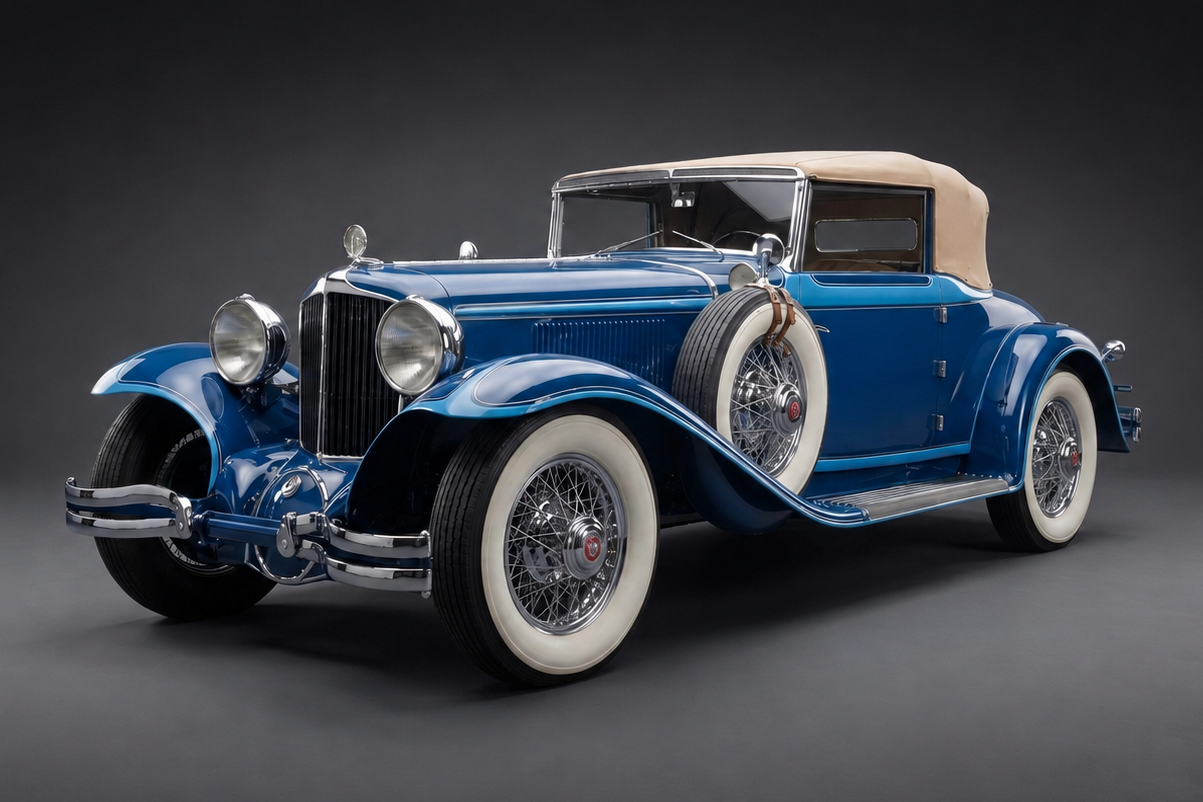
Cord L-29 Cabriolet, front three-quarter view — a 1930-era American front-wheel-drive open two-door in deep royal blue, with tan folding fabric roof, dual side-mount spare wheel, white-wall tyres, chromed radiator grille and dual cowl-mounted spotlights, photographed inside a dark studio.
Overview

Why this car matters

Announced in the summer of 1929 and in dealer hands by August of that year, the Cord L-29 was the first front-wheel-drive automobile offered to the American public. Built at Auburn, Indiana by E. L. Cord's Auburn Automobile Company as the launch model of the newly-created Cord marque — the middle plank between Auburn and Duesenberg — the L-29 married a Lycoming L-head straight-eight of 4,895 cc and about 125 bhp to a three-speed manual gearbox mounted ahead of the engine, driving the front wheels through Cardan universal joints derived from Harry Miller's Indianapolis racing patents. The absence of a driveshaft tunnel let designer Al Leamy draw a body that sat about four inches lower than a comparable contemporary American sedan, and the resulting silhouette — long hood, sweeping fenders, low beltline — is the reason the car still stops traffic at concours nearly a century later. Four factory body styles were catalogued out of Auburn: Sedan, Brougham, Cabriolet and Phaeton Sedan. A significant number of chassis were rebodied in period by named American and European coachbuilders, and it is those custom cars that anchor the top of the surviving L-29 market. Priced at $3,095 to $3,295 at launch and cut aggressively through 1931 and 1932 as the Depression bit, the L-29 was killed by a combination of economic collapse, early Cardan-joint reliability trouble and the development programme that would deliver the supercharged Cord 810/812 for 1936. About 4,400 to just over 5,000 cars in total across the 1929–1932 run, with sources genuinely differing on the exact total.

The L-29 is the car that put front-wheel drive on an American public road for the first time, and it did so on the strength of engineering directly derived from Harry Miller's Indianapolis-winning race cars. Every subsequent American front-wheel-drive road car — from the 1936 Cord 810 through the Oldsmobile Toronado of 1966 and every mass-market car since — traces a direct engineering lineage back to Cornelius Van Ranst's L-29 drivetrain. It is also the launch model of the Cord marque itself, the middle plank of the Auburn / Cord / Duesenberg empire that defined American luxury and technical ambition at the end of the 1920s, and one of only a handful of American pre-war cars carrying full Classic Car Club of America Full Classic recognition across every body style. Beyond the engineering, the L-29 is a genuinely important design object: its low, long silhouette — the fruit of a chassis with no driveshaft tunnel — was recognised in period as a design breakthrough, and the custom-coachbuilt chassis that came out of Hayes, Murphy, LeBaron and the European houses include some of the most significant pre-war concours cars in the world. The Hayes Coupe won the Concours d'Elegance de Monaco in 1931 and remains one of the definitive records against which pre-war American concours cars are judged.

Variants

Range and production

VariantYearsProductionNotes
Cord L-29 Sedan1929–1932Four-door closed factory body, the majority factory body style of the model. Lycoming L-head straight-eight of 298.6 cu in (4,895 cc) driving the front wheels through a three-speed manual gearbox mounted ahead of the engine and outboard Cardan universal joints. No per-body-style production count is authoritatively published in the marque literature; Sedan and Brougham together accounted for the majority of factory output.
Cord L-29 Brougham1929–1932Four-door closed factory body with a shorter, more formal roofline than the Sedan and a distinct rear-quarter treatment. The second majority factory body of the model alongside the Sedan; also not separately production-counted in the published record.
Cord L-29 Cabriolet1929–1932Two-door open factory body with a folding fabric roof and rumble seat. Considerably rarer within the ~4,400 to just over 5,000-car total than the Sedan and Brougham, and the standing open-body factory L-29 collector pick beneath the custom-coachwork tier.
Cord L-29 Phaeton Sedan1929–1932Four-door open factory body in the dual-cowl phaeton idiom, the rarest of the four factory catalogue bodies. Long open coachwork on the L-29 chassis exposes the low silhouette of the front-wheel-drive platform to full effect.
Custom-coachbuilt Cord L-29 chassis1929–1932Extensive period custom coachwork was fitted to the L-29 chassis by American houses (Hayes, Murphy, LeBaron, Weymann of America) and European houses (Freestone & Webb in the UK, Voll & Ruhrbeck in Germany, Saoutchik in France, among others). No aggregate figure for the number of L-29 chassis rebodied outside the Auburn works is authoritatively published; individually-documented cars include the Hayes Coupe (winner of the 1931 Concours d'Elegance de Monaco), Murphy-bodied Town Car and Convertible Sedan examples, and several one-off European rebodies now catalogued in reference pre-war collections. Each is effectively a one-off and sits at the top of the L-29 collector market.
Collector Variants

Limited & special editions

The models below represent the most significant limited and special edition variants — factory-produced cars that command meaningful premiums over standard examples and warrant specific attention from serious collectors.

Period custom-coachbuilt Cord L-29 chassis (Hayes / Murphy / LeBaron / Weymann of America / Freestone & Webb / Voll & Ruhrbeck / Saoutchik and others) · 1929–1932

No aggregate figure authoritatively published; each documented period-coachbuilt car is effectively a one-off
Distinguishing features
Individually-designed period coachwork on the L-29 front-wheel-drive chassis, built to owner order by American and European coachbuilders during the 1929–1932 window. Documented cars include the Hayes Coupe (winner of the 1931 Concours d'Elegance de Monaco), Murphy-bodied Town Car and Convertible Sedan examples, LeBaron and Weymann of America bodies, and European rebodies by Freestone & Webb (UK), Voll & Ruhrbeck (Germany) and Saoutchik (France). Each carries its own concours history and its own documented coachbuilder provenance.
Value premium
Definitive top of the Cord L-29 market. Concours-restored period-coachbuilt cars regularly trade in the USD $600,000 – $2,500,000+ band at reference international sales, with the definitive named records (Hayes Coupe and comparable) at the top of the range and above.
Inspection points
Verify coachbuilder body against period photographic records, ACD Club chassis-number documentation and any surviving coachbuilder records. Confirm that the body is a period rebody on the correct chassis — not a later replica body fitted to a factory L-29 chassis. Verify body-off restoration paperwork at a pre-war coachwork specialist with direct experience of the named coachbuilder's practice.
Authentication
Period custom coachwork must be documented against the ACD Club chassis records, contemporary coachbuilder records and period photography. Cross-check against the ACD Automobile Museum archive and against the concours records for the individual car (Pebble Beach, Amelia Island, Villa d'Este, Concours d'Elegance de Monaco).

Cord L-29 Cabriolet and Phaeton Sedan (factory open bodies) · 1929–1932

No per-body-style factory figure authoritatively published; both are considerably rarer than the Sedan and Brougham within the ~4,400 to just over 5,000-car total
Distinguishing features
The two open factory catalogue bodies on the L-29 chassis — the two-door Cabriolet with folding fabric roof and rumble seat, and the four-door Phaeton Sedan in the dual-cowl phaeton idiom. Both expose the low silhouette of the front-wheel-drive chassis to full effect and are the standing open-body factory L-29 collector picks beneath the custom-coachwork tier.
Value premium
Concours-standard factory open cars regularly clear the USD $325,000 print with Phaeton Sedan cars trading at the upper end of the tier — a documented Phaeton Sedan sits at or above USD $600,000 in comparable condition, materially clear of the closed factory bodies.
Inspection points
Verify original factory open-body specification against ACD Club chassis records and period photography — a factory Cabriolet or Phaeton Sedan chassis is distinct from a closed car re-bodied to open coachwork later in life. Verify folding-roof frame and attachment, coachwork wood-frame condition and body-off restoration paperwork.
Authentication
Factory open-body status must be documented against the ACD Club chassis records. Any car offered as a factory Cabriolet or Phaeton Sedan without ACD Club documentation for the original body style should be treated as a re-bodied car for market purposes.

Production figures sourced from official marque records and specialist registers. Verify chassis documentation with the relevant marque register before purchase.

Buyer's Guide

What to look for

Front-wheel-drive drivetrain — Cardan universal joints, ring-and-pinion, transmission ahead of the engine

The L-29 front-wheel-drive drivetrain is the defining item on the car. Early Cardan universal joints at the outboard drive-shaft ends were the standing weakness of the launch specification and were revised in production; verify service history against a marque specialist familiar with the L-29 drivetrain, and inspect the joints for wear, boot condition and evidence of catch-up service. The three-speed manual gearbox sits ahead of the engine at the very front of the chassis with the ring-and-pinion further forward still — no driveshaft, no tunnel — and any competent pre-war restoration must document the correct gear ratios, correct-specification joints and correct oil grades throughout the front-drive assembly.

Lycoming L-head straight-eight — bore condition, oil pressure and correct-specification carburettor

The 298.6 cu in Lycoming L-head straight-eight is technically straightforward by the standard of the period but is now a hundred years old on any surviving car. Compression across all eight cylinders, warm-oil pressure at cruise, condition of the water-jacketed intake manifold, correct-specification updraft carburettor and evidence of a documented rebuild by a Lycoming-experienced specialist are the reference PPI items. Verify the engine number against the chassis-number stamping and against any surviving CCCA / ACD Club documentation.

Body originality — factory Auburn body vs period custom coachwork vs later re-body

The four Auburn factory bodies (Sedan, Brougham, Cabriolet, Phaeton Sedan) are documented against the L-29 chassis records held by the Auburn Cord Duesenberg Club and the ACD Automobile Museum archive. Period custom coachwork by Hayes, Murphy, LeBaron, Weymann of America, Freestone & Webb, Voll & Ruhrbeck, Saoutchik and others is individually documented per chassis and per coachbuilder. The pricing structure across the L-29 market has three clearly-separated tiers, and confirming that a car offered as a Hayes / Murphy / European-coachbuilt L-29 is a genuine period rebody rather than a later replica body on a factory chassis is the single most consequential verification exercise on any six-figure L-29 transaction.

Chassis, quarter-elliptic front springs and inboard front brakes

The L-29 chassis carries quarter-elliptic front springs and inboard drum brakes at the front, with the brake drums grouped inboard of the drive-shafts rather than at the wheel hubs. Both are period-correct features that need specialist service. Corrosion in the front cross-member, condition of the quarter-elliptic leaves, inboard front-brake actuation linkage and drum surface condition are the standing PPI items on top of the drivetrain checks.

Coachwork — aluminium and steel panelling over wood-framed bodies, running boards, canework on Phaeton and Cabriolet

Both factory and custom L-29 bodies are period wood-framed coachwork with metal panelling — the standing corrosion and wood-rot hotspots are the sill structure, the A-pillar base, the door-hinge post and the boot floor. Priority PPI items are paint-depth-gauge readings across every panel, wood-frame inspection at the sill and A-pillar base, and (on open cars) inspection of the folding-roof frame and its attachment to the body wood. Any car represented as concours-restored must carry photographic body-off restoration documentation from a pre-war coachwork specialist.

Interior originality — instruments, steering wheel, seat trim, wood cappings

L-29 interiors carry period-correct instrumentation grouped in front of the driver, four-spoke steering wheel, leather or wool broadcloth seat trim by body style, and wood cappings on the dashboard and door tops. Verify original specification against period reference photography and against any surviving factory or coachbuilder records; retrimmed seats, non-original steering wheels, replacement instruments and replacement wood cappings are common on cars that have been through multiple owners and each downgrade a concours-standard car.

Pre-purchase inspection — pre-war and specifically Cord / Auburn expertise required

PPI must be conducted by a pre-war marque specialist with direct Cord / Auburn / L-29 experience. A generalist collector-car workshop is not the reference on the front-wheel-drive drivetrain, and neither is a specialist familiar only with the later Cord 810/812. Insist on: full compression and warm-oil-pressure check on the Lycoming straight-eight, drive-shaft and Cardan-joint inspection, ring-and-pinion and gearbox oil-drain and inspection, quarter-elliptic front spring and inboard front-brake inspection, and coachwork inspection by a pre-war body specialist. Cross-reference chassis and engine numbers against ACD Club records and the ACD Automobile Museum archive.

Insurance, storage and event access

A CCCA Full Classic L-29 is a natural agreed-value pre-war policy car with Hagerty, Chubb Masterpiece or a comparable HNW carrier. Premiums vary materially by body style and by documented custom coachwork, with the top-tier period-coachbuilt cars carrying agreed values well into six and, on the definitive records, seven figures. Climate-controlled storage is the standing reference — a pre-war wood-framed body cannot be stored competently in unheated ambient conditions long-term. Event access includes the full CCCA Grand Classic and CARavan calendar, Pebble Beach Concours (pre-war American classes), Amelia Island Concours, Villa d'Este for the definitive period-coachbuilt records, and the ACD Club Reunion at Auburn, Indiana each Labor Day weekend.

Pricing

What to pay

Concours — documented period custom-coachbuilt Cord L-29 (Hayes / Murphy / LeBaron / Weymann of America / Freestone & Webb / Voll & Ruhrbeck / Saoutchik and others) with full ACD Club and coachbuilder documentation
USDUSD $600,000 – $2,500,000+ auction / private-treaty basis. Reflects the one-off custom-coachwork status; the definitive named records (Hayes Coupe and comparable) trade at the top of the range and above at reference international sales.
GBPGBP £450,000 – £1,900,000+ dealer-listed basis at UK pre-war specialists. Authored independently per region — NOT FX-converted.
EUREUR €550,000 – €2,300,000+ dealer-listed basis at continental European pre-war specialists. Authored independently per region — NOT FX-converted.
Basis: authored independently per region — NOT FX-converted. Top of the L-29 market is a documented period custom-coachbuilt chassis with full ACD Club records, coachbuilder documentation and concours-standard body-off restoration paperwork. Wide range because the tier covers everything from a modest period rebody through to the definitive named records.
Excellent — matching-numbers factory Cabriolet or Phaeton Sedan (open factory bodies) with ACD Club documentation and full CCCA-standard restoration
USDUSD $325,000 – $600,000 auction / private-treaty basis. Phaeton Sedan at the upper end on the strength of its extreme rarity among the four factory bodies; Cabriolet at the lower end.
GBPGBP £250,000 – £460,000 dealer-listed basis. Authored independently per region — NOT FX-converted.
EUREUR €300,000 – €560,000 dealer-listed basis. Authored independently per region — NOT FX-converted.
Basis: authored independently per region — NOT FX-converted. Concours-standard factory open cars are the standing open-body L-29 collector pick beneath the custom-coachwork tier; ACD Club documentation and body-off restoration paperwork are the reference conditions.
Excellent — matching-numbers factory Sedan or Brougham (closed factory bodies) with ACD Club documentation and full CCCA-standard restoration
USDUSD $130,000 – $220,000 auction / private-treaty basis. The volume band for concours-standard factory closed L-29 cars.
GBPGBP £100,000 – £170,000 dealer-listed basis. Authored independently per region — NOT FX-converted.
EUREUR €120,000 – €205,000 dealer-listed basis. Authored independently per region — NOT FX-converted.
Basis: authored independently per region — NOT FX-converted. Concours-standard factory Sedan and Brougham cars are the sensible entry into serious L-29 collector ownership; ACD Club documentation and body-off restoration paperwork are the reference conditions.
Good — driver-quality factory Sedan or Brougham with documented service history and honest older restoration
USDUSD $75,000 – $130,000 auction / private-treaty basis. Older restorations, cosmetic needs, running-and-driving CCCA-tour condition.
GBPGBP £60,000 – £100,000 dealer-listed basis. Authored independently per region — NOT FX-converted.
EUREUR €70,000 – €120,000 dealer-listed basis. Authored independently per region — NOT FX-converted.
Basis: authored independently per region — NOT FX-converted. Driver-quality factory closed cars are the CCCA CARavan / touring band; expect near-term drivetrain and coachwork attention at the lower end of the band and price against a documented restoration budget.
Fair / Project — long-term-stored or partly-restored L-29 requiring full body-off recommissioning or with paperwork gaps
USDUSD $40,000 – $80,000 auction / private-treaty basis. Non-matching engine, incomplete drivetrain or major coachwork wood rot at the bottom of the band.
GBPGBP £30,000 – £60,000 auction / private-treaty basis. Authored independently per region — NOT FX-converted.
EUREUR €35,000 – €70,000 auction / private-treaty basis. Authored independently per region — NOT FX-converted.
Basis: authored independently per region — NOT FX-converted. Any L-29 in this band should be priced against a documented body-off restoration budget at a pre-war marque specialist — a full L-29 restoration will typically consume a material multiple of the entry-band premium and is not economic on any car offered as a project without ACD Club chassis documentation.

Regional ranges authored independently — each reflects its local market, not an FX conversion

Ownership

Living with it

Typical mileage
500–1,500 miles / 800–2,400 km typical for a CCCA Full Classic used for Grand Classic events and CARavan tours; lower on a concours-restored custom-coachbuilt car reserved for major concours entries.
Service interval
Annual service at a pre-war marque specialist familiar with the Cord L-29 front-wheel-drive drivetrain. Front-drive Cardan universal joints, ring-and-pinion, quarter-elliptic front-spring articulation and inboard front-brake linkage are the standing recurring items on top of the Lycoming straight-eight top-end service.
Annual running cost
USD $5,000 – $12,000+ typical annual budget for a driver-quality factory L-29 in active CCCA use; USD $10,000 – $25,000+ for a concours-restored factory or custom-coachbuilt car where every service is pre-war-marque-specialist work and coachwork upkeep is a distinct budget line.
Fuel economy
~10–14 mpg (US) / ~12–17 mpg (imp) / ~17–23 L/100 km on real-world CCCA touring use.
Insurance
Agreed-value pre-war classic-policy cover through Hagerty, Chubb Masterpiece or a comparable HNW carrier is the standing channel; policies for a matching-numbers period custom-coachbuilt L-29 (Hayes / Murphy / European coachwork) require carrier familiarity with six- and seven-figure pre-war values and specific coachbuilder provenance documentation.

Pre-war specialist network — the standing reference

Route all major work through a pre-war marque specialist with direct Cord / Auburn L-29 experience: the ACD Automobile Museum's recommended restorer network, established US pre-war restorers with documented Cord experience, and the small number of European pre-war specialists with L-29 drivetrain expertise. Independent generalist workshops are not the reference on any L-29 mechanical work, and are not the reference at all on custom-coachbuilt cars.

Front-wheel-drive drivetrain service reserve

The single largest ongoing mechanical item on an L-29 is the front-wheel-drive drivetrain — Cardan universal-joint service, ring-and-pinion oil condition, gearbox inspection and inboard front-brake service. Build this into the annual running-cost budget rather than treat it as a one-off event, and plan a documented drivetrain overhaul as a scheduled long-interval service line.

Coachwork — wood-framed body maintenance and restoration reserve

The wood-framed body over metal panelling is the defining ownership item on any pre-war L-29. Correct-specification wood-frame work at a pre-war coachwork specialist is a materially different cost line from generic bodywork. Budget a distinct coachwork reserve for any car being kept to concours standard, and a materially higher reserve for a period custom-coachbuilt car where correct-specification restoration must match the original coachbuilder's practice.

Common Problems

Known issues by system

Front-wheel-drive drivetrain — Cardan universal joints, ring-and-pinion, gearbox ahead of engine

The Cardan universal joints at the outboard ends of the front drive-shafts were the standing weakness of the launch-specification L-29 and were revised in production. Ring-and-pinion oil-level and condition, gearbox lubrication and drive-shaft alignment are all recurring cost-of-ownership items on a hundred-year-old front-wheel-drive drivetrain.

CriticalUSD $15,000 – $45,000+ for full front-drive overhaul (Cardan joints, ring-and-pinion, gearbox) at a pre-war marque specialist.
Symptoms — Knocking or clicking from the front of the chassis on lock, uneven power delivery through the drive-shafts, gearbox whine, oil weep from the ring-and-pinion housing or the drive-shaft joints.
Inspection — Full drive-shaft, Cardan-joint and ring-and-pinion inspection at PPI by a pre-war marque specialist; documented service history covering the front-drive assembly across the prior ownership.
Lycoming L-head straight-eight — bore, oil pressure, updraft carburettor

The Lycoming 298.6 cu in L-head straight-eight is technically straightforward but is now a century old. Bore condition, warm-oil pressure at cruise, water-jacketed intake manifold condition and correct-specification updraft carburettor are the standing engine items.

CriticalUSD $18,000 – $45,000+ for a full straight-eight rebuild at a pre-war specialist.
Symptoms — Low compression on individual cylinders, low warm-oil pressure at cruise, water-jacket weep at the intake manifold, uneven idle, hot-start hesitation.
Inspection — Full compression and warm-oil-pressure test at PPI, water-jacket pressure test, correct-specification carburettor inspection, documented rebuild history at a Lycoming-experienced pre-war specialist.
Matching-numbers engine and chassis — replacement Lycoming engines within the L-29 family

A proportion of the surviving L-29 population has been fitted with a non-original replacement Lycoming straight-eight at some point in its ownership chain. None carry the matching-numbers premium of an original chassis-matched engine.

MajorUSD $18,000 – $60,000+ for a correct-specification matching-numbers rebuild; sourcing a chassis-correct replacement engine is a distinct market exercise.
Symptoms — Engine number does not match the chassis-number stamping; incorrect casting date on the block for the chassis build; missing ACD Club documentation for engine-to-chassis correspondence.
Inspection — Cross-check engine number against the ACD Club records and the chassis-number stamping; verify block casting date against the chassis build date.
Wood-framed body structure — sill, A-pillar base, door-hinge post, boot floor

L-29 bodies (factory Auburn and period custom coachwork alike) are wood-framed with metal panelling. Wood rot at the sill, A-pillar base, door-hinge post and boot floor is the standing coachwork failure mode on any car that has lived in damp storage.

MajorUSD $25,000 – $120,000+ for correct-specification wood-frame and coachwork restoration at a pre-war body specialist; materially higher on a period custom-coachbuilt car.
Symptoms — Doors sitting proud of the aperture, sill flex under load, visible cracking or lifting at the A-pillar base, filler signature at the boot floor and lower rear quarters.
Inspection — Full wood-frame inspection at PPI by a pre-war coachwork specialist; paint-depth-gauge readings across every panel; documented body-off restoration paperwork on any concours-represented car.
Inboard front brakes and quarter-elliptic front springs

The inboard front drum brakes and the quarter-elliptic front-spring set-up are period-correct features that need specialist service. Drum surface condition, brake actuation linkage geometry and quarter-elliptic leaf condition are the standing chassis items.

ModerateUSD $5,000 – $15,000 for front-brake service and quarter-elliptic spring refresh at a pre-war specialist.
Symptoms — Uneven front braking, pulling to one side under braking, sagging front ride height, cracked or delaminated quarter-elliptic leaves.
Inspection — Front-brake linkage inspection, drum surface measurement and quarter-elliptic spring inspection at PPI.
Electrical system — six-volt loom, period instruments, correct-specification lighting

L-29 electrics are period six-volt, with cloth-braided loom, period-correct instruments and correct-specification lighting. Corrosion at connector blocks, instrument-cluster faults and non-original replacement lighting are all common on cars that have been long-term-stored or partially restored.

ModerateUSD $3,000 – $12,000 for a correct-specification six-volt loom recondition or partial rewire at a pre-war specialist.
Symptoms — Intermittent lighting, dashboard-instrument fluttering, non-original headlamps or tail lamps, missing or replacement horn.
Inspection — Full six-volt electrical inspection at a pre-war specialist; verification of original lighting and instrument specification against period reference photography.
Interior originality — period instruments, steering wheel, seat trim, wood cappings

L-29 interiors are individually trimmed to period specification. Retrimmed seats, non-original steering wheels, replacement instruments and replacement wood cappings are common on cars that have passed through multiple owners and materially downgrade a matching-numbers pre-war car.

MinorUSD $8,000 – $25,000 for correct-specification interior sourcing and refit at a pre-war coachwork specialist.
Symptoms — Non-original seats or seat trim, non-original steering wheel, retrimmed dashboard, replacement instrument cluster, replacement wood cappings.
Inspection — Verify original trim specification against period reference photography and against any surviving factory or coachbuilder records.
Valuation

Current value bands by region

Concours
USD
USD $600,000 – $2,500,000+ (period custom coachwork); USD $325,000 – $600,000 (factory Cabriolet / Phaeton Sedan); USD $130,000 – $220,000 (factory Sedan / Brougham)
GBP
GBP £450,000 – £1,900,000+ / £250,000 – £460,000 / £100,000 – £170,000 (by tier)
EUR
EUR €550,000 – €2,300,000+ / €300,000 – €560,000 / €120,000 – €205,000 (by tier)
+4% 12-mo
Excellent
USD
USD $130,000 – $325,000 (factory bodies, top of the closed range through entry Cabriolet)
GBP
GBP £100,000 – £250,000
EUR
EUR €120,000 – €300,000
+3% 12-mo
Good
USD
USD $75,000 – $130,000 (driver-quality factory Sedan / Brougham)
GBP
GBP £60,000 – £100,000
EUR
EUR €70,000 – €120,000
0% 12-mo
Fair
USD
USD $50,000 – $80,000 (older restoration, cosmetic needs)
GBP
GBP £40,000 – £62,000
EUR
EUR €45,000 – €72,000
0% 12-mo
Project
USD
USD $30,000 – $55,000 (long-term-stored, drivetrain or coachwork case-by-case; non-matching engine at bottom of band)
GBP
GBP £22,000 – £42,000
EUR
EUR €26,000 – €50,000
0% 12-mo

Each region quoted in its local currency — independent market readings, not FX conversions

The Cord L-29 market splits into three clearly-separated bands. Driver-quality factory Sedan and Brougham cars are the CCCA CARavan and Grand Classic entry into serious pre-war American Full Classic ownership at the USD mid-five-figure to low-six-figure level; concours-standard examples of the same closed factory bodies trade a step above at USD low-to-mid six figures on the strength of ACD Club documentation, matching numbers and body-off restoration paperwork. The factory open bodies — Cabriolet and, still more so, the Phaeton Sedan — are considerably rarer than the closed cars within the ~4,400 to just over 5,000-car total and trade at a further step above in comparable condition, with concours-standard cars regularly clearing USD $325,000 and the definitive Phaeton Sedan records approaching or exceeding USD $600,000. The top of the market is unambiguous: the documented period custom-coachbuilt L-29 chassis, individually rebodied by Hayes, Murphy, LeBaron, Weymann of America and the European houses, and each effectively a one-off with its own concours history. These cars trade in the USD $600,000 to $2,500,000+ band, with the definitive named records — the Hayes Coupe and comparable — at the top of the range and above at reference international sales. Practical market read: a concours-restored factory Cabriolet or Phaeton Sedan with ACD Club documentation is the sensible open-body collector target beneath the custom-coachwork tier, a documented period-coachbuilt L-29 is the top-of-market goal, and any L-29 offered without ACD Club chassis-number documentation or with paperwork gaps in the drivetrain and coachwork restoration history should be priced against a documented body-off recommissioning budget rather than against the top-of-band print.

Auctions

Recent results

DateAuctionCarMileageResult
2023-08-19
RM Sotheby's
Monterey 2023
1930 Cord L-29 Cabriolet (factory body)
Reference public-print band for a matching-numbers factory Cabriolet L-29 with ACD Club documentation at a Monterey Car Week sale. CCI has NOT independently re-fetched the specific RM Sotheby's lot page during this review — the entry is cited from widely-referenced public marque literature and should be verified against the specific lot record at rmsothebys.com before use as a firm market anchor.
USD $250,000 – $400,000 (public-print band)
Sold
2022-08-19
Gooding & Company
Pebble Beach 2022
1930 Cord L-29 Phaeton Sedan (factory body)
Reference public-print band for a concours-standard factory Phaeton Sedan L-29 at a Gooding & Company sale during the Pebble Beach week. CCI has NOT independently re-fetched the specific Gooding lot page during this review — the entry is cited from widely-referenced public marque literature and should be verified against the specific lot record at goodingco.com before use as a firm market anchor.
USD $400,000 – $600,000 (public-print band)
Sold
2019-08-16
Bonhams
Bonhams Quail Lodge (Monterey week)
1930 Cord L-29 Brougham (factory body)
Reference public-print band for an older-restoration factory Brougham L-29 at a Bonhams Quail Lodge sale during the Monterey week. CCI has NOT independently re-fetched the specific Bonhams lot page during this review — the entry is cited from widely-referenced public marque literature and should be verified against the specific lot record at bonhams.com before use as a firm market anchor.
USD $130,000 – $200,000 (public-print band)
Sold
2016-08-19
RM Sotheby's
Monterey 2016
1930 Cord L-29 Hayes-bodied Coupé (period custom coachwork)
Reference public-print band for a documented period Hayes-bodied Cord L-29 Coupé at a Monterey Car Week sale — cited as the reference top-of-market anchor for period custom-coachbuilt L-29 cars. CCI has NOT independently re-fetched the specific RM Sotheby's lot page during this review — the entry is cited from widely-referenced public marque literature and should be verified against the specific lot record at rmsothebys.com before use as a firm market anchor.
USD $1,500,000 – $2,500,000 (public-print band)
Sold

The results above are cited from widely-referenced public marque literature covering Cord L-29 sales at reference international auction houses. CCI has NOT independently re-fetched the individual auction-house lot pages for these results during this specific review — each entry should be verified against the specific lot record at the naming auction house before use as a firm market anchor. The L-29 market trades across a wide band by body style and by presence or absence of documented period custom coachwork, and specific transaction pricing must be built from ACD Club chassis-number documentation, documented body-off restoration paperwork and direct inspection at a pre-war marque specialist rather than from secondary auction reporting.

Investment

Long-term outlook

Strong HoldHorizon: 5–15 years

Three factors underwrite the L-29 investment case. First, absolute historical primacy: the L-29 is the first front-wheel-drive automobile offered to the American public, engineered directly from Harry Miller's Indianapolis racing patents — a lineage argument that anchors the car in every serious pre-war American collection and every survey of engineering firsts. Second, CCCA Full Classic status across every body style: the L-29 is a senior US pre-war collector designation qualifying every car for the full Grand Classic and CARavan calendar, and Full Classic recognition is a standing repricing floor for pre-war American cars. Third, stratified market structure: the three-tier market (factory closed bodies at the entry, factory open bodies at a step above, period custom coachwork at the top) gives collectors a clear specification ladder within a single model, and the top tier has repeatedly cleared seven-figure levels at reference international sales when the definitive named records appear. Best hold: a matching-numbers factory Cabriolet or Phaeton Sedan with ACD Club documentation for concours collectors seeking a reference open pre-war American Full Classic; a documented period custom-coachbuilt L-29 for the top of the market. Watch items over the horizon: whether the closed factory Sedan and Brougham tier is repriced upwards as CCCA Full Classic pre-war closed cars catch up with the open bodies, and whether more of the surviving European-coachbuilt L-29 population (Freestone & Webb, Voll & Ruhrbeck, Saoutchik and others) is formally re-documented and brought to auction over the next decade.

Recommended

The trusted network

Specialists

  • Auburn Cord Duesenberg Automobile Museum
    View →
    Auburn, Indiana, USA
    The marque-heritage archive and reference museum for the Cord L-29 — chassis-number and engine-number verification, factory documentation reference and the recommended pre-war restorer network.
  • Auburn Cord Duesenberg Club (ACD Club)
    View →
    USA / International
    The marque owners' club and reference technical resource for Cord L-29 owners — chassis records, technical bulletins on the front-wheel-drive drivetrain, and the Reunion at Auburn each Labor Day weekend.
  • Classic Car Club of America (CCCA)
    View →
    USA / International
    The senior US pre-war collector club — Full Classic recognition for the Cord L-29 across every body style, and the reference Grand Classic and CARavan calendar for pre-war Full Classic ownership.
  • RM Sotheby's / Gooding & Company / Bonhams / Broad Arrow Auctions
    View →
    International
    Reference international auction houses appropriate to top-condition matching-numbers factory Cord L-29 cars and period custom-coachbuilt L-29 chassis at Pebble Beach, Amelia Island and Monterey Car Week.
  • Hagerty
    View →
    USA / UK / EU
    Agreed-value cover for pre-war American Full Classics, including the Cord L-29.
  • Chubb Masterpiece
    View →
    USA / International
    HNW carrier familiar with pre-war Classic Car Club of America (CCCA) Full Classic risks.

Storage

  • Windrush Car Storage
    View →
    London / Cotswolds, UK
    Climate-controlled UK storage appropriate to a pre-war Auburn / Cord front-wheel-drive car.
  • Autobahn Indoor Storage
    View →
    Chicago / Dallas / West Palm Beach, USA
    Climate-controlled US collector-car storage appropriate to a pre-war Cord L-29.

Transport

  • Reliable Carriers
    View →
    USA (nationwide)
    Enclosed US collector-car transport for pre-war Auburn-Cord-Duesenberg family cars.
  • CARS UK
    View →
    UK / EU
    Enclosed European transport for pre-war American classics of the Cord L-29 era.

Enjoyed this guide?

Get new buyer's guides and collector market intelligence delivered to your inbox. No spam. We respect your inbox.

The valuation figures in this guide are for research purposes only and do not constitute financial or investment advice. See our full disclaimer.