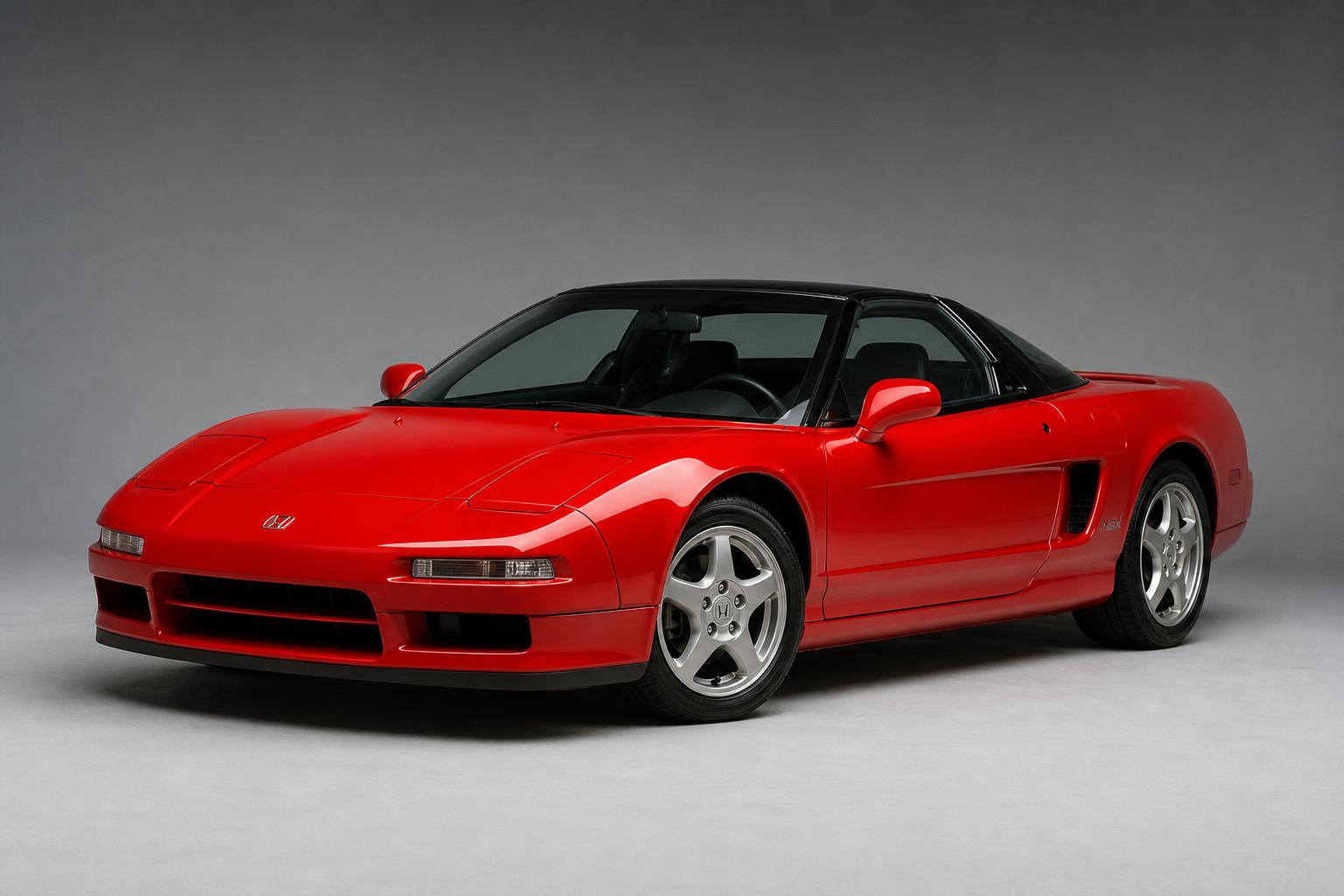
Launched in 1990 after a development programme led by Honda chief engineer Shigeru Uehara and famously sharpened by Ayrton Senna at Suzuka and the Nürburgring, the NSX (sold as the Acura NSX in North America) was the first production car with an all-aluminium monocoque chassis and body. Power came from a mid-mounted, transversely-installed 3.0-litre VTEC V6 producing 270 hp, mated to either a five-speed manual or a four-speed automatic. The targa-roofed NSX-T joined the range in 1995, and a comprehensive update in 2002 brought fixed headlamps, larger 17/18-inch wheels and a 3.2-litre engine on manual cars.
The NSX was designed to deliver supercar performance with the reliability, ergonomics and daily usability of a Honda. It achieved that, and in doing so set a new benchmark that contemporary rivals from Ferrari and Lamborghini were measured against for the rest of the decade. Production ended in 2005 after roughly 18,000 cars across fifteen model years.
The original NSX is now widely regarded as one of the most historically significant supercars of the modern era: the first to combine usable everyday character with genuine mid-engine dynamics, and the catalyst for a generational rethink of how supercars should drive. As the last hand-built car from Honda's Tochigi facility and the only mainstream supercar designed around an aluminium monocoque in its decade, it occupies a position no rival can replicate.