
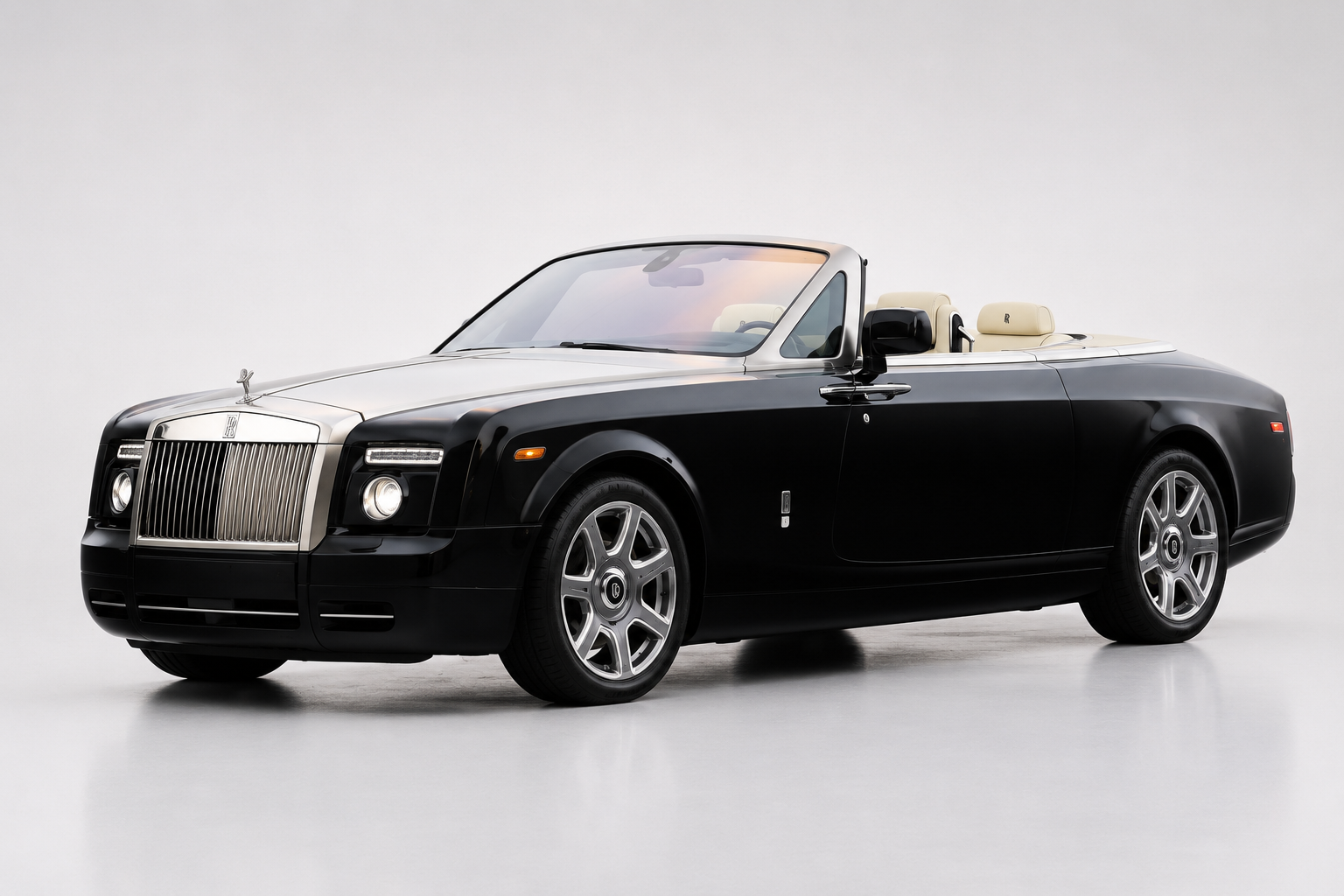
This guide covers the four separately-numbered Phantom generations that ran, without direct commercial overlap, from 1950 to 2017: the coachbuilt straight-eight Phantom IV (1950–1956, 18 chassis built), the V8-powered Phantom V (1959–1968, 516 or 518 built — see sourcing note) and its Phantom VI successor (1968–1990/91, 374 built) — the last body-on-frame Rolls-Royces to leave Crewe — and the BMW-era Phantom VII (2003–2017, 10,327 delivered) built at the purpose-built Goodwood plant. The 1998–2002 hiatus between Phantom VI and VII coincided with the Volkswagen/BMW split of Rolls-Royce and Bentley; there was no Phantom in production during those years.
Sourcing note: production figures are drawn from the most authoritative sources actually fetched for this review. Phantom IV — 18 chassis per the Wikipedia infobox and chassis-by-chassis table (citing Bennett, Rolls-Royce & Bentley: The Crewe Years, 3rd ed. 2011). Phantom V — Verify, genuinely unresolved between two independently-supported totals with a 22-unit gap on the largest coachbuilder category.
Camp A (518, Dalton breakdown): Wikipedia infobox and body text state 518, citing Dalton, Rolls-Royce: The Elegance Continues (Dalton Watson Fine Books, 2005, p. 258, ISBN 1-85443-208-7). Breakdown: James Young 197 / Mulliner Park Ward 174 / Park Ward 133 / H.J. Mulliner 9 / Other (Hooper, Chapron, Woodall Nicholson) 5.
Camp B (516, Coachbuild/Powerhouse breakdown): The Powerhouse Museum object record for chassis 5VD81 (collection.powerhouse.com.au object 212035, curator Margaret Simpson) states 516 total and Mulliner Park Ward 152, and explicitly credits 'chassis, body and test cards from Rolls-Royce Ltd, Crewe, provided by David Davis, Trustee, Sir Henry Royce Foundation, Australia, 2012' as its source — i.e. factory build records, not a secondary monograph. Coachbuild.com's James Young Rolls-Royce Phantom V Limousine encyclopedia entry (live URL 404 as of this review; recovered from Wayback Machine snapshot 2022-05-25 at web.archive.org/web/20220525035749/https://coachbuild.com/index.php/encyclopedia/coachbuilders-models/item/james-young-rolls-royce-phantom-v-limousine) states verbatim: 'The series achieved overall production of 516 examples between 1959 and 1968. Park Ward, now fully owned by Rolls-Royce, made 156 bodies. In 1962, H.J. Mulliner and Park ward were merged by Rolls-Royce, forming Mulliner-Park Ward. A number of 152 bodies were built by this new entity. Prior to the merger, only eight Phantom Vs were made by H.J. Mulliner. As a moderately successful independent company James Young maintained themselves with 195 bodies.' That gives 195 + 156 + 152 + 8 = 511, with the residual 5 attributable to Hooper, Chapron and Woodall Nicholson — arithmetically consistent with the Powerhouse Museum's 516 total. Classic Cars Fandom Wiki independently states 516 (uncited).
832 outlier — repeated, not one-off: The figure of 832 Phantom Vs appears on Hagerty's own valuation-tool page (hagerty.com/valuation-tools/rolls~royce/phantom_v/1968/1968-rolls~royce-phantom_v-hj_mulliner: 'A total of 832 Phantom V examples were built in 10 years') and in an RM Sotheby's Auburn Fall 2020 lot description (r0130). It is contradicted by every other source retrieved (Wikipedia, Powerhouse Museum, Coachbuild.com, Classic Cars Wiki) and is not treated as a credible third total, but its appearance on Hagerty means it should be recognised as a repeated error propagating across at least two reputable industry sources rather than dismissed as a one-off catalogue typo. Buyers relying on Hagerty valuation pages should be aware the model overview text is materially wrong on this figure.
RM Sotheby's separately cites 217 James Young cars in two independent lot descriptions (Auburn Fall 2020 r0130; Driving into Summer 2020 r0009); this contradicts both Dalton (197) and Coachbuild (195) and is uncited. The 2-unit gap between 516 and 518, the 22-unit gap on Mulliner Park Ward (152 vs 174), and the ~20-unit gap on James Young (195/197 vs 217) cannot be resolved from public sources; the RREC members-only chassis register is the definitive arbiter. All figures and their sources are shown in the variants list below. Phantom VI — 374 per Wikipedia (citing rrsilverspirit.com), corroborated by RM Sotheby's Auburn Fall 2019 catalogue for chassis PRH4578; ConceptCarz implies 372 via a different derivation (890 combined V+VI − 518 V = 372) and this two-car discrepancy is flagged as Verify. Phantom VII — 10,327 deliveries 2003 through end-of-production January 2017, per the Wikipedia production table drawn from BMW Group annual reports; per-body-style lifetime splits (SWB vs. EWB vs. Coupé vs. Drophead) are not published in any source retrieved and are not asserted here.
The Phantom line is the top-of-marque Rolls-Royce across seven decades. The IV, V and VI are the last true coachbuilt Rolls-Royces — chassis delivered from Crewe, bodied by H.J. Mulliner, Park Ward, Mulliner Park Ward, James Young, Hooper, Franay and (once) Henri Chapron. The VII is the BMW-era ground-up reset that saved the Phantom nameplate. Collectively they define the ceremonial and state-car category from the post-war reconstruction era to the pre-electric present.