Modern Classic · 1993–2002

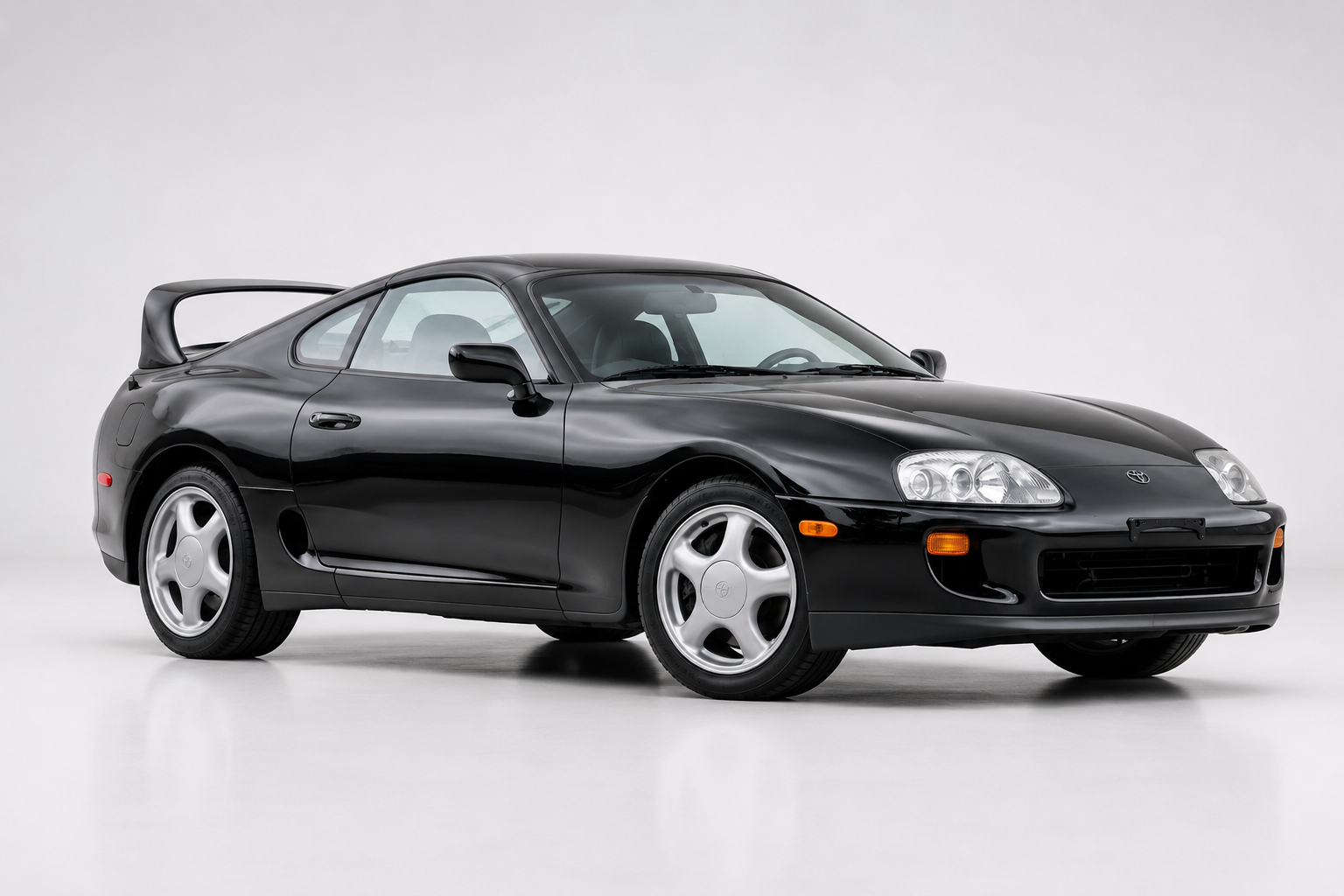
Toyota Supra (A80)

The 2JZ-GTE coupe that became the defining Japanese performance car of its generation.

CoupeSport Roof (targa)
Car Collector International Editorial
Toyota Supra (A80)
Overview

Why this car matters

Launched in May 1993 and produced until August 2002, the fourth-generation Toyota Supra — internally A80, commonly Mk IV — was Toyota's flagship sports coupe and the technical halo for the company's late-1990s performance programme. Built on a shortened, stiffened version of the Aristo / Lexus GS platform, it paired a 3.0-litre inline-six with double-wishbone suspension at all four corners and, on the top variant, sequential twin turbochargers from Hitachi. In Japanese-market RZ trim the twin-turbo 2JZ-GTE was officially rated at 280 PS, the limit of the Japanese gentlemen's agreement; export cars were re-rated and ran higher boost, producing 320 hp in US and European specification.

Production split into the naturally-aspirated SZ and SZ-R (2JZ-GE, ~220 hp) and the twin-turbo RZ / Turbo (2JZ-GTE). A six-speed Getrag V160 manual was offered with the turbo car — a gearbox now widely regarded as one of the strongest fitted to a road car of its era — alongside a four-speed automatic. The Sport Roof, a removable targa-style roof panel, was offered in most markets and is now the most desirable body configuration. Export to the United States ended after the 1998 model year; production for Japan continued until 2002.

The A80 is the moment Japanese performance engineering caught up with — and in raw capability often overtook — its European peers, and it did so with a powertrain whose long-term reputation has become almost mythological. The cast-iron 2JZ-GTE block, closed-deck construction and forged rotating assembly are routinely cited as the reason a stock bottom end can absorb power outputs well beyond the factory rating. For a generation of buyers introduced to the car through motorsport, period magazine tests and later popular culture, the A80 is the defining 1990s Japanese GT. For collectors, original twin-turbo six-speed cars with documented history and unmodified drivetrains now sit clearly inside the modern-classic blue-chip set.

Variants

Range and production

VariantYearsProductionNotes
SZ (NA, JDM)1993–2002Naturally-aspirated 2JZ-GE, ~220 PS; Japan only. Entry-level A80.
SZ-R (NA, JDM)1994–2002SZ chassis with six-speed Getrag manual and uprated suspension; Japan only.
RZ / RZ-S (Turbo, JDM)1993–2002Twin-turbo 2JZ-GTE; 280 PS gentlemen's-agreement rating. Getrag V160 6-speed or 4-speed auto.
Turbo (US)1993–19982JZ-GTE rated 320 hp / 315 lb-ft; Getrag V160 6-speed or 4-speed auto. Sport Roof optional.
Non-Turbo (US)1993–19982JZ-GE rated 220 hp; W58 5-speed manual or 4-speed auto.
Turbo (Europe)1993–1996European-spec 2JZ-GTE; small volumes — UK official imports particularly scarce.
15th Anniversary2002Japan-market run-out edition marking the end of A80 production.
Buyer's Guide

What to look for

Originality is the whole story

More than almost any other modern classic, A80 values turn on how original the car is. A stock, unmodified twin-turbo six-speed with a documented chain of ownership is in a different market to an outwardly similar car that has been mapped, had its turbos replaced, or run a single-turbo conversion. Insist on factory ECU, factory turbos, factory exhaust manifolds, factory intercooler piping and unmolested wiring. Returning a heavily modified car to stock is expensive and rarely complete.

Body, paint and corrosion

Inspect the rear arches, sills, tailgate lower edge and the seams around the fuel filler. Cars that have lived in salt-belt climates can show bubbling along the arch lips and inside the boot floor. Check panel gaps around the front bumper and bonnet — accident-repaired cars are common and the giveaway is usually shut-line consistency and paint depth. Sport Roof cars should be cycled fully and checked for water staining in the rear footwells.

Variant strategy

Manual twin-turbo cars — US 1993–1998 Turbo, JDM RZ, and the very small number of European Turbos — define the top of the market. Sport Roof bodies command a clear premium over fixed-roof coupes. Automatic turbo cars and naturally-aspirated coupes are the most accessible entry points and have appreciated more slowly. The JDM SZ-R is interesting on its merits: NA driveline with the six-speed gearbox.

The pre-purchase inspection

A specialist PPI is essential. Budget £500–£900 ($650–$1,200) with a recognised Toyota or Japanese-performance independent. The inspection should include a compression and leak-down test, a boost-leak test on turbo cars, a full underbody photograph set, an ECU read for stored codes, and an explicit check that the turbos, intercooler piping, exhaust manifold and ECU are factory parts. Confirm gearbox identity (V160 stamping) on cars sold as Turbo manuals.

Pricing

What to pay

Project / modified, NA auto
USD$25,000 – $45,000
GBP£18,000 – £32,000
EUR€22,000 – €38,000
Higher-mileage automatics, modified or accident-repaired cars, incomplete history.
Good driver (NA manual / Turbo auto)
USD$50,000 – $90,000
GBP£35,000 – £65,000
EUR€42,000 – €78,000
Honest unmodified NA manuals and well-kept turbo automatics with continuous history.
Excellent Turbo 6-speed
USD$110,000 – $185,000
GBP£80,000 – £140,000
EUR€95,000 – €165,000
Original twin-turbo manuals, sub-80k miles, factory drivetrain, documented service history.
Low-mile / Sport Roof / JDM RZ
USD$185,000 – $300,000
GBP£140,000 – £225,000
EUR€165,000 – €270,000
Sub-30k mile turbo manuals, desirable colours, Sport Roof, factory-stock JDM RZ examples.
Auction outliers (concours / sub-10k mile)
USD$300,000 – $675,000+
GBP£225,000 – £510,000+
EUR€270,000 – €600,000+
Time-capsule cars. A 7-mile 1994 Turbo sold for $675,000 at Mecum Indianapolis in May 2025.

Regional ranges authored independently — each reflects its local market, not an FX conversion

Ownership

Living with it

Typical mileage
3,000–6,000 miles typical
Service interval
12 months / 6,000 miles minor; 36 months / 30,000 miles major
Annual running cost
$2,500 – $5,500 (excluding tyres and any deferred maintenance)
Fuel economy
18–22 mpg combined (Turbo, manual)
Insurance
Agreed-value policies from Hagerty, Adrian Flux or Lockton commonly run $900–$2,200/yr on a $140k Turbo with limited mileage and secure storage.

Drivetrain longevity

The 2JZ-GE and 2JZ-GTE are widely regarded as among the most durable production sixes built. Stock bottom-end failure on an unmodified car is rare; the more common ownership issues are ancillary — coolant hoses, turbo oil feed and return lines, vacuum hoses, and the rubber boost-control plumbing. A comprehensive hose and seal refresh once in the ownership cycle is normal preventive practice.

Storage and exercise

Climate-controlled storage materially extends paint, interior and rubber life on cars now thirty years old. Plan for monthly fluid-circulation drives and a battery conditioner during winter. See recommended storage providers below.

Common Problems

Known issues by system

Engine — Vacuum and boost plumbing

Original rubber vacuum and boost-control hoses perish

Moderate$400 – $1,200 (full refresh with quality silicone or OEM)
Symptoms — Sequential turbo transition rough or non-existent; boost spikes or holds low; check-engine light.
Inspection — Inspect every rubber hose under the intake manifold; expect age cracking on unrefreshed cars.
Engine — Sequential turbo system

Failure of the sequential changeover (single → twin turbo mode)

Major$600 – $2,500 to diagnose and refresh the system
Symptoms — Sudden boost drop around 4,000 rpm; whistling from the engine bay; intermittent fault codes.
Inspection — Verify smooth boost transition on a road test; check all VSV solenoids and actuator hoses.
Engine — Turbochargers

Original CT12B/CT20B turbocharger wear

Major$3,500 – $7,500 (OEM rebuilt pair, fitted)
Symptoms — Blue smoke under load, oil consumption, shaft play, reduced boost.
Inspection — Visual check of compressor wheels and shaft; oil analysis if available.
Drivetrain — Clutch (Turbo manual)

Original twin-plate clutch wear

Moderate$2,200 – $4,500 (OEM-spec replacement, fitted)
Symptoms — Slipping under load above 3,500 rpm; juddery take-up; high biting point.
Inspection — Test for slip in 3rd or 4th gear under full throttle at 3,000 rpm.
Body — Rear arches and sills

Corrosion on cars run in salt climates

Moderate$1,500 – $6,000 depending on extent
Symptoms — Bubbling at the arch lips, blistering along the sill seam, rust on the tailgate lower edge.
Inspection — Magnet and paint-depth gauge on arches, sills and tailgate; lift the car for an underside check.
Electrical — Targa roof leaks (Sport Roof)

Aged roof seal allows water into the rear footwells

Moderate$300 – $1,200 for seal replacement and trim refresh
Symptoms — Damp carpets, musty smell, intermittent rear electrical faults.
Inspection — Lift the rear carpets; cycle the roof and inspect the seal for compression set.
Interior — Dashboard and trim

UV-related dashboard cracking and headlining sag

Minor$400 – $1,800 for refurbishment or replacement
Symptoms — Cracks along the top of the dashboard; drooping headliner; faded centre-console plastics.
Inspection — Direct visual; lift the sun-visors to check the headlining edge.
Suspension — Bushes and dampers

Age-related wear in original bushes and OE dampers

Minor$1,200 – $3,000 for a full corner refresh
Symptoms — Vague steering on-centre, uneven tyre wear, knocking over expansion joints.
Inspection — Lift the car; check each bush by hand; look for damper weep.
Valuation

Current value bands by region

Concours
USD
$215,000
GBP
£165,000
EUR
€195,000
+1% 12-mo
Excellent
USD
$135,000
GBP
£105,000
EUR
€122,000
+2% 12-mo
Good
USD
$82,000
GBP
£62,000
EUR
€74,000
0% 12-mo
Fair
USD
$52,000
GBP
£38,000
EUR
€46,000
-2% 12-mo
Project
USD
$32,000
GBP
£22,000
EUR
€28,000
-3% 12-mo

Each region quoted in its local currency — independent market readings, not FX conversions

The A80 Supra repriced dramatically between 2018 and 2022, when original-spec twin-turbo manual cars moved from sub-$60,000 to consistent six-figure trades. Through 2024 and 2025 that market matured rather than corrected: ordinary-spec automatic and modified cars softened, while unmodified, low-mileage twin-turbo six-speeds continued to set strong public results. Hagerty's price guide places a #2-condition US Turbo manual close to $140,000 in late 2025, with concours cars trading meaningfully above.

The top of the market is now defined by single auction outliers. A 7-mile 1994 Turbo sold at Mecum Indianapolis in May 2025 for $675,000, the highest publicly recorded price for a road-going A80 and a clear statement that time-capsule examples sit in their own segment. Sport Roof bodies, manual transmissions, factory paint codes and an unbroken chain of stock drivetrain components are the four variables that move a car between bands.

Auctions

Recent results

DateAuctionCarMileageResult
2025-05-16
Mecum Auctions
Indianapolis 2025
1994 Turbo (6-speed, Sport Roof)
Effectively delivery-mileage; one of the highest publicly recorded A80 results.
7 mi
$675,000
Sold
2025-01-18
Bring a Trailer
Online (Jan 2025)
1997 Turbo (6-speed)
Renaissance Red over tan; documented history, factory drivetrain.
31,500 mi
$185,000
Sold
2024-08-15
RM Sotheby's
Monterey 2024
1994 Turbo (6-speed, Sport Roof)
9,400 mi
$352,000
Sold
2024-06-28
Bring a Trailer
Online (Jun 2024)
1996 Turbo (auto)
44,000 mi
$96,500
Sold
2024-03-09
Bonhams
Amelia Island 2024
1995 Turbo (6-speed)
$148,400
Sold
Investment

Long-term outlook

Strong HoldHorizon: 5–10 years

The A80 has completed the transition from used-car-market modified-tuner staple to documented modern classic. The collector population — buyers who experienced the car as new or as a halo machine in the late 1990s — is now at peak purchasing age, and supply of original, unmodified twin-turbo six-speed cars is structurally limited because so many were modified during the cheap years.

Downside risk is concentrated in automatic and modified examples, which trade more like used performance cars than collectibles. Upside is concentrated in low-mileage Sport Roof manual Turbos and in stock JDM RZ cars. Sustained appreciation depends less on macro speculation than on the simple fact that the supply of factory-original cars cannot increase.

Recommended

The trusted network

Specialists

  • Toyota Supra Specialists
    United Kingdom
    A80-focused servicing, PPIs and OE parts sourcing.
  • Driftworks
    View →
    Yorkshire, UK
    Japanese performance specialist; A80 servicing and inspection.
  • Real Street Performance
    View →
    Sanford, FL
    Long-established 2JZ engine builder and Supra specialist.
  • Titan Motorsports
    View →
    Orlando, FL
    OEM-spec A80 service, drivetrain rebuilds and concours preparation.
  • Toysport
    Costa Mesa, CA
    Authorised Toyota performance specialist; long A80 history.

Storage

  • Windrush Car Storage
    View →
    Cotswolds, UK
    Benchmark UK collection facility; climate-controlled, fully insured.
  • Autovault
    View →
    Bicester, UK
    Climate-controlled storage at Bicester Heritage.
  • Classic Car Club Manhattan
    View →
    New York, NY
    Secure indoor storage for US East Coast owners.

Transport

  • Reliable Carriers
    View →
    USA (national)
    Enclosed coast-to-coast transport.
  • CARS UK
    View →
    UK & Europe
    Enclosed event and concours transport.
  • FERRLOG
    View →
    Italy / Europe
    Air-ride enclosed transport across the EU.

Own a Toyota Supra (A80)?

Join Car Collector International's owners register for valuation updates, auction alerts and members-only events.

Register interest