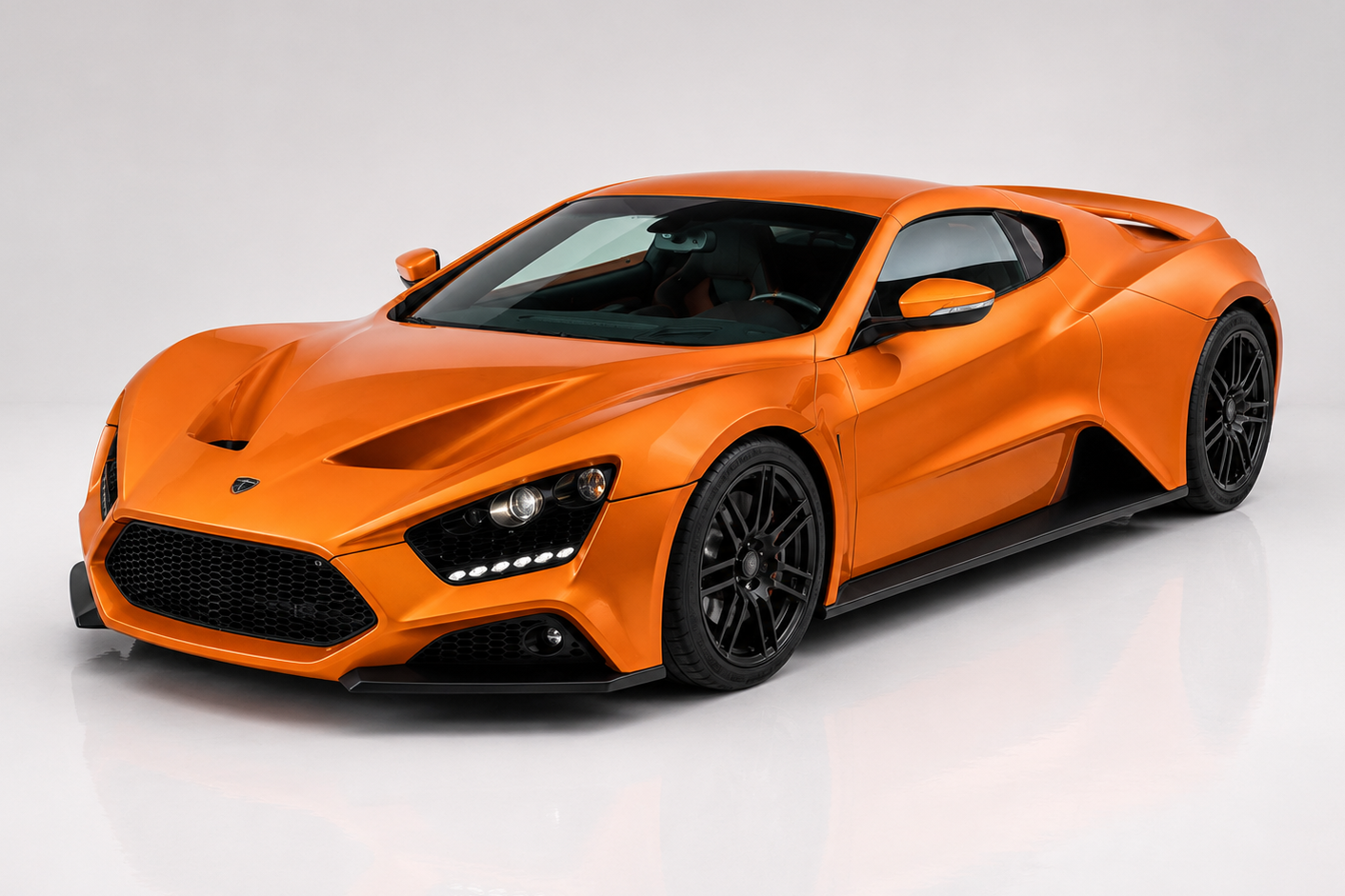
Denmark's first hand-built hypercar — Zenvo Automotive's ST1, produced in a factory-declared total of 15 cars from 2009 to 2016 with a twin-charged 6.8-litre V8, GM-derived architecture extensively developed by Zenvo, and the three-unit ST1 50S North American special edition at ~1,250 PS / ~1,233 bhp with ~1,500 Nm.
The Zenvo ST1 was Denmark's first hand-built hypercar and the launch product of Zenvo Automotive, based in Præstø. Fifteen cars in total were built across the entire ST1 programme between 2009 and 2016. At its core is a twin-charged 6.8-litre (6,800 cc) V8, GM-derived architecture extensively developed by Zenvo, supercharged and turbocharged in the definitive configuration, mid-mounted longitudinally in a carbon-fibre composite body on a lightweight steel/aluminium monocoque with steel front and rear subframes. The car was offered with either a six-speed manual or a seven-speed automated-manual paddle-shift gearbox; rear-wheel drive. Headline output evolved through the programme — commonly cited around ~1,089 bhp / ~1,104 PS on the standard car with torque up to 1,430 Nm / 1,055 lb-ft — and reached ~1,250 PS / ~1,233 bhp with ~1,500 Nm on the three-unit ST1 50S, announced in November 2011 as a North American special edition distributed by Red Sea Distribution. Zenvo built the car with a direct factory-support ownership model, engaged owners as programme participants rather than dealership customers, and continued to rectify and deliver final-specification cars through and after highly-publicised 2014 and 2015 fire incidents during UK television and Copenhagen press appearances. The ST1 is now one of the smallest-production European hypercars of its era, thinly traded on a private-treaty basis and effectively unseen at public auction.
The ST1 matters as the founding product of Zenvo Automotive and, on its own factory-declared 15-car build, as one of the smallest-production European hypercars of the post-2000 hand-built hypercar era. Three things underwrite its historic significance. First, national significance: it is the first road-going hypercar developed and manufactured in Denmark, and it established Zenvo as the standing Danish entry in a hypercar segment otherwise dominated by Italy, Germany, the UK and the United States. Second, engineering approach: the twin-charged 6.8-litre V8, GM-derived architecture extensively developed by Zenvo — supercharged and turbocharged in its definitive configuration — with over 1,100 PS on the standard car and ~1,250 PS on the ST1 50S is a genuinely bespoke powertrain rather than a re-badged mainstream OEM engine, and the car sits on a bespoke steel-and-aluminium chassis architecture with a carbon-composite body. Third, programme character: the ST1 was built as a direct owner-engaged, factory-supported product, with Zenvo continuing to develop, rectify and deliver final-specification cars through the ST1's most public setbacks — the 2014 UK television shakedown fire and the 2015 Copenhagen track-event fire — and delivering a discrete three-unit North American special edition. Fifteen cars, three of which are the final edition, is genuinely low-volume by any standard of European hand-built hypercar production of the period.
Variants
Range and production
Variant
Years
Production
Notes
ST1 (base) and ST1 Special Edition — 2009–2015
2009–2015
Not separately recorded
Base and Special Edition cars within the 15-car total ST1 programme. Twin-charged 6.8-litre (6,800 cc) V8, GM-derived architecture extensively developed by Zenvo — supercharged and, in the definitive configuration, turbocharged — mid-mounted RWD. Power output evolved across the run; commonly cited around ~1,089 bhp / ~1,104 PS on the standard specification with torque up to 1,430 Nm / 1,055 lb-ft. offered with either a six-speed manual or a seven-speed automated-manual paddle-shift gearbox; rear-wheel drive. Split between base and Special Edition within the 12-car non-50S remainder is not precisely published in the public record and is treated here as unresolved; total ST1 programme build is the standing 15-car figure with 3 cars allocated to the 50S final edition.
ST1 50S — 3-unit North American special edition, 2011– (collector-variant anchor)
2011–
Not separately recorded
Three cars only, at top-of-programme specification. ~1,250 PS / ~1,233 bhp and ~1,500 Nm on the twin-charged 6.8-litre (6,800 cc) V8, GM-derived architecture extensively developed by Zenvo, offered with either a six-speed manual or a seven-speed automated-manual paddle-shift gearbox; rear-wheel drive. Announced in November 2011 as a North American special edition distributed by Red Sea Distribution, with distinct 50S-specific bodywork detail, wheels and interior trim. Anchor collector variant of the ST1 programme; provenance rests on Zenvo factory build documentation for the specific chassis number and the 50S's discrete 3-unit factory-declared allocation.
Collector Variants
Limited & special editions
The models below represent the most significant limited and special edition variants — factory-produced cars that command meaningful premiums over standard examples and warrant specific attention from serious collectors.
Zenvo ST1 50S · 2011–
3 (North American special edition distributed by Red Sea Distribution; within a total ST1 build of 15 cars)
Distinguishing features
Top-of-programme specification on the twin-charged 6.8-litre V8, GM-derived architecture extensively developed by Zenvo, at ~1,250 PS / ~1,233 bhp with ~1,500 Nm; offered with either a six-speed manual or a seven-speed automated-manual paddle-shift gearbox; RWD. Distinct 50S-specific bodywork detail, wheels and interior trim. Denmark's founding-marque hypercar in its lowest-volume and highest-specification form.
Value premium
Materially above base and ST1 Special Edition chassis on rarity and specification; anchors the top of the ST1 model on the strength of the discrete three-unit factory-declared allocation. Effectively no public secondary-market history exists — pricing is a Zenvo factory-mediated private-treaty exercise.
Inspection points
Zenvo Automotive factory build-record correspondence confirming allocation within the three-unit 50S final-edition run; complete Zenvo-mediated service history; documented completion of post-2014 rectification-programme thermal-management specification as delivered; twin-charger system integrity; automated-manual gearbox actuator and control-system function.
Authentication
The definitive authentication axis is direct Zenvo Automotive factory correspondence for the specific chassis number confirming ST1 50S allocation. On a 15-car total ST1 build with a 3-unit final-edition allocation, the factory build record is the single reference; badging, wheels or bodywork detail alone are not proof of ST1 50S specification. Any car represented as ST1 50S without direct Zenvo factory correspondence must be treated as unresolved on provenance until confirmed.
Buyer's Guide
What to look for
Zenvo factory documentation and chassis-number correspondence
The primary authentication axis for any Zenvo ST1 is direct Zenvo Automotive factory build documentation for the specific chassis number, and — on any car represented as ST1 50S — factory correspondence confirming allocation within the three-unit 50S final-edition run. On a model with a 15-car total build, the factory build record is the reference for specification (base ST1, ST1 Special Edition, ST1 50S), engine calibration, gearbox generation, bodywork detail and interior trim. Require the full factory build record and, where available, complete original delivery paperwork before proceeding.
Twin-charged V8 — supercharger, turbocharger, cooling and calibration
The 6.8-litre (6,800 cc) V8 is GM-derived architecture extensively developed by Zenvo and twin-charged in the definitive configuration, but its supercharger, turbocharger, intercooler system, cooling capacity and engine calibration are all Zenvo-specific rather than shared with a mainstream OEM. Documented Zenvo-mediated engine service is the standing reference — the car does not have a broad independent specialist network of any depth, and any period of non-Zenvo-supported service on a car represented at reference tier is a specific paperwork item. Verify supercharger drive, turbocharger condition, intercooler routing integrity, coolant capacity function under load, and factory ECU calibration.
2014–2015 rectification programme — cars delivered after and cars delivered before
Following fire incidents during a 2014 UK television shakedown and a 2015 Copenhagen track event, Zenvo addressed the underlying engine-bay and thermal-management causes and continued delivering final-specification cars — most notably the ST1 50S final edition in 2016. On any pre-2014 chassis, verify that the post-2014 rectification programme was applied at the factory and documented in the build record; on any post-2014 chassis, the definitive-specification thermal-management and engine-bay layout should be present as delivered. Post-rectification specification is the reference; a pre-2014 chassis without a documented Zenvo-mediated rectification programme in the file is a specific PPI item.
Transmission — early manual, later automated manual
Early ST1 cars were delivered with a six-speed manual gearbox; later cars — including the ST1 50S — used a seven-speed automated manual. Verify gearbox specification against the factory build record, confirm shift quality and clutch condition on the manual cars, and on the automated-manual cars confirm the hydraulic actuator and control-system function through a range of shift modes. Any evidence of non-factory transmission intervention on either generation is a specific paperwork item.
Carbon body and steel-spaceframe / aluminium-subframe chassis
The ST1 uses a lightweight steel/aluminium monocoque with steel front and rear subframes carrying a carbon-fibre composite body. Inspect for prior repair to the composite panels (lay-up quality, gel-coat consistency, colour-match integrity), any evidence of chassis-tube repair or straightening on the spaceframe, and integrity of the aluminium subframes at the suspension pickup points. Any prior structural repair must be reconciled against factory correspondence and independent expert inspection.
Interior electronics, HVAC and infotainment
Interior electronics on hand-built low-volume hypercars typically use a mix of OEM sub-systems (climate, audio, dashboard modules) integrated with bespoke Zenvo-specific control logic. Verify climate control, dashboard warning-lamp function, audio system, seat memory (where fitted), interior lighting and window function individually at PPI. Component sourcing on a bespoke low-volume car is a specialist exercise and any documented interior-electronics work should be reconciled to Zenvo-mediated service history.
Wheels, tyres, brakes and ride-height / geometry
Verify factory wheel specification, tyre age and specification correspondence, brake-disc and pad condition (with attention to disc-hat corrosion on a low-mileage car), and factory geometry / ride-height set-up. The ST1's suspension geometry and ride-height was set at the factory to model-specific specification; any evidence of aftermarket suspension modification or non-factory geometry is a documented reversion item and should be priced accordingly.
PPI on any Zenvo ST1 must involve direct Zenvo Automotive factory correspondence for the specific chassis. A generalist supercar workshop, however experienced with other European hypercars, is not the reference channel on a model with a 15-car total build and a Zenvo-specific twin-charged V8. Insist on: Zenvo factory build-record correspondence; documented service history through Zenvo or a Zenvo-approved specialist; independent expert inspection of composite bodywork, spaceframe and subframes; and diagnostic-scan and cold/hot function verification of the twin-charged V8 and gearbox.
Insurance, storage and event access
The ST1 underwrites as a bespoke low-volume hypercar risk requiring specialist agreed-value cover, with underwriting bands that reflect a 15-car total build and a Zenvo-specific parts, calibration and factory-labour rate structure. Climate-controlled storage is the standing reference. Event access includes European hypercar concours and manufacturer-supported gatherings — the ST1's very low unit count makes any concours or invitational gathering appearance a distinct provenance-enhancing event.
Ownership
Living with it
Typical mileage
200–1,500 miles / 320–2,400 km typical — the ST1 is a low-use hand-built hypercar with a very low expected annual mileage across owners.
Service interval
Annual service through Zenvo Automotive direct or a Zenvo-approved specialist; interval typically factory-mediated on a per-chassis basis rather than fixed distance.
Annual running cost
USD $15,000 – $50,000+ typical for a Zenvo-mediated annual service programme; higher on any chassis requiring engine-bay, twin-charger, or thermal-management rectification.
Fuel economy
Very low fuel economy under load reflecting a 1,100+ PS twin-charged 6.8-litre V8; economy on high-mileage use is not a material ownership consideration on this car.
Insurance
Specialist agreed-value hypercar cover required; underwriting bands reflect a 15-car total build, Zenvo-specific parts availability and factory-labour rate structure. ST1 50S underwrites at a distinct higher tier reflecting the three-unit factory-declared final-edition run.
Zenvo factory direct — the reference service channel
Route all major service through Zenvo Automotive direct in Denmark or through a Zenvo-approved specialist. Generalist supercar workshops and non-Zenvo-mediated independent servicing are not the reference channel on a 15-car-total-build model with a bespoke twin-charged 6.8-litre V8, GM-derived architecture extensively developed by Zenvo. Zenvo's direct factory-support ownership model is a defining feature of the car and any period of non-Zenvo-mediated service is a specific paperwork item.
Pre-2014 chassis and the rectification programme
On any pre-2014 chassis, documented completion of Zenvo's post-2014 engine-bay and thermal-management rectification programme is the reference paperwork item. Absence of documented rectification on a pre-2014 chassis represented at reference tier is a specific PPI item.
Component sourcing and long-lead-time parts
On a bespoke low-volume hypercar, major components (twin-charger hardware, gearbox internals, composite body panels, bespoke interior trim) are long-lead-time items sourced through the factory. Owners should plan around Zenvo-mediated component lead times rather than off-the-shelf availability.
Common Problems
Known issues by system
Engine-bay thermal management (pre-2014 chassis)
Pre-2014 chassis were subject to underlying engine-bay and thermal-management issues that were addressed by Zenvo's post-2014 rectification programme. Documented completion of the rectification programme on the specific chassis is the reference; absence of documentation is a specific PPI item.
MajorUSD $30,000 – $150,000+ for Zenvo-mediated rectification-programme completion depending on chassis status and componentry required.
Symptoms — Elevated engine-bay temperatures on cold-to-hot cycling; thermal-imaged hotspots on inspection; absence of definitive-specification thermal-management components; incomplete Zenvo build-record documentation of the rectification programme.
Inspection — Zenvo factory build-record review; specialist thermal-imaging inspection of engine bay; verification of definitive-specification thermal-management componentry on the chassis.
Twin-charger system — supercharger drive, turbocharger, intercooler routing
The twin-charged 6.8-litre (6,800 cc) V8, GM-derived architecture extensively developed by Zenvo uses both a supercharger and a turbocharger in the definitive configuration. Each is a Zenvo-specific service item; supercharger drive belts, turbocharger shaft condition, wastegate function and intercooler routing are the standing preventative-service surfaces.
MajorUSD $15,000 – $60,000+ for a Zenvo-mediated twin-charger service and boost-system refresh depending on componentry required.
Symptoms — Loss of full-boost power output; supercharger drive-belt wear or slip on inspection; excessive turbocharger shaft play; intercooler pipework loose, oily or leaking; stored engine-management diagnostic codes referencing boost or knock.
Inspection — Diagnostic scan at PPI; supercharger drive-belt inspection; turbocharger shaft-play check; visual inspection of intercooler and boost-control hardware; documented Zenvo-mediated service history review.
Automated-manual gearbox — actuator, control system, clutch
Later ST1 cars use a seven-speed automated manual with a hydraulic actuator and dedicated control system. Actuator wear, hydraulic-system integrity and clutch condition are the standing service items on higher-use chassis.
ModerateUSD $10,000 – $40,000 for a Zenvo-mediated actuator, control-system and clutch service.
Symptoms — Slow or inconsistent shift quality; audible actuator function on shifts; hydraulic-fluid evidence in the gearbox area; clutch bite-point drift; stored gearbox-controller diagnostic codes.
Inspection — Cold and hot shift-quality verification at PPI; actuator function inspection; documented service history review; Zenvo diagnostic scan.
Composite bodywork and paint integrity
Composite bodywork on hand-built hypercars is susceptible to gel-coat crazing on high-flex areas, colour-match challenges after any repair and lay-up-quality issues on any non-factory panel repair.
ModerateUSD $5,000 – $50,000+ for specialist composite panel repair or replacement depending on extent.
Symptoms — Gel-coat crazing on high-flex composite panels; colour or texture mismatch on any repaired area; visible lay-up irregularities on close inspection; documented body-shop history outside the Zenvo network.
Inspection — Independent expert composite inspection at PPI; documented body-shop history review; ultraviolet paint inspection for repair signatures.
Interior electronics on a bespoke low-volume car
Interior electronics integrate OEM sub-systems (climate, audio, dashboard) with bespoke Zenvo control logic. Component sourcing is long-lead-time and specialist.
MinorUSD $2,000 – $15,000 per subsystem depending on component sourcing and specialist labour.
Symptoms — Intermittent HVAC or audio function; dashboard warning-lamp anomalies; interior lighting or seat function intermittent; documented interior-electronics work outside the Zenvo-approved network.
Inspection — Full interior-electronics function check at PPI; documented service history review; Zenvo diagnostic scan.
Low-annual-mileage low-volume hypercars accumulate long-idle preservation service items: fluid degradation, seal drying, tyre ageing, battery health and rodent-damage risk in non-climate-controlled storage.
ModerateUSD $3,000 – $15,000 for a comprehensive long-idle service including fluids, filters, tyres and battery.
Symptoms — Aged tyres past date code; degraded brake or clutch fluid on inspection; battery replacement history in service file; evidence of long unheated storage.
Inspection — Full underside inspection at PPI; tyre date-code verification; fluid chemistry check; documented storage history review.
Auctions
Recent results
No verified public auction results are currently available for this model. We publish sale figures only from examples we have confirmed against auction house records, and will update this guide as results appear. The Zenvo ST1 does not have a material public auction footprint. On a 15-car total build with a 3-unit final edition, transactions occur on a private-treaty and factory-mediated basis rather than through public auction consignment; there is no headline auction figure to cite. Reference pricing on any specific ST1 chassis must be built from Zenvo Automotive factory build-record correspondence, continuous Zenvo-mediated service history, documented completion of the post-2014 rectification programme on pre-2014 chassis and — on any ST1 50S — factory correspondence confirming allocation within the three-unit final-edition run. Comparable low-volume European hand-built hypercars of the same period are the standing reference for pricing.
Investment
Long-term outlook
Strong HoldHorizon: 10+ years
Three factors underwrite the ST1 investment case. First, absolute rarity: a factory-declared total of 15 cars across the entire ST1 programme, of which three are the ST1 50S final edition, is genuinely low-volume by any standard of European hand-built hypercar production of the period. Second, founder-model provenance: the ST1 is the launch product of Zenvo Automotive and Denmark's first hand-built hypercar, and its historic significance as the founding car of the marque is a distinct and non-replicable provenance line. Third, engineering originality: a twin-charged 6.8-litre (6,800 cc) V8, GM-derived architecture extensively developed by Zenvo with both supercharger and turbocharger, over 1,100 PS on the standard car and ~1,250 PS on the ST1 50S, on a bespoke steel-and-aluminium chassis with a carbon-composite body, is a genuinely bespoke engineering exercise rather than a badge-engineered OEM-based product. Best holds: any matching-factory-build-record ST1 50S; a documented pre-2014 chassis with complete Zenvo-mediated post-2014 rectification-programme correspondence; a post-2014 chassis delivered to definitive specification. Watch items over the horizon: the pace at which Zenvo's continuing model programme (TS1 / TSR-S and successors) elevates the founding ST1 as the historic collector-anchor of the marque; and the pace at which any public auction consignment of an ST1 — currently effectively absent — begins to establish an open-market reference for the model.
Our view, not advice. This section is Car Collector International's editorial judgement on where this model sits in the collector market, based on the production, specification and market data set out in this guide. It is not a recommendation to buy or sell and it is not investment advice. Values can fall as well as rise.