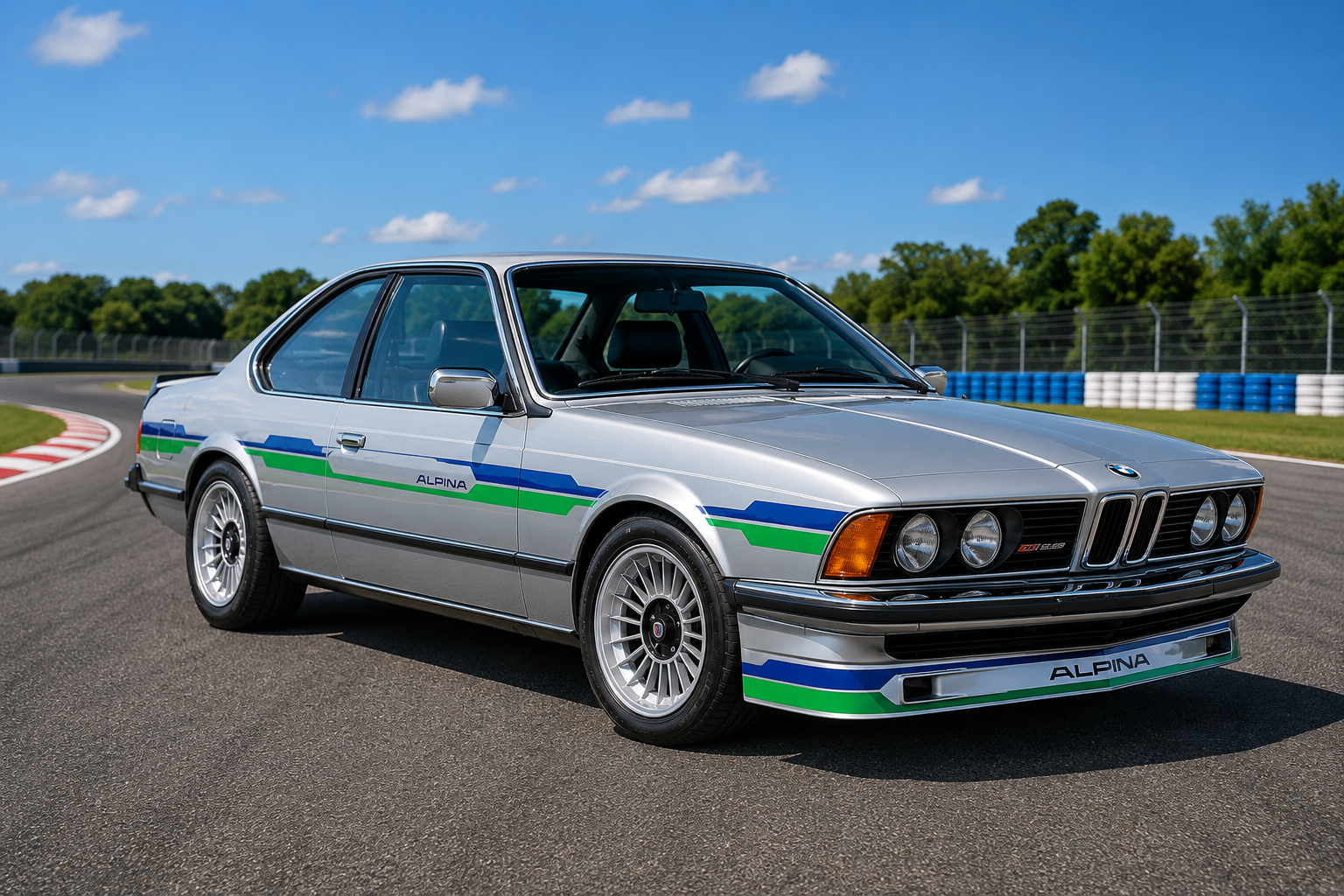
Alpina's turbocharged 6-Series — 153 pre-facelift B7 Turbo Coupés, then the facelifted B7 Turbo Coupé/1 (130 built, of which 20 were Katalysator) — the fastest 6-Series of its era and the connoisseur's alternative to the M635CSi.
The Alpina B7 Turbo Coupé is Alpina's turbocharged reworking of the BMW 6 Series (E24) shark-nose coupé, and remains one of the defining German gentleman's supercars of the late 1970s and 1980s. Introduced in 1978 in parallel with the E12-based B7 Turbo saloon, the E24 B7 Turbo Coupé used BMW's 6-cylinder platform as the base, into which Alpina fitted its own turbocharged engine, revised suspension and brakes, transmission, aerodynamic addenda and unmistakable multi-spoke wheels and side stripes.
Production ran in two visually and mechanically distinct phases within a single Alpina model programme. The pre-facelift B7 Turbo Coupé (1978–1982) used the 3.0-litre M30-based Alpina turbo six developed alongside the saloon programme, in a body still wearing the early-E24 dashboard and interior. Its total production is consistently cited as 153 cars — a figure used verbatim by Bring a Trailer for the 1980 example sold as Lot #42,997 ("#44 of 153 examples built between 1978 and 1982") and by RM Sotheby's Amelia Island 2020 for the 1982 example at Lot 108 ("One of only 153 examples built"). The post-facelift Alpina B7 Turbo Coupé/1 (1984–1988) used the facelifted E24 6-Series shell (revised interior, updated dashboard, later BMW electrics) with a larger, more powerful 3.5-litre Alpina turbo evolution of the M30, in both non-catalyst (B7/1) and catalysed (B7/1 Katalysator) forms. RM Sotheby's Miami 2022 Lot 159 catalogue text gives the definitive framing: "Alpina built 130 B7 Turbo Coupés upon BMW's E24 6 Series chassis, [and] just 20 of those were equipped with catalytic converters and designated the B7 Turbo Coupé/1 Katalysator." The 130 total is therefore the headline figure, with the 20 Katalysator cars counted within it, not additional to it. Alpina-Archive.com's Unofficial BMW Alpina Register independently lists 130 units ("E24 B7 C/1 & /1 Kat, 4/84–6/88, 130 units"), combining non-catalyst and catalyst. Older catalogue references to 110 (RM Sotheby's Miami 2022 Lot 115) or 120 (Bonhams Lot 181) are best read as loose auction-house wording rather than a separate production total.
A short-run high-output variant, the Alpina B7 S Turbo Coupé (1982), was built alongside the pre-facelift Coupé at the end of its production, using a 3.5-litre turbo engine with a stated 330 bhp. Per the Alpina-Archive dedicated model page (alpina-archive.com/Original/e24b7st.html), production of the S Turbo Coupé was limited to just 30 cars — the 30-coupé subset of the wider B7 S Turbo programme, which Wikipedia summarises as 60 cars total across both E24 coupé and E12 saloon body styles. The B7 S Turbo Coupé is therefore the definitive short-run enthusiast variant of the E24 programme and one of the rarest E24-based cars of any period.
Alpina's role at this point was not that of a tuner adding badges to a warm car but of a full factory-in-miniature: cars were sold as Alpinas, not as BMWs, with their own chassis numbering (WAPB7T..), their own type approval, their own build books and their own dealer network in Continental Europe. The B7 Turbo Coupé programme therefore sits in a different category to a Hartge, AC Schnitzer or Hamann-modified 635CSi: it is a factory-built low-volume Alpina, and provenance is documented at Buchloe rather than by a tuner-conversion invoice.
The E24 B7 Turbo Coupé is the Alpina that made Alpina taken seriously as a manufacturer rather than a tuner. Where the M635CSi (BMW's own answer, launched later) went naturally aspirated and high-revving, Alpina committed to forced induction on a longer wheelbase two-door and produced a car with a very different character — huge mid-range torque, five-speed ZF gearbox specifically developed to handle 500 Nm, a smoother and more Continental Grand Touring personality — that in period was the fastest 6-Series available and remains the connoisseur's choice today. Three collector currents underwrite the market: (1) 'youngtimer' German cars broadly, and Youngtimer Collection-provenance examples specifically, which materially outperformed the wider E24 market when they came to auction from 2019 onwards; (2) low-volume, factory-documented turbocharged cars of the 1970s–1980s, a segment that has re-rated hard since 2020; and (3) the direct comparability to the M635CSi, against which a well-documented B7/1 now trades at a substantial premium reflecting both the scarcity and the ZF-manual, Alpina-badge distinctiveness. The 2026 Villa d'Este outing of an Alpina Green E24 B7 S alongside the Vision BMW Alpina concept confirms that BMW itself now treats the E24 B7 as the mid-period model that defines Alpina's design language.
Variants
Range and production
Variant
Years
Production
Notes
B7 Turbo Coupé (pre-facelift) — total production
1978–1982
153
Consensus figure. Used verbatim by Bring a Trailer for Lot #42,997 (1980 car sold 11 February 2021: '#44 of 153 examples built between 1978 and 1982'), by RM Sotheby's Amelia Island 2020 for Lot 108 (1982 car: 'One of only 153 examples built'), and by BMWBlog's 2026 coverage of the Villa d'Este outing ('The 153-unit E24 B7 Turbo'). No single primary Alpina factory ledger for the pre-facelift Coupé alone is in the public record, but the number is consistent across independent auction and press sources.
B7 S Turbo Coupé — total production
1982
30
Sourced. Per the Alpina-Archive dedicated B7S Turbo page (alpina-archive.com/Original/e24b7st.html): 'In May 1982 the limited edition Alpina B7S Turbo Saloon went out of production. In the same month Alpina introduced the second limited edition series, the B7S Turbo Coupé. But this time the production was limited to just 30 cars instead of 60. The Coupé had the same 330 bhp 3.5 litre turbocharged engine and the same gearbox as the saloon.' A definitive short-run variant and one of the rarest E24-based cars of any specification.
B7 Turbo Coupé/1 (post-facelift) — total production
1984–1988
130
Sourced. RM Sotheby's Miami 2022 Lot 159 catalogue text gives the definitive framing: "Alpina built 130 B7 Turbo Coupés upon BMW's E24 6 Series chassis, [and] just 20 of those were equipped with catalytic converters and designated the B7 Turbo Coupé/1 Katalysator." The 20 Katalysator cars are therefore a subset of the 130 total, not additional to it. Alpina-Archive.com / Unofficial BMW Alpina Register lists the 130-unit production run as 'E24 B7 C/1 & /1 Kat, 4/84–6/88' (April 1984–June 1988). The 'Coupé/1' designation followed BMW's E24/1 6-Series facelift from 1982, but the 130-unit production run itself was 1984–1988. Older auction-house references to 110 (RM Sotheby's Miami 2022 Lot 115) or 120 (Bonhams Lot 181) are best read as loose catalogue wording rather than a separate production total.
B7 Turbo Coupé/1 Katalysator — subset of Coupé/1
1986–1988
20
Sourced. Per RM Sotheby's Miami 2022 Lot 159 catalogue text, the 20 Katalysator cars are a subset of the 130 B7 Turbo Coupé/1 total: "just 20 of those were equipped with catalytic converters and designated the B7 Turbo Coupé/1 Katalysator." The catalyst-equipped B7/1 makes 324 bhp against the non-catalyst car's 334 bhp, with a slightly lower compression ratio (7.45:1 vs 8.0:1) and a torque delivery weighted lower in the rev range.
Turbocharger: KKK K27, deliberately specified small to limit lag. Variable boost control 0.6–0.9 bar. Alpina development target of 100 bhp per litre. Zenith-Pierburg DL fuel injection. Lower-compression Mahle pistons. Bilstein gas dampers with progressive front springs and height-adjustable progressive rear springs. Vented discs all round. 16-inch wheels with 205/55 front and 225/50 rear tyres.
Collector Variants
Limited & special editions
The models below represent the most significant limited and special edition variants — factory-produced cars that command meaningful premiums over standard examples and warrant specific attention from serious collectors.
B7 S Turbo Coupé (1982) — 30 built · 1982
30 cars (Alpina-Archive dedicated B7S page, alpina-archive.com/Original/e24b7st.html: 'the production was limited to just 30 cars')
Distinguishing features
A limited-run high-output derivative of the pre-facelift E24 B7 Turbo Coupé introduced in May 1982, running the 3.5-litre Alpina turbo six (nominally 330 bhp, 500 Nm) rather than the standard 3.0-litre; ZF five-speed manual specifically re-worked for the torque; visually differentiated by period-correct Alpina livery specification and specific interior appointments per the S-programme. Sits within the wider B7 S programme alongside the E12-based B7 S Turbo Saloon. One compilation's '60 B7 S Turbos' figure is the combined total of both body styles (30 E24 coupés + 30 E12 saloons); the 30 figure used here refers to the coupé only, and is by production count the rarer of the two S-variants.
Value premium
A material multiple over a standard pre-facelift Coupé in principle; in practice, public throughput is negligible and public price discovery is thin, so the number is private-treaty-derived rather than auction-anchored. Any documented B7 S with continuous Alpina paperwork should transact meaningfully above the €90,000+ / US$100,000+ level typical for Youngtimer-provenance standard Coupés.
Inspection points
Verify the 3.5-litre B7 S engine specification and factory Alpina build documentation directly, not just an S badge or S-look decal set. Cross-reference the chassis number against the Alpina-Archive.com Unofficial BMW Alpina Register and, where possible, against Alpina Buchloe's own historical records.
Authentication
Given only 30 Coupés were built, provenance must be effectively airtight: Alpina order form, delivery certificate, engine and chassis number cross-referenced against the Alpina-Archive.com register, and independent inspection of the specific S-programme mechanical hardware. A car offered as an S without factory documentation should be treated as a standard B7 Turbo Coupé with an S-look specification, not as a confirmed S.
B7 Turbo Coupé/1 Katalysator (1986–1988) — 20 built · 1986–1988
20 cars (RM Sotheby's Miami 2022 Lot 159 catalogue text: 'One of only 20 examples produced with the B7/3 engine featuring a catalytic converter')
Distinguishing features
The catalyst-equipped derivative of the post-facelift B7 Turbo Coupé/1 — a subset of the 130 total Coupé/1 cars, not a separate production run. Uses the B7/3 engine variant — 324 bhp against the non-catalyst car's 334 bhp — with a slightly lower compression ratio (7.45:1 vs 8.0:1) and a torque delivery weighted lower in the rev range (383 lb-ft at 2,400 rpm vs 377 lb-ft at 3,000 rpm). Alpina's first catalysed six, developed to meet emerging emissions requirements in Switzerland and Germany, and typically found on Alpina Buchloe-documented cars delivered new via Max Heidegger AG or the German Alpina dealer network.
Value premium
Trades meaningfully above the non-catalyst Coupé/1 on the basis of scarcity — RM Sotheby's Miami 2022 Lot 159 cleared at US$140,000 against the same sale's non-catalyst Coupé/1 (Lot 115) at US$106,400, a US$33,600 spread with matching Youngtimer provenance across both lots. Well-documented cars should continue to hold this premium.
Inspection points
Verify the B7/3 engine variant, catalyst installation, Alpina-specific management calibration and period documentation directly. Confirm the car has not been de-catted in service — de-catting a Katalysator car is a reversible modification, but the value case for the variant is the factory catalyst specification and its documentation.
Authentication
Cross-reference the chassis and engine numbers against the Alpina-Archive.com Unofficial BMW Alpina Register and the Alpina order form / delivery certificate. Cars delivered new to Switzerland (Max Heidegger AG) or Germany typically carry the fullest documentation set.
Buyer's Guide
What to look for
The E24 B7 within the Alpina programme
The B7 Turbo Coupé is one of two body styles in Alpina's late-1970s / 1980s turbo programme: the E12-based B7 Turbo Saloon and this E24-based B7 Turbo Coupé, later joined by the E28-based B7 Turbo/3. All three shared broadly the same Alpina engineering approach — turbocharged BMW M30 six, ZF five-speed manual specifically re-worked for the torque, Bilstein suspension, ventilated brakes, Alpina wheels and body kit — but only the E24 Coupé combined that engineering with the shark-nose 6-Series body. That combination is why the E24 B7 Turbo Coupé today reads as the definitive turbo-era Alpina to a collector who values body as well as engineering. Within the E24 programme itself, the pre-facelift (1978–1982) and post-facelift Coupé/1 (1984–1988) are genuinely different cars: different interior architecture, different engine specification and output, and different regulatory life (the /1 Katalysator was Alpina's first catalysed six). Caution: do not conflate these E24 Coupé figures (153 / 130 / 20) with the E28 Saloon B7 Turbo/1, which is a different car (278 built, 42 Katalysator); sources frequently mix the two up.
Provenance and documentation
The E24 B7 Turbo Coupé market is provenance-first. Because Alpina's own chassis series is small — 153 pre-facelift Coupés, 130 post-facelift Coupé/1s (of which 20 were Katalysator), and 30 S Coupés — and the base BMW 635CSi/635i is common and cheap, the market openly discounts cars whose Alpina-build authenticity is not documented at Buchloe. Insist on: the Alpina chassis stamp (WAPB7T..), a period Alpina order form and delivery certificate (RM Sotheby's Miami 2022 lots 115 and 159 were both documented this way), continuous ownership records, and where possible a cross-check against the Alpina-Archive.com Unofficial BMW Alpina Register, which lists a large number of E24 B7 build numbers with original colour, interior and export destination. Any car offered as a B7 Turbo Coupé on the basis of Alpina wheels, decals and a body kit fitted to a BMW-VIN 635CSi should be treated and priced as a modified 635CSi, not as a factory Alpina.
Mechanical inspection priorities
The Alpina turbo engine is not fragile but is highly stressed by 1978–1988 standards, particularly on the pre-facelift 3.0-litre. Priorities at PPI: cold-start behaviour, hot oil pressure, boost pressure to Alpina specification (do not assume a modern boost gauge is factory), turbocharger shaft play and oil weep, condition of the specific Alpina-spec fuel injection (Bosch K-Jetronic on early cars, updated management on the /1), and the condition of the ZF five-speed synchromesh — this is not the standard BMW 265/5 but a torque-uprated variant, and rebuilds are expensive and slow. Confirm the engine number matches Alpina documentation and that the turbo and manifold are Alpina-specification, not a later BMW turbo installation. Overheating history is the single most expensive factor: the M30 head is aluminium, warps if run hot, and a warped head plus specialist gasket-set costs run into five figures on a car whose engine is not shared with any large-volume model.
Body, paint and structural condition
The E24 6-Series shell rusts in the sills, jacking points, rear wheelarch lips, front wing tops, boot floor and window surrounds — indistinguishable from a BMW-brand E24 in this respect. Concealed rust repair is common on cars that came out of long storage in the mid-2010s onwards. Use a paint-depth gauge on every panel, lift the boot mat to check the spare-wheel well, and inspect the sills and jacking points from underneath on a lift. On Alpina-specific bodywork — the front spoiler, sill extensions, rear spoiler and boot decklip — original Alpina panels versus replica reproductions matter both for authenticity and for fit, and are worth calling out at inspection. Repaints are less penalised on E24s generally than on some German coupés, but a period-correct Alpina Blau/Grün decal set (or documented factory-delete) is a value contributor.
Specification and market strategy
Values are driven by: chassis authenticity first; documented Alpina paperwork second; then variant (pre-facelift Coupé vs facelift Coupé/1 vs S Coupé vs /1 Katalysator); then specification (five-speed manual is standard — an automatic would be a red flag); then colour, interior and mileage. The best-selling examples publicly — RM Paris 2019 at €97,750 for a 1985 pre-facelift Coupé and RM Miami 2022 at $140,000 for a 1987 Coupé/1 Katalysator — combined Youngtimer Collection provenance, complete Alpina order-form documentation, and specification chosen for period authenticity rather than showroom appeal. Right-hand-drive cars are scarce (Alpina's late-1970s and 1980s output was overwhelmingly LHD, with a small UK RHD allocation via Sytner in period).
Ownership
Living with it
Typical mileage
1,500–4,500 miles typical for collector use; the E24 B7 is a genuinely usable long-distance GT, unlike many contemporaries.
Service interval
12 months / 5,000 miles at a recognised BMW M30 / Alpina specialist; oil and filter, spark plugs and boost-system inspection are annual regardless of mileage.
Annual running cost
$4,500 – $9,000
Fuel economy
~15–19 mpg imperial combined; low teens under sustained boost.
Insurance
Agreed-value cover with limited mileage and secure storage is standard. UK premiums typically £450–£900/yr on agreed-value limited-mileage cover for a documented Alpina; US and EU rates vary widely and documented Alpina provenance is the single biggest factor for agreed values above the pure-BMW-635CSi baseline.
Maintenance planning
The M30-based Alpina turbo six shares its bottom end and much of its ancillary architecture with the wider BMW M30 family, which means specialist knowledge and many parts are still available — but the Alpina-specific turbo installation, exhaust manifold, intake, fuel management calibration and specific ZF five-speed are Alpina-only, and parts require sourcing through the Alpina-friendly specialist network. Budget for a fluid service every 12 months, a full boost-system inspection every two years, cambelt (chain on M30) does not apply — M30 is a chain engine — but the timing chain guides and tensioner should be inspected on schedule. Cars that have sat unused should be commissioned by a specialist before use; sitting is the enemy of turbo seals and injection system components on this generation.
Parts and specialist access
General M30 parts (gaskets, bearings, service items) are cheap and abundant through the wider BMW E24/E28/E32 specialist trade. Alpina-specific parts — turbo installation components, exhaust manifold, boost management, wheel centres and decal sets — need to be sourced through Alpina Buchloe (Alpina still supports its historic cars directly, unusually for a 40-year-old low-volume programme), the Alpina-Archive.com register, and a small number of independent specialists in Germany, Switzerland and the UK. Confirm parts sourcing before purchase, especially for a car with any missing or non-original Alpina-specific hardware.
Common Problems
Known issues by system
Body — sills, jacking points and rear arches
Structural rust in sills, jacking points, rear wheelarches, boot floor and window surrounds
Critical$8,000 – $22,000 (full sill and arch repair with paint at a recognised specialist)
Symptoms — Bubbling at the base of the A-pillar, sagging sills under jack loading, visible rust at the rear arch lip, damp spare-wheel well, filler in the front wing tops.
Inspection — Full underbody inspection on a lift with a paint-depth gauge on every panel; lift the boot mat; inspect all four jacking points directly. A car with concealed structural repair should be priced as a project regardless of cosmetic condition.
Engine — turbocharger and boost system
Turbo shaft play, oil seal weep, cracked exhaust manifold, boost leak from Alpina-specific pipework
Major$4,500 – $9,500 (turbo rebuild and boost-system overhaul)
Symptoms — Blue-smoke on lift-throttle, oil weep at the turbo, low boost, whistling under load, uneven power delivery, exhaust smell in the engine bay.
Inspection — Boost-pressure test to Alpina specification; visual inspection of the turbo, oil feed and return lines, exhaust manifold and every boost pipe; road test to full boost from cold and warm. A rebuild of the Alpina-specific turbo installation is expensive and specialist-only.
Engine — M30 head, gasket and cooling system
Head gasket failure, warped head, aged radiator, plastic expansion tank cracking
Critical$6,500 – $15,000 (head off, new gasket, head skim; more if head replacement is required)
Symptoms — Coolant loss with no external leak, mayonnaise under the oil cap, hot-side pressurisation, temperature climb in traffic, coolant staining down the block.
Inspection — Cold and warm coolant pressure test; borescope of the bores where possible; sniff test for combustion gases in the coolant; compression test across all six cylinders. An overheated M30 is a bill measured in five figures on an Alpina.
Fuel injection — K-Jetronic (pre-facelift) or later Alpina-managed
K-Jetronic fuel distributor drift on pre-facelift cars, warm-up regulator failure, aged injectors, Alpina-specific management drift on /1 cars
Symptoms — Poor cold-start, flat spots under load, poor idle, black smoke on overrun, uneven power delivery, high fuel consumption at cruise.
Inspection — Full injection-system diagnosis by a K-Jetronic-competent specialist; injector balance and pressure test; inspection of warm-up regulator; on /1 cars, inspection of the Alpina-specific management installation against period documentation.
Transmission — ZF five-speed uprated Alpina unit
Synchromesh wear, bearing whine, weak second gear, aged seals — Alpina-specific ratios and torque handling
Major$3,500 – $7,000 (specialist ZF rebuild)
Symptoms — Baulking into second and third, whine on the overrun, weeping seal at the input shaft, difficulty finding reverse cold.
Inspection — Full road test through all five gears cold and warm; verify the specific ZF unit against period Alpina documentation; a specialist rebuild is available but is not cheap and requires specific Alpina parts.
Suspension — Bilstein dampers, bushes and Alpina-spec geometry
Aged Bilstein dampers, perished bushes throughout, dropped ride height not to Alpina spec
Moderate$1,800 – $4,000 (full damper and bush refresh to Alpina specification)
Symptoms — Poor damping over undulations, clonks on turn-in, uneven tyre wear, ride height noticeably off period photographs.
Inspection — Full suspension inspection at PPI including every bush; check ride height at all four corners against Alpina specification; verify dampers are Alpina-specification Bilsteins, not generic aftermarket.
Symptoms — Intermittent lights and instruments, dashboard dot-matrix pixel dropout on /1 cars, blower and heater faults, weak starter, occasional no-start.
Inspection — Test every switched item at PPI; inspect connectors behind the dash and under the ECU tray; check for previous repair splices; on /1 cars, inspect dashboard for pixel loss and OBC function.
Interior — Alpina-specific trim, wheel, gauges and Recaro seats
Missing or replaced Alpina interior details — Alpina-branded gauges, Alpina steering wheel, Recaro sport seats, Alpina plaque
Minor$1,500 – $6,000 (correct Alpina wheel, plaque, gauge refresh; Recaro re-trim is separate and significant)
Inspection — Photographic inspection of every interior surface against period Alpina brochure and delivery documentation. A correct-look interior is a material value contributor and the parts (particularly the wheel and plaque) are neither cheap nor easy to source.
Auctions
Recent results
No verified public auction results are currently available for this model. We publish sale figures only from examples we have confirmed against auction house records, and will update this guide as results appear.
Investment
Long-term outlook
Strong HoldHorizon: 5–10 years
The E24 B7 Turbo Coupé market cleared its provenance-and-scarcity re-rate in 2019–2022 and has held that level. The five-figure gap between a driver-quality US-market pre-facelift Coupé (US$65,500 at BaT February 2021, US$70,000 at RM Amelia 2020) and a Youngtimer-provenance Coupé/1 Katalysator (US$140,000 at RM Miami 2022) is a real premium for documentation, variant scarcity and Alpina factory paperwork, not an outlier. The upside case is straightforward: 153 pre-facelift Coupés + 130 post-facelift Coupé/1s (of which 20 were Katalysator) + 30 S Coupés is a genuinely small population for a car BMW itself now treats as design-heritage material (Villa d'Este 2026), and both the M635CSi comparable and the wider low-volume-1980s-turbo segment continue to firm. The downside case is provenance risk — the market openly discounts cars offered as 'Alpina' on the strength of wheels and decals — and running cost, which is materially higher than a BMW-brand 635CSi on any given service. Best buys are Alpina-documented Coupé/1s (particularly the 20-off Katalysator) and any documented B7 S Coupé; standard pre-facelift Coupés are also defensible on driver-market grounds at the current US$65,000–US$85,000 band. Cars offered on Alpina wheels and a story should be priced as 635CSis until proven otherwise.
Our view, not advice. This section is Car Collector International's editorial judgement on where this model sits in the collector market, based on the production, specification and market data set out in this guide. It is not a recommendation to buy or sell and it is not investment advice. Values can fall as well as rise.